English
 Le français
 Türkçe




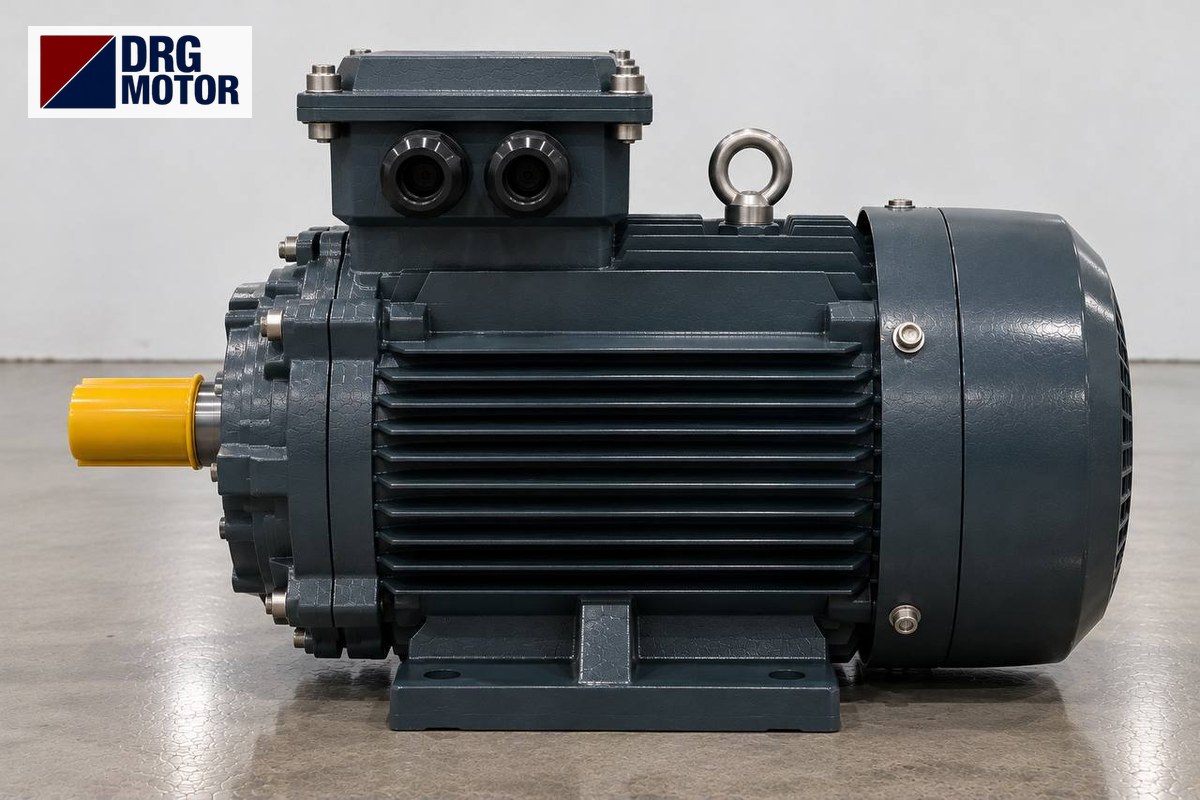

A wood chipper or wood-chip mill motor is chosen from two groups depending on the machine: on a disc or drum chipper that turns logs into chips, a 4-pole motor that drives the heavy disc through belts — rated speed 1465–1475 rpm between 15 and 30 kW in the DRG catalogue — and on a hammer mill that refines shavings or chips through a screen, a 2-pole motor that drives the rotor directly (2940–2955 rpm at 18.5–22 kW). On small and medium machines the disc chipper motor is usually 15–30 kW and the hammer mill motor 11–30 kW; the exact value comes from the machine nameplate and the builder's data. What really strains the motor on these machines is not cutting but accelerating the heavy disc or rotor at start-up; the calculations below show this with their assumptions.
The disc and rotor keep turning for a long time after the power is cut; the cover must only be opened once they have fully stopped, and the machine must be isolated and locked out when knives are changed. The wiring, the starter panel and the overload setting must be done by a qualified electrician.
You can pick the right frame and power for your machine from the 120 models on the Buy Electric Motors Online page; the tables below show which model goes on which machine.
Wood chippers and chip mills: which motor for which machine?
This article covers two machine families. The first is chippers that turn logs, branches and sawmill waste into chips: on the disc type the knives sit on the face of a heavy disc, on the drum type around a drum. The second is mills that reduce chips and shavings to a finer size for panels, pellets or fuel: the hammer type beats the material over a screen with freely swinging hammers, the knife type reduces it by cutting.
| Machine | Poles / drive | Governing load | Indicative power |
|---|---|---|---|
| Disc wood chipper | 4-pole + belt | Heavy disc, flywheel effect | 15–30 kW |
| Drum wood chipper | 4-pole + belt | Drum inertia, feeding | 22–55 kW |
| Hammer mill for wood chips | 2-pole, direct | Rotor speed, screen | 11–30 kW |
| Knife ring flaker / mill | 4-pole + belt | Knife cutting | 7.5–22 kW |
The power ranges are indicative for each machine class; wood species, moisture and the largest diameter that can be fed change the motor even within the same class. Planers, saws and extraction motors in a joinery workshop are a separate subject, covered in our article Electric Motor Selection for Woodworking Machines.
Flywheel inertia and start time on a disc chipper
The disc of a disc chipper is heavy on purpose: the energy it stores while turning keeps the motor from slowing down when it cuts a thick branch. The same mass works against the motor at start-up. To estimate the start time, the disc inertia must be referred to the motor shaft.
- Assumption: disc mass 300 kg, diameter 1000 mm (radius 0.5 m), treated as a solid disc: J = ½·m·r² = 0.5 × 300 × 0.5² = 37.5 kg·m².
- Disc speed 750 rpm, motor DRG-180L-4 (22 kW, 1470 rpm). Pulley ratio i = 1470 / 750 ≈ 1.96; with a 200 mm motor pulley the disc pulley is ≈ 392 mm.
- Inertia referred to the motor shaft: J / i² = 37.5 / 1.96² ≈ 9.76 kg·m² (motor rotor and pulleys neglected; the real value is slightly higher).
- Angular speed of the motor shaft: ω = 2π × 1470 / 60 ≈ 153.9 rad/s.
Start time is found with t = J·ω / T, where T is the motor's average accelerating torque during the start. The DRG-180L-4 has a rated torque of 142.9 Nm, Ts/Tn 2.0 and Tmax/Tn 2.3. Conservative assumptions for average accelerating torque:
| Value | Direct-on-line | Star (first stage) | Note |
|---|---|---|---|
| Average accelerating torque | ≈ 214 Nm (1.5 × Tn) | ≈ 71 Nm (0.5 × Tn) | Assumption |
| Start time t = J·ω/T | ≈ 7.0 s | ≈ 21 s | Empty disc |
| Starting current from supply | ≈ 310 A | ≈ 103 A | Is/In 7.8 |
With an empty disc, a direct-on-line start takes about 7 seconds; in star the average torque drops so much that the time roughly triples, and if the changeover to delta happens before the motor gets close to full speed the current surge is large. Check star-delta currents with your own values in the Motor Starting Methods (Star-Delta) tool.
Why does starting energy heat the winding?
At full speed (ω ≈ 78.54 rad/s) the disc carries kinetic energy E = ½·J·ω² = 0.5 × 37.5 × 78.54² ≈ 115.7 kJ. In an induction motor started direct-on-line with no load, the energy turned into heat in the rotor during the start is roughly equal to this kinetic energy delivered to the load. Every start heats the motor somewhat; repeated starts heat the winding before it can cool. On a heavy-disc machine, therefore, limit the number of starts per hour, consider idling the machine during short breaks instead of stopping and restarting it, and use an overload relay class suited to long starts.
- Power: 22 kW
- Rated speed: 1470 rpm
- Current 400 V / 380 V: 39.7 A / 41.8 A
- cos φ: 0.86
- Rated torque: 142.9 Nm
- Ts/Tn · Tmax/Tn: 2.0 · 2.3
- Is/In: 7.8
- Shaft D×E: 48×110 mm
- Voltage: 400/690 V (Δ/Y)
- Frame: Cast iron, IEC 180L
Belt drive: pulleys, alignment and slip
Most chippers are belt-driven. The belt sets the speed and, by slipping slightly during a jam, protects the motor and bearings from shocks. A belt that slips all the time, however, heats up, wears and lowers the disc speed, and cut quality suffers. A belt squealing at start-up shows either low belt tension or too few belts for the disc's inertia.
When changing the motor, seat the pulley fully on the new motor's shaft; if the shaft diameter and length (D×E) differ from the old motor, the pulley hub must change. The DRG-180L-4 in the example has a 48×110 mm shaft. Use the Pulley and Belt Calculator for pulley diameters and belt length. Align the motor slide so that both pulleys are in the same plane; misalignment eats the belt edge and puts side load on the motor bearing.
Hammer mill for wood chips: 2 poles and direct coupling
In a hammer mill it is the hammer tip speed that refines the shavings, so the rotor is usually coupled directly to a 2-pole motor. Example: with a 600 mm rotor and a DRG-180M-2 motor (22 kW, 2955 rpm), the hammer tip speed is v = π × 0.6 × 2955 / 60 ≈ 92.8 m/s. For a coarser product the speed is reduced with a 4-pole motor or a smaller rotor; for a finer product the screen hole size is reduced, which increases motor load at the same throughput.
With direct coupling, motor and rotor axes must be aligned precisely and the rotor must be balanced; a broken or missing hammer creates imbalance, and the vibration reaches the motor bearing first. You will find the general framework for motor selection in mills in our article Electric Motor Selection in Mills and Grinding Plants.
Wood dust, fire and explosion risk
Fine wood dust is combustible and can form an explosive atmosphere when suspended in air at certain concentrations. The mill outlet, the cyclone and the filter area are the most critical zones. If your plant has an explosive-atmosphere (ATEX) zone classification, every piece of equipment placed in a zone must carry the marking for that zone; position standard three-phase motors outside these zones and have the classification done by a qualified specialist.
Outside the zones the motor still needs protection from dust: use IP55 motors, clean shavings from the cooling fins and fan cover regularly (a dust layer reduces cooling and is an ignition risk on a hot surface), and check the terminal box gasket and cable gland. We cover motor selection on the extraction side in our article Woodworking Machine Motor Supply.
DRG models for chippers and mills
| Model | Power / speed | Frame | Current 400 V |
|---|---|---|---|
| DRG-160L-4 | 15 kW / 1465 rpm | Cast iron 160L | 27.3 A |
| DRG-180M-4 | 18.5 kW / 1470 rpm | Cast iron 180M | 33.5 A |
| DRG-180L-4 | 22 kW / 1470 rpm | Cast iron 180L | 39.7 A |
| DRG-200L-4 | 30 kW / 1475 rpm | Cast iron 200L | 53.8 A |
| DRG-160L-2 | 18.5 kW / 2940 rpm | Cast iron 160L | 32.5 A |
| DRG-180M-2 | 22 kW / 2955 rpm | Cast iron 180M | 38.5 A |
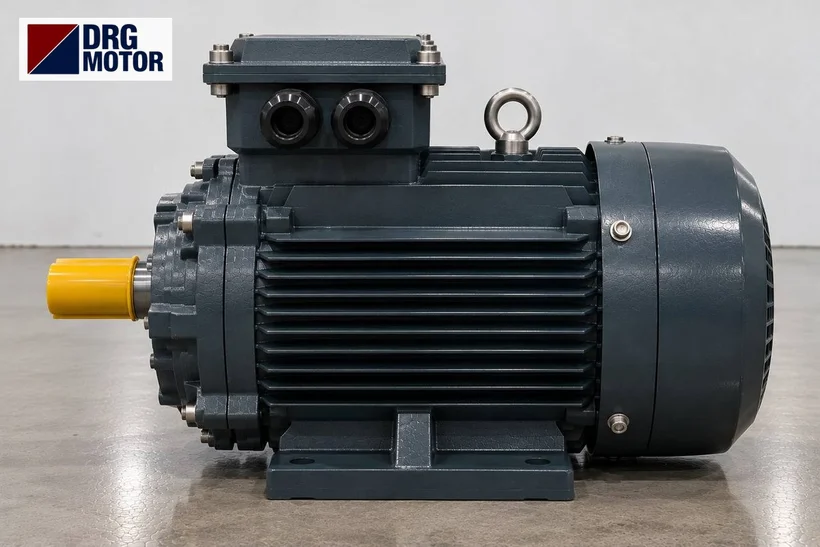
The first four models are for belt-driven chippers and knife mills, the last two for direct-coupled hammer mills. All have cast iron frames and 400/690 V (Δ/Y) windings; on a 400 V supply they are connected in delta and are suitable for star-delta starting. You can use the Motor Overload, Fuse and Contactor Selection tool for overload and fuse values.
Checklist before choosing the motor
- Disc/rotor mass and diameter, or the inertia given by the builder; disc speed.
- Pulley ratio, number and type of belts; does the belt slip at start-up?
- Starting: direct-on-line, star-delta or soft starter; has the start time in star been calculated?
- Is the overload relay class suitable for a long start; is the number of starts per hour limited?
- Shaft D×E and key; does the pulley or coupling hub fit the new shaft?
- For direct coupling: axis alignment and rotor balance; check for missing or broken hammers.
- Motor position: away from the chip outlet, the cyclone and any classified dust zone?
- An interlock and wait time that prevent the cover from opening before the disc has stopped.
Motors in this power range
- DRG-160L-4 – 15 kW – 1465 rpm – Cast iron 160L
- DRG-180M-4 – 18.5 kW – 1470 rpm – Cast iron 180M
- DRG-180L-4 – 22 kW – 1470 rpm – Cast iron 180L
- DRG-200L-4 – 30 kW – 1475 rpm – Cast iron 200L
- DRG-180M-2 – 22 kW – 2955 rpm – Cast iron 180M
Click to see current prices and order these motors nowSEE PRICES →
Frequently Asked Questions
How many kW does a wood chipper motor need?
It depends on the machine type. On small and medium machines a disc chipper is usually 15–30 kW, a drum chipper 22–55 kW and a hammer mill for wood chips 11–30 kW. The exact value comes from the machine nameplate and the builder's data.
Why does a wood chipper motor take so long to start?
The heavy disc appears at the motor shaft as a high inertia. In the example, for a 300 kg disc the start takes about 7 seconds direct-on-line and about 21 seconds in the star stage. A slack belt, a long star stage and starting with a full chamber make it even longer.
Should a wood chip mill use a 2-pole or a 4-pole motor?
Hammer mills usually use a direct-coupled 2-pole motor for hammer tip speed; in the DRG catalogue the rated speed at 18.5–22 kW is 2940–2955 rpm. Belt-driven chippers and knife mills commonly use 4 poles (1465–1475 rpm).
How many amps does a 22 kW chipper motor draw?
The DRG-180L-4 (4-pole) draws 39.7 A at 400 V and 41.8 A at 380 V; the DRG-180M-2 (2-pole) draws 38.5 A at 400 V and 40.5 A at 380 V. Direct-on-line, the 4-pole model's starting current is about 310 A.
Send us your machine's nameplate or the builder's data and we will pin down the right frame together: phone +90 (542) 666 11 11, e-mail [email protected], contact page. DRG Motor is a manufacturer, supplier and seller of electric motors; you can browse every model on the Buy Electric Motors Online page.