English
 Le français
 Türkçe




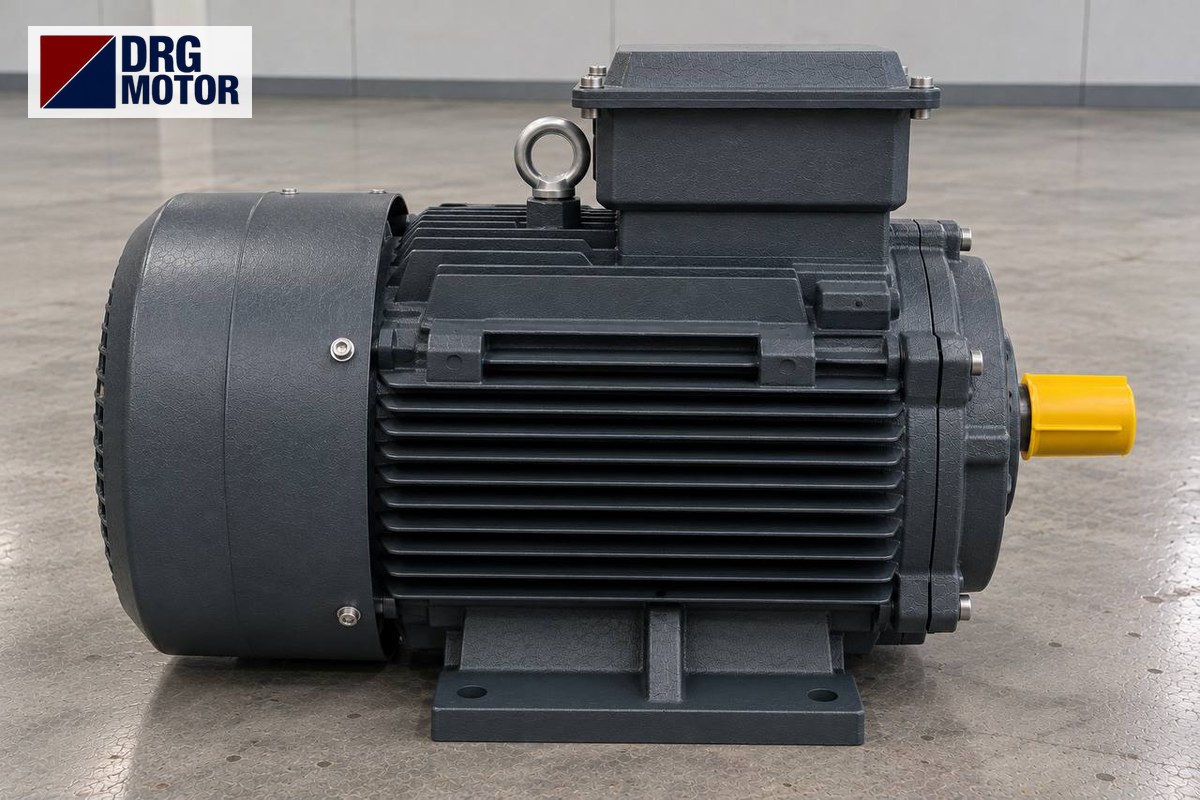

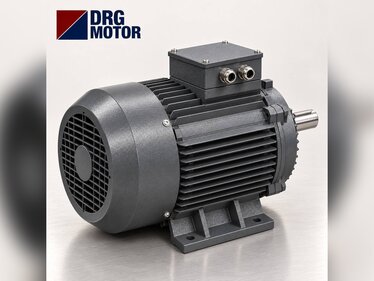
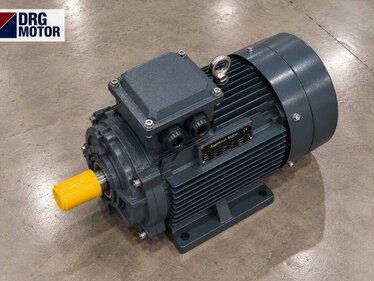
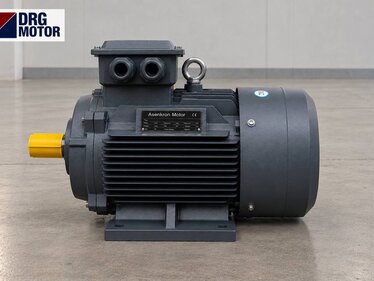
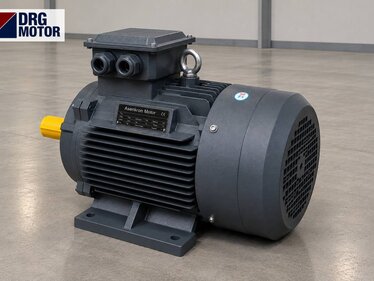
On a concrete block and paving stone machine, the hydraulic pump motor is usually a 4-pole cast iron three-phase motor connected to the pump by a bell housing and coupling, and its power is chosen from the pump torque at the highest-demand phase. In this article's double-pump example the toughest phase needs about 90 Nm of torque; the 15 kW 4-pole DRG-160L-4 delivers 97.8 Nm rated torque at 1465 rpm and draws 27.3 A at 400 V, so it covers this load. Vibration is handled by separate motors (vibration motors under the table or 2-pole motors driving eccentric shafts), which share the same panel and the same vibrating frame as the hydraulic motor.
What wears a motor most on these machines is not power but the environment: cement dust, constant vibration and a pressing cycle repeated every few seconds. So besides the torque check, the selection must consider loosening of foot and flange bolts, clogging of the fan cover and cable entries opening up under vibration. You can find technical data for suitable 2- and 4-pole models for hydraulic units and vibration drives on the Buy Electric Motors Online page. Pump sizes and pressures in this article are example assumptions; definitive values are on the machine and hydraulic unit nameplates. Panel and motor connection work must be done by a qualified electrician.
What Do the Motors Do on a Block Machine?
A concrete block or paving stone machine usually has three motor groups:
- Hydraulic unit motor: drives the pumps that move the mould, the tamper head and the pallet push cylinders. This is the main subject of this article.
- Vibration motors or vibration drive motor: compact the concrete in the mould by vibration. Either vibration motors bolted directly under the table, or standard 2-pole motors driving eccentric shafts by belt, are used.
- Auxiliary motors: feed box, material conveyor and mixer. For the mixer motor see Concrete Mixer Electric Motor Selection.
The DRG vibration motors page gives details on the design and selection of vibration motors; below we only cover how to protect a standard motor in a vibration drive and on the hydraulic unit.
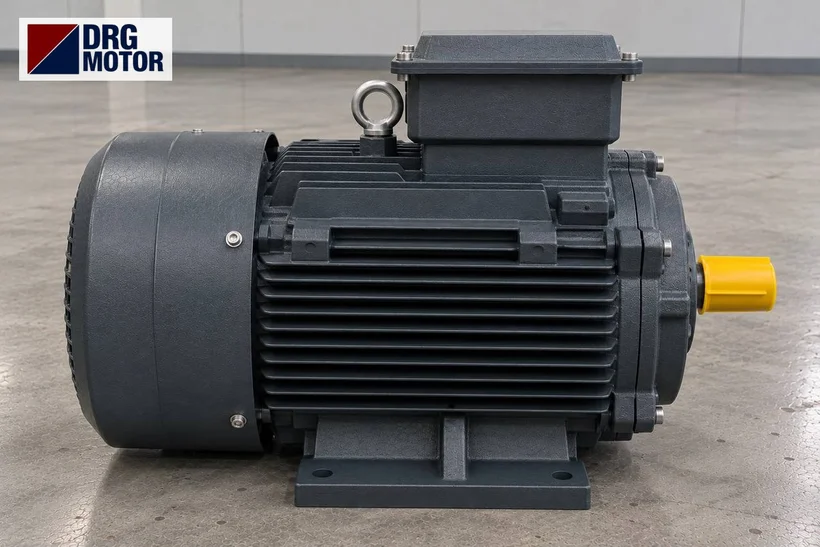
Double-Pump Hydraulic Unit: Torque and Power Example
A pressing cycle is short but contains different load phases:
| Movement | Pump arrangement | Pressure / flow | Demand on motor |
|---|---|---|---|
| Mould and tamper up-down | Both pumps together | Low pressure, high flow | Fast movement |
| Pressing (compaction) | Small pump only | High pressure, low flow | Highest torque |
| Pallet push / product out | Large pump or both | Low pressure | Short, frequent moves |
| Standby (vibration) | Pumps unloaded | Low pressure | Idling |
The general kW calculation from flow and pressure is in Hydraulic Pump Electric Motor Selection: kW Calculation from Pressure and Flow. Here we use the double-pump layout typical of block machines to find which phase loads the motor most. Assumptions:
- Large pump 40 cm³/rev, small pump 20 cm³/rev (assumption)
- Fast-movement pressure 80 bar, pressing pressure 180 bar (assumption)
- Overall pump efficiency 0.85 (assumption)
- Motor: DRG-160L-4, 1465 rpm
Flows: large pump 40 × 1465 ÷ 1000 ≈ 58.6 l/min, small pump 20 × 1465 ÷ 1000 ≈ 29.3 l/min.
Fast movement (both pumps, 87.9 l/min, 80 bar): P = Q × p ÷ 600 ÷ 0.85 = 87.9 × 80 ÷ 600 ÷ 0.85 ≈ 13.8 kW.
Pressing (small pump, 29.3 l/min, 180 bar): P = 29.3 × 180 ÷ 600 ÷ 0.85 ≈ 10.3 kW.
In this example the phase that loads the motor is not the high-pressure pressing but the fast movement where both pumps deliver together. Required torque T = P × 9550 ÷ n = 13.8 × 9550 ÷ 1465 ≈ 90 Nm; the DRG-160L-4 rated torque is 97.8 Nm, so 15 kW is enough. The 11 kW DRG-160M-4 gives 71.7 Nm and would be continuously overloaded in this phase. The pressure at which the large pump is unloaded (unloading valve setting) directly determines motor load: raise the setting and the motor load rises too.
Catalogue values of the motor in the example:
- Power: 15 kW
- Rated speed: 1465 rpm
- Current (400 V): 27.3 A
- cos φ: 0.86
- Rated torque: 97.8 Nm
- Ts/Tn: 2.2
- Tmax/Tn: 2.3
- Is/In: 7.8
- Shaft (D×E): 42×110 mm
- IEC frame: 160L (cast iron)
Standard Motor in a Vibration Drive
On machines with an eccentric-shaft vibrator under the table, the shaft is belt-driven by a 2-pole motor; vibration frequency depends on shaft speed. The 2-pole DRG-160M1-2 runs at 2945 rpm, which gives about 49 vibrations/s (2945 ÷ 60) with 1:1 pulleys; the pulley ratio changes this value. Use the pulley and belt calculator for the pulley calculation. Motor power depends on the eccentric mass and table weight; the definitive value is on the machine nameplate.
The characteristic of a vibration drive motor is very frequent starting and stopping: vibration is switched on and off for a few seconds in every pressing cycle. That is why on many machines the motor runs continuously and vibration is engaged by a clutch or brake; if the motor is stopped and restarted every cycle, winding heating accelerates and an inverter or the starting arrangement specified by the machine builder is required. In a belt drive, the motor feet should be isolated from the vibrating frame as far as possible; if not, check belt tension frequently.
Dust and Vibration: Checklist Against Loosening
On a block machine, most motor problems are mechanical rather than electrical. DRG store models are IP55 and cooled over the outer surface of the frame (IC 411); if the frame fins and fan cover fill with dust, the motor overheats. In weekly and monthly maintenance:
- Are the motor foot bolts and flange bolts torqued, with lock nuts or spring washers? A paint mark on the bolt heads makes loosening visible at a glance.
- Is there any crack, ovality or burr on the spigot surface between bell housing and motor flange?
- Is the coupling element (rubber or polyurethane) cracked or crushed? It wears quickly under vibration.
- Have the fan cover grille and frame fins been cleaned of cement dust?
- Are the cable glands tight, or has the cable been pulled loose by vibration? Clamp the cable before it reaches the motor.
- Have the connection nuts inside the terminal box been checked? A loose terminal heats up and leads to phase loss.
- Is there abnormal bearing noise? Shorten the bearing check interval for motors on a vibrating frame.
Cable, Protection and Starting: 15 kW Example
The DRG-160L-4 is wound 400/690 V and connected in delta on a 400 V supply, so it is suitable for star-delta starting. On a DOL start the current is 7.8 times rated, about 213 A; in star this falls to one third (about 71 A). If the pump is unloaded at start (the usual arrangement on hydraulic units), the reduced starting torque in star is not a problem. You can compare methods on the motor starting methods and star-delta page.
For cable size, rated current 27.3 A × 1.25 = 34.1 A; for copper PVC cable 4 mm² carries 34 A, which is borderline, so 6 mm² (43 A) is chosen. Over a 30 m run the voltage drop is ΔU = √3 × 27.3 × 0.03 × 3.08 × 0.86 ≈ 3.8 V, about 0.9% at 400 V. With star-delta, two separate cables run to the motor and each is sized for phase current (1/√3 of rated current); installation method and grouping change the result. Check your own values with the motor cable size calculator.
Which DRG Motor Should You Choose?
On concrete block and paving stone machines the hydraulic unit motor varies with machine size; on medium-size machines it is mostly seen in the 7.5–22 kW range, the definitive value being the machine nameplate. 4-pole cast iron models for the hydraulic unit:
| Model | Power / speed | Frame | Current 400 V |
|---|---|---|---|
| DRG-132M-4 | 7.5 kW / 1460 rpm | 132M cast iron | 14.3 A |
| DRG-160M-4 | 11 kW / 1465 rpm | 160M cast iron | 20.4 A |
| DRG-160L-4 | 15 kW / 1465 rpm | 160L cast iron | 27.3 A |
| DRG-180M-4 | 18.5 kW / 1470 rpm | 180M cast iron | 33.5 A |
| DRG-180L-4 | 22 kW / 1470 rpm | 180L cast iron | 39.7 A |
2-pole models for an eccentric-shaft vibration drive:
| Model | Power / speed | Frame | Current 400 V |
|---|---|---|---|
| DRG-132S1-2 | 5.5 kW / 2930 rpm | 132S cast iron | 10.1 A |
| DRG-132S2-2 | 7.5 kW / 2930 rpm | 132S cast iron | 13.7 A |
| DRG-160M1-2 | 11 kW / 2945 rpm | 160M cast iron | 19.6 A |
When replacing, keep the old motor's flange type (B5 / B35), shaft size and frame: the 15 kW DRG-160L-4 and the 18.5 kW DRG-180M-4 carry the same B5 flange (P 350 mm) but different shaft diameters (42 mm versus 48 mm), which means changing the coupling hub. See the DRG motor technical drawings page for dimensions.
Motors in This Power Range for Block Machines
- DRG-132M-4 – 7.5 kW – 1460 rpm – 132M cast iron
- DRG-160M-4 – 11 kW – 1465 rpm – 160M cast iron
- DRG-160L-4 – 15 kW – 1465 rpm – 160L cast iron
- DRG-180M-4 – 18.5 kW – 1470 rpm – 180M cast iron
- DRG-132S2-2 – 7.5 kW – 2930 rpm – 132S cast iron
- DRG-160M1-2 – 11 kW – 2945 rpm – 160M cast iron
Click to see current prices and order these motors nowSEE PRICES →
Frequently Asked Questions
What kW is a concrete block machine motor?
The hydraulic unit motor varies with machine size and pump layout; on medium-size machines it is mostly seen in the 7.5–22 kW range. In our example a 40 + 20 cm³/rev double pump needed about 13.8 kW in fast movement at 80 bar and a 15 kW motor was chosen.
Why do motors on block machines fail often?
The most common causes are foot/flange bolts and terminal connections loosened by vibration, overheating due to a fan cover clogged with dust, and a worn coupling element. These three points should be checked regularly.
How many amps does a 15 kW motor draw?
The 4-pole DRG-160L-4 draws 27.3 A at 400 V and 28.8 A at 380 V at full load. About 213 A is seen on a DOL start, and about 71 A in the star stage of a star-delta start.
Can a standard motor be used instead of a vibration motor on a paving stone machine?
If there is an eccentric shaft under the table, it can be belt-driven by a standard 2-pole motor. A vibrator bolted directly to the table, however, is a vibration motor with its own eccentric weights and cannot be replaced by a standard motor.
Send us the nameplate or the machine's hydraulic/mechanical data and we will pin down the right DRG model with you: phone +90 (542) 666 11 11, e-mail [email protected], or our contact page. To browse the models directly, go to Buy Electric Motors Online.