English
 Le français
 Türkçe




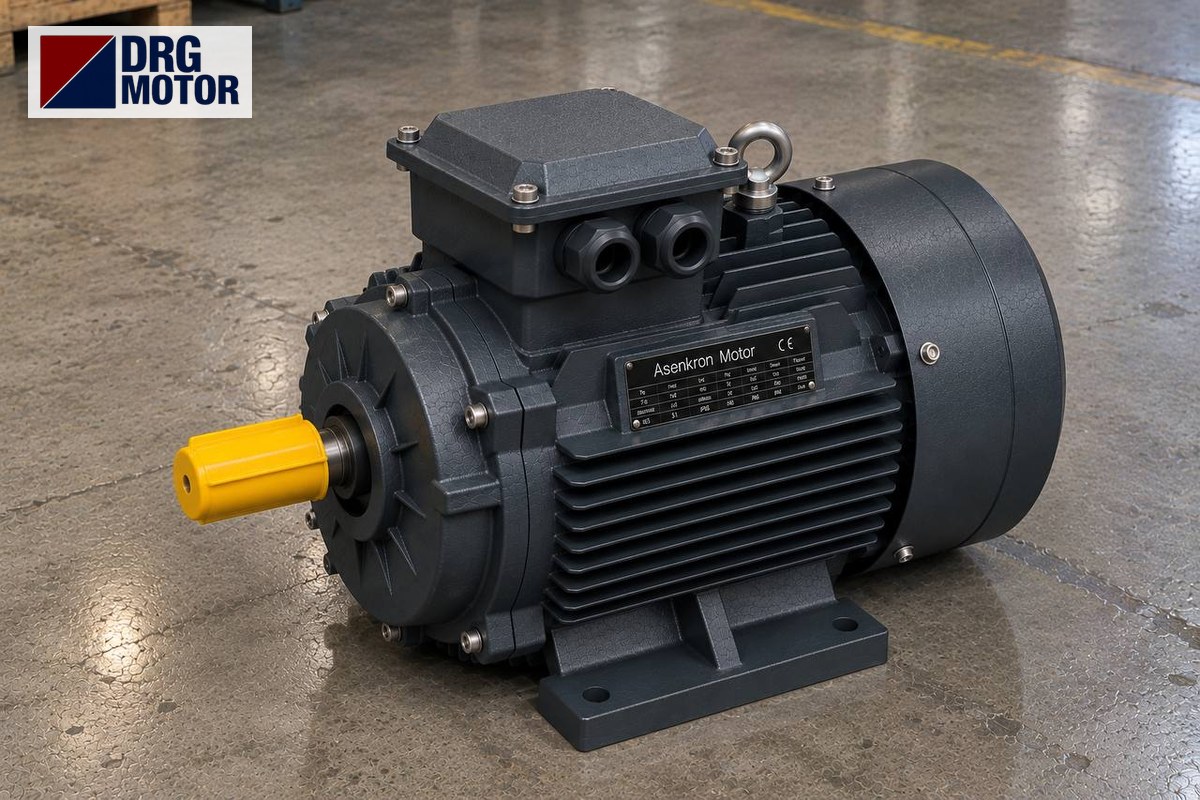

A flour mill roller motor is a 4-pole (1500 rpm class) three-phase motor that drives the roll pair through a belt and pulleys. The motor driving a single roll pair is usually found in the 7.5–22 kW range; the exact figure is on the roller mill’s nameplate and in its manufacturer’s data. Example: for 15 kW, DRG-160L-4 delivers 97.8 Nm at a rated speed of 1465 rpm, draws 27.3 A at 400 V, has an IEC 160L frame and a 42 × 110 mm shaft. To keep the roll at the same speed, the new motor must keep the old motor’s pole number and shaft size.
The choice changes at three points: pulley ratio (roll speed comes from the pulleys, not from the motor), load (a roll is heavily or lightly loaded depending on its grinding passage) and the spare motor plan (grouping the mill’s rolls into a few frame sizes). This article covers all three with numbers. For the other motors of a milling line, see our article Torque-Rich Motor Supply for Grain and Flour Mills; for the full range, see the 120 models in our online store. Motor connection and panel settings must be carried out by a qualified electrician.
Pole number, power and drive of a roller mill motor
Roller mill motors are almost always 4-pole: a 1500 rpm class motor reaches the roll speed with reasonable pulley diameters. With a 2-pole motor the pulley ratio doubles, and the large pulley causes space and belt wrap problems. A 6-pole motor on the same pulleys slows the roll and changes fineness and throughput.
| Item | Roll side | Motor side |
|---|---|---|
| Speed | Fast roll speed | Pulley ratio × motor speed |
| Differential | Slow roll, gears/belt | Untouched when motor changes |
| Load | Heavy/light by passage | Monitored by current |
| Mounting | Slide rails, belt tension | B3 foot, shaft D×E |
In a roll pair the motor usually drives the fast roll; the slow roll turns with a set speed difference (differential) through the machine’s own gears or belt. Replacing the motor does not change this internal arrangement; only the speed of the motor pulley changes.
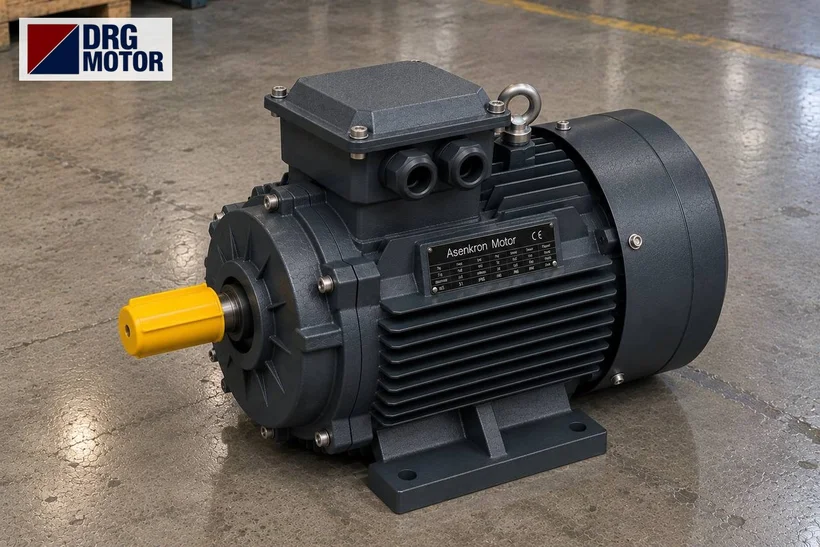
Pulley ratio and roll speed: a worked example with stated assumptions
Assume the fast roll should run at 550 rpm and the roll diameter is 250 mm (the real values are in the machine’s catalogue). The motor is DRG-160L-4, rated speed 1465 rpm.
- Required ratio: 1465 / 550 ≈ 2.66
- With a 160 mm motor pulley, roll pulley: 160 × 2.66 ≈ 426 mm → standard 425 mm
- Actual roll speed: 1465 × 160 / 425 ≈ 551.5 rpm
- Roll surface speed: v = π·D·n/60 = π × 0.25 × 551.5 / 60 ≈ 7.2 m/s
- Torque on the roll shaft: T = 9550 × 15 / 551.5 ≈ 259.7 Nm
Check: the catalogue rated torque of the motor is 97.8 Nm; multiplied by the pulley ratio it gives 97.8 × 425 / 160 ≈ 259.8 Nm (belt losses excluded), so the result is consistent. If the differential is, for example, 2.5:1, the slow roll turns at ≈ 220.6 rpm; this ratio belongs to the machine.
If a 6-pole motor (DRG-160L-6, 970 rpm) is fitted with the same pulleys, the roll drops to 970 × 160 / 425 ≈ 365 rpm, i.e. the fast roll slows by about one third. That is why, when the old nameplate is unreadable, you should first establish the pole number. If your pulley diameters differ, repeat the calculation with the pulley and belt calculator.
A motor under load all day: current, overload relay and cable
After starting, a roller mill motor runs under load for hours, so the key check is not the start but the normal grinding current. If the ammeter reading exceeds the rated nameplate current (27.3 A at 400 V and 28.8 A at 380 V for DRG-160L-4), the roll may be overfed, the roll gap too tight, or the belt slipping. A bigger motor does not solve this; it only hides it.
- Overload relay: set to the motor nameplate current; check the setting range on the overload relay, fuse and contactor selection page.
- Cable (example value, copper PVC): 27.3 × 1.25 ≈ 34.1 A → 4 mm² (34 A) is not enough, 6 mm² (43 A) is required.
- Voltage drop, 40 m cable: ΔU = √3 × 27.3 × 0.04 × 3.08 × 0.86 ≈ 5.0 V, i.e. 1.25 %; below the 3 % accepted for the supply.
For your own cable length use the motor cable size calculator. DRG-160L-4 is wound for 400/690 V, is connected in delta on a 400 V network and is suitable for star-delta starting; since the roll starts unloaded and is fed afterwards, starting is not demanding.
Flour dust: IP55, fan cover and cleaning
Flour is a fine, sticky dust that coats the motor from the outside. DRG motors come with IP55 protection and class F (155 °C) insulation; IP55 limits dust entry into the winding, but it does not stop flour building up between the housing fins and spoiling the cooling.
- If the fan cover grille clogs with a flour felt, the motor cannot draw its own air; brush the grille clean at regular intervals.
- Clean the housing dry; do not aim high-pressure air or water at the motor, it damages the seals and the terminal box gasket.
- The terminal box gasket and cable glands (2 × M40×1.5 on DRG-160L-4) must be tight; an unused gland opening must be plugged.
- In areas classified as dust explosion zones, the motor is selected according to the site’s zone classification; a standard IP55 motor does not replace that classification.
Spare motor strategy: grouping rolls into a few frame sizes
In one mill, dozens of rolls may run on motors of different power. Instead of holding a separate spare for each power, grouping motors by frame and shaft size reduces the number of spares. The table below shows DRG catalogue dimensions:
| Model | Power / speed | Shaft D×E | Feet A×B / H |
|---|---|---|---|
| DRG-160M-4 | 11 kW / 1465 rpm | 42 × 110 mm | 254 × 210 / 160 mm |
| DRG-160L-4 | 15 kW / 1465 rpm | 42 × 110 mm | 254 × 254 / 160 mm |
| DRG-180M-4 | 18.5 kW / 1470 rpm | 48 × 110 mm | 279 × 241 / 180 mm |
| DRG-180L-4 | 22 kW / 1470 rpm | 48 × 110 mm | 279 × 279 / 180 mm |
Frames 160M and 160L share the same shaft (42 × 110 mm) and shaft height (160 mm); only the foot length B differs (210 and 254 mm). On a line whose slide rails fit both hole spacings, a single DRG-160L-4 can serve as the spare for both 11 and 15 kW rolls. Frames 180M and 180L form a separate group with a 48 × 110 mm shaft and 180 mm shaft height: fitted to a roll built for frame 160, the pulley hub has to be re-machined and the base lowered by 20 mm. If the spare motor is more powerful, the overload relay is set to the new motor’s nameplate current and the cable size is checked again.
Pulley, alignment and direction of rotation when replacing the motor
The most common mistakes during replacement are forcing the old pulley onto the new shaft or tensioning the belt by eye. Checklist:
- Shaft diameter and key: on DRG-160L-4 the shaft is 42 mm and the key width 12 mm; if the old pulley hub differs, it must be re-machined.
- Pulley diameter: keep the old motor pulley; if the diameter changes, the roll speed changes (see the calculation above).
- Alignment: the faces of the motor and roll pulleys must lie in one plane, checked with a straightedge; misalignment wears belts and bearings.
- Tension: set to the belt manufacturer’s deflection value and re-check after the first hours of running.
- Direction of rotation: check at first start without belts or with a brief jog; a roll turning backwards throws the product back. Correct the direction by swapping two phases.
- Mounting dimensions: for foot holes and shaft height, see the frame dimensions on the DRG technical drawings page.
Suitable DRG models for roller mills
The models below are 4-pole motors with cast iron frames; current values are for 400 V. Choose the nearest higher value to the power on your roller mill’s nameplate.
| Model | Power / speed | Frame | Current 400 V |
|---|---|---|---|
| DRG-132M-4 | 7.5 kW / 1460 rpm | 132M cast iron | 14.3 A |
| DRG-160M-4 | 11 kW / 1465 rpm | 160M cast iron | 20.4 A |
| DRG-160L-4 | 15 kW / 1465 rpm | 160L cast iron | 27.3 A |
| DRG-180M-4 | 18.5 kW / 1470 rpm | 180M cast iron | 33.5 A |
| DRG-180L-4 | 22 kW / 1470 rpm | 180L cast iron | 39.7 A |
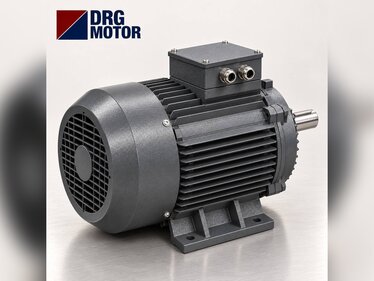
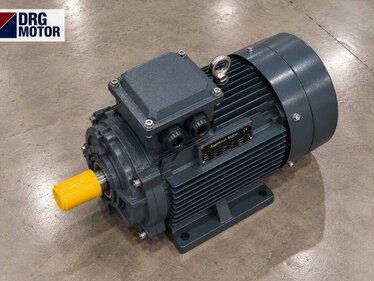
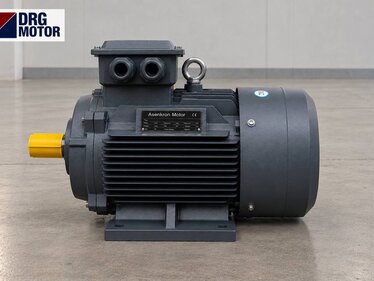
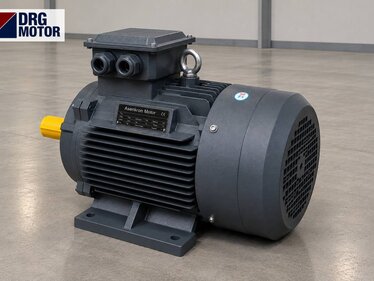
Technical data of the featured 15 kW model:
- Power: 15 kW (20 HP)
- Rated speed: 1465 rpm
- Frame: IEC 160L, cast iron
- Current 400 V / 380 V: 27.3 A / 28.8 A
- cos φ: 0.86
- Rated torque: 97.8 Nm
- Ts/Tn · Tmax/Tn: 2.2 · 2.3
- Is/In: 7.8
- Shaft D×E: 42 × 110 mm
- Voltage: 400/690 V (Δ/Y)
- Bearing: 6309-C3
Motors in this power range
- DRG-132M-4 – 7.5 kW – 1460 rpm – 132M cast iron
- DRG-160M-4 – 11 kW – 1465 rpm – 160M cast iron
- DRG-160L-4 – 15 kW – 1465 rpm – 160L cast iron
- DRG-180M-4 – 18.5 kW – 1470 rpm – 180M cast iron
- DRG-180L-4 – 22 kW – 1470 rpm – 180L cast iron
Click to see current prices and order these motors nowSEE PRICES →
Frequently Asked Questions
What speed should a flour mill roller motor have?
Roller mill motors are usually 4-pole, 1500 rpm class; in the DRG catalogue, rated speed is 1465–1470 rpm between 11 and 22 kW. The roll speed is set by the pulley ratio; do not change the pole number when replacing the motor.
How many amps does a 15 kW roller mill motor draw?
DRG-160L-4 draws 27.3 A at 400 V and 28.8 A at 380 V at full load. If the ammeter rises above this value during grinding, check the feed, the roll gap and the belt.
Can a 15 kW motor replace an 11 kW roller motor?
Mechanically, frames 160M and 160L share the same shaft (42 × 110 mm) and shaft height; only the foot length differs. If the slide rails fit, it can be installed; set the overload relay to the new motor’s nameplate current and re-check the cable size.
Why does a roller mill motor overheat?
The most common causes are a fan grille and housing fins clogged with flour, overfeeding, a roll gap set too tight and an overtensioned belt. Clean first and measure the current; if the motor is hot even at nameplate current, check the airflow.
Send us the power, speed, shaft size and mounting details from your machine’s nameplate and we will help you pick the right DRG model: phone +90 (542) 666 11 11, e-mail [email protected], contact page. For all models and ordering, see Buy Electric Motors Online.