English
 Le français
 Türkçe




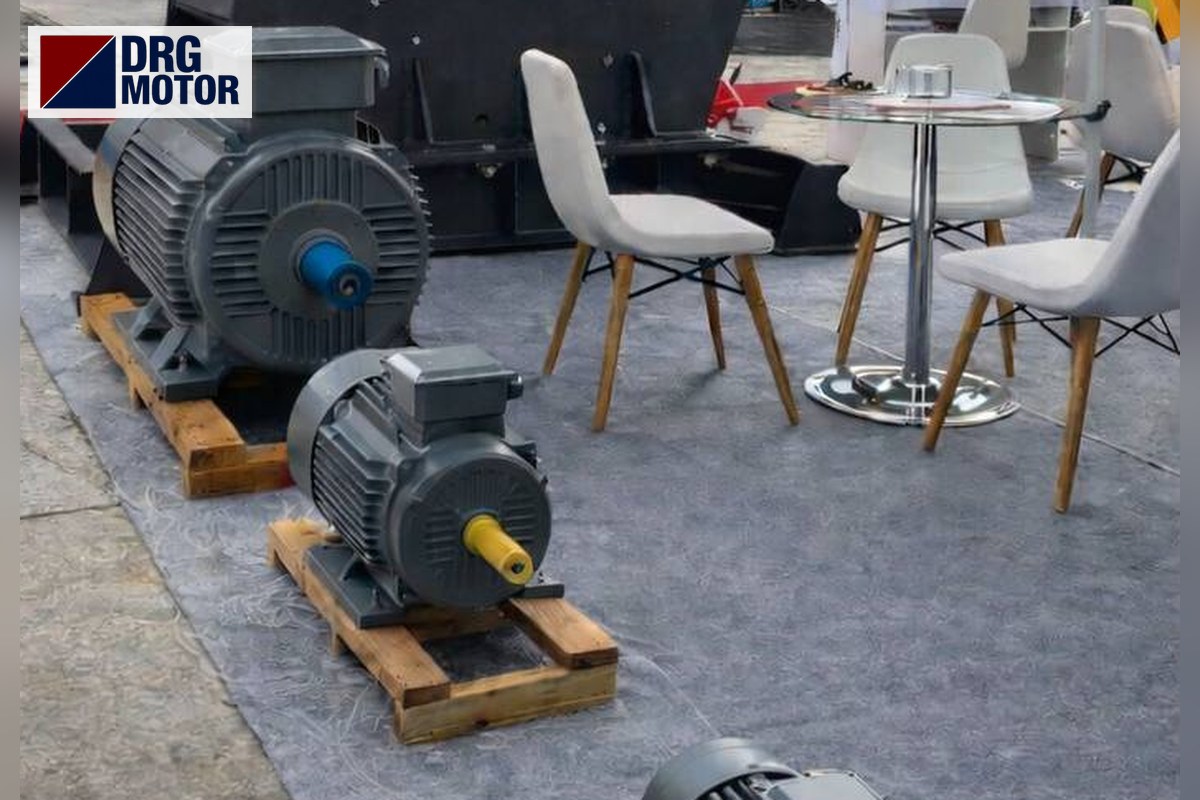

On a stone and marble cutting machine the blade motor is chosen from the blade diameter and the peripheral speed the blade needs: a 600 mm blade must turn at about 1273 rpm for 40 m/s; that speed is taken from a 2-pole motor through a belt, and the blade motor on a bridge saw is typically in the 11–22 kW range, while large-diameter block cutters are seen at 30 kW and above. Example: the DRG-160M2-2 (15 kW, 2945 rpm, 26.5 A at 400 V) drives a 600 mm blade at 40.1 m/s with 130/300 mm pulleys. The exact power is stated on the machine's nameplate and in the machine builder's data; the ranges here are cautious estimates.
The motor on this machine is stressed in two ways: the cutting resistance changes with the hardness of the stone and the feed rate, and the environment is permanently wet with water and stone slurry. When you replace a motor, compare speed, shaft, foot dimensions and protection rating one by one with the old motor; the connection must be made by a qualified electrician, because an earthing fault on a wet floor is a direct risk to life.
You can filter suitable blade and feed motors by power, speed and frame material among the 120 models on our Buy Electric Motors Online page.
Bridge saw, block cutter and side cut: which motor works where?
A bridge saw lays the slab on the table; the blade moves back and forth and up and down on a bridge. The blade motor sits on the head of the bridge and usually drives the blade shaft through a belt. In addition, there are low-power motors for the bridge travelling on its rails, the cross movement of the head and the plunge (downward) movement of the blade.
A block cutter slices the raw block coming from the quarry. The blade diameter is large (1,200–1,600 mm and more are seen), speed drops and torque rises. On this machine the blade motor is clearly larger than on a bridge saw and has to accelerate a heavy blade mass when starting.
A side (horizontal) cut blade makes horizontal cuts under or beside the block; on most machines it has its own, smaller second blade motor separate from the main blade.
All three machines have two separate motor families, and they are selected separately:
- Blade (cutting) motor: 2-pole, foot-mounted, belt-driven; its power is set by blade diameter and stone hardness.
- Feed / travel / plunge motors: 4-pole low power, slowed down by a gearbox or a frequency inverter; their power comes from the mass moved and friction, not from the cutting force.
From blade diameter to speed: the v = π·D·n/60 calculation
The speed at the cutting edge of the blade (peripheral speed) is found with: v = π · D · n / 60, where v is in m/s, D is the blade diameter in metres and n is in rpm. To find the speed, the formula is reversed: n = v · 60 / (π · D). Which peripheral speed to use depends on the stone and the blade maker; the maximum permitted speed is marked on the blade and must never be exceeded. The table below gives calculated speeds for 30 and 40 m/s; they are a starting point for the motor and pulley calculation, not for blade selection.
| Blade diameter (mm) | Speed for 30 m/s (rpm) | Speed for 40 m/s (rpm) |
|---|---|---|
| 350 | 1637 | 2183 |
| 400 | 1432 | 1910 |
| 500 | 1146 | 1528 |
| 625 | 917 | 1222 |
| 1200 | 477 | 637 |
| 1600 | 358 | 477 |
As the table shows, 350–625 mm bridge saw blades need roughly 900–2,200 rpm, while 1,200–1,600 mm block cutter blades drop to 360–640 rpm.
Why a 2-pole motor and a belt?
What happens if the motor is coupled directly to the blade? If a 2-pole motor (2945 rpm) drove a 400 mm blade directly, the peripheral speed would be π × 0.4 × 2945 / 60 ≈ 61.7 m/s, above the limit of most stone blades. So the 2-pole motor's high speed is reduced by a belt. The belt has two further benefits: it absorbs part of the shock when the blade snags in the stone, and it lets the motor be placed away from the blade area where the water splashes.
Worked example 1: 600 mm blade on a bridge saw
Assumption: blade diameter 600 mm, target peripheral speed 40 m/s, motor DRG-160M2-2.
- Required blade speed: n = 40 × 60 / (π × 0.6) ≈ 1273 rpm.
- Pulley ratio: 2945 / 1273 ≈ 2.31. With a 130 mm motor pulley the blade pulley is 130 × 2.31 ≈ 300 mm.
- Check: blade speed = 2945 × 130 / 300 ≈ 1276 rpm → v = π × 0.6 × 1276 / 60 ≈ 40.1 m/s.
- Torque on the blade shaft (belt losses ignored): 48.6 Nm × 300 / 130 ≈ 112 Nm.
Worked example 2: 1,600 mm blade on a block cutter
Assumption: blade diameter 1,600 mm, target 30 m/s. Required speed ≈ 358 rpm. At such a low speed the ratio with a 2-pole motor goes above 8 and is hard to achieve with a single belt stage, which is why 4-pole motors are also common on large block cutters. With the DRG-200L-4 (1475 rpm), a 180 mm motor pulley and a 740 mm blade pulley, the blade turns at 1475 × 180 / 740 ≈ 359 rpm and the peripheral speed is ≈ 30.1 m/s. To try other pulley sizes, use the pulley and belt calculator.
How many kW should the blade motor be?
Blade motor power is the product of the cutting force at the blade edge and the peripheral speed: P (kW) = Ft (N) × v (m/s) / 1000. The cutting force changes with stone hardness, depth of cut, feed rate and the condition of the blade (sharp or worn segments) and is hard to measure on site. So the calculation can only be made with an assumption.
Example assumption: edge force 300 N on a 600 mm blade, peripheral speed 40 m/s → P = 300 × 40 / 1000 = 12 kW. Adding a 20% margin for belt losses and short overloads such as a hard vein or a worn blade gives 14.4 kW; the next standard rating, 15 kW, is chosen. Had the edge force been taken as 200 N, the same calculation would give 9.6 kW and 11 kW would be enough. The result depends entirely on the assumption; the old motor's nameplate is the most reliable starting point.
Cautious ranges seen in practice: 4–7.5 kW on small side-cut and workshop-type cutting machines, 11–22 kW on bridge saws, and 30 kW and above on large-diameter block cutters. If your old motor trips its overload often, check whether the blade segments are worn, the belt tension and the feed rate before increasing the power.
Water, slurry and mounting: IP55, B3 feet and a slide rail
In stone cutting the blade is cooled with water all the time; water mixes with stone dust into slurry that splashes everywhere. These points decide the motor choice and mounting:
- Protection at least IP55: protects against dust and water jets from any direction. Still, place the motor outside the blade's water curtain, ideally behind a sheet-metal guard; IP55 is not meant for pressure washing.
- Terminal box and cable gland: the box gasket must be in place, the gland tightened to suit the cable diameter and any unused entry closed with a blanking plug. This is where moisture most often enters the motor.
- Foot-mounted B3 with a slide rail: belt tension can only be adjusted on a slide rail that lets the motor move. The feet sit on the rail and a tensioning bolt sets the belt. A slack belt slips and heats up; an over-tight belt overloads the motor bearing.
- Fan cover: as the slurry dries it clogs the fan cover grille and the motor cannot cool. Add the fan cover to the weekly cleaning list.
Shaft diameter (D), shaft length (E), foot hole spacing (A×B) and shaft height (H) must match the old motor, otherwise the pulley and the rail holes will not line up. You can compare the dimensions by frame on the technical drawings page.
Starting large motors: star-delta
The blade motor starts without load, i.e. before the blade touches the stone, but the mass of the blade and pulley lengthens the start. With direct-on-line starting the motor draws several times its rated current. Data for the DRG-160M2-2: 26.5 A at 400 V, Is/In = 8.1 → about 215 A on a direct start. For the DRG-200L-4 on a block cutter: 53.8 A × 7.3 ≈ 393 A.
Star-delta starting reduces this line current to roughly one third (≈ 72 A and ≈ 131 A in the examples), but starting torque also drops to one third. Because the blade starts unloaded, this lower torque is usually enough. For star-delta the motor must run in delta on a 380–400 V supply (400/690 V nameplate); DRG models of 4 kW and above have this connection. To compare methods see motor starting methods and star-delta, and for the supply cable the motor cable size calculator.
If the quarry also has a crushing plant, the crusher motors there carry a very different type of load (shock load, heavy flywheel, starting under load); our separate guide is Choosing an Electric Motor for a Stone Crusher.
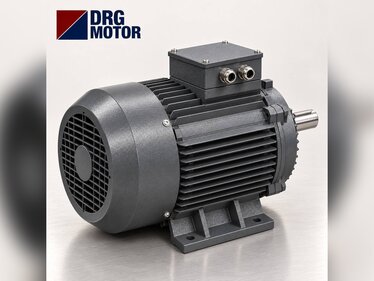
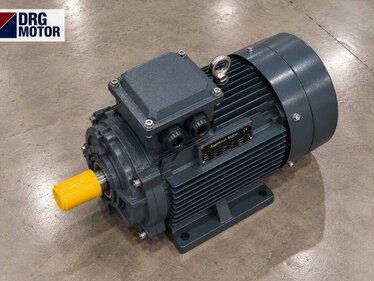
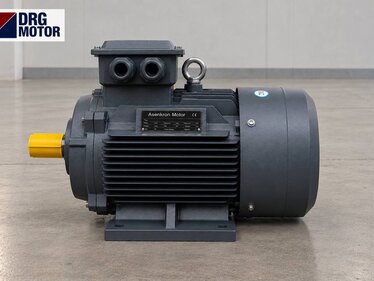
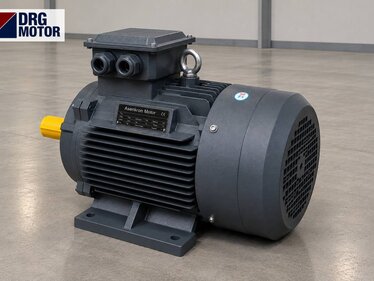
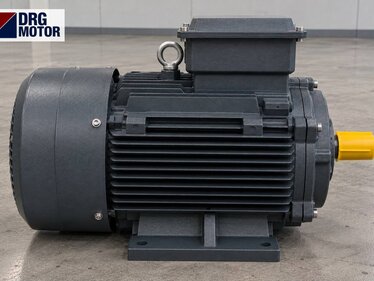
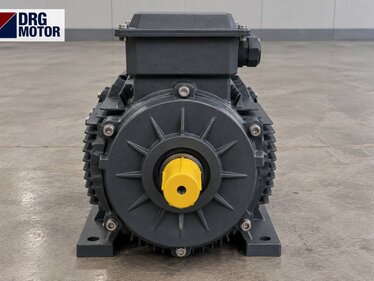
DRG motors suitable for stone cutting machines
The values in the table are taken from the data sheet (cast iron frame). Listed are 2-pole models for the blade, 4-pole models for the low blade speed of block cutters, and small 4-pole models to be used with a gearbox for feed and travel.
| Model | Power (kW) | Rated speed (rpm) | Frame | Current at 400 V (A) | Is/In | Shaft D×E (mm) | Typical duty |
|---|---|---|---|---|---|---|---|
| DRG-132S2-2 | 7.5 | 2930 | 132S | 13.7 | 7.9 | 38×80 | small bridge or side-cut blade |
| DRG-160M1-2 | 11 | 2945 | 160M | 19.6 | 8.1 | 42×110 | bridge saw blade |
| DRG-160M2-2 | 15 | 2945 | 160M | 26.5 | 8.1 | 42×110 | bridge saw blade (worked example) |
| DRG-160L-2 | 18.5 | 2940 | 160L | 32.5 | 8.2 | 42×110 | larger blade / hard stone |
| DRG-180M-2 | 22 | 2955 | 180M | 38.5 | 8.2 | 48×110 | larger blade / hard stone |
| DRG-200L-4 | 30 | 1475 | 200L | 53.8 | 7.3 | 55×110 | block cutter (worked example) |
| DRG-801-4 | 0.55 | 1400 | 80 | 1.31 | 5.2 | 19×40 | feed or lift drive (with gearbox) |
| DRG-90L-4 | 1.5 | 1445 | 90L | 3.3 | 7 | 24×50 | bridge travel (with gearbox) |
Checklist before replacing the motor
- Have the kW, speed and voltage/connection (230/400 V or 400/690 V) from the old nameplate been noted?
- Have the shaft diameter and length (D×E), key width and shaft height (H) been measured?
- Does the foot hole spacing (A×B) fit the slide rail?
- Is the maximum speed marked on the blade still respected with the new pulley ratio?
- Does the panel starting method (direct / star-delta) suit the new motor's connection?
- Do the terminal box and cable entry face away from the water curtain?
- Has the overload relay been set to the new motor's nameplate current?
Motors in this power range
- DRG-160M1-2 – 11 kW – 3000 rpm – 160M cast iron
- DRG-160M2-2 – 15 kW – 3000 rpm – 160M cast iron
- DRG-160L-2 – 18.5 kW – 3000 rpm – 160L cast iron
- DRG-180M-2 – 22 kW – 3000 rpm – 180M cast iron
- DRG-200L-4 – 30 kW – 1500 rpm – 200L cast iron
- DRG-90L-4 – 1.5 kW – 1500 rpm – 90L cast iron
Click to see current prices and order these motors nowSEE PRICES →
Other ratings and frames are listed among the 120 models in our online store.
Frequently Asked Questions
What speed should a marble cutting machine motor have?
The blade motor is usually 2-pole and its own speed is around 2945 rpm (15 kW model). The blade speed is set by the pulleys: a 600 mm blade should turn at about 1273 rpm for 40 m/s, a 400 mm blade at about 1910 rpm. The maximum speed marked on the blade always governs.
What kW motor goes on a bridge saw?
On bridge saws the blade motor is typically in the 11–22 kW range; the exact value is on the machine nameplate and in the machine builder's data. Keep the old motor's rating; if it trips often, check the blade, belt and feed rate first.
Can I couple a stone cutting motor directly to the blade?
Usually not. If a 2-pole motor drives a 400 mm blade directly, the edge speed is about 61.7 m/s, above the limit of most blades. The belt both lowers the speed and keeps the motor away from the splash zone.
Why do motors fail in wet cutting?
The most common cause is moisture entering through the terminal box and cable gland; the second is the fan cover clogging with slurry so the motor overheats. Choose at least IP55, check gaskets and glands, and clean the fan cover regularly.
To choose a motor, send us a photo of the old nameplate and the shaft/foot dimensions: phone +90 (542) 666 11 11, e-mail [email protected] or the contact page.