English
 Le français
 Türkçe




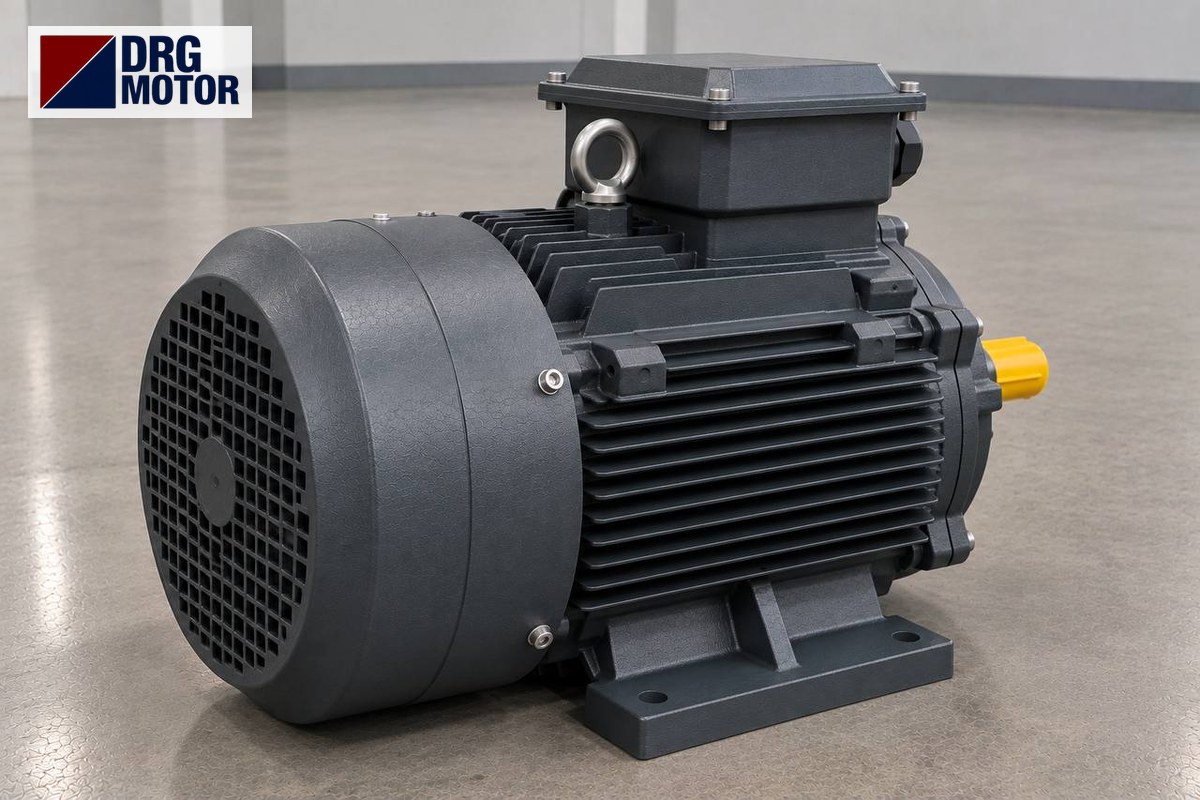

The short answer for fertilizer mixing and granulation machines: granulator drums, pan granulators, mixers and dryer drums all turn slowly, so almost all of them use a 4-pole (1500 rpm) three-phase motor + gearbox, and the power is set by the torque and speed required at the machine's drive shaft. For example, a granulator needing 2600 Nm at 12 rpm on the drum shaft works out to 4 kW, and the DRG-112M-4 (4 kW, 1450 rpm, 7.95 A at 400 V) fits the job. What really sets a fertilizer plant apart is the environment: ammonia, humidity and hygroscopic dust wear the motor from the outside long before anything happens electrically.
Below you will find the speed–gearbox relationship for each machine type, a power calculation with its assumptions stated, and how to protect the motor in a corrosive atmosphere. The exact kW for a given machine comes from its nameplate and its manufacturer's data; the figures here are worked examples. To compare models and order right away, see the 120 models on our Buy Electric Motors Online page. Connection, overload setting and earthing of the motor must be carried out by a qualified electrician.
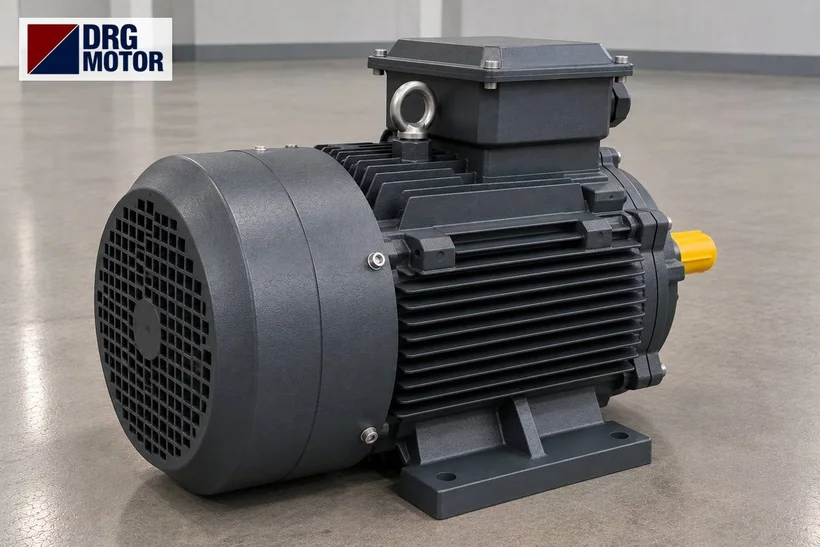
Which motor does each machine in a fertilizer line need?
A granular fertilizer line combines loads of quite different character. What they share is a low output speed; they differ in how they start and how much the load fluctuates.
| Machine | Output speed character | Drive | Motor choice |
|---|---|---|---|
| Granulator drum | Very slow, runs loaded | Gearbox + girth gear | 4-pole, high Ts/Tn |
| Pan granulator | Slow, adjustable tilt | Bevel gearbox | 4-pole, with VFD |
| Horizontal mixer | Slow, inside the material | Gearbox + coupling | 4-pole, torque margin |
| Dryer / cooler drum | Very slow, long shell | Gearbox + chain/gear | 4-pole, loaded start |
| Screens and screws | Medium speed, light load | Belt or gearbox | 4-pole, small power |
On a pan granulator the granule size depends on disc speed and tilt, so speed is commonly adjusted with a variable frequency drive. On drums the speed stays fixed; the problem is breakaway: the motor must overcome the inertia of a drum full of material and the resistance of caked product at the very first moment.
Granulator drum power calculation: from torque and speed to kW
The drum manufacturer usually gives the torque at the drive shaft (or girth gear) and the drum speed. Motor power then follows from P = T · n / 9550. The values in the example below are assumptions:
- Assumption: drum shaft torque 2600 Nm, drum speed 12 rpm.
- Shaft power: P = 2600 × 12 / 9550 ≈ 3.27 kW.
- 10% allowance for gearbox and gear losses: 3.27 × 1.1 ≈ 3.6 kW → next standard rating 4 kW.
- Overall reduction ratio: 1450 / 12 ≈ 121 (gearbox + girth gear together).
Let us check: the DRG-112M-4 has a rated torque of 26.3 Nm. With a ratio of 121, theoretically 26.3 × 121 ≈ 3182 Nm reaches the drum; after deducting 10% losses about 2860 Nm remain, above the assumed 2600 Nm. With a Ts/Tn ratio of 2.2 the motor produces about 26.3 × 2.2 ≈ 57.9 Nm at start; through the same ratio and after the loss allowance that is roughly 6300 Nm at the drum. If the breakaway torque needed to move the loaded drum is higher, step up to the next rating (5.5 kW) or use a VFD with a soft start. You can try the ratio and output torque with your own values in our gearbox output speed and torque calculator.
Why the same power may not be enough for a mixer
A horizontal mixer runs faster and its torque fluctuates more. Assumption: 900 Nm at 40 rpm on the mixer shaft. P = 900 × 40 / 9550 ≈ 3.77 kW; with a 10% allowance ≈ 4.15 kW. Here 4 kW is not enough and the DRG-132S-4 (5.5 kW, 1460 rpm) is chosen; the gearbox ratio becomes 1460 / 40 ≈ 36.5. With damp, lumpy raw material the torque rises further, so ask the mixer manufacturer for the maximum loaded torque. We cover motor supply for mixers and agitators in general in our article on motor supply for mixing equipment.
Dryer drums and starting under load
Dryer and cooler drums are longer than granulators and carry more product. When the line stops because of a fault or a power cut, the drum stays full; once the product cools and crusts, the first start is the heaviest moment. Therefore:
- Assess the motor not only by rated power but also by the catalogue Ts/Tn (starting torque ratio); for the 4-pole cast iron models in the table it lies between 2.0 and 2.3.
- Star-delta starting reduces starting torque to about one third, which is often not enough for a loaded drum. For heavy starts consider a VFD or direct-on-line starting (if the supply allows). Compare the methods with our motor starting methods and star-delta tool.
- The drum's burner and extraction fans are separate motors; do not size them with the same calculation as the drum drive.
Ammonia, moisture and fertilizer dust: protecting the motor from corrosion
Fertilizer dust absorbs moisture and forms a wet layer on the motor frame, terminal box and cooling fins. Together with this layer, ammonium and nitrate salts attack paint, bolts and cable glands. Motor failures usually start here rather than in the winding: moisture entering the terminal box causes short circuits, clogged fins cause overheating, and a rusted shaft end damages bearings and seals.
- Protection degree: use at least IP55 motors in dusty, humid fertilizer environments; the models in our store are listed as IP55.
- Terminal box gasket: each time the box is opened, check that the gasket is seated and not crushed; tighten the cover bolts crosswise.
- Cable entry: the gland must match the cable diameter, and unused entries must be closed with blanking plugs. On the 112M frame the cable entry is 2 × M32×1.5.
- Paint: the standard electrostatic powder coating is intended for indoor industrial environments; for areas directly exposed to ammonia vapour, tell us about any extra coating requirement before ordering.
- Placement: if possible, position the motor away from product spillage and wash water, with drain holes facing down.
- Cooling: clean the fan cover and fins regularly; a motor covered with caked fertilizer runs hotter at the same load.
Recommended DRG models: 4-pole cast iron motors for fertilizer machines
In fertilizer plants the cast iron frame is preferred because it withstands impact and abrasive environments better. The values in the table below are DRG catalogue data:
| Model | Power / speed | Frame | Current 400 V |
|---|---|---|---|
| DRG-90L-4 | 1.5 kW · 1445 rpm | Cast iron 90L | 3.3 A |
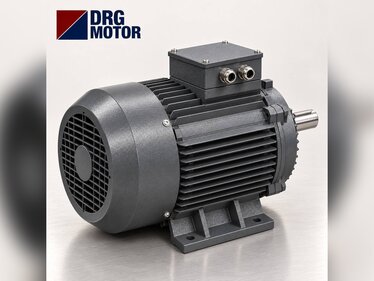
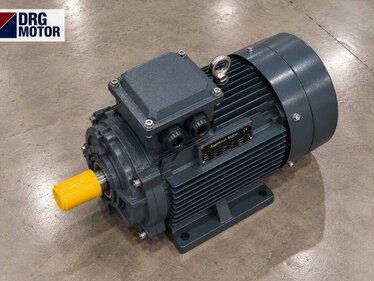
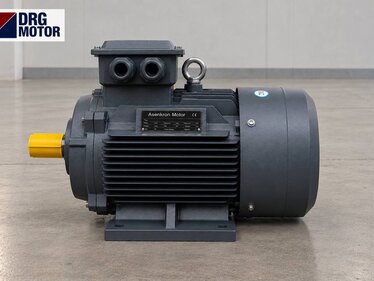
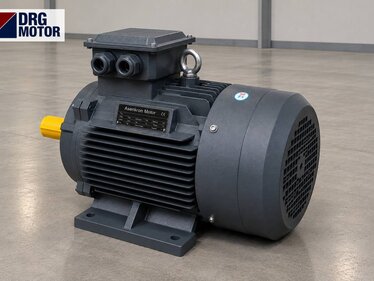
| DRG-112M-4 | 4 kW · 1450 rpm | Cast iron 112M | 7.95 A |
| DRG-132S-4 | 5.5 kW · 1460 rpm | Cast iron 132S | 10.7 A |
| DRG-132M-4 | 7.5 kW · 1460 rpm | Cast iron 132M | 14.3 A |
| DRG-160M-4 | 11 kW · 1465 rpm | Cast iron 160M | 20.4 A |
| DRG-160L-4 | 15 kW · 1465 rpm | Cast iron 160L | 27.3 A |
| DRG-180L-4 | 22 kW · 1470 rpm | Cast iron 180L | 39.7 A |
Typical ranges are the DRG-90L-4 for small screws and screens, the DRG-112M-4–DRG-132M-4 for medium granulators and mixers, and the DRG-160L-4 and above for large dryer drums. The final choice is made from the calculation and the machine nameplate.
Example: technical summary of a 4 kW motor for a granulator
- Power: 4 kW (5.5 HP)
- Synchronous / rated speed: 1500 / 1450 rpm
- Current 380 V / 400 V: 8.37 A / 7.95 A
- cos φ: 0.82
- Rated torque: 26.3 Nm
- Ts/Tn · Tmax/Tn: 2.2 · 2.3
- Is/In: 7.8
- Shaft D × E: 28 × 60 mm
- Frame: Cast iron IEC 112M
- Voltage: 400/690 V (Δ/Y)
- Cable entry: 2 × M32×1.5
- Bearing: 6206-ZZ-C3
On a 380 V supply this motor is connected in delta (Δ). For overload relay and contactor selection use our overload relay, fuse and contactor selection tool.
Motor replacement and maintenance checklist for fertilizer machines
- Note kW, speed, voltage and connection from the old motor's nameplate.
- Measure the shaft height (H), foot hole spacing (A × B) and shaft size (D × E); shaft diameter and key must match the gearbox input exactly.
- For a flange-mounted gearbox (B5), compare the spigot diameter and bolt circle with the technical drawing.
- Check the direction of rotation briefly with no load, before coupling the gearbox.
- Check the terminal box gasket, glands and blanking plugs on the new motor as well.
- Set the overload relay to the rated current on the motor label and watch whether it trips during a loaded start.
- At the end of the season clean fertilizer dust off the motor with a dry brush and vacuum, not compressed air; do not blow dust into the terminal box.
- During long shutdowns run the motor briefly once a month to drive moisture out of bearings and windings.
Motors in this power range
The 4-pole cast iron models most often asked about for fertilizer mixing, granulation and drying machines:
- DRG-90L-4 – 1.5 kW – 1445 rpm – Cast iron 90L
- DRG-112M-4 – 4 kW – 1450 rpm – Cast iron 112M
- DRG-132S-4 – 5.5 kW – 1460 rpm – Cast iron 132S
- DRG-132M-4 – 7.5 kW – 1460 rpm – Cast iron 132M
- DRG-160M-4 – 11 kW – 1465 rpm – Cast iron 160M
- DRG-160L-4 – 15 kW – 1465 rpm – Cast iron 160L
Click to see current prices and order these motors nowSEE PRICES →
Frequently Asked Questions
What kW motor does a granulator drum need?
It is calculated from the torque and speed at the drum shaft: P = T × n / 9550, plus about 10% for gearbox losses. For example, 2600 Nm at 12 rpm gives ≈ 3.6 kW, so a 4 kW motor is chosen. If the loaded start is heavy, consider the next rating or a VFD.
Why do fertilizer machine motors rust so quickly?
Fertilizer dust is hygroscopic; it absorbs moisture and forms a salty layer that attacks paint, bolts and the terminal box. An IP55 motor, a sound terminal box gasket, the correct gland and regular dry cleaning noticeably extend service life.
Should a fertilizer mixer use a 4-pole or a 6-pole motor?
Mostly a 4-pole (1500 rpm) motor with a gearbox is used; gearbox options are wide and the motor frame is more compact. A 6-pole (1000 rpm) motor gives higher shaft torque at the same power and needs a lower gearbox ratio; it can be chosen if the gearbox input speed suits it.
How many amps does a 4 kW motor draw on a fertilizer machine?
The DRG-112M-4 (4 kW, 1450 rpm) draws 8.37 A at 380 V and 7.95 A at 400 V at full load. When the granulator is lightly loaded the current stays below this; if you see a continuous current above rated, check the drum for sticking and the bearings or gearbox.
Send us your machine's nameplate or dimensions and we will match the right DRG model with you: +90 (542) 666 11 11 · [email protected] · Contact page. All models: Buy Electric Motors Online.