English
 Le français
 Türkçe




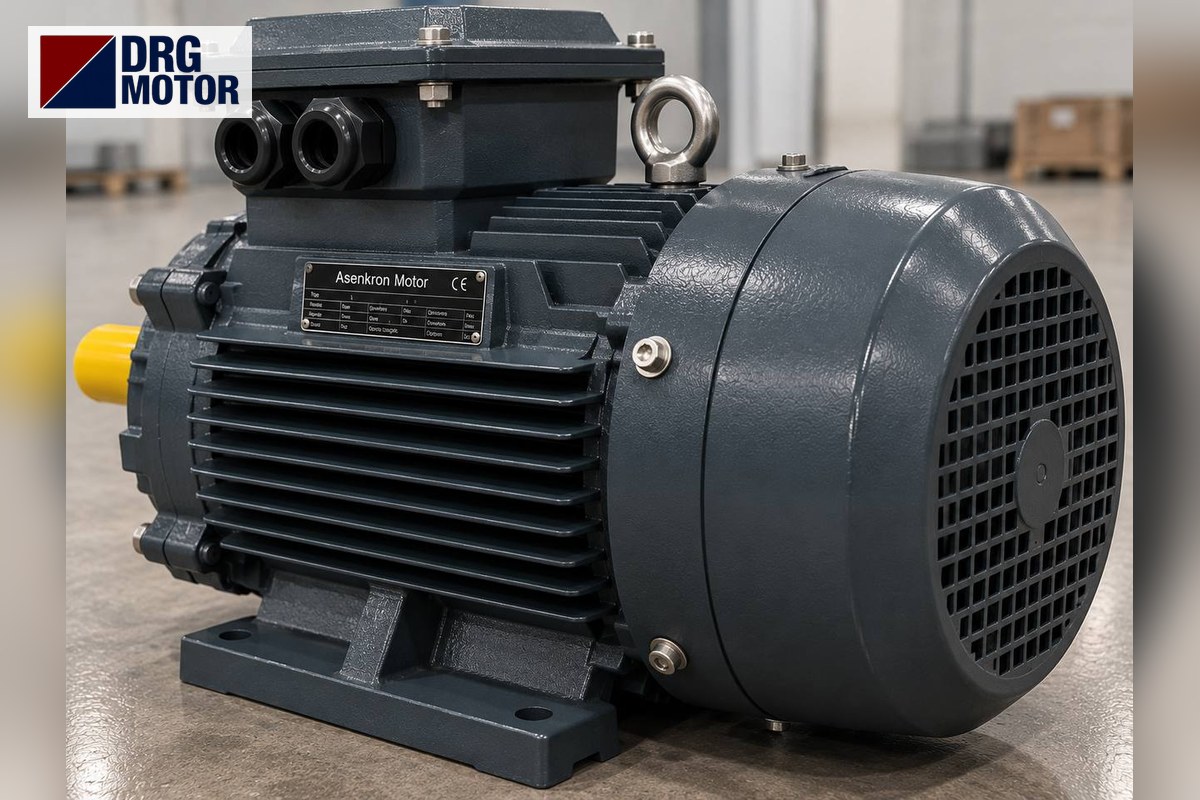

A cable granulator line does not run on one motor but on a group of motors chosen for three different jobs: a 4-pole motor with a gearbox that delivers high torque at low speed on the pre-shredder that cuts the cable into coarse pieces, a belt-driven 4-pole motor on the knife granulator that strips the copper from the plastic sheath (1465–1470 rpm between 11 and 22 kW in the DRG catalogue), and small motors in the 1.5–5.5 kW band on the air table, separator and suction fan that separate the copper granulate from the plastic. On small and medium lines the granulator motor is usually in the 11–22 kW range and the pre-shredder motor in the 11–30 kW range; the exact value comes from the machine nameplate and the machine builder's data. The ranges below are conservative and every calculation is shown with its assumptions.
The granulator rotor is heavy and fitted with knives; with the wrong starting method or overload setting the motor trips during start-up or the winding overheats. The wiring, the star-delta panel and the protection settings must be done by a qualified electrician, and the machine must be isolated and locked out whenever knives or screens are changed.
You can pick the right frame and power for each job on your line from the 120 models on the Buy Electric Motors Online page; the tables below show which model goes where.
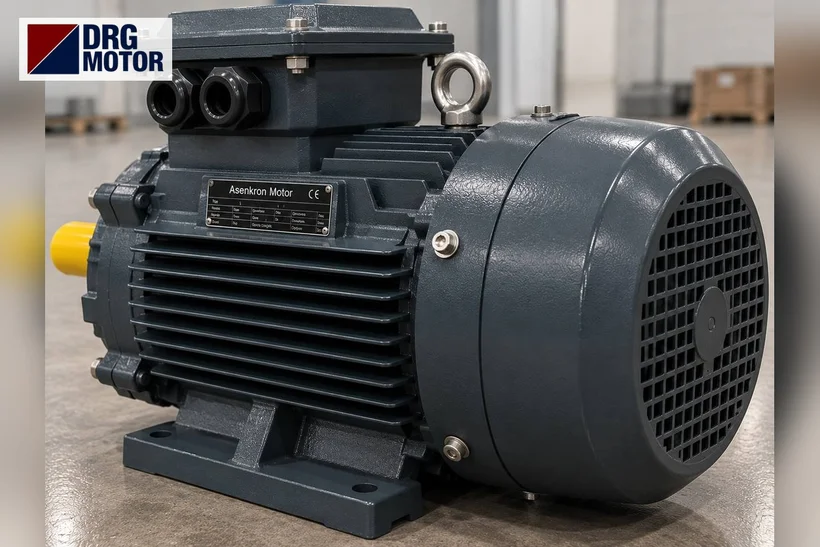
Motors on a cable recycling line: pre-shredder, granulator, separation
A copper granulate line first brings the cable down to a coarse size, then cuts and reduces the copper away from the plastic, and finally separates the two materials by density. Each step has a different load profile, so each motor is chosen differently: the pre-shredder needs torque, the granulator needs acceleration and inertia to be managed, and the separation equipment needs small motors that are well protected against dust.
| Line section | Poles / drive | Load type | Indicative power |
|---|---|---|---|
| Pre-shredder | 4-pole + gearbox | Shock load, high torque | 11–30 kW |
| Granulator (knife rotor) | 4-pole + belt | Heavy, high-inertia rotor | 11–22 kW |
| Air table / separator | 4-pole, eccentric | Light, vibrating | 1.5–4 kW |
| Suction / dust fan | 2-pole, direct | Fan load | 2.2–5.5 kW |
| Feed belt / screw | 4-pole + gearbox | Light, steady | 0.75–2.2 kW |
The power ranges are indicative for each machine class. Thin cable (telephone, data, automotive harness) passes the knives easily; heavy power cable and steel-armoured cable put a much heavier load on the pre-shredder and granulator. Two machines quoting the same throughput can therefore have different motor ratings. If the old motor's nameplate is still there, take the power, number of poles and shaft size from it.
Pre-shredder: calculating torque at low speed
The pre-shredder (single- or twin-shaft) reduces the cable to a size the granulator can accept. Its shaft turns at a few tens of rpm, with a high-ratio gearbox between motor and shaft. That is why you need the shaft torque first; the power follows from it: P = T·n / 9550.
- Assumption: shaft torque given by the machine builder 5.5 kN·m, shaft speed 25 rpm.
- Shaft power: P = 5500 × 25 / 9550 ≈ 14.4 kW.
- A factor of 0.9 for gearbox losses (assumption): 14.4 / 0.9 ≈ 16.0 kW → next standard step 18.5 kW.
- Choice: DRG-180M-4 (18.5 kW, 1470 rpm, rated torque 120.2 Nm). Gear ratio i = 1470 / 25 ≈ 58.8.
- Check: rated torque at the shaft ≈ 120.2 × 58.8 × 0.9 ≈ 6.4 kN·m, which is above the 5.5 kN·m required.
You can check the ratio and output torque with your own values in the Gearbox Output Speed and Torque Calculator. Heavy cable jams between the knives; most pre-shredders therefore monitor current and free themselves with a short reverse run. Reversing without waiting for the motor to stop means a current surge even higher than the starting current every time, so leave a short dwell time before reversing.
Granulator: rotor speed, pulleys and starting inertia
In the granulator the copper is separated from the sheath by the cut between the rotating rotor knives and the fixed bed knives. Cutting speed is the peripheral speed of the rotor: v = π·D·n / 60.
- Assumption: rotor diameter 400 mm, rotor speed 500 rpm.
- Knife tip speed: v = π × 0.4 × 500 / 60 ≈ 10.5 m/s.
- With the DRG-160L-4 motor (15 kW, 1465 rpm) the pulley ratio is 1465 / 500 ≈ 2.93; with a 160 mm motor pulley the rotor pulley is ≈ 469 mm (belt slip neglected).
You can work out pulley diameters and belt length with the Pulley and Belt Calculator. The rotor and the large pulley act together like a flywheel: they smooth out the cutting shocks but make the motor accelerate for a long time at start-up. The granulator should therefore always start with an empty chamber, and the feed belt should only start once the rotor is at full speed.
Direct-on-line or star-delta?
The DRG-160L-4 draws 27.3 A at 400 V and has a starting current ratio Is/In of 7.8. Direct-on-line, the starting current is ≈ 27.3 × 7.8 ≈ 213 A. With star-delta, the starting current drawn from the supply drops to about one third, ≈ 71 A, but the starting torque also drops to one third: a motor with Ts/Tn 2.2 gives ≈ 0.73 × Tn in star. That is enough to start an empty rotor, and often not enough for a rotor with material left inside. Since the motor voltage is 400/690 V (Δ/Y), it runs in delta on a 400 V supply and is suitable for star-delta starting. Use the Motor Starting Methods (Star-Delta) tool for the changeover time and current calculation.
- Power: 15 kW
- Rated speed: 1465 rpm
- Current 400 V / 380 V: 27.3 A / 28.8 A
- cos φ: 0.86
- Rated torque: 97.8 Nm
- Ts/Tn · Tmax/Tn: 2.2 · 2.3
- Is/In: 7.8
- Shaft D×E: 42×110 mm
- Voltage: 400/690 V (Δ/Y)
- Frame: Cast iron, IEC 160L
DRG models by job
| Model | Power / speed | Frame | Current 400 V |
|---|---|---|---|
| DRG-160M-4 | 11 kW / 1465 rpm | Cast iron 160M | 20.4 A |
| DRG-160L-4 | 15 kW / 1465 rpm | Cast iron 160L | 27.3 A |
| DRG-180M-4 | 18.5 kW / 1470 rpm | Cast iron 180M | 33.5 A |
| DRG-180L-4 | 22 kW / 1470 rpm | Cast iron 180L | 39.7 A |
| DRG-200L-4 | 30 kW / 1475 rpm | Cast iron 200L | 53.8 A |
| DRG-112M-2 | 4 kW / 2905 rpm | Cast iron 112M | 7.45 A |
| DRG-100L-2 | 3 kW / 2895 rpm | Cast iron 100L | 5.71 A |
| DRG-100L1-4 | 2.2 kW / 1450 rpm | Cast iron 100L | 4.52 A |
| DRG-90L-4 | 1.5 kW / 1445 rpm | Cast iron 90L | 3.3 A |
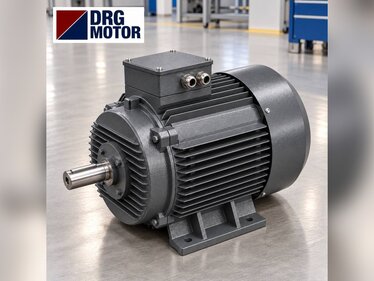
The first five models in the table are for the pre-shredder and granulator, the last four for the suction fan, feeding and separation equipment. A cast iron frame is preferred for these heavy, dusty duties. Motor selection for plastic granulators is a close topic; we cover the differences in our article Which Electric Motor for a Plastic Granulator or Shredder?
Copper fines, plastic dust and IP55
Cable recycling produces two kinds of dust: plastic sheath dust and fine copper particles. Copper fines are conductive; if they get into the terminal box they create a risk of leakage current and phase-to-phase flashover. Use IP55 motors, check the terminal box gasket and cable gland at every motor change, and close unused cable entries with blanking plugs. Details on terminal boxes and cable entries are in our article Motor Terminal Box: IP Protection and Cable Entry.
The motor's own fan blows air along the cooling fins; if the fins fill with dust, cooling falls and the winding heats up. Mount the motor away from the granulator's screen outlet and from open suction inlets, and include the fan cover in weekly cleaning. On air tables and vibrating screens, loosening foot bolts are a common fault; add a tightening check to the maintenance plan.
Cable size and protection: a 15 kW granulator example
Example: a DRG-160L-4 motor 40 m from the panel. The motor draws 27.3 A at 400 V and 28.8 A at 380 V; cos φ is 0.86. With a sizing factor of 1.25 the cable must carry at least 27.3 × 1.25 ≈ 34.1 A.
| Cross-section | Ampacity | Resistance | Result |
|---|---|---|---|
| 4 mm² | 34 A | 4.61 Ω/km | Too small for 34.1 A |
| 6 mm² | 43 A | 3.08 Ω/km | Suitable |
| 10 mm² | 60 A | 1.83 Ω/km | Reserve for long runs |
Voltage drop with 6 mm²: ΔU = √3 × 27.3 × 0.04 × 3.08 × 0.86 ≈ 5.0 V, about 1.25% of 400 V, below the 3% limit accepted for the supply. The ampacities in the table are example values for copper, PVC insulation and about 30 °C; the installation method and grouping reduce them. Use the Motor Cable Size Calculator for your own distance. Set the overload relay to the rated current on the nameplate; raising it because "it trips at start-up" only hides the real problem (loaded start, blunt knives, slack belt).
Checklist before choosing the motor
- Old motor nameplate: kW, rated speed, voltage (230/400 V or 400/690 V), current.
- Shaft diameter and length (D×E), key width; the pulley must sit fully on the shaft.
- Mounting: foot-mounted (B3) or flange; foot hole spacing and shaft height H.
- Starting: direct-on-line, star-delta or soft starter; is the winding suitable for that method?
- Does the granulator start with an empty chamber; does the feed start before the rotor is up to speed?
- Is the reverse logic and dwell time set on the pre-shredder?
- Terminal box position (right/left/top) and cable entry; gland seal, blanking plug.
- Belt alignment, tension and belt guard; tightness of the motor slide rails.
- Is the overload relay set to rated current; has the cable size been checked for the distance?
Motors in this power range
- DRG-160L-4 – 15 kW – 1465 rpm – Cast iron 160L
- DRG-180M-4 – 18.5 kW – 1470 rpm – Cast iron 180M
- DRG-180L-4 – 22 kW – 1470 rpm – Cast iron 180L
- DRG-112M-2 – 4 kW – 2905 rpm – Cast iron 112M
- DRG-100L1-4 – 2.2 kW – 1450 rpm – Cast iron 100L
Click to see current prices and order these motors nowSEE PRICES →
Frequently Asked Questions
How many kW does a cable granulator need?
There is no single value; the line is split into sections. On small and medium lines the granulator motor is usually 11–22 kW, the pre-shredder 11–30 kW, and separation and fan motors 1.5–5.5 kW. The exact value comes from the machine nameplate and the builder's data; for the pre-shredder you can calculate from shaft torque with P = T·n/9550.
What speed should a granulator motor have?
Granulators usually use 4-pole motors; in the DRG catalogue the rated speed between 11 and 22 kW is 1465–1470 rpm. The rotor speed is set by the pulley ratio; for a 500 rpm rotor, for example, the ratio is ≈ 2.93.
How many amps does a 15 kW granulator motor draw?
The DRG-160L-4 draws 27.3 A at 400 V and 28.8 A at 380 V. Direct-on-line the starting current rises to about 213 A; with star-delta the starting current drawn from the supply drops to about 71 A.
Is star-delta starting enough for a cable granulator?
If the granulator starts with an empty chamber it is usually enough: in star the motor delivers about 0.73 times rated torque (for Ts/Tn 2.2). If material is left in the rotor it cannot accelerate in star; empty the rotor first, or use a soft starter or a frequency inverter.
Send us your machine's nameplate or the builder's data and we will pin down the right frame together: phone +90 (542) 666 11 11, e-mail [email protected], contact page. DRG Motor is a manufacturer, supplier and seller of electric motors; you can browse every model on the Buy Electric Motors Online page.