English
 Le français
 Türkçe




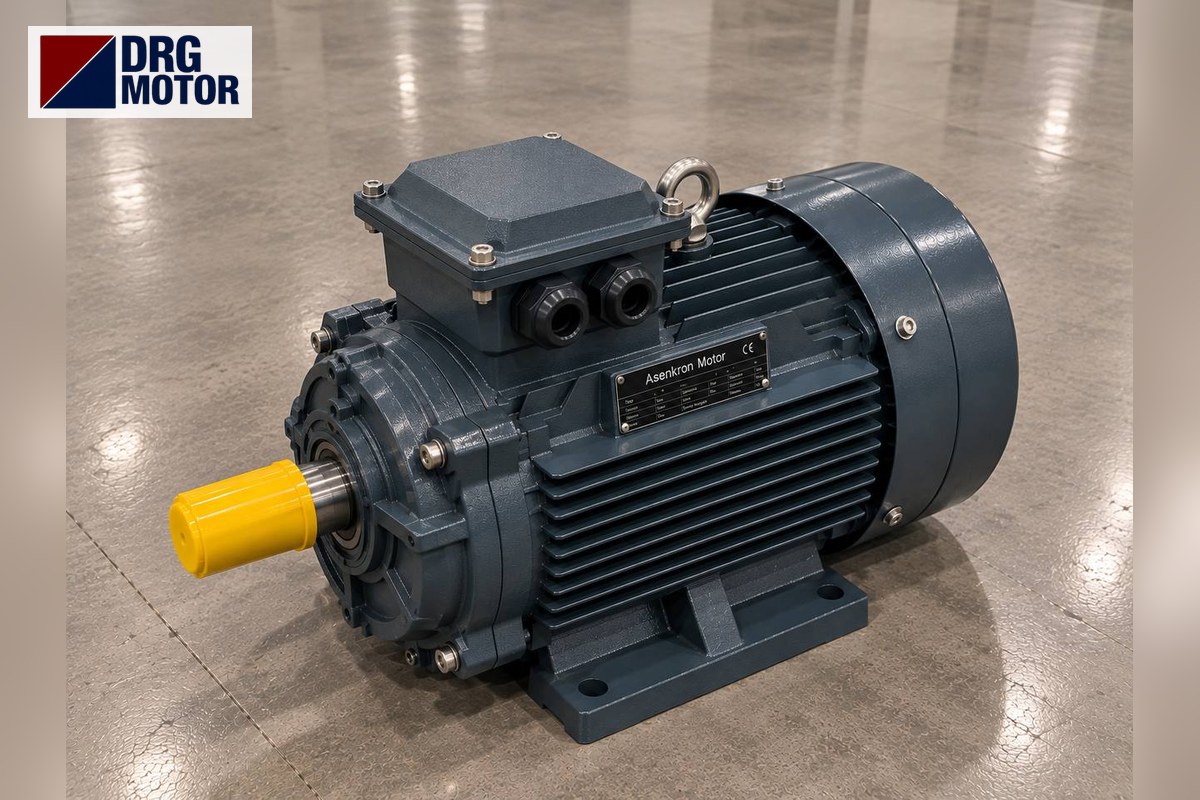

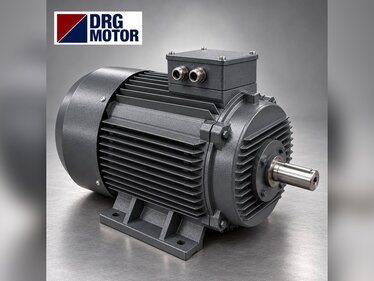
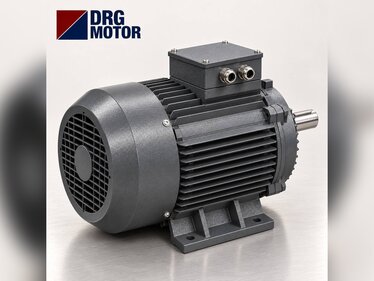
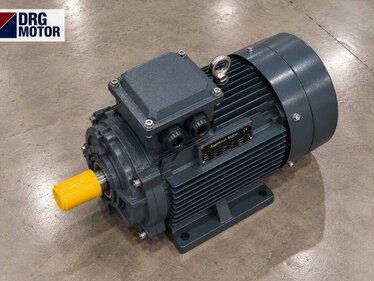
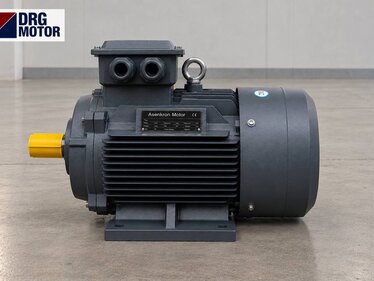
An extruder motor on most lines is a 4-pole, roughly 1500 rpm three-phase motor, reduced to screw speed through a gearbox and driven by a frequency inverter in constant-torque mode. Its power is estimated as hourly output × specific energy: assuming 60 kg/h and 0.25 kWh/kg for the screw drive gives 15 kW, a 20% margin brings it to 18 kW, and the next standard rating is 18.5 kW. At this rating DRG-180M-4 delivers 120.2 Nm at 1470 rpm and draws 33.5 A at 400 V; if the screw turns at 60 rpm, the gearbox ratio is about 24.5. The definitive power is the machine’s nameplate or the machine builder’s data.
What sets an extruder apart from a pump or fan is the load characteristic: the screw pushes the melt with the same resistance on every revolution, so torque does not fall with speed. When the inverter lowers the speed, the motor is still loaded close to full torque, but its own fan turns slower and cools less. Motor selection, inverter selection and cooling therefore go together. The motor and inverter must be connected by a qualified electrician. All 4-pole models are listed by power and frame among the 120 models in our online store.
From Output to Motor Power: kg/h × Specific Energy
A practical formula for screw drive power is P (kW) = Q (kg/h) × e (kWh/kg). Here e is the specific energy the screw spends through the shaft to melt and pressurise the plastic; heater band power is not part of this calculation. e depends on the polymer, screw geometry, melt temperature and die pressure; without trial data from the machine builder, the 0.25 kWh/kg above is only an example assumption.
Steps: 60 × 0.25 = 15 kW shaft power; with a 20% margin for load fluctuation and cold starts, 15 × 1.2 = 18 kW; the next standard rating up is 18.5 kW. At 40 kg/h the same assumption gives 10 kW, 12 kW with margin, which points to the 15 kW DRG-160L-4. Replace the assumption with your own measurement: logging motor current and screw speed on an existing line and dividing by hourly output gives the most reliable e value.
Screw Speed, Gearbox Ratio and Screw Shaft Torque
An extruder screw usually turns at a few tens of rpm. The gearbox ratio is i = motor speed / screw speed. In our example the screw tops out at 60 rpm: i = 1470 / 60 = 24.5. Torque at the screw shaft is motor torque × ratio; ignoring gearbox losses, 120.2 × 24.5 ≈ 2945 Nm. The same result follows from P = T · n / 9550: T = 9550 × 18.5 / 60 ≈ 2945 Nm. The gearbox is sized for this torque and for the screw’s axial thrust; you can check the gearbox side with the gearbox output speed and torque calculator.
A common approach is to place the highest screw speed at 50 Hz, so that the motor runs below 50 Hz across the whole production range. Going above 50 Hz pushes the motor into the constant-power region where torque falls; on a constant-torque load such as an extruder, this strains the screw.
Why 4 Poles? Comparing 2-, 4- and 6-Pole Motors
The same 18.5 kW can be obtained with three different pole counts. The difference lies in the speed and torque entering the gearbox and in frame size:
| Model | Speed / torque | Frame, shaft D×E | Ratio (screw 60 rpm) |
|---|---|---|---|
| DRG-160L-2 | 2940 rpm / 60.1 Nm | 160L, 42 × 110 mm | ≈ 49 |
| DRG-180M-4 | 1470 rpm / 120.2 Nm | 180M, 48 × 110 mm | ≈ 24.5 |
| DRG-200L1-6 | 980 rpm / 180.3 Nm | 200L, 55 × 110 mm | ≈ 16.3 |
With a 2-pole motor the gearbox ratio rises to 49, which means more stages and a larger gearbox, and the high input speed adds noise and bearing load. A 6-pole motor brings the ratio down to 16.3 but grows to a 200L frame and a 55 mm shaft. Four poles sit in between: frame 180M, a 48 × 110 mm shaft and a reasonable ratio. On an existing machine the gearbox input flange and coupling are machined for this shaft, so do not change the pole count when replacing the motor.
Constant-Torque Inverter Selection and Speed Range
On a constant-torque load the motor’s usable power falls in proportion to frequency. With the 18.5 kW 4-pole motor and a 24.5 ratio gearbox, approximate values are:
| Frequency | Motor speed (approx.) | Screw speed | Usable power |
|---|---|---|---|
| 50 Hz | 1470 rpm | 60 rpm | 18.5 kW |
| 40 Hz | 1176 rpm | 48 rpm | 14.8 kW |
| 30 Hz | 882 rpm | 36 rpm | 11.1 kW |
| 20 Hz | 588 rpm | 24 rpm | 7.4 kW |
The speeds in the table ignore slip; actual speed under load is slightly lower. Points to watch when selecting the inverter:
- Choose the inverter in the “heavy duty / constant torque” class; a fan-and-pump (variable torque) rating falls short at extruder start-up.
- The inverter’s rated output current must not be below the motor nameplate current: 33.5 A at 400 V for DRG-180M-4.
- If start-up torque demand is high, vector control gives more torque at low speed.
- Keep the ramp time long enough not to strain the screw in cold melt.
To see the frequency, torque and power relationship with your own values, use the VFD frequency-torque-power calculator.
Heating at Low Frequency and Forced Cooling
Standard motors are cooled by a fan mounted on their own shaft (IC 411). Fan airflow falls with speed; at 25 Hz the motor runs at half speed and the fan moves far less air. On an extruder, however, torque, and therefore current, stays the same. The result: on a line producing at low speed for long periods, the motor frame gradually heats up.
If the line often runs below 30 Hz there are two remedies: choose the motor one rating higher, or use a separately powered forced-cooling fan. A forced fan supplies constant air independent of motor speed and allows the motor to run at full torque at low speed. The insulation side of this subject is covered in our article VFD motor insulation and forced cooling. Discuss forced cooling and the PTC/PT100 thermal protection listed as an option on the product pages with us before ordering.
Checklist for Selecting and Replacing an Extruder Motor
- Note the nameplate power, speed and frame; the new motor should have the same number of poles.
- Gearbox input flange and coupling: do shaft D × E (48 × 110 mm for 18.5 kW 4-pole) and the B5 flange dimensions (180M: P 350, N 250, M 300 mm) match?
- Is the inverter constant-torque rated and suited to the motor current?
- At what frequency does the line mostly run? Below 30 Hz, plan forced cooling.
- Do not turn the screw before the heaters reach working temperature; torque demand multiplies in cold plastic.
- Cable size: for 33.5 A × 1.25 ≈ 41.9 A, the first suitable size in the table is 6 mm² (43 A); on long runs check voltage drop with the motor cable size calculator.
- For a dusty, pellet-laden environment, are the motor’s IP55 protection and terminal box gasket intact?
4-Pole Model Table for Extruders
4-pole cast iron models covering the power range common on small and medium single-screw lines (current at 400 V full load):
| Model | Power / speed | Frame | Current 400 V |
|---|---|---|---|
| DRG-160M-4 | 11 kW / 1465 rpm | 160M cast iron | 20.4 A |
| DRG-160L-4 | 15 kW / 1465 rpm | 160L cast iron | 27.3 A |
| DRG-180M-4 | 18.5 kW / 1470 rpm | 180M cast iron | 33.5 A |
| DRG-180L-4 | 22 kW / 1470 rpm | 180L cast iron | 39.7 A |
Extruder Motors in This Power Range
- DRG-160M-4 – 11 kW – 1465 rpm – 160M
- DRG-160L-4 – 15 kW – 1465 rpm – 160L
- DRG-180M-4 – 18.5 kW – 1470 rpm – 180M
- DRG-180L-4 – 22 kW – 1470 rpm – 180L
- DRG-160L-2 – 18.5 kW – 2940 rpm – 160L
- DRG-200L1-6 – 18.5 kW – 980 rpm – 200L
Click to see current prices and order these motors nowSEE PRICES →
Frequently Asked Questions
How many kW should an extruder motor be?
It follows from output × specific energy. With the example assumption (0.25 kWh/kg), 40 kg/h needs about 10 kW and 60 kg/h about 15 kW of shaft power; with a 20% margin, 15 and 18.5 kW motors are chosen. The definitive value is the machine nameplate or the machine builder’s data.
What speed motor is used on an extruder?
Usually a 4-pole motor of about 1500 rpm, reduced to screw speed by a gearbox. The 18.5 kW DRG-180M-4 runs at a rated 1470 rpm; for a 60 rpm screw the ratio is about 24.5.
Which mode should an extruder inverter run in?
Constant torque (heavy duty). The screw is loaded with similar torque on every revolution; variable-torque mode cuts torque at low speed and strains the screw.
How many amps does an 18.5 kW motor draw?
The 18.5 kW, 1500 rpm DRG-180M-4 draws 33.5 A at full load on 400 V and 35.3 A on 380 V; cos φ is 0.86. Inverter and overload selection are based on this current.
Send us your extruder’s output, screw speed and current motor nameplate, and let us choose the right motor together: +90 (542) 666 11 11, [email protected] or our contact page. All models: Buy Electric Motors Online.