English
 Le français
 Türkçe




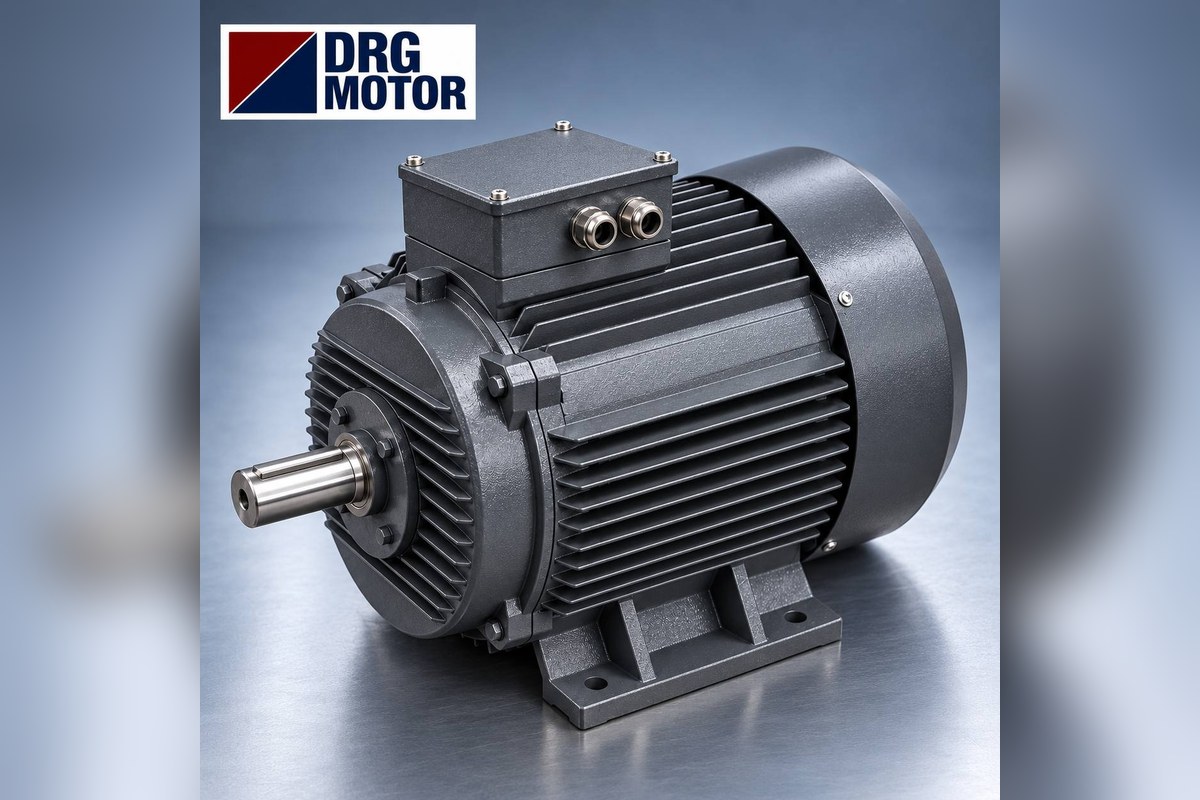

Two motors with the same kW and speed do the same job electrically, yet they often cannot be swapped directly, because the dimensions that connect them to the machine differ: shaft height, shaft diameter and length, foot holes, flange size, terminal box position and cable entry depend on the frame, not on the power. Two 5.5 kW 1500 rpm motors in the DRG catalogue show this clearly: the standard DRG-132S-4 is in frame 132S with a 38 mm shaft; the compact DRG-112M-4K is in frame 112M with a 28 mm shaft. Power, speed and current (10.7 A) are the same, but neither fits the other’s coupling, pulley or base holes.
That is why “5.5 kW, 1500 rpm” alone is not enough when looking for a replacement motor; you also need the frame code and mounting type. Cable and terminal work during a motor change must be done by a qualified electrician after the supply has been switched off and locked out.
DRG Motor is a manufacturer, supplier and seller of electric motors. For each of the 120 models on our Buy Electric Motors Online page, the frame code is part of the product name (DRG-frame-poles), so you can compare two models of the same power by their dimensions. We covered the general steps of finding an equivalent for an old motor in our equivalent electric motor selection article; here we focus only on the question “same kW, so why doesn’t it fit?”.
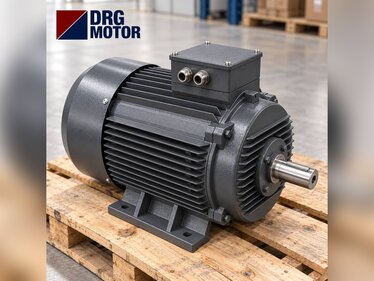
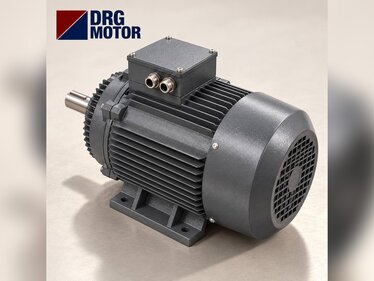
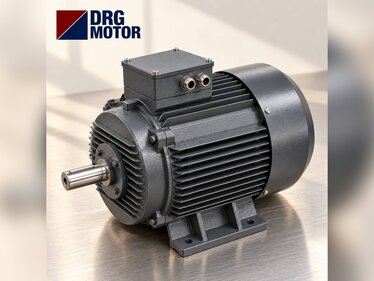
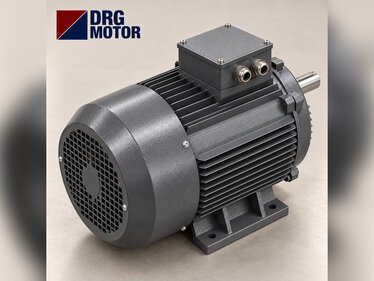
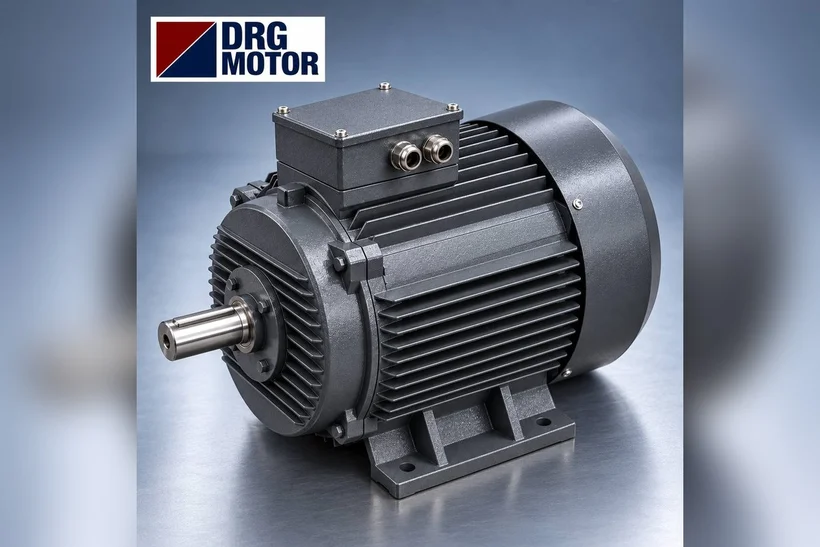
Two motors of the same power: DRG-112M-4K and DRG-132S-4 side by side
All values in the table below come from the DRG catalogue. The two motors’ electrical data are almost identical, while their mechanical dimensions differ markedly.
| Value | DRG-112M-4K | DRG-132S-4 |
|---|---|---|
| Power / rated speed | 5.5 kW / 1460 rpm | 5.5 kW / 1460 rpm |
| Current 400 V / cos φ | 10.7 A / 0.83 | 10.7 A / 0.83 |
| Rated torque | 36 Nm | 36 Nm |
| Shaft height H | 112 mm | 132 mm |
| Shaft D×E, key F | 28×60 mm, 8 mm | 38×80 mm, 10 mm |
| Feet A×B / C | 190×140 / 70 mm | 216×140 / 89 mm |
| Frame dia. AC / length L | 230 / 394 mm | 258.4 / 438 mm |
| Bearing | 6206-ZZ-C3 | 6208-ZZ-C3 |
In short: the shaft axis is at a height 20 mm different, the shaft diameter differs by 10 mm, the shaft length by 20 mm, and the foot holes across the shaft are 26 mm apart differently. The only common mechanical dimension is the foot spacing along the shaft, B (140 mm). For general information on the compact range, see our article what is a compact electric motor.
Which differences prevent mounting?
Shaft height: the biggest obstacle on coupled drives
On a pump or fan connected by a coupling, the motor shaft must sit exactly on the axis of the driven shaft. If a 112M-frame motor replaces a 132S-frame motor, the shaft ends up 20 mm too low; the other way round it ends up 20 mm too high and the motor will not fit the base. The first can be solved with a packing base; the second needs the base to be machined.
Shaft diameter and key: coupling hub and pulley will not fit
Coupling hubs and pulleys are bored to the shaft diameter. A hub for a 38 mm shaft cannot be fitted on a 28 mm shaft, and a 28 mm hub will not go on a 38 mm shaft. The key width also differs (8 mm and 10 mm). If shaft length E is shorter, the hub does not grip the full shaft; if longer, the hub may butt against the other side.
Foot holes and dimension C: base holes do not line up
Dimension A changes between 190 mm and 216 mm; the holes in the base must be re-drilled. When C (distance from shaft shoulder to the first foot hole) goes from 70 mm to 89 mm, the position of the shaft end also changes. This affects the gap between the two shafts on a coupled drive and pulley alignment on a belt drive.
Flange: the large flange differs too
If the motor is flange-mounted, the difference is even clearer. In the DRG catalogue the B5 flange of frame 112M is P 250 / M 215 / N 180 mm, and that of frame 132S is P 300 / M 265 / N 230 mm. Because the spigot diameter differs, the motor will not enter the mating recess; no connection is possible without an adapter.
Click to see current electric motor prices and order nowSEE PRICES →
What to check on the electrical side?
Nameplate voltage and connection
In the DRG catalogue models of the same power share the same nameplate voltage: 230/400 V up to 3 kW, 400/690 V from 4 kW upwards. But two motors of the same kW from different sources may have different nameplate voltages. For example, if the old motor is rated 400/690 V and the panel uses star-delta starting, the replacement must also be 400/690 V; a 230/400 V motor cannot be used with this panel. For starting methods, see our star-delta starting page.
Terminal box position and cable entry
The terminal box may be on top on one motor and on the side on the other. If there is a cover plate or another part in front of the box on the machine, a motor with the box in the wrong place cannot be mounted or cannot be wired. Cable entry also depends on the frame: 2 × M32×1.5 on frames 112M and 132, 2 × M40×1.5 on frames 160. If the gland size changes, the existing gland will not fit the new box.
Bearing and shaft load
The bearing is 6206-ZZ-C3 on the compact 112M motor and 6208-ZZ-C3 on the standard 132S motor. On a belt drive, the radial load on the shaft end is limited by bearing size. If a compact motor of the same power is to be used on a belt drive, pulley diameter and belt tension must be checked with this in mind.
Second example: the same picture at 11 kW 1500 rpm
The same applies at 11 kW. The compact DRG-132M-4K and the standard DRG-160M-4 have the same power, speed (1465 rpm), current (20.4 A) and torque (71.7 Nm):
| Dimension | DRG-132M-4K | DRG-160M-4 |
|---|---|---|
| Shaft height H | 132 mm | 160 mm |
| Shaft D×E | 38×80 mm | 42×110 mm |
| Feet A×B | 216×178 mm | 254×210 mm |
| Length L / cable entry | 476 mm / 2 × M32 | 608 mm / 2 × M40 |
Here the shaft axis differs by 28 mm and the motor length by 132 mm. The compact motor may fit into a narrow machine housing, but placed where a 160M-frame motor used to be, it needs both a packing base and a new coupling hub.
Does changing the frame material change the dimensions?
In the DRG catalogue aluminium and cast-iron models with the same code have the same mounting dimensions. For example DRG-112M-4 has H 112 mm, A×B 190×140 mm and shaft 28×60 mm in both aluminium and cast iron. So moving from cast iron to aluminium or vice versa does not change the installation; what changes is weight and frame robustness. At the same kW the real dimensional difference arises between standard and compact frames, and between motors built to different standards.
Which frame to choose for a replacement: the same as before or a different one?
The rule is simple: if the machine was built around the existing motor’s frame, the new motor is chosen in the same frame. Moving to a different frame only makes sense in three cases:
- Lack of space: if the machine housing does not allow the length or diameter of the standard frame, a compact frame is the solution; base and coupling hub changes are then planned from the start.
- The machine is being redesigned: if the base, coupling and pulley are being remade anyway, the frame choice is free; even so, staying with a common frame makes future replacements easier.
- The old motor has non-IEC dimensions: if no IEC frame matches exactly, the nearest frame is chosen and the difference is made up with an adapter.
Outside these three cases, searching by “same frame code + same poles” instead of “same kW” removes surprises on installation day. That is why the product codes in the store include the frame: DRG-132S-4 means frame 132S and 4 poles, while a trailing K denotes the compact range. If the old motor’s nameplate does not show the frame code, measuring the shaft height is enough; the distance from the underside of the feet to the shaft centre gives the frame number.
Comparison checklist before ordering
- Do the old and new motors have the same frame code (e.g. 132S)?
- Is shaft height H the same; if not, has a base or machining been planned?
- Do shaft diameter D, length E and key width F suit the coupling hub or pulley?
- Do foot holes A×B and dimension C match the base?
- If flanged, are P, M and N the same as the mating recess?
- Does the nameplate voltage suit the panel’s starting method (400/690 V for star-delta)?
- Do the terminal box position and cable entry suit the space on the machine?
- On a belt drive, is the bearing size suitable for the pulley load?
You can verify dimensions before ordering against the frame drawings on our technical drawings page.
Models of the same power in different frames
The models below show different frame options at the same power; once you know your existing motor’s frame code, choosing the right one is easy:
| Model | Power / speed | Frame | Current 400 V |
|---|---|---|---|
| DRG-112M-4K | 5.5 kW / 1460 rpm | 112M aluminium | 10.7 A |
| DRG-132S-4 | 5.5 kW / 1460 rpm | 132S cast iron | 10.7 A |
| DRG-132M-4K | 11 kW / 1465 rpm | 132M aluminium | 20.4 A |
| DRG-160M-4 | 11 kW / 1465 rpm | 160M cast iron | 20.4 A |
- DRG-112M-4K – 5.5 kW – 1460 rpm – 112M aluminium
- DRG-132S-4 – 5.5 kW – 1460 rpm – 132S cast iron
- DRG-132M-4K – 11 kW – 1465 rpm – 132M aluminium
- DRG-160M-4 – 11 kW – 1465 rpm – 160M cast iron
Click to see current prices and order these motors nowSEE PRICES →
Frequently Asked Questions
Are motors of the same kW always the same size?
No. There are standard and compact frame motors of the same kW and speed; for example a 5.5 kW 1500 rpm motor exists in the DRG catalogue in both frame 132S and frame 112M. Shaft, foot and flange dimensions change with the frame.
What is the shaft diameter of a 5.5 kW motor?
It depends on the frame: in the DRG catalogue it is 38 mm on DRG-132S-4 (frame 132S) and 28 mm on the compact DRG-112M-4K (frame 112M).
Can a compact motor replace a standard motor?
Electrically it does the same job, but because shaft height, shaft diameter and foot holes differ, a base, new holes and a new coupling hub are needed. In tight spaces, however, this difference is an advantage.
Can an aluminium motor replace a cast-iron motor?
Models with the same code have the same mounting dimensions; installation does not change. The choice depends on ambient conditions, vibration and weight.
You can send a nameplate photo and the dimensions of your existing motor to +90 (542) 666 11 11 or [email protected]; all channels are on our contact page. For current models by frame code, see the 120 models in our online store.