English
 Le français
 Türkçe




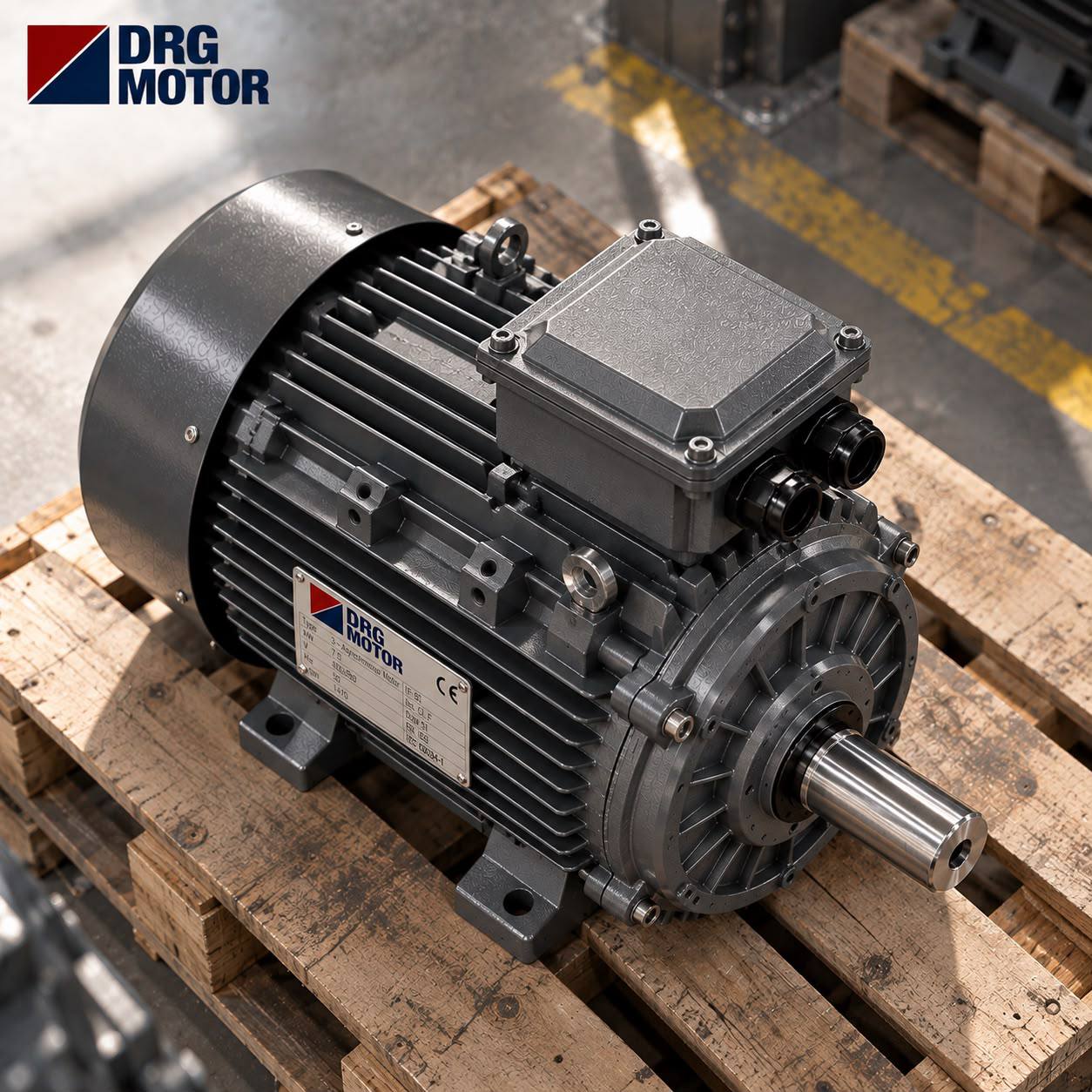

At an olive oil plant, the motor on the malaxer has burned out and the rewinder says it cannot be rewound again. The maintenance technician removes it and puts it on the bench; half of the nameplate is hidden under paint, the other half under oil. All he has is the motor itself, a tape measure and a caliper, and the machine has to run tomorrow morning. This article is written for exactly that situation: finding, step by step, an equivalent model that fits the same place, turns the same pulley at the same speed and works with the protection already in the panel.
Choosing an equivalent is not just "buy the same kW". A correct equivalent matches three things at once: mechanical fit (feet, flange, shaft), speed match (number of poles) and electrical match (voltage, connection, current). Skip one of them and the motor either does not fit or it fits but the machine runs at a different speed or the overload relay trips.
Information to Collect from the Old Motor
If the nameplate is readable, half of the job is done. We have already explained what each field means in our guide to reading a motor nameplate; for someone looking for an equivalent, these six lines matter:
- Power (kW or HP): If it says HP, multiply by 0.746 to get kW; 10 HP is about 7.46 kW and corresponds to the 7.5 kW step.
- Speed (rpm): Around 2850–2950 means 2 poles, around 1400–1480 means 4 poles, around 930–980 means 6 poles.
- Voltage and connection: "Δ/Y 380/660 V" and "Δ/Y 220/380 V" are not the same thing; we cover this separately below.
- Current (A): The overload relay in the panel was set to this value.
- Frame code: Such as 90L, 112M, 132S; it is the key to the mechanical dimensions.
- Mounting type: B3 foot-mounted, B5 large flange, B14 small flange, B35 foot + flange.
If the plate is only partly readable, photograph every readable line; we will complete the missing information by measuring.
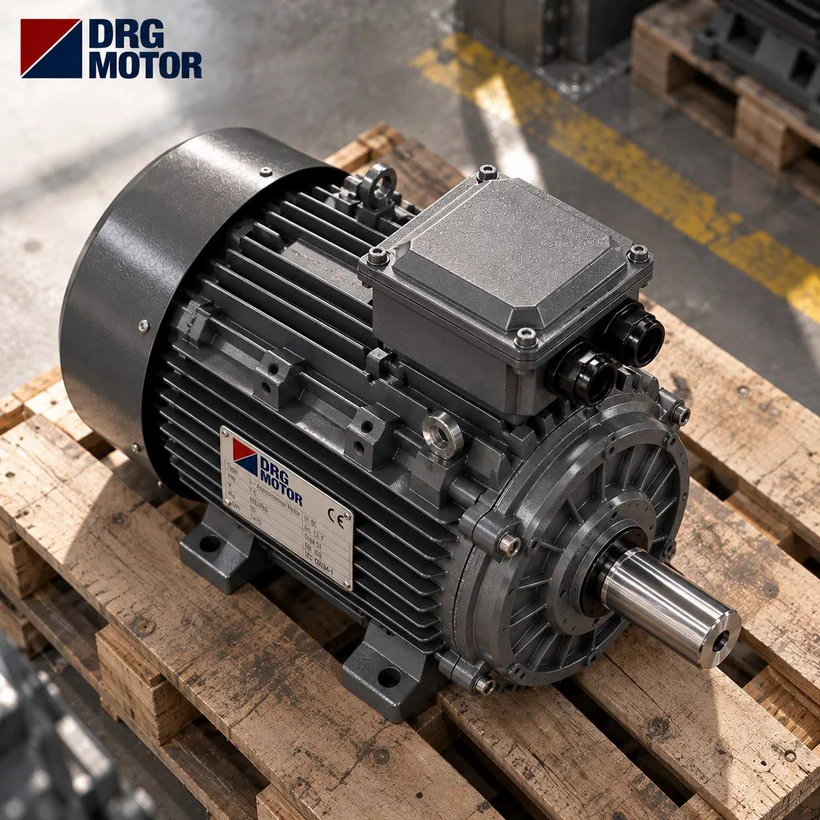
If the Nameplate Is Unreadable: Finding the Frame with Four Measurements
In the IEC standard the frame number is itself a dimension: on a 112M frame the shaft centre is 112 mm above the bottom of the feet. That is why you can identify the frame of a motor without a nameplate using a caliper and a tape measure.
Shaft height (H)
Place the motor on a flat surface, measure from the surface to the top of the shaft, then subtract half the shaft diameter. For example, if you measure 126 mm to the top of the shaft and the shaft diameter is 28 mm, H = 126 − 14 = 112 mm; the frame is 112.
Foot holes (A and B)
A is the centre-to-centre distance between the two foot holes across the shaft axis; B is the distance between holes along the shaft axis. Frames with the same H are told apart by B: on 132S, A = 216 and B = 140 mm; on 132M, A = 216 and B = 178 mm. 160M (B = 210) and 160L (B = 254) are distinguished the same way.
Shaft diameter and length (D×E)
Measure the shaft diameter with a caliper and the shaft length from the end-shield face to the shaft end. Note the key width (F) as well; the pulley or coupling has been machined for that key. Typical values: 28×60 mm for 100L and 112M, 38×80 mm for 132S/M, 42×110 mm for 160M/L.
Flange (B5 or B14)
On a flanged motor, measure the outside diameter (P), the bolt circle (M) and the spigot diameter (N). If the holes are clearance holes (the bolt passes through) it is B5; if they are threaded it is B14. The 100L and 112M frames share the same B5 flange: P = 250, M = 215, N = 180 mm.
| Frame | H (mm) | A (mm) | B (mm) | Shaft D×E (mm) | B5 flange P / M / N (mm) |
|---|---|---|---|---|---|
| 90S | 90 | 140 | 100 | 24×50 | 200 / 165 / 130 |
| 90L | 90 | 140 | 125 | 24×50 | 200 / 165 / 130 |
| 100L | 100 | 160 | 140 | 28×60 | 250 / 215 / 180 |
| 112M | 112 | 190 | 140 | 28×60 | 250 / 215 / 180 |
| 132S | 132 | 216 | 140 | 38×80 | 300 / 265 / 230 |
| 132M | 132 | 216 | 178 | 38×80 | 300 / 265 / 230 |
| 160M | 160 | 254 | 210 | 42×110 | 350 / 300 / 250 |
| 160L | 160 | 254 | 254 | 42×110 | 350 / 300 / 250 |
Dimensions are taken from the IEC mounting tables in the DRG Motor technical catalogue; for other frames, see the dimension pages of the catalogue.
The Frame Alone Does Not Tell the Power: Determine the Number of Poles
The most common mistake in the field is assuming that once the frame is known, the power is known too. On the same 112M frame, the 2-pole motor is 4 kW, the 4-pole motor is 4 kW and the 6-pole motor is 2.2 kW. On a 132S frame we find 5.5 kW and 7.5 kW with 2 poles, 5.5 kW with 4 poles and 3 kW with 6 poles. In other words, you need the speed as well as the frame.
Without a nameplate, the speed can be found in three ways:
- Measure it at the shaft end with a tachometer while the machine runs; if you read 1440 rpm, the motor has 4 poles (synchronous speed 1500).
- Work it back from the pulley diameters: if the machine side turns at 600 rpm, the motor pulley is 100 mm and the machine pulley is 240 mm, the motor speed is about 600 × 240 / 100 = 1440 rpm.
- Ask the rewinder; the number of poles is visible from the coil groups when the winding is removed.
Choose the wrong speed and the machine runs at the wrong speed. If a 2-pole motor replaces a 4-pole one with the same pulleys, the machine speed roughly doubles and the power demand rises accordingly. The speed difference can be compensated with pulleys, but that needs a separate calculation; for this you can use the pulley and torque calculators in our electric motor calculation tools.
Comparing Voltage, Connection and Current
After mechanical and speed matching comes the electrical side. The industrial grid in Turkey is 380–400 V three-phase; look at the voltage pair on the nameplate:
- Δ/Y 220/380 V (230/400 V): On a 380 V grid the motor is connected in star (Y). Star-delta starting is not possible; if the panel has a star-delta starter, this motor cannot be the equivalent.
- Δ/Y 380/660 V (400/690 V): On a 380 V grid the motor runs in delta (Δ) and is suitable for star-delta starting. If the panel uses star-delta, the new motor must have this connection too.
Before disconnecting, photograph the link arrangement in the old motor's terminal box (three vertical links = delta, one horizontal link joining the bottom row = star). State this clearly when ordering.
The current comparison is the final filter. The candidate's rated current at 380 V should be close to the current on the old nameplate. For example, if the old 7.5 kW 4-pole motor's plate says 15.2 A, the 7.5 kW 4-pole model in the DRG catalogue draws 15.0 A at 380 V; the overload setting hardly changes. If the candidate's current is clearly higher, either the number of poles or the voltage/connection is wrong; check the contactor, overload relay and cable cross-section in the panel again.
Equivalent Motor Checklist Table
Fill in the table below next to the old motor; if you cannot say "matches" on every row, hold the order.
| Check | How to get it from the old motor | What to look for on the new motor | What happens if it does not match |
|---|---|---|---|
| Shaft height H | Frame code on the plate or floor-to-shaft measurement | Same H value | Coupling/pulley alignment is lost, shims or a base are needed |
| Foot holes A × B | Caliper/tape, centre to centre | Same A and B | New holes must be drilled in the base |
| Shaft D × E, key F | Caliper | Same diameter, length and key | Pulley/coupling does not fit or a bushing is needed |
| Flange P / M / N | Outside diameter, bolt circle, spigot | Same flange, same type (B5/B14) | Cannot be bolted to the gearbox or pump |
| Speed / poles | Nameplate, tachometer, pulley calculation | Same synchronous speed | Machine runs at a different speed, load changes |
| Power | Nameplate or frame + poles | Equal or one step higher | If smaller, it overheats and the overload trips |
| Voltage / connection | Nameplate, terminal links | Same voltage pair | Star-delta starting does not work |
| Rated current | Nameplate | Close current at 380 V | Overload relay and cable must be reselected |
| Terminal box position | Top / right / left | Position suited to the cable entry | Cable is too short or the conduit changes |
Three Example Matches
Example 1: Foot-mounted motor with a readable nameplate
Plate: 7.5 kW, 1450 rpm, Δ 380 V, 15.2 A, frame 132M, B3. Candidate: 7.5 kW, 1500 rpm, 132M frame DRG-132M-4. In the catalogue its rated speed is 1460 rpm, current at 380 V is 15.0 A and rated torque 49.1 Nm (9550 × 7.5 / 1460 ≈ 49.06 Nm, consistent). Dimensions: H 132, A 216, B 178, shaft 38×80 mm. The pulley and base are reused as they are; with a 10 rpm difference the machine speed practically does not change.
Example 2: Foot-mounted motor without a nameplate
Measurements: 126 mm from the floor to the top of the shaft, shaft 28×60 mm, A = 190 mm, B = 140 mm. H = 126 − 14 = 112 mm, so the frame is 112M. The tachometer shows 1440 rpm, so the motor has 4 poles. The 4-pole model on a 112M frame is 4 kW: the equivalent is DRG-112M-4. The old motor may have been built to an older standard; on the first run, measure the load current with a clamp meter — if it stays below the rated 8.37 A at 380 V, the choice is right.
Example 3: B5 flanged motor on a pump
Measurements: flange outside diameter 250 mm, bolt circle 215 mm, spigot 180 mm, clearance holes, shaft 28×60 mm. This flange and shaft are the same on both 100L and 112M frames, so the power is needed to tell them apart. The pump plate says "motor 3 kW, 2900 rpm": 2 poles and 3 kW correspond to the 100L frame. The equivalent is DRG-100L-2, requested in B5 mounting. A 4 kW 112M motor would also bolt to the same flange, but there is no need for it unless the pump draws more power.
Common Mistakes When Looking for an Equivalent
- Looking only at kW: 4 kW 2-pole and 6-pole motors are on different frames; one fits, the other does not.
- Confusing B5 and B14: Both look flanged from outside; if the holes are threaded it is B14, and a B5 flange will not mate with the gearbox.
- Guessing the shaft diameter: 24 and 28 mm cannot be told apart by eye; use a caliper.
- Forgetting the connection: Connecting a 220/380 V motor to a star-delta panel causes starting problems.
- Not checking the direction of rotation: Direction matters on fans and pumps; on the new motor it is set by swapping two phases.
- Leaving the overload at the old value: Set it according to the new motor's rated current.
Pre-Order Checklist
When asking for a quotation or when you buy an electric motor from the online store, send the following in one message and the chance of receiving the wrong motor largely disappears:
- A photo of the old nameplate (even if unreadable)
- Power (kW) and speed (rpm), or frame + number of poles
- Mounting type: B3, B5, B14, B35 or vertical
- Shaft diameter and length, key width
- If flanged, the P / M / N dimensions and whether the holes are clearance or threaded
- Voltage pair and starting method in the panel (direct, star-delta, drive)
- Terminal box position
- Preferred housing material: aluminium or cast iron
If you want to know more about the role of nameplate data in selection, our article on why nameplate information matters when choosing an electric motor will also help.
Frequently Asked Questions
Can the equivalent motor be more powerful than the old one?
It can, but one step up usually means moving to another frame. If it stays on the same frame there is no problem; if the frame changes, the foot and shaft dimensions change too, and the base and pulley need adapting.
If there is no nameplate at all, can I find the right motor from measurements alone?
You can find the frame by measuring; to find the power you also need the speed. Frame + number of poles together correspond to the power in the IEC table. With motors built to older standards, confirm the choice by measuring the load current on the first run.
My old motor says 380 V and new motors say 400 V; is that a problem?
No. 380 V and 400 V are two ways of describing the same grid; the catalogue gives currents for both voltages separately. What matters is that the voltage pair (220/380 or 380/660) and the connection match the panel.
The foot holes do not line up but everything else fits; what should I do?
Check H first; if H is the same, drilling new holes in the base or using an adapter plate is usually enough. If H is different, shaft alignment is lost and shims or a new base are needed; in that case it may be better to look at another frame.
Send us a photo of the old motor's nameplate or its measurements and we will determine the suitable equivalent model together: +90 (542) 666 11 11, [email protected] or our contact page.