English
 Le français
 Türkçe




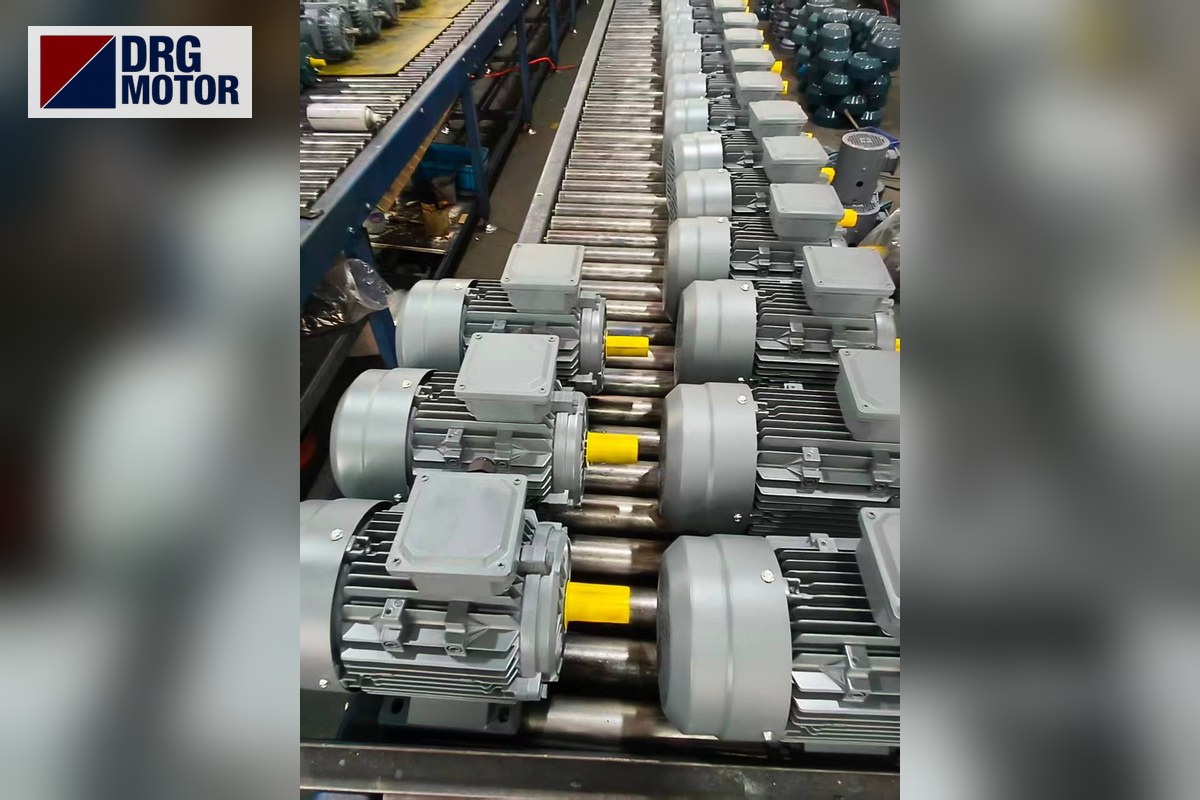

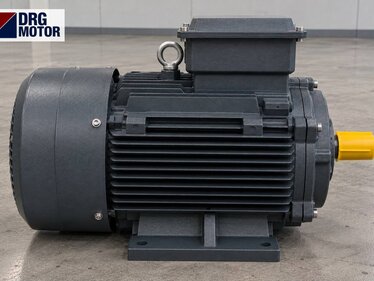
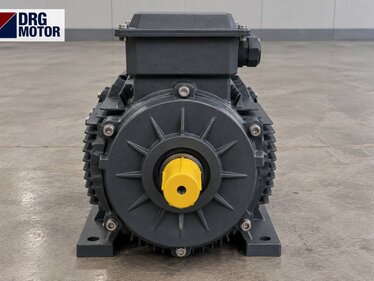
A compact motor is an electric motor that delivers a given power in one IEC frame size smaller than standard. For example, an 11 kW, 1500 rpm motor normally comes in a 160M frame; the compact DRG-132M-4K delivers the same 11 kW in a 132M frame: shaft height 132 instead of 160 mm, length 476 instead of 608 mm, while the current at 400 V is still 20.4 A and the torque still 71.7 Nm. In short, the electrical values are the same as a standard motor of the same power; the outside dimensions are one frame smaller.
This difference helps in two situations: when space for the motor inside the machine is tight, or when you want to increase power by one step without changing the existing frame. In the opposite direction it needs care: if you fit a compact motor in place of an old standard one, the foot, shaft and flange dimensions will not match. Three of the 120 models in our online store are compact (on the Buy Electric Motors Online page they are marked by the letter K at the end of the code); below we compare all three with their standard counterparts, dimension by dimension.
What compact means: the "one frame smaller" rule
In the IEC standard each motor frame is named after its shaft height (H): 90, 100, 112, 132, 160… The foot holes, shaft diameter and flange dimensions are tied to this number, so motors from different builders can replace one another. In the standard allocation each power and pole number falls into a given frame: 4-pole 5.5 kW into 132S, 4-pole 11 kW into 160M, and so on.
A compact motor shifts this allocation by one step: the same power is fitted into the frame below. The outside dimensions are the standard dimensions of that lower frame, so a compact 132M motor has the same feet, shaft and flange as a standard 7.5 kW 132M motor. In the DRG product code this is shown by the final letter K: DRG-132M-4K = 132M frame, 4-pole, compact.
- DRG-90L-2K: 3 kW, 3000 rpm — standard frame 100L
- DRG-112M-4K: 5.5 kW, 1500 rpm — standard frame 132S
- DRG-132M-4K: 11 kW, 1500 rpm — standard frame 160M
Compact versus standard at the same power: dimension by dimension
All values in the table are taken from the data sheets. In each pair the upper row is the compact model and the lower row the standard model of the same power and speed.
| Model | Type | kW | Frame | H (mm) | Shaft D×E (mm) | Feet A×B (mm) | Length L (mm) | Current 400 V (A) | Torque (Nm) |
|---|---|---|---|---|---|---|---|---|---|
| DRG-90L-2K | compact | 3 | 90L | 90 | 24×50 | 140×125 | 361 | 5.71 | 9.9 |
| DRG-100L-2 | standard | 3 | 100L | 100 | 28×60 | 160×140 | 406 | 5.71 | 9.9 |
| DRG-112M-4K | compact | 5.5 | 112M | 112 | 28×60 | 190×140 | 394 | 10.7 | 36 |
| DRG-132S-4 | standard | 5.5 | 132S | 132 | 38×80 | 216×140 | 438 | 10.7 | 36 |
| DRG-132M-4K | compact | 11 | 132M | 132 | 38×80 | 216×178 | 476 | 20.4 | 71.7 |
| DRG-160M-4 | standard | 11 | 160M | 160 | 42×110 | 254×210 | 608 | 20.4 | 71.7 |
Three concrete conclusions from the table:
- Electrical values are identical: in each pair current and torque are exactly the same. Overload setting, cable and contactor are chosen by power and do not change with the frame.
- Height and length shrink: at 11 kW the shaft height drops by 28 mm and the length by 132 mm; at 5.5 kW height by 20 mm and length by 44 mm; at 3 kW height by 10 mm and length by 45 mm.
- The shaft gets thinner: at 11 kW 38×80 instead of 42×110, at 5.5 kW 28×60 instead of 38×80, at 3 kW 24×50 instead of 28×60 mm. Pulley and coupling hubs must be chosen accordingly.
Checking by calculation: are torque and power consistent?
Shaft power is P = T · n / 9550. For the DRG-132M-4K: 71.7 Nm × 1465 rpm / 9550 ≈ 11.0 kW. So the smaller frame does not compromise the rated power; it gives the same torque at the same speed. The difference is that this power is carried by less surface and a shorter rotor stack, which brings heat to the fore (see below).
One step more power in the same frame
The most practical use of a compact motor is to replace the existing motor on a machine with a more powerful one in the same frame. The compact model has exactly the same outside dimensions as the standard model of the same frame; the foot holes, shaft and flange do not change. For example, if the 7.5 kW DRG-132M-4 is not enough, the DRG-132M-4K sits on the same base and the same pulley as an 11 kW motor.
| Frame | Standard model | Compact model | Power (kW) | Current 400 V (A) | Torque (Nm) | Example cable (mm²) |
|---|---|---|---|---|---|---|
| 90L | DRG-90L-2 | DRG-90L-2K | 2.2 → 3 | 4.35 → 5.71 | 7.26 → 9.9 | 1.5 → 1.5 |
| 112M | DRG-112M-4 | DRG-112M-4K | 4 → 5.5 | 7.95 → 10.7 | 26.3 → 36 | 1.5 → 1.5 |
| 132M | DRG-132M-4 | DRG-132M-4K | 7.5 → 11 | 14.3 → 20.4 | 49.1 → 71.7 | 1.5 → 4 |
The mechanical dimensions stay the same but the electrical side changes. Because the current rises, the overload relay must be reset and the cable and contactor checked. The example cable sizes in the table come from the table of the cable size tool on our site (copper, PVC, about 30 °C, design current = rated current × 1.25): at 7.5 kW 14.3 × 1.25 ≈ 17.9 A → 1.5 mm²; at 11 kW 20.4 × 1.25 = 25.5 A, which exceeds the 25 A of 2.5 mm² → 4 mm². This is an example; line length, voltage drop and installation method must be calculated separately (motor cable size calculator, overload, fuse and contactor selection).
There is also the mechanical side of the machine: a stronger motor puts more torque on the belt, gearbox and couplings (on 132M from 49.1 Nm to 71.7 Nm). Check the rating of these parts before increasing power.
Which machines use compact motors?
A compact motor makes sense where dimensions come before power:
- Motors built into the machine body: on packaging, filling and cutting machines the motor is usually inside a cabinet or frame; a 20–30 mm difference in height decides whether the cover closes.
- Short centre distance on belt drives: a smaller frame lets the motor sit closer to the pulley.
- Portable and skid-mounted equipment: a shorter and lighter motor makes layout easier on mobile pumps, fans or mixers.
- Existing machines that need more power: one step more power without changing base, pulley or flange (table above).
- Builders designing a new machine: a builder who wants a smaller machine footprint picks the compact frame at the start and draws the frame around it.
On the other hand, for applications with very frequent starts, long running at low speed on a frequency inverter, or a hot and poorly ventilated location, a standard frame leaves a wider thermal margin; in those cases the standard frame is the more cautious choice.
Mounting compatibility when replacing an old motor
A compact motor is not a "direct" replacement for a standard motor of the same power. If you are replacing your existing standard motor with a compact one, check the following:
- Foot (B3) mounting: the foot hole spacing gets smaller (for example at 5.5 kW 190×140 instead of 216×140 mm) and the shaft height drops. You need new holes in the base and a spacer plate equal to the H difference (20 mm at 5.5 kW) to align the shaft axis.
- Shaft and pulley: because the shaft diameter is smaller, the existing pulley or coupling hub will not fit; a new hub or bush is required.
- Flange (B5) mounting: flange dimensions shrink with the frame and the gearbox or pump connection will not seat directly. The values below are from the B5 flange table.
| Power | Compact frame | Flange P / M / N (mm) | Standard frame | Flange P / M / N (mm) |
|---|---|---|---|---|
| 3 kW | 90L | 200 / 165 / 130 | 100L | 250 / 215 / 180 |
| 5.5 kW | 112M | 250 / 215 / 180 | 132S | 300 / 265 / 230 |
| 11 kW | 132M | 300 / 265 / 230 | 160M | 350 / 300 / 250 |
We covered flange adaptation using the 11 kW example in 11 kW flanged motor and the compact 132M. To compare dimensions frame by frame, use the technical drawings page.
Heating and ventilation: how to treat a compact motor
The same power in a smaller frame has to dissipate its losses through less surface. Anything that hinders cooling therefore raises the temperature faster than on a standard frame. Practical rules:
- Leave free space behind the fan cover for air intake; do not put the motor in a closed box without ventilation.
- Keep the fan cover grille and frame fins clean of dust, oil and fibre.
- Set the overload relay to the nameplate current; do not raise it "just to be safe".
- In stop-start duty the starting current adds heat: for the DRG-132M-4K, 20.4 A × 7.7 ≈ 157 A.
- If the motor will run for long periods at low speed on a frequency inverter, its own fan also slows down; ask us about this use before ordering.
Compact motor ordering checklist
- Have the height, length and width of the motor space in the machine been measured?
- Have the mounting type (B3 foot, B5 flange, B35) and flange size been determined?
- Do the shaft diameter and length fit the pulley or coupling hub?
- If power is increased in the same frame, have the overload, cable and contactor been checked for the new current?
- Can the belt, gearbox and coupling carry the higher torque?
- Is there space around the motor for cooling air?
Motors in this power range
- DRG-90L-2K – 3 kW – 3000 rpm – 90L cast iron
- DRG-112M-4K – 5.5 kW – 1500 rpm – 112M aluminium
- DRG-132M-4K – 11 kW – 1500 rpm – 132M aluminium
- DRG-112M-4 – 4 kW – 1500 rpm – 112M aluminium
- DRG-132M-4 – 7.5 kW – 1500 rpm – 132M aluminium
Click to see current prices and order these motors nowSEE PRICES →
For other standard-frame models see the 120 models in our online store, and compare currents in the motor current chart.
Frequently Asked Questions
What does compact motor mean?
It is a motor that delivers a given power in one IEC frame smaller than standard. For example, 11 kW at 1500 rpm is normally in a 160M frame; its compact version is in a 132M frame. Current and torque are the same, the outside dimensions are smaller.
Can a compact motor replace a standard motor?
Not directly: foot holes, shaft height, shaft diameter and flange are one frame smaller. A spacer plate, a new pulley hub or a flange adaptor is needed. It does, however, fit one-to-one in place of a lower-power standard motor of the same frame.
Does a compact motor run hotter?
Since the same power is cooled through a smaller surface, it is more sensitive to cooling conditions. With a clean fan cover, good air around it and a correctly set overload, it runs at rated power; for frequent starts and long low-speed inverter operation a standard frame is the more cautious choice.
What does the letter K in a DRG code mean?
It marks the compact model. DRG-112M-4K = 112M frame, 4-pole, compact (5.5 kW). The same frame without K, DRG-112M-4, is a 4 kW standard motor.
Send us the dimensions of the motor space in your machine and the old motor's nameplate, and we will decide together whether compact or standard is needed: phone +90 (542) 666 11 11, e-mail [email protected], contact page.