English
 Le français
 Türkçe




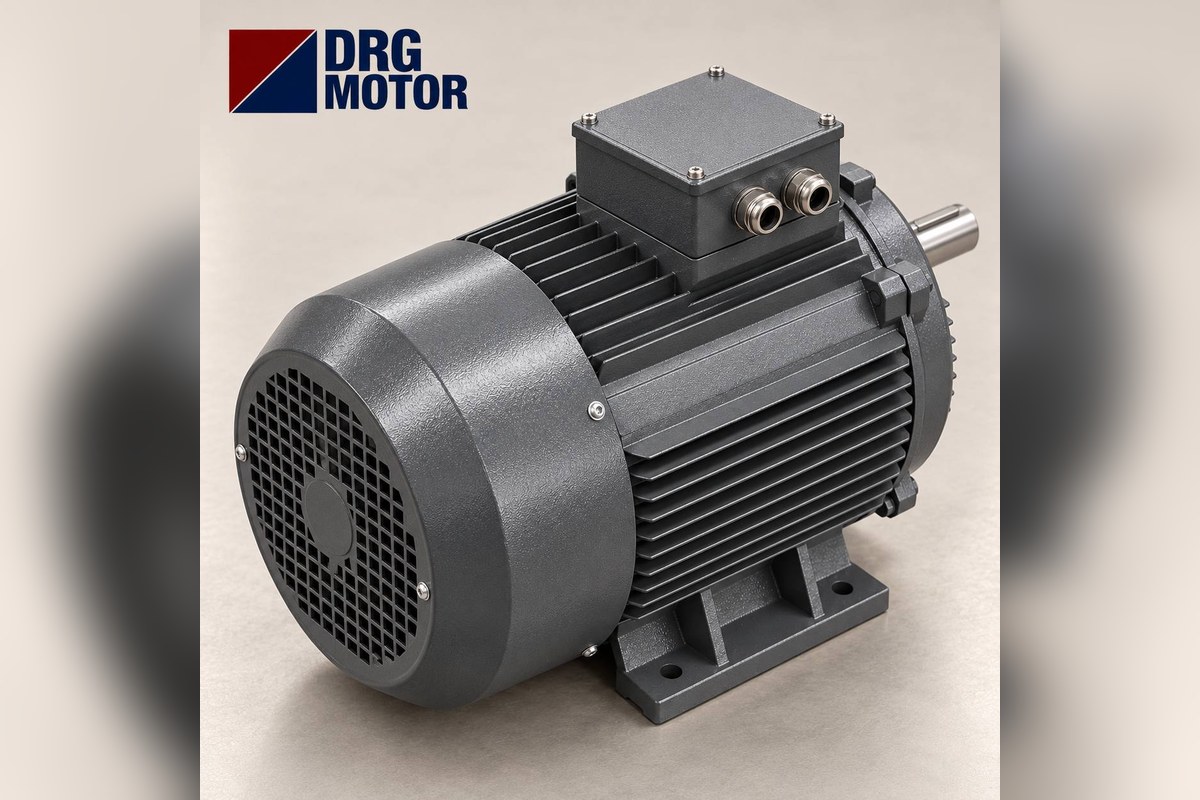

Yes, a three-phase induction motor can replace a DC motor; but the DC motor’s job is taken over not by the motor alone but by the pair induction motor + vector-controlled frequency inverter. The right match is made not by the DC motor’s power but by the required torque and speed range: torque comes from T = 9550 × P / n, and the induction motor is chosen to deliver that torque at base speed. If full torque is needed at very low speed, an encoder is added; if it runs long at low speed, a forced-ventilation fan is added.
Removing the old DC drive and connecting the new inverter and motor cable is live electrical work; it must be done by a qualified electrician after the supply has been isolated and locked off. Once the calculation points to a model, you can see the options among the 120 on our Buy Electric Motors Online page.
A general comparison of the two motor types is in our article AC vs DC motor selection. Here the subject is what to match, and how, when you remove the DC motor from a running machine and fit an induction motor.
What job was the DC motor doing on this machine?
Shunt or separately excited DC motors were chosen for extruders, winders and unwinders, calenders, rolling mills, printing machines, test benches and old lifts for two features: a wide speed range and full torque at low speed. As armature voltage rises, speed increases up to base speed, with constant torque in this range. Above base speed the field (excitation) current is reduced; here power is constant and torque falls.
The reasons forcing the change today are clear: commutator and brush wear, brush dust, commutator maintenance cost, difficulty finding a spare armature, and no more spare boards for old analogue DC drives. A squirrel-cage induction motor has no brushes or commutator; maintenance comes down to bearings and cleaning.
| Speed range | On a DC motor | Induction motor + VFD |
|---|---|---|
| 0 to base speed | By armature voltage | By frequency, constant torque |
| Very low speed | Full torque, tacho | Vector control + encoder |
| Above base speed | Field weakening | Above 50 Hz, torque ≈ 50/f |
| Braking / regeneration | 4-quadrant drive | Brake resistor or regen unit |
The 3 most common mistakes
- Looking only at kW. Fitting a 15 kW, 3000 rpm induction motor in place of a 15 kW, 1500 rpm DC motor halves the torque at low speed. Matching is done on torque.
- Using an ordinary V/f inverter. Below a few hertz, V/f control does not give full torque. To do what the DC motor did at low speed, vector control (closed loop with an encoder if needed) is required; the difference is explained in V/f vs vector control.
- Forgetting cooling. Large DC motors often have a separate blower; an induction motor’s fan sits on its shaft. If it runs near rated torque at low speed for long periods, a forced-ventilation fan is essential.
Click to see current electric motor prices and order nowSEE PRICES →
How are power and torque matched?
Take three values from the DC motor nameplate: power (kW), base speed (speed at rated armature voltage) and, if given, top speed (with field weakening). Required torque is T = 9550 × P / n. The induction motor is chosen from the synchronous speed closest to base speed (1500 or 1000 rpm) with a rated torque equal to or above this value.
| DC motor (power / base speed) | Required torque | DRG model | Rated torque |
|---|---|---|---|
| 7.5 kW / 1500 rpm | ≈ 47.8 Nm | DRG-132M-4 | 49.1 Nm |
| 15 kW / 1500 rpm | ≈ 95.5 Nm | DRG-160L-4 | 97.8 Nm |
| 30 kW / 1500 rpm | ≈ 191 Nm | DRG-200L-4 | 194.2 Nm |
| 22 kW / 1000 rpm | ≈ 210.1 Nm | DRG-200L2-6 | 214.4 Nm |
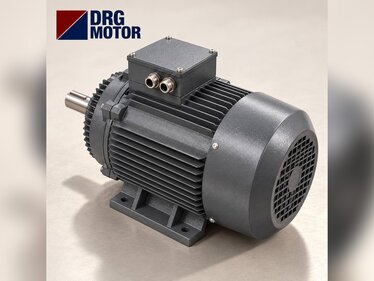
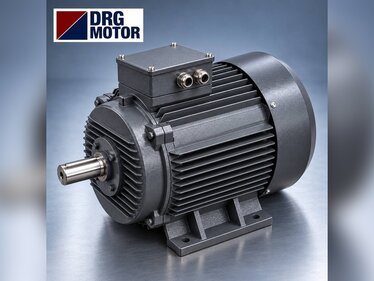
In every row, the DRG model’s rated torque is slightly above the DC motor’s torque at base speed. For example, a 15 kW, 1500 rpm DC motor gives 9550 × 15 / 1500 ≈ 95.5 Nm; DRG-160L-4 meets this with 97.8 Nm rated torque, 1465 rpm rated speed and 27.3 A at 400 V.
The 2-pole DRG-160M2-2 of the same power gives only 48.6 Nm: to run at 1500 rpm the inverter drops it to half frequency and the motor delivers half the torque needed. The pole number must follow the DC motor’s base speed.
Is the motor enough at both ends of the speed range?
Above base speed: the field-weakening range
If the DC motor goes above 1500 rpm by field weakening, say to 2200 rpm, power stays constant in that range and the required torque drops to 9550 × 15 / 2200 ≈ 65.1 Nm. An induction motor behaves similarly above 50 Hz: available torque falls roughly by 50/f. A 4-pole motor runs at about 75 Hz for 2200 rpm; available torque is 97.8 × 50 / 75 ≈ 65.2 Nm. Result: in this example the 4-pole motor is right at the limit. If more speed is needed, either choose one power size larger or change the mechanical ratio (pulley); the high-speed limit of bearings and rotor must always be confirmed with the manufacturer.
You can try the frequency, speed and torque relationship with your own values in the VFD frequency, torque and power calculator.
Torque at very low speed: encoder and forced ventilation
Machines such as extruders or winders need full torque even at very low speeds like 100 rpm. For a 4-pole motor that means about 3.3 Hz. Sensorless vector control reaches this range in many applications; but holding torque at zero speed, positioning or precise speed calls for closed loop with an encoder. The encoder is usually mounted on the rear of the motor with an adapter, so ask about encoder and forced-ventilation mounting before ordering.
At low speed torque stays constant, so motor current is close to rated, but the shaft-mounted fan turns slowly. At 100 rpm, 95.5 Nm delivers only 95.5 × 100 / 9550 ≈ 1 kW to the shaft, while heat inside the motor is close to that at rated load. If this operation lasts long, a separately supplied forced-ventilation fan should be fitted on the rear cover and winding temperature monitored with PTC sensors.
What changes in the drive, cabling and braking?
- The DC drive (thyristor bridge) is removed and replaced with a vector-controlled inverter matching the motor current. For the 15 kW example, inverter output current must not be below 27.3 A.
- Instead of the DC motor’s two armature and two field cables, a shielded 3-phase + PE motor cable is run; size it for the new current with the motor cable size calculator.
- Tacho-generator feedback is replaced by an encoder; the speed reference (0–10 V or 4–20 mA) moves to the inverter’s analogue input.
- If the DC drive worked in 4 quadrants and returned energy to the grid (winders, lifts, fast stops), a brake resistor or regenerative unit is added to the inverter; see inverter dynamic braking and brake resistor.
- A 400/690 V motor is connected in delta (Δ) to a 400 V inverter.
Mechanical mounting differences
DC motor dimensions are often not the same as IEC induction motor dimensions: shaft height, shaft diameter, flange and foot holes may differ, and a DC motor is usually longer than an induction motor of the same power. So take the shaft height H, shaft D × E, foot hole spacing or flange size from the old motor and compare them with the new model. Values of the example model:
- Power: 15 kW
- Rated speed: 1465 rpm
- Frame: 160L cast iron
- Current 400 V: 27.3 A
- cos φ: 0.86
- Rated torque: 97.8 Nm
- Shaft D × E: 42 × 110 mm
- Shaft height H: 160 mm
If dimensions differ, the solution is usually an adapter plate, an intermediate flange or a new coupling. Dimensions of all frames are on the DRG technical drawings page.
Replacement checklist
- Power, armature voltage and current, field voltage, base speed and top speed on the DC nameplate are photographed.
- The machine’s minimum and maximum operating speed and the torque needed at those speeds are noted.
- Required torque is calculated with T = 9550 × P / n; the pole number is chosen from the base speed.
- Daily running time at low speed is known; forced ventilation and PTC decided.
- The need for an encoder (torque at zero speed, positioning, precise speed) is clarified.
- Braking and regeneration needs are noted; a brake resistor or regenerative unit is planned.
- H, D × E, foot and flange dimensions are compared; adapter and coupling needs identified.
- Removal of the old DC drive and the new connection are given to a qualified electrician.
On the purchasing side, a few facts are enough: DRG Motor is an electric motor manufacturer, supplier and seller; product codes follow the DRG-frame-poles pattern (e.g. DRG-160L-4). DRG MOTOR motors are guaranteed against material and manufacturing defects for 2 years from the delivery date (warranty certificate). Shipping is by contracted freight or courier companies and is paid by the buyer; details are on the sales, delivery and return terms page. Periodic instalment campaigns may be available with Halköde; message us on WhatsApp for the current option (payment options).
DRG motors to consider instead of a DC motor
- DRG-132M-4 – 7.5 kW – 1460 rpm – 132M cast iron
- DRG-160L-4 – 15 kW – 1465 rpm – 160L cast iron
- DRG-200L-4 – 30 kW – 1475 rpm – 200L cast iron
- DRG-200L2-6 – 22 kW – 980 rpm – 200L cast iron
- DRG-160M2-2 – 15 kW – 2945 rpm – 160M cast iron
Click to see current prices and order these motors nowSEE PRICES →
Frequently Asked Questions
Which AC motor replaces a DC motor?
A three-phase induction motor that delivers the base-speed torque, with the synchronous speed closest to the base speed, together with a vector-controlled inverter. For a 15 kW, 1500 rpm DC motor, a 4-pole 15 kW motor (97.8 Nm) fits.
Can the DC drive run an induction motor?
No. A DC drive produces direct voltage; an induction motor needs a frequency inverter supplying variable-frequency three-phase voltage.
Does an induction motor give as much torque as a DC motor at low speed?
With a vector-controlled inverter, yes; for full torque near zero speed and precise speed, closed loop with an encoder is used. Long periods at low speed require forced ventilation.
Does converting a DC motor to an AC motor reduce maintenance?
Yes; a squirrel-cage induction motor has no commutator or brushes, so brush changes, commutator skimming and brush-dust cleaning disappear.
To narrow down the model together, send a photo of the old nameplate and your measurements via WhatsApp to +90 (542) 666 11 11 or to [email protected]; other channels are on our contact page. For current prices of all models, visit Buy Electric Motors Online.