English
 Le français
 Türkçe




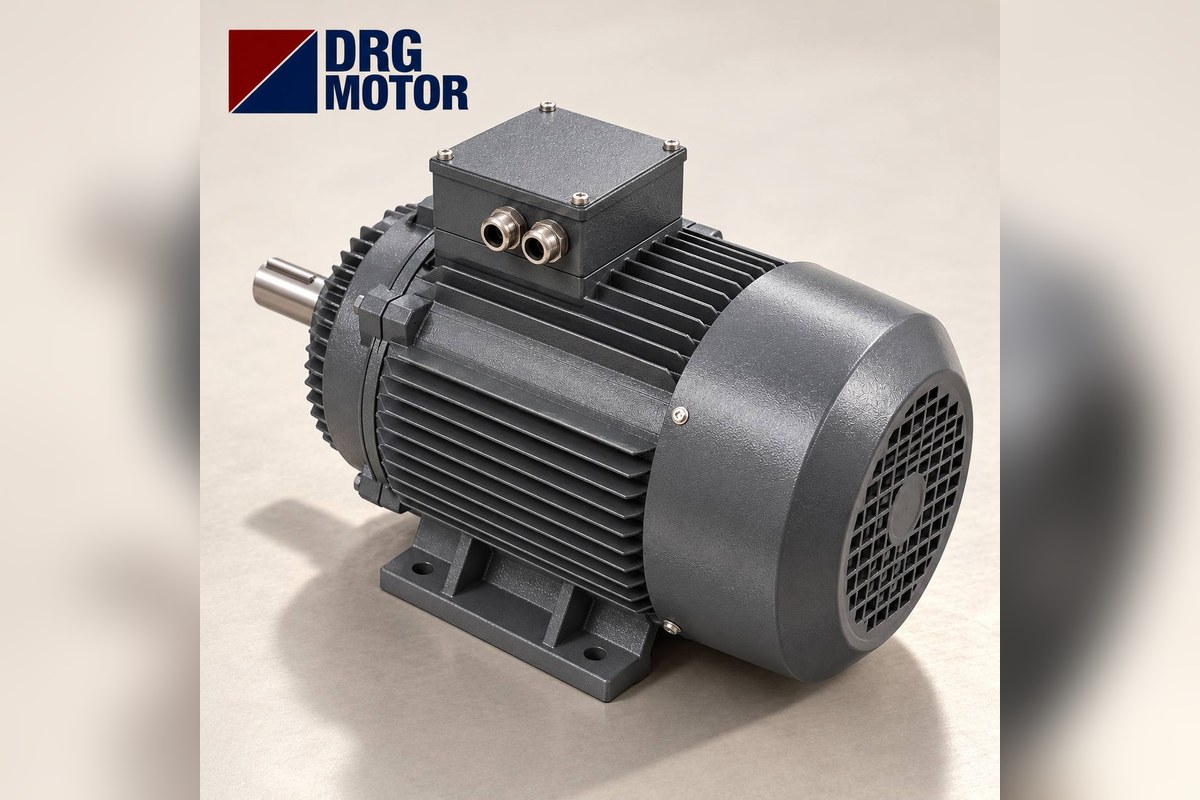

The old motor’s pulley can be used on the new motor, but only if three conditions are met together: the pulley bore must suit the new motor’s shaft diameter and key width, the pulley hub must sit far enough along the shaft, and the pulley diameter must not overload the new motor’s shaft and bearing. For example, if the old motor is frame 90L its shaft is 24 mm; if it is replaced by a 112M-frame motor the shaft becomes 28 mm and the old pulley’s bore will not go onto the new shaft. As both shafts have the same key width (8 mm), the pulley bore can be enlarged and reused; the reverse, fitting a large-bore pulley on a smaller shaft, is not correct.
A pulley is often a sound part and reusing it makes sense; but if the shaft size changed with the motor, the pulley becomes a part that “has to be made compatible”. Removing and fitting the pulley must be done after the motor supply has been switched off and locked out; the motor’s electrical connection must be made by a qualified electrician.
DRG Motor is a manufacturer, supplier and seller of electric motors. Each model’s shaft diameter and length are shown on its product page; you can choose the motor with the shaft size that suits your pulley among the 120 models on our Buy Electric Motors Online page. The full list of shaft diameters by frame is in our motor shaft diameter by kW table article; here we focus on adapting the pulley to the new shaft and checking the load.
The 3 most common mistakes when refitting an old pulley
1. Fitting a large-bore pulley to a smaller shaft with a sleeve or shim
Filling a pulley bore that is too large for the shaft with thin shim or a home-made sleeve throws the pulley off centre. The pulley runs out, the belt vibrates, and the shaft and keyway wear over time. If the shaft diameter has become smaller, use a new pulley or a taper-bush pulley of the right size.
2. Taking the key from the old motor
Key width can change with shaft diameter: in the DRG catalogue the key is 8 mm on a 28 mm shaft, 10 mm on a 38 mm shaft and 12 mm on a 42 mm shaft. Forcing the old key onto the new shaft or roughly widening the keyway spoils the key seating. Use the key supplied with the new motor; if the pulley keyway differs, have it machined to the new key.
3. Not pushing the pulley fully onto the shaft
The pulley hub should sit close to the shaft shoulder. If the pulley is left at the end of the shaft, the belt force acts far from the bearing and the load on the bearing rises. If the new motor’s shaft is shorter than the old one, part of the hub may overhang; in that case check pulley alignment and seating length again.
Shaft diameter and key compatibility: which shaft in which frame?
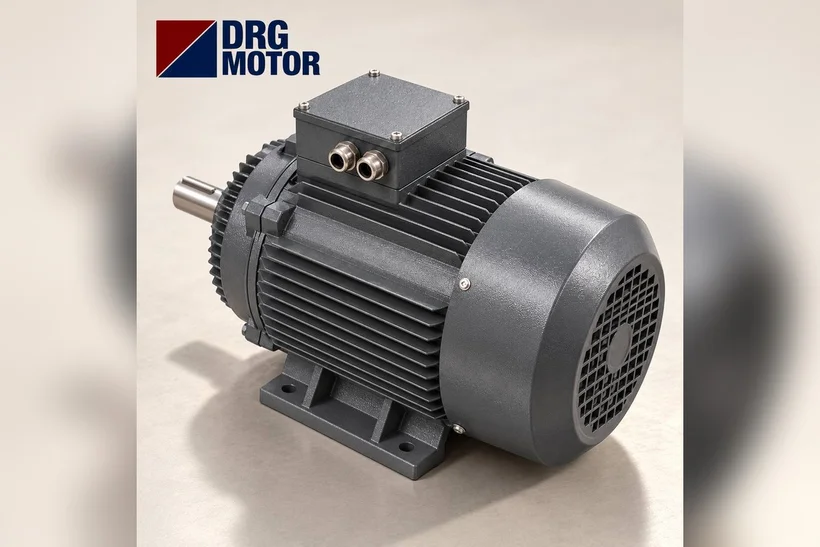
The first step in telling whether the pulley will fit the new motor is to set the shaft diameter (D), shaft length (E) and key width (F) of the old and new motors side by side. The values below are from the DRG catalogue:
| Frame | Shaft D×E (mm) | Key F (mm) | Bearing |
|---|---|---|---|
| 80 | 19×40 | 6 | 6204-ZZ-C3 |
| 90S / 90L | 24×50 | 8 | 6205-ZZ-C3 |
| 100L / 112M | 28×60 | 8 | 6206-ZZ-C3 |
| 132S / 132M | 38×80 | 10 | 6208-ZZ-C3 |
| 160M / 160L | 42×110 | 12 | 6309-C3 |
Practical rules from the table:
- Same shaft (e.g. moving from 100L to 112M, both 28×60 mm): the old pulley can be used directly; only alignment and seating are checked.
- Larger shaft (e.g. from 24 mm to 28 mm): the pulley bore can be enlarged, provided the hub has enough wall thickness. As the key is 8 mm on both 24 and 28 mm shafts, the keyway width stays the same and only its depth is re-machined.
- Shaft 10 mm larger (e.g. from 28 mm to 38 mm): the key also goes from 8 mm to 10 mm; on small pulleys the hub may not take this enlargement and a new pulley is needed.
- Smaller shaft: the old pulley should not be used; buy a taper-bush pulley or a new pulley.
Click to see current electric motor prices and order nowSEE PRICES →
When does a taper-bush (taper lock) pulley make life easier?
In a taper-bush pulley, the pulley body and the bush that grips the shaft are separate parts. The bush has a bore machined to the shaft diameter and a tapered outer surface; as the screws are tightened the bush is drawn into the pulley and grips the shaft firmly. Bushes with different bore diameters can be fitted into the same pulley body.
The advantage in a motor change is obvious: when the shaft changes from 24 mm to 28 mm or from 28 mm to 38 mm, it may be enough to change only the bush, not the pulley. The condition is that the pulley body accepts a bush size that can take the new shaft diameter; the bush size is marked on the pulley or in its maker’s table. Taper-bush pulleys also use a key, and its width must suit the new shaft.
On plain-bore pulleys (bored directly in the pulley), the only options are to enlarge the bore or to replace the pulley. On drives where motors are changed often or swapped between machines, moving to taper-bush pulleys makes things easier in the long run.
How does pulley diameter change shaft load? The F = 2T/d calculation
The belt pulls at the circumference of the pulley. Motor torque T (Nm) and pulley diameter d (m) are related as follows:
F = 2 × T / d
Here F is the tangential force transmitted by the belt (N). The smaller the pulley, the greater the force needed to transmit the same torque. The actual radial load on the shaft end is even greater, because the belt is pre-tensioned so that it can pull without slipping; this tension factor depends on belt type and is the belt maker’s data.
Example: the rated torque of DRG-112M-4 (4 kW, 1450 rpm) is 26.3 Nm.
- With a 100 mm pulley: F = 2 × 26.3 / 0.1 ≈ 526 N
- With an 80 mm pulley: F = 2 × 26.3 / 0.08 ≈ 658 N
- With a 125 mm pulley: F = 2 × 26.3 / 0.125 ≈ 421 N
If the old motor ran with a 125 mm pulley and an 80 mm pulley is fitted to the new motor for lack of space, the tangential force rises about 1.6 times. This extra load strains the shaft end and the drive-end bearing. As a rule, do not reduce the old pulley’s diameter; if the diameter has to change, change the driven pulley in the same proportion to keep the ratio. The same calculation for the 7.5 kW DRG-132M-4 (49.1 Nm) gives about 786 N with a 125 mm pulley and 982 N with a 100 mm pulley.
Check speed and belt speed too
The rated speeds of the old and new motors may differ by a few rpm. The driven shaft speed is n2 = n1 × d1 / d2. With a 1450 rpm motor, a 100 mm motor pulley and a 200 mm machine pulley, the machine shaft turns at 725 rpm. You can use our pulley and belt calculator for the same calculation. Belt speed is v = π × d × n / 60: about 7.6 m/s for a 100 mm pulley at 1450 rpm and about 6.1 m/s for an 80 mm pulley. As belt speed drops, the force needed to transmit the same power increases.
Pulley alignment and belt tension: post-installation checks
If the new motor’s dimension C (from shaft shoulder to the first foot hole) differs from the old motor’s, the pulley face shifts along the axis even if the motor is bolted into the same holes. In the DRG catalogue C is 70 mm on frame 112M and 89 mm on frames 132S and 132M. This difference stops the pulleys sitting in the same plane.
- Check that the pulleys are in one plane by laying a straight edge or a taut string across their side faces.
- The motor pulley and machine pulley axes must be parallel; angled axes wear the belt edges.
- Tension the belt with the slide rail; adjust with the rail screw, not by pushing the motor by hand.
- Set tension to the deflection value recommended by the belt maker; over-tension shortens bearing life.
- The belt beds in after the first few hours of running; re-check the tension.
Checklist for a changeover with the old pulley
- Have shaft diameter D, shaft length E and key width F of the old and new motors been measured?
- Does the pulley bore suit the new shaft; if it is to be enlarged, is there enough wall in the hub?
- If it is a taper-bush pulley, is a bush available for the new shaft diameter?
- Is the key supplied with the new motor being used?
- Does the pulley hub sit close to the shaft shoulder, along the full shaft length?
- Is the pulley diameter the same as before; if smaller, has the load been checked with F = 2T/d?
- Are the pulleys in one plane with parallel axes?
- Has belt tension been set and a re-check planned after the first run?
Models commonly used on belt drives
4-pole (1500 rpm) motors are common on belt-and-pulley machines. The cast-iron models below show different shaft diameters; compare them with your pulley bore:
| Model | Power / speed | Frame | Current 400 V |
|---|---|---|---|
| DRG-90L-4 | 1.5 kW / 1445 rpm | 90L cast iron | 3.3 A |
| DRG-100L2-4 | 3 kW / 1450 rpm | 100L cast iron | 6.02 A |
| DRG-112M-4 | 4 kW / 1450 rpm | 112M cast iron | 7.95 A |
| DRG-132M-4 | 7.5 kW / 1460 rpm | 132M cast iron | 14.3 A |
| DRG-160M-4 | 11 kW / 1465 rpm | 160M cast iron | 20.4 A |
- DRG-90L-4 – 1.5 kW – 1445 rpm – 90L cast iron
- DRG-100L2-4 – 3 kW – 1450 rpm – 100L cast iron
- DRG-112M-4 – 4 kW – 1450 rpm – 112M cast iron
- DRG-132M-4 – 7.5 kW – 1460 rpm – 132M cast iron
- DRG-160M-4 – 11 kW – 1465 rpm – 160M cast iron
Click to see current prices and order these motors nowSEE PRICES →
Frequently Asked Questions
Can a motor pulley bore be enlarged?
Yes, if the hub has enough wall thickness; the bore is turned to the new shaft diameter and the keyway is cut to the new key. A bore cannot be made smaller; a smaller shaft needs a new pulley or a suitable taper bush.
What is the shaft diameter of a 4 kW motor?
In the DRG catalogue the 4 kW 1500 rpm DRG-112M-4 and the 4 kW 3000 rpm DRG-112M-2 have a 28×60 mm shaft with an 8 mm key. The 4 kW 1000 rpm DRG-132M1-6 has a 38×80 mm shaft.
Why does a small pulley strain the motor?
The belt force needed to transmit the same torque, F = 2T/d, increases as the pulley diameter gets smaller. This force acts as a radial load on the shaft end and the bearing.
What is a taper lock pulley?
A pulley in which the pulley body and the tapered bush that grips the shaft are separate parts. When the shaft diameter changes, changing only the bush is often enough.
You can send the shaft and pulley dimensions of your old motor to +90 (542) 666 11 11 or [email protected]; all channels are on our contact page. For current models by shaft size, see the 120 models in our online store.