English
 Le français
 Türkçe




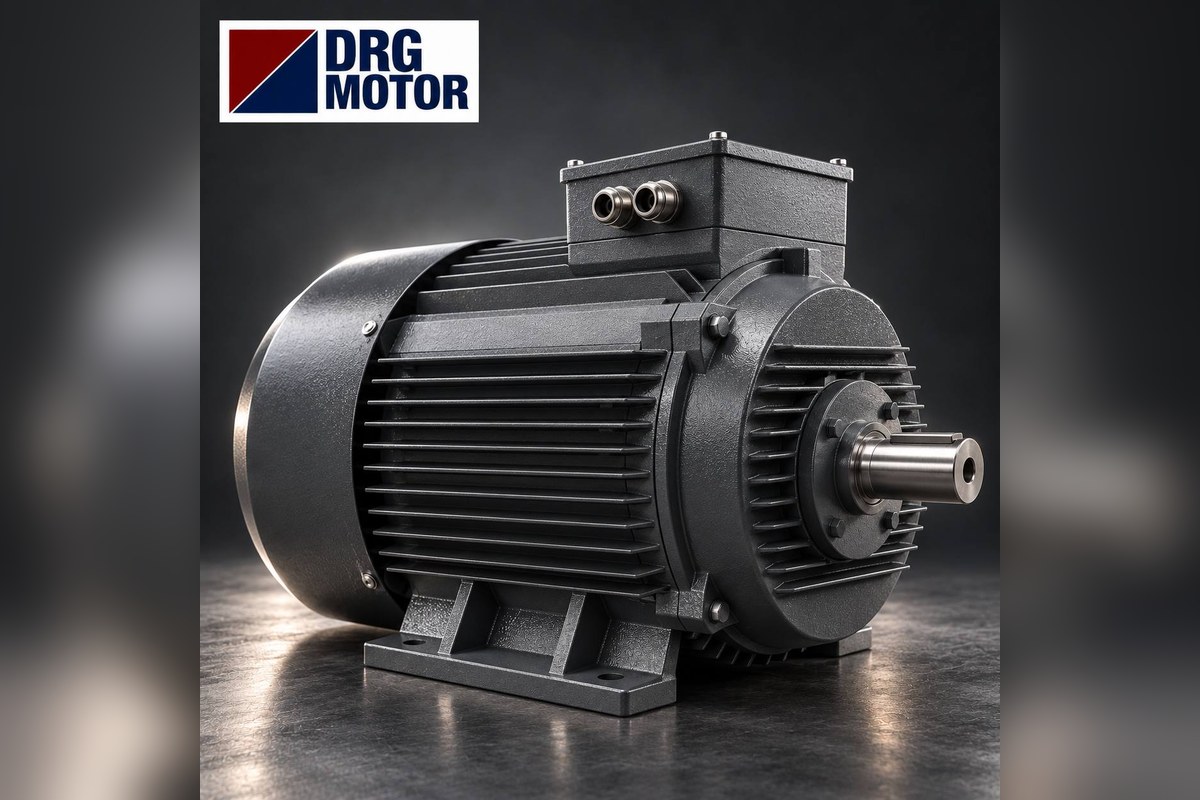

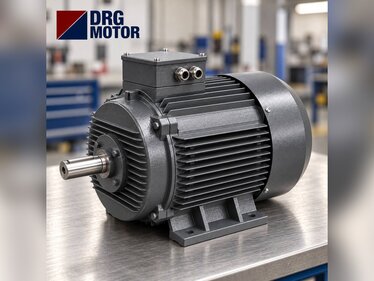
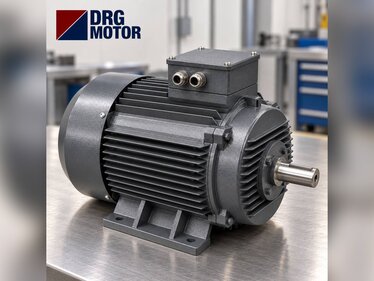
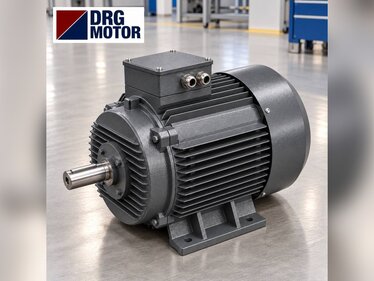
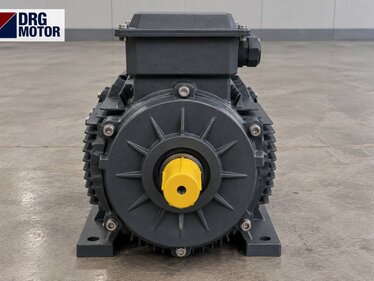
When buying a vertical pump motor you check two things: that the motor is suitable for running suspended from its flange with the shaft pointing down (V1), and whether its drive-end bearing can carry the axial load the pump puts on the shaft — the impeller and rotor weight plus hydraulic thrust. If the flange dimensions (P / M / N), shaft diameter and key match the old motor and the pump maker does not ask for a specific axial load capacity, then on a 7.5 kW 2-pole vertical multistage pump, for example, a DRG-132S2-2 (B5 flange 300 / 265 / 230 mm, shaft 38 × 80 mm, bearing 6208-ZZ-C3) replaces the old motor.
The difference from a horizontal motor is that, in the vertical position, gravity and pump thrust act along the same line, directly on the bearing. So "same kW, same speed" is not a sufficient description for a vertical pump; the mounting code, the position of the drain holes and protection of the fan cover from above must also be written into the order. Connection and rotation check must be done by a qualified electrician. You can find suitable frames and current prices among the 120 models on the Buy Electric Motors Online page.
The 3 most common mistakes with vertical pump motors
- Adapting a B3 foot-mounted motor to a vertical bell housing: A foot motor’s end shield has no spigot (N); held to the bell housing by bolts alone, the shaft runs off-centre and the pump seal soon leaks.
- Leaving the drain holes in the wrong place: Condensation drain holes at the bottom of a horizontal motor end up on the side when vertical; water collecting inside reaches the winding and bearing.
- Not asking about the pump’s axial load: Vertical multistage pumps may have no bearing of their own, so the motor bearing carries all the thrust. If the pump nameplate or catalogue states an axial load requirement, the motor choice must be confirmed against it.
V1, V3, V18: what does the vertical mounting code tell you?
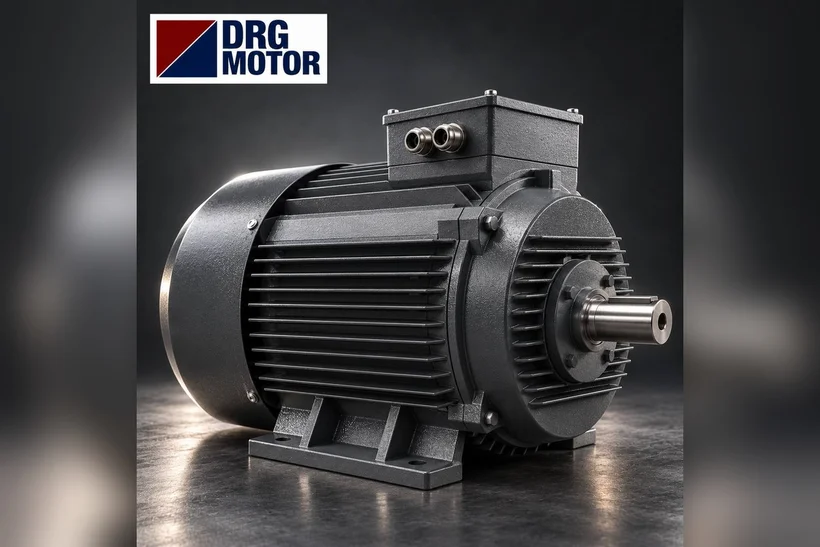
The "V" in the IEC mounting code means the motor runs vertically; the number says which way the shaft points and how the motor is held. Most vertical pumps use the V1 arrangement: the motor sits on the pump’s bell housing by its large flange (B5), the shaft points down and drives the pump shaft through a coupling.
| Code | Shaft direction | Mounting | Typical use |
|---|---|---|---|
| V1 | Down | B5 large flange | Vertical inline / multistage |
| V3 | Up | B5 large flange | Drive from above |
| V18 | Down | B14 small flange | Small vertical pump, mixer |
| V5 | Down | Feet (wall) | Wall-mounted vertical drive |
V1 and V3 differ not only in shaft direction. In V1 the rotor weight pulls the drive-end bearing downwards, in the same direction as the pump thrust; in V3 the rotor weight loads the bearing the other way. The V18 arrangement with a small B14 flange is mostly found at low power; since B14 flange dimensions are not in the catalogue, they must be measured on the old motor and confirmed. For bearing lubrication and grease behaviour in vertical mounting see our article on horizontal vs vertical motor mounting; here the subject is compatibility at the time of purchase.
Where does the axial load come from, and can the motor bearing carry it?
On a vertical pump three forces act along the same line on the motor’s drive-end bearing: the rotor’s own weight, the weight of the pump shaft and impellers (with a rigid coupling), and hydraulic thrust from the pressure difference across the impeller faces. A rough estimate of hydraulic thrust uses:
F ≈ Δp × A (F: thrust, N; Δp: pressure difference across the impeller, N/mm²; A: unbalanced effective area, mm²)
An assumed example: with Δp = 10 bar (= 1 N/mm²) and an unbalanced effective diameter of 40 mm, A = π × 40² / 4 ≈ 1257 mm² and F ≈ 1257 N, about 1.26 kN. At the same pressure with a 60 mm effective diameter, the area becomes 2.25 times larger: A ≈ 2827 mm², F ≈ 2827 N (about 2.83 kN). Thrust therefore grows with the square of the diameter; as the number of stages and the discharge pressure rise, the load on the motor bearing rises quickly. This calculation only gives an order of magnitude; the real value depends on balancing holes, stage design and the operating point, and must come from the pump maker’s data.
Practical conclusion: if the pump catalogue says a standard bearing is sufficient, a standard motor is used; if there is a specific axial load or a reinforced/angular-contact bearing requirement, send us that value before ordering and have it confirmed on the motor side. For the relationship between bearing end-float and bearing load see our article on motor axial end-float.
Click to see current electric motor prices and order nowSEE PRICES →
Flange and shaft size: which frame fits which bell housing?
A vertical pump bell housing centres the motor on its spigot (N), bolts it on the pitch circle (M), and the outside diameter (P) must fit the housing. Values from the DRG catalogue for the 2-pole frames common on vertical pumps:
| Frame | Flange P / M / N | Shaft D × E | Bearing (drive end) |
|---|---|---|---|
| 100L | 250 / 215 / 180 mm | 28 × 60 mm | 6206-ZZ-C3 |
| 112M | 250 / 215 / 180 mm | 28 × 60 mm | 6206-ZZ-C3 |
| 132S | 300 / 265 / 230 mm | 38 × 80 mm | 6208-ZZ-C3 |
| 160M | 350 / 300 / 250 mm | 42 × 110 mm | 6309-C3 |
As the table shows, 100L and 112M share the same flange and shaft and also the same bearing (6206-ZZ-C3). At 132S the flange grows to 300 mm and the shaft to 38 mm; at 160M the flange is 350 mm, the shaft 42 × 110 mm and the bearing 6309-C3. If you want to move the pump to a higher power, the bell housing and coupling hub may have to change too. All dimensions, including spigot length (T) and flange thickness (LA), are on the technical drawings page.
Drain holes, rain canopy and cable entry
In the V1 position the motor’s fan cover faces upwards. At an outdoor pump station, rain, condensation drips or water leaking from a pipe above fall straight through the fan cover grille. For this reason a rain canopy (roof-type protection) over the fan cover is common practice on outdoor vertical pump motors; state when ordering that the motor will run vertically outdoors.
- Drain holes: must be at the lowest point of the housing. In V1 the lowest point is the flange end; confirm the hole position when ordering and check after installation that they are not blocked.
- Cable entry: the gland on the terminal box should face down or sideways, and the cable should enter with a drip loop. An upward-facing gland collects water.
- Fan air: leave an air gap between the rain canopy and the fan cover; resting the canopy on the grille makes the motor run hot.
- Terminal box orientation: on vertical bell housings, check that the box does not hit the pump pipework or the bell housing bolts.
Pre-order checklist
- Old motor nameplate: kW, speed, voltage, current, mounting code (V1, V18, etc.).
- Flange type: large flange (B5, clearance holes) or small flange (B14, tapped holes)?
- Flange dimensions: P, M, N and number/diameter of holes; measure with a caliper.
- Shaft diameter and length (D × E), key width; seating length of the coupling hub.
- Does the pump catalogue state an axial load or bearing requirement for the motor?
- Installation site: indoor room or outdoors (rain canopy needed)?
- Direction of rotation: arrow on the pump casing; brief check at first start.
- Overload setting to the new motor’s nameplate current; the overload, fuse and contactor selection tool helps.
Which DRG motor should you buy?
The most common powers on vertical multistage and inline pumps are 2-pole (3000 rpm) units of 3–15 kW. The models below have cast iron housings and IP55; the B5 flange version is specified in the order.
| Model | Power / speed | Frame | Current 400 V |
|---|---|---|---|
| DRG-100L-2 | 3 kW / 2895 rpm | 100L · cast iron | 5.71 A |
| DRG-112M-2 | 4 kW / 2905 rpm | 112M · cast iron | 7.45 A |
| DRG-132S1-2 | 5.5 kW / 2930 rpm | 132S · cast iron | 10.1 A |
| DRG-132S2-2 | 7.5 kW / 2930 rpm | 132S · cast iron | 13.7 A |
| DRG-160M1-2 | 11 kW / 2945 rpm | 160M · cast iron | 19.6 A |
| DRG-160M2-2 | 15 kW / 2945 rpm | 160M · cast iron | 26.5 A |
Technical summary of a common match for a 7.5 kW 2-pole vertical multistage pump:
- Power: 7.5 kW
- Rated speed: 2930 rpm
- Frame: 132S · cast iron
- Current 400 V: 13.7 A
- cos φ: 0.88
- Rated torque: 24.4 Nm
- Starting torque: 2 × Tn
- Starting current: 7.9 × In
- Shaft D × E: 38 × 80 mm
- B5 flange P / M / N: 300 / 265 / 230 mm
- Bearing (drive end): 6208-ZZ-C3
- Voltage: 400/690 V (Δ/Y)
DRG Motor is an electric motor manufacturer, supplier and seller; DRG MOTOR motors are guaranteed against material and manufacturing defects for 2 years from the delivery date (warranty certificate).
Motors in this power range
- DRG-100L-2 – 3 kW – 2895 rpm – 100L cast iron
- DRG-112M-2 – 4 kW – 2905 rpm – 112M cast iron
- DRG-132S1-2 – 5.5 kW – 2930 rpm – 132S cast iron
- DRG-132S2-2 – 7.5 kW – 2930 rpm – 132S cast iron
- DRG-160M1-2 – 11 kW – 2945 rpm – 160M cast iron
- DRG-160M2-2 – 15 kW – 2945 rpm – 160M cast iron
Click to see current prices and order these motors nowSEE PRICES →
Frequently Asked Questions
Is there a difference between a vertical pump motor and a normal motor?
Not electrically; the difference is mechanical. A vertical motor hangs from its flange, its bearing carries rotor weight and pump thrust together, and the drain holes and fan protection must suit the vertical position.
What does V1 motor mean?
V1 is the mounting arrangement in which a motor with a large B5 flange runs vertically with the shaft pointing down. Most vertical inline and multistage pumps use it.
How many amps does a 7.5 kW vertical pump motor draw?
The 2-pole DRG-132S2-2 draws 13.7 A at 400 V and 14.4 A at 380 V; set the overload relay to this value.
Is a rain canopy required on an outdoor vertical pump motor?
Because the fan cover faces up, a rain canopy is a common and recommended precaution outdoors. It must be spaced so that it does not block the fan’s air intake.
Send us the old motor’s nameplate, flange dimensions and the pump’s axial load requirement, and we will confirm the right DRG model with you. Phone +90 (542) 666 11 11, e-mail [email protected], contact page. For all models and current prices, see Buy Electric Motors Online.