English
 Le français
 Türkçe




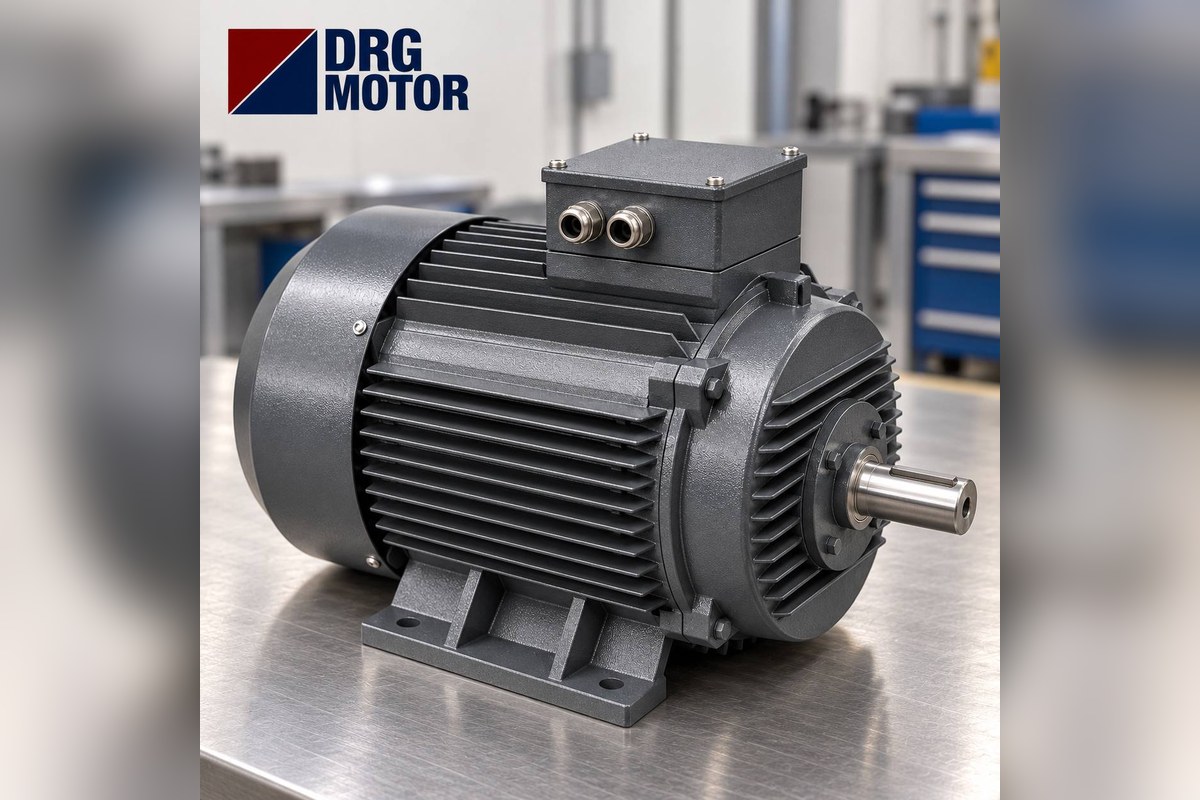

When replacing a pump motor, buying the motor alone is enough if the pump side is sound and the pump is driven through a coupling or a standard-size flange; on a monobloc pump, where the impeller sits directly on the end of the motor shaft, the new motor must have exactly the same shaft end as the old one, and a catalogue motor usually does not — in that case you need a special-shaft motor or a complete pump. For example, on a coupled 4 kW, 3000 rpm pump the old motor can be replaced directly by a DRG-112M-2 (7.45 A at 400 V, shaft 28 × 60 mm); on a monobloc pump of the same power you must measure the shaft end first.
Three things decide: the pump connection type, the condition of the pump side (impeller, seal, casing, pump bearings) and the dimensions of the old motor. This article covers these three checks in order; removal, connection and first start-up must be done by a qualified electrician. You can see standard-size motors and current prices among the 120 models in our online store.
Motor only or complete pump? Quick decision table
| Situation | What you see on site | Decision |
|---|---|---|
| Close-coupled via coupling, pump OK | Coupling, own pump shaft, base | Motor only |
| Coupled, impeller/seal worn | Low pressure, leak marks | Motor + pump overhaul |
| Monobloc, standard shaft end | D × E matches catalogue, keyed | Motor only (check sizes) |
| Monobloc, special shaft | Long stepped/threaded shaft end | Special-shaft motor or full unit |
| Pump casing damaged | Cracks, holes, heavy corrosion | Complete pump |
In short: when pump and motor are joined through separate shafts and a coupling, the motor is an independent part and replacing it is simple. In a monobloc unit the motor is part of the pump; the motor shaft is also the pump shaft. That is why "same kW and speed" is not a sufficient description for a monobloc pump.
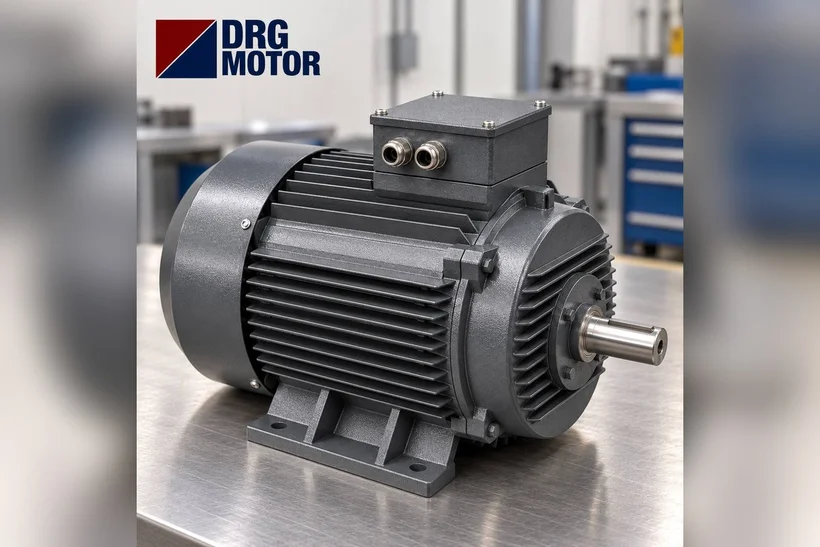
Why does monobloc vs coupled change the motor choice?
On a coupled pump the pump has its own shaft and its own bearings. The motor is either foot-mounted (B3) on the same base as the pump or attached to it through a bell housing with a B5 flange. The motor only transmits torque; the pump bearings carry the impeller weight and hydraulic thrust. If the new motor has the same power, speed, frame size, shaft diameter and flange as the old one, the swap is an assembly job of an hour or two.
On a monobloc pump the impeller is fitted directly on the extended end of the motor shaft and the pump casing is bolted to the motor end shield or an adapter flange. In this design the motor bearings also carry the impeller weight and axial thrust, and the shaft end is specific to the pump maker: it may be longer than a standard shaft end, stepped, threaded for the impeller nut, or fitted with a stainless sleeve in the seal area. A standard catalogue motor does not have this shaft, so even if it physically fits, the impeller will not seat or the seal face ends up in the wrong place.
If your monobloc pump has a shaft end of standard D × E size (some small units do), a motor alone is still possible; you find this out by measuring with a caliper and comparing with the table below, not by eye.
Is the pump side sound? 6 checks before ordering the motor
In a large share of burnt pump motors the real cause is the pump side, not the motor. A new motor fitted without checking the pump will suffer the same failure.
- Gland / mechanical seal: Water marks, scale or rust under the motor or on its front end shield mean leaking water got inside. Do not fit a new motor before renewing the seal.
- Turn the pump shaft by hand: With the motor removed (coupled pump), the pump shaft must turn freely and smoothly. Binding, rubbing noise or tight spots mean pump bearing damage or impeller rub.
- Impeller: Worn vanes, cavitation pitting or trapped debris reduce flow and cause unbalanced running.
- Coupling and alignment: A shredded elastic coupling insert or visible offset between hubs means the motor bearings were overloaded; realign with the new motor.
- Overload protection: If the motor burnt without the overload relay tripping, the setting is wrong or the contactor contacts are welded. Check the setting with the overload, fuse and contactor selection tool.
- Pump casing and pipework: A cracked casing or pipe strain transmitted to the pump (unsupported pipes) is not solved by a motor swap.
Click to see current electric motor prices and order nowSEE PRICES →
Which dimensions should you take from the old motor?
Write down power (kW), speed, voltage and current from the nameplate, then take the mechanical dimensions. B5 flange and shaft dimensions of the 2-pole frames most common in pump applications, from the DRG catalogue:
| Frame | Shaft D × E | Flange P / M / N | Example model |
|---|---|---|---|
| 90L | 24 × 50 mm | 200 / 165 / 130 mm | DRG-90L-2 |
| 100L | 28 × 60 mm | 250 / 215 / 180 mm | DRG-100L-2 |
| 112M | 28 × 60 mm | 250 / 215 / 180 mm | DRG-112M-2 |
| 132S | 38 × 80 mm | 300 / 265 / 230 mm | DRG-132S1-2 |
| 160M | 42 × 110 mm | 350 / 300 / 250 mm | DRG-160M1-2 |
Two practical conclusions follow. First, frames 100L and 112M share the same shaft (28 × 60 mm) and B5 flange (250 / 215 / 180 mm), so the 3 kW DRG-100L-2 and the 4 kW DRG-112M-2 fit the same bell housing and coupling hub, though body length and foot dimensions differ. Second, going from 132S to 160M changes both the shaft (38 to 42 mm) and the flange; if you want to step up in power you may need to change coupling and bell housing too. For foot dimensions (A, B, H) and overall length see the technical drawings page.
On a monobloc pump also measure the total shaft-end length, step diameters, any thread size and the pitch circle diameter of the pump mounting holes on the end shield. If these do not match the catalogue D × E, your motor is a special-shaft motor. For the general logic of choosing power and speed for water pumps see our article choosing a motor for a water pump; here we focus only on the replacement decision.
How do you compare cost without figures?
Choosing between a complete pump and a motor alone is not just comparing two price tags. Write both options with the same items:
- Motor only: Cm = M + S + Lm + D × tm
- Complete pump: Cc = Pc + Lc + D × tc
Here M is the motor cost, S the pump-side parts (seal, coupling insert, bearings, impeller), L labour, D the cost of one hour of downtime and t the time the machine stands still. If the pump side is sound, S is close to zero and the motor alone clearly wins. If impeller, seal and bearings are all needed, S grows and the complete pump comes closer; with old pumps whose parts are no longer available a complete replacement becomes sensible. On a monobloc pump, the time spent sourcing a special-shaft motor increases D × t; on a critical line that item alone can change the decision.
Which DRG motor should you buy?
On coupled or standard-shaft pumps the most frequently replaced motors are 2-pole (3000 rpm) units of 2.2–11 kW. All models below have cast iron housings and IP55; match them with the kW and speed on your pump nameplate.
| Model | Power / speed | Frame | Current 400 V |
|---|---|---|---|
| DRG-90L-2 | 2.2 kW / 2895 rpm | 90L · cast iron | 4.35 A |
| DRG-100L-2 | 3 kW / 2895 rpm | 100L · cast iron | 5.71 A |
| DRG-112M-2 | 4 kW / 2905 rpm | 112M · cast iron | 7.45 A |
| DRG-132S1-2 | 5.5 kW / 2930 rpm | 132S · cast iron | 10.1 A |
| DRG-132S2-2 | 7.5 kW / 2930 rpm | 132S · cast iron | 13.7 A |
| DRG-160M1-2 | 11 kW / 2945 rpm | 160M · cast iron | 19.6 A |
The most common match for a coupled centrifugal pump with a 4 kW, 2-pole (3000 rpm class) nameplate:
- Power: 4 kW
- Rated speed: 2905 rpm
- Frame: 112M · cast iron
- Current 400 V: 7.45 A
- cos φ: 0.88
- Rated torque: 13.1 Nm
- Starting torque: 2.2 × Tn
- Starting current: 8.3 × In
- Shaft D × E: 28 × 60 mm
- B5 flange P / M / N: 250 / 215 / 180 mm
- Bearing (drive end): 6206-ZZ-C3
- Voltage: 400/690 V (Δ/Y)
The new motor’s current should be close to the current on the old nameplate; set the overload relay accordingly. For cable size use the cable size calculator. DRG Motor is an electric motor manufacturer, supplier and seller; DRG MOTOR motors are guaranteed against material and manufacturing defects for 2 years from the delivery date (warranty certificate).
Motors in this power range
- DRG-90L-2 – 2.2 kW – 2895 rpm – 90L cast iron
- DRG-100L-2 – 3 kW – 2895 rpm – 100L cast iron
- DRG-112M-2 – 4 kW – 2905 rpm – 112M cast iron
- DRG-132S1-2 – 5.5 kW – 2930 rpm – 132S cast iron
- DRG-132S2-2 – 7.5 kW – 2930 rpm – 132S cast iron
- DRG-160M1-2 – 11 kW – 2945 rpm – 160M cast iron
Click to see current prices and order these motors nowSEE PRICES →
Frequently Asked Questions
Should the whole pump be replaced when the pump motor burns out?
Not always. If the pump is coupled and impeller, seal and pump bearings are sound, replacing the motor alone is enough. On a monobloc pump with a special shaft end, or with a damaged casing, you need a complete pump or a special-shaft motor.
Can a standard electric motor be fitted to a monobloc pump?
Yes, if the shaft end has the standard D × E size and the pump casing fits a standard B5 flange. If the shaft is stepped, threaded or longer than standard, a catalogue motor cannot carry the impeller.
How many amps does a 4 kW pump motor draw?
The 2-pole DRG-112M-2 draws 7.45 A at 400 V and 7.84 A at 380 V. Set the overload relay to this value.
Does it make sense to step up the pump motor power?
As long as the pump stays the same, the motor only draws the power the pump demands; a larger motor does not fix the problem. If it keeps tripping, first check the pump side (binding, impeller, excessive flow) and the supply voltage. A larger motor often also means a different shaft and flange.
Send us the old motor’s nameplate, the shaft-end dimensions and the pump connection type, and we will confirm the right DRG model with you. Phone +90 (542) 666 11 11, e-mail [email protected], contact page. For all models and current prices, see Buy Electric Motors Online.