English
 Le français
 Türkçe




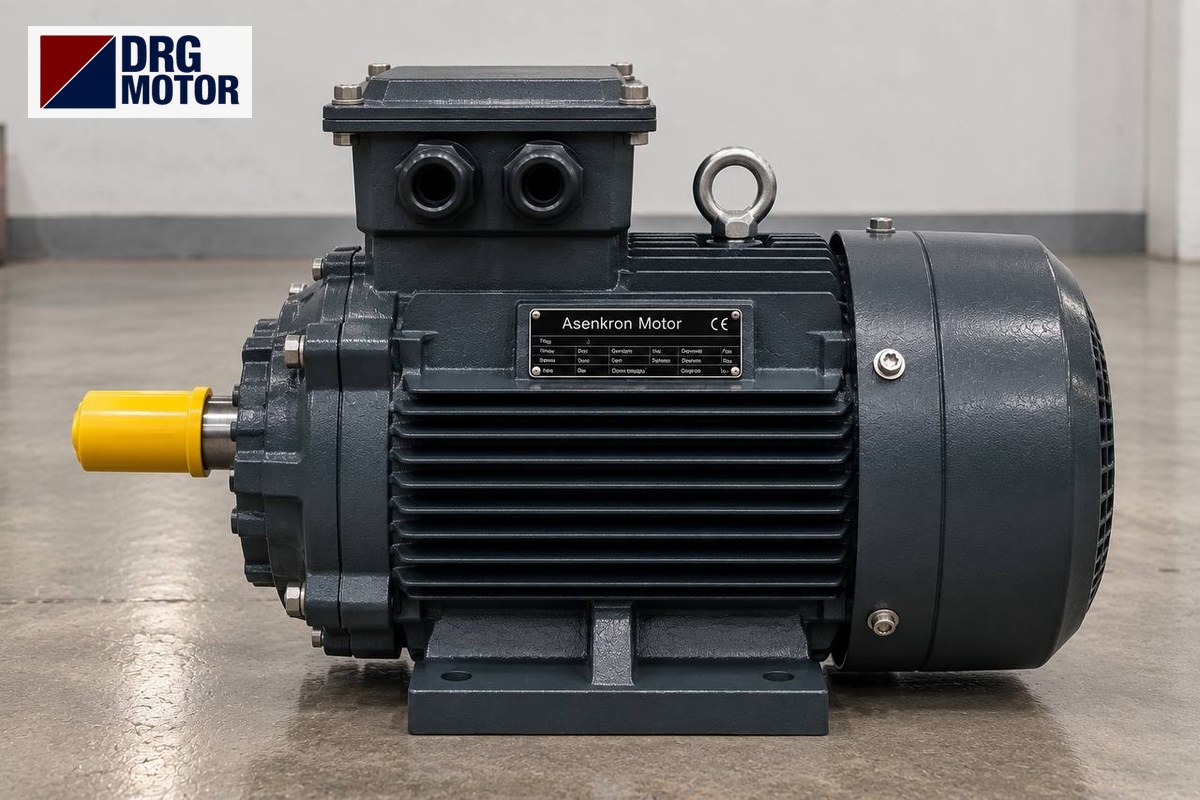

A tyre shredder motor is a 4- or 6-pole three-phase motor that works with a gearbox on a twin-shaft shredder and produces high torque at low shaft speed; when choosing it, the starting torque ratio (Ts/Tn) and the breakdown torque ratio (Tmax/Tn) matter as much as the kW rating. In the DRG catalogue, 4-pole cast iron motors between 22 and 55 kW have Ts/Tn 2.0–2.2 and Tmax/Tn 2.3. On small and medium twin-shaft tyre shredders the power per motor is usually in the 22–55 kW range, and on most machines each shaft has its own motor; the exact value comes from the machine nameplate and the builder's data. The ranges below are conservative and every calculation is shown with its assumptions.
The steel cord and bead wire in a tyre can lock the shafts suddenly, and at that moment the motor draws several times its rated current. Protection, reversing logic and starting settings must be done by a qualified electrician, and the machine must be isolated and locked out during knife maintenance.
You can pick the frame that matches your shaft torque from the 120 models on the Buy Electric Motors Online page; below we show step by step which values to check and why.
Why is the load on a twin-shaft shredder a shock load?
On a twin-shaft shredder the two shafts turn slowly towards each other; the hooked knives grab the tyre, squeeze it and cut it. A tyre is not uniform: it has a steel belt in the tread and a thick bundle of steel wire in the bead. While the knife passes through soft rubber the torque is low; when it meets the steel wire it jumps. The motor therefore does not see a steady load but a sequence of torque swings above and below rated within seconds.
With this kind of load three values matter together: rated torque to carry the average load, starting torque to restart with a full chamber, and breakdown torque to keep the motor from stalling on sudden peaks. We explain these three points on the curve in our article Induction Motor Torque-Speed Curve: Starting, Breakdown and Rated Torque; here we apply them to the shredder.
From shaft torque to motor power: a worked example
The shredder builder usually gives the required torque per shaft and the shaft speed. The power follows from these with P = T·n / 9550.
- Assumption: continuous torque required per shaft 12 kN·m, shaft speed 18 rpm.
- Shaft power: P = 12,000 × 18 / 9550 ≈ 22.6 kW.
- A factor of 0.9 for gearbox losses (assumption): 22.6 / 0.9 ≈ 25.1 kW → next standard step 30 kW.
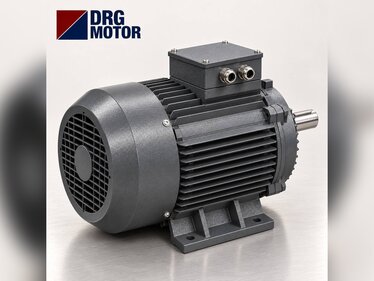
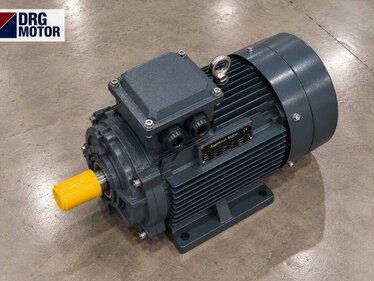
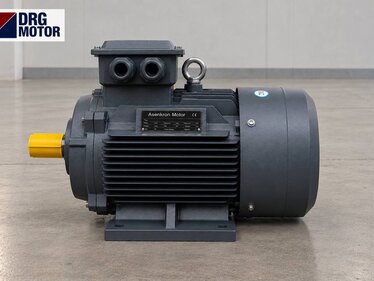
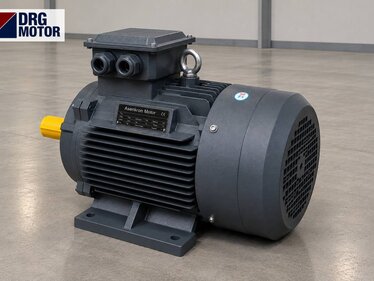
- Choice: DRG-200L-4 (30 kW, 1475 rpm, rated torque 194.2 Nm).
- Gear ratio: i = 1475 / 18 ≈ 81.9. Rated torque at the shaft ≈ 194.2 × 81.9 × 0.9 ≈ 14.3 kN·m, above the 12 kN·m required.
You can try your own ratios and torques in the Gearbox Output Speed and Torque Calculator.
- Power: 30 kW
- Rated speed: 1475 rpm
- Current 400 V / 380 V: 53.8 A / 56.6 A
- cos φ: 0.86
- Rated torque: 194.2 Nm
- Ts/Tn · Tmax/Tn: 2.0 · 2.3
- Is/In: 7.3
- Shaft D×E: 55×110 mm
- Voltage: 400/690 V (Δ/Y)
- Frame: Cast iron, IEC 200L
Why Ts/Tn and Tmax/Tn are decisive
For the DRG-200L-4, Ts/Tn is 2.0 and Tmax/Tn is 2.3. In the example above this means about 28.6 kN·m starting torque and 32.9 kN·m breakdown torque at the shaft. There are two practical consequences:
- Loaded start: if the machine stopped with a full chamber after a fault or a power cut, the motor must overcome the load with its starting torque when it restarts. If the starting torque is lower than the jam torque at the shaft, the motor does not turn; it only draws current.
- Sudden peak: when steel wire reaches the knife, torque briefly rises above rated. As long as the peak stays below breakdown torque the motor slows down and recovers; if it exceeds it, speed collapses, the motor stalls and the current rises to starting-current level.
Comparing a 4-pole and a 6-pole motor of the same power is instructive here:
| Value (18 rpm shaft) | 4-pole DRG-200L-4 | 6-pole DRG-225M-6 | Note |
|---|---|---|---|
| Gear ratio i | ≈ 81.9 | ≈ 54.4 | Smaller with 6 poles |
| Rated torque at shaft | ≈ 14.3 kN·m | ≈ 14.3 kN·m | Same power, same torque |
| Starting torque at shaft | ≈ 28.6 kN·m | ≈ 28.6 kN·m | Ts/Tn 2.0 on both |
| Breakdown torque at shaft | ≈ 32.9 kN·m | ≈ 30.1 kN·m | Tmax/Tn 2.3 / 2.1 |
At the same power and shaft speed, rated torque is the same for both options; the difference comes from the gear ratio and the breakdown torque ratio. The 6-pole motor works with a lower-ratio gearbox, while in this example the 4-pole motor leaves slightly more breakdown reserve at the shaft. The decision usually depends on the available gearbox and the layout.
Service factor and protecting the gearbox
A shock load strains the gearbox as much as the motor. Gearbox makers require a service factor (SF) according to the load type; for heavy shock loads it is high, and the exact value comes from the gearbox catalogue. Example: assuming SF = 1.75, the gearbox's rated output torque must be at least 14.3 × 1.75 ≈ 25.0 kN·m.
The point that is often missed: during a jam the motor can produce torque up to its breakdown torque, which in the example corresponds to about 32.9 kN·m at the shaft. In the short time before the electrical protection cuts the current, this torque goes into the gears and keys. That is why twin-shaft shredders use a torque-limiting coupling, a shear pin or a fast current-based stop. Choosing the motor one size larger "to be safe" increases this risk: a larger motor also has a larger breakdown torque and sends a higher peak into the gearbox.
Reversing on a jam: the right sequence for the motor
The shredder control monitors the current; if it exceeds the threshold set by the builder for a certain time, it briefly reverses the shafts to release the material, then runs forward again. From the motor's point of view the right sequence is:
- The forward contactor opens and the motor coasts.
- Short dwell: the shaft stops or slows right down. Reversing while it still turns means a current surge even higher than the starting current and a reverse torque shock in the gearbox.
- The reverse contactor closes and the motor runs backwards briefly.
- Another dwell, then forward.
The forward and reverse contactors must have both electrical and mechanical interlocks. Frequent reversing heats the motor: every change of direction counts as a start. Ask the machine builder how many starts per hour are allowed; on a machine that jams constantly the problem is not the motor but the knife gap or the feed rate.
Overload setting and starting method
The DRG-200L-4 draws 53.8 A at 400 V and 56.6 A at 380 V; Is/In is 7.3. Direct-on-line, the starting current is ≈ 53.8 × 7.3 ≈ 393 A.
- Direct-on-line: the overload relay is set to the motor's rated current (53.8 A at 400 V).
- Star-delta: in most panels the overload sits in the motor winding circuit, after the main contactor; it is then set to the phase current, In/√3 ≈ 53.8 / 1.732 ≈ 31.1 A. Do not set it without checking where it sits in the panel.
- The limit of star-delta: in star the starting torque drops to one third; a motor with Ts/Tn 2.0 gives ≈ 0.67 × Tn in star. That is enough with an empty chamber, not with a full one. If loaded starts are frequent, a torque-controlled inverter is more suitable than a soft starter.
You can calculate overload, fuse and contactor values with the Motor Overload, Fuse and Contactor Selection tool and star-delta currents with the Motor Starting Methods (Star-Delta) tool. Raising the setting because the overload "keeps tripping" leaves the winding unprotected; check the knives, the feed rate and the gearbox oil first.
DRG models for tyre shredders
| Model | Power / speed | Frame | Current 400 V |
|---|---|---|---|
| DRG-180L-4 | 22 kW / 1470 rpm | Cast iron 180L | 39.7 A |
| DRG-200L-4 | 30 kW / 1475 rpm | Cast iron 200L | 53.8 A |
| DRG-225S-4 | 37 kW / 1485 rpm | Cast iron 225S | 66.1 A |
| DRG-225M-4 | 45 kW / 1485 rpm | Cast iron 225M | 80.2 A |
| DRG-250M-4 | 55 kW / 1485 rpm | Cast iron 250M | 97.6 A |
| DRG-225M-6 | 30 kW / 980 rpm | Cast iron 225M | 56.2 A |
The torque values are:
| Model | Rated torque | Ts/Tn | Tmax/Tn |
|---|---|---|---|
| DRG-180L-4 | 142.9 Nm | 2.0 | 2.3 |
| DRG-200L-4 | 194.2 Nm | 2.0 | 2.3 |
| DRG-225S-4 | 237.9 Nm | 2.0 | 2.3 |
| DRG-225M-4 | 289.4 Nm | 2.0 | 2.3 |
| DRG-250M-4 | 353.7 Nm | 2.2 | 2.3 |
| DRG-225M-6 | 292.3 Nm | 2.0 | 2.1 |
All models in the table have cast iron frames, preferred for rubber dust and vibration. We touch on other machines in the tyre and rubber sector in our article Electric Motors in the Rubber Industry.
Checklist before choosing the motor
- Torque per shaft and shaft speed from the builder; one motor per shaft, or one motor plus a gear train?
- Gear ratio, rated output torque and service factor; do the motor flange and shaft D×E fit the gearbox input?
- Is there a torque-limiting coupling or shear pin; has it been checked against breakdown torque?
- Dwell time before reversing, and electrical + mechanical interlock on the contactors.
- Overload relay position (line or winding) and the correct setting.
- Likelihood of loaded starts: is star-delta enough, or is an inverter needed?
- Cable size for starting and rated current: Motor Cable Size Calculator.
- Motor foot bolts and gearbox connection; check for loosening under vibration.
Motors in this power range
- DRG-200L-4 – 30 kW – 1475 rpm – Cast iron 200L
- DRG-225S-4 – 37 kW – 1485 rpm – Cast iron 225S
- DRG-225M-4 – 45 kW – 1485 rpm – Cast iron 225M
- DRG-250M-4 – 55 kW – 1485 rpm – Cast iron 250M
- DRG-225M-6 – 30 kW – 980 rpm – Cast iron 225M
Click to see current prices and order these motors nowSEE PRICES →
Frequently Asked Questions
How many kW does a tyre shredder motor need?
On small and medium twin-shaft tyre shredders the power per motor is usually in the 22–55 kW range, and most machines have one motor per shaft. The exact value is calculated from the shaft torque and speed given by the builder with P = T·n/9550; in the example, 30 kW was chosen for 12 kN·m at 18 rpm.
Should a shredder motor be 4-pole or 6-pole?
Both are used. At the same power and shaft speed the rated torque at the shaft is the same; the 6-pole motor works with a lower-ratio gearbox, while the 4-pole motor's Tmax/Tn (2.3 in the DRG catalogue) is slightly higher than the 6-pole's (2.1).
How many amps does a 30 kW shredder motor draw?
The DRG-200L-4 draws 53.8 A at 400 V and 56.6 A at 380 V. Direct-on-line the starting current is about 393 A; with star-delta, an overload in the winding circuit is set to about 31.1 A.
Why does a shredder motor keep tripping the overload?
The most common causes are frequent reversing (each one counts as a start), blunt knives, overfeeding and trying to start in star with a full chamber. Remove these causes instead of raising the setting, and check that the setting matches the overload's position in the panel.
Send us your machine's nameplate or the builder's data and we will pin down the right frame together: phone +90 (542) 666 11 11, e-mail [email protected], contact page. DRG Motor is a manufacturer, supplier and seller of electric motors; you can browse every model on the Buy Electric Motors Online page.