English
 Le français
 Türkçe




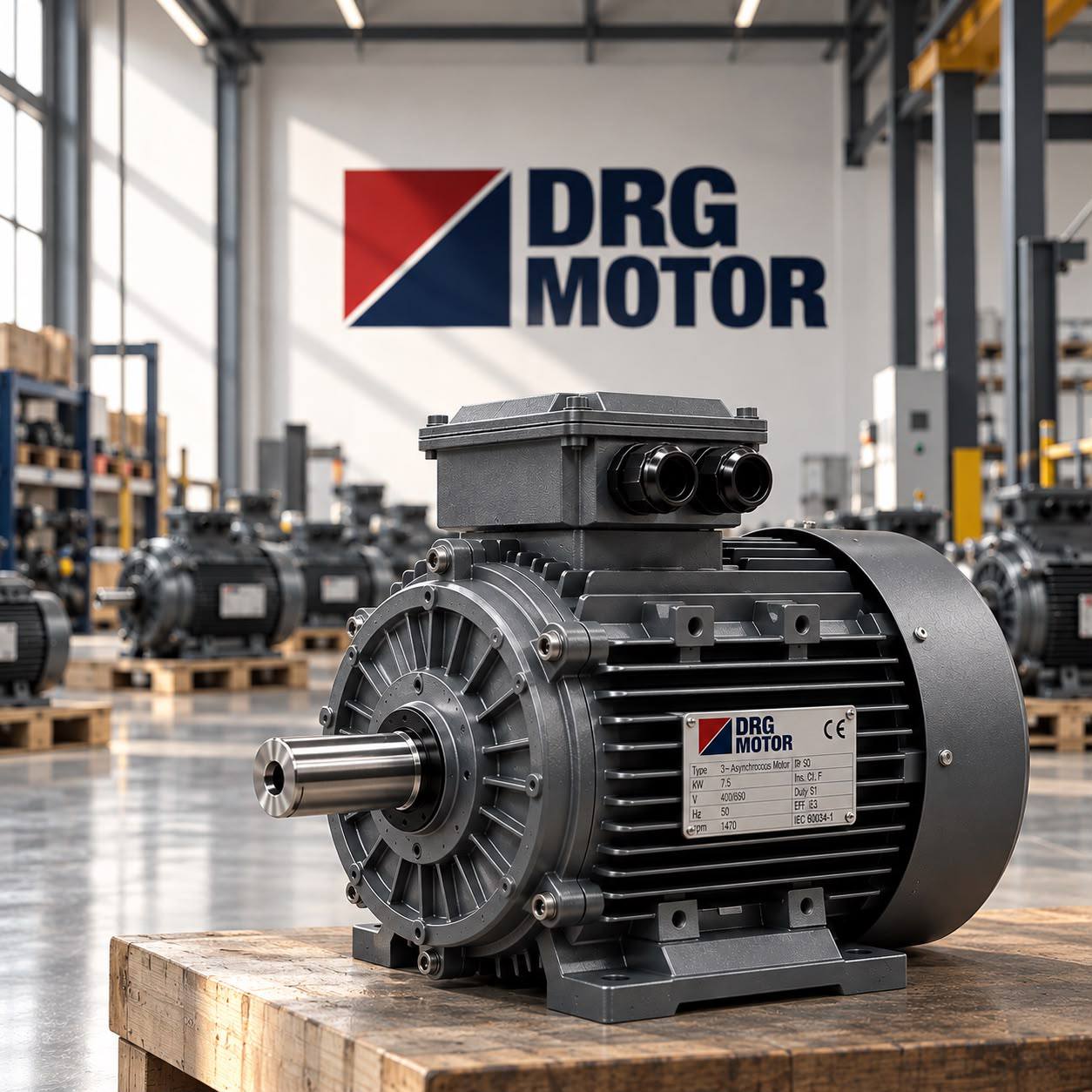

Halfway through a shift, a 37 kW rotary screw compressor trips on its overload relay, and on the second attempt there is a burning smell coming from the motor. The maintenance supervisor takes a photo of the nameplate and calls: "If we find the same kW, will the line have compressed air again tomorrow morning?" Most of the time the answer is yes, but not on kW alone; the pole count, shaft and flange dimensions, pulley diameter, starting method and enclosure temperature must be checked on the same list. This article explains, step by step and with worked examples, what to look at when selecting a motor for a screw compressor and when replacing a failed one, along with the mistakes most often made in the field.
Three Conditions That Stress a Screw Compressor Motor
The motor of a screw compressor lives a more "restless" life than a pump or fan motor. When pressure reaches the upper limit, the inlet valve closes and the machine runs unloaded; when pressure drops, the valve opens and the motor goes back on load. In a workshop with fluctuating air demand, this transition repeats many times within an hour. That is the first condition that stresses the motor: current swinging between load and idle, and the thermal cycling it creates in the winding.
The second condition is the enclosure. Screw compressors usually run inside a closed, sound-insulated canopy; the oil cooler, aftercooler and air-oil separator in the same canopy also give off heat. The motor's cooling fan draws in this warm air. If the canopy filter is clogged or the compressor room is not ventilated, the motor runs hotter than it should, even at the power stated on its nameplate.
The third condition is mechanical. On belt-driven models, belt tension places a permanent radial force on the drive-end bearing; an over-tightened belt shortens bearing life, while a loose belt slips and heats the pulley. On direct-coupled models, misalignment between the motor and the screw block fatigues the same bearing through vibration. Some failures that look like a burnt winding actually start at the bearing or the alignment, which is why it matters to find the cause before fitting the new motor.
2-Pole or 4-Pole? Deciding by Drive Type
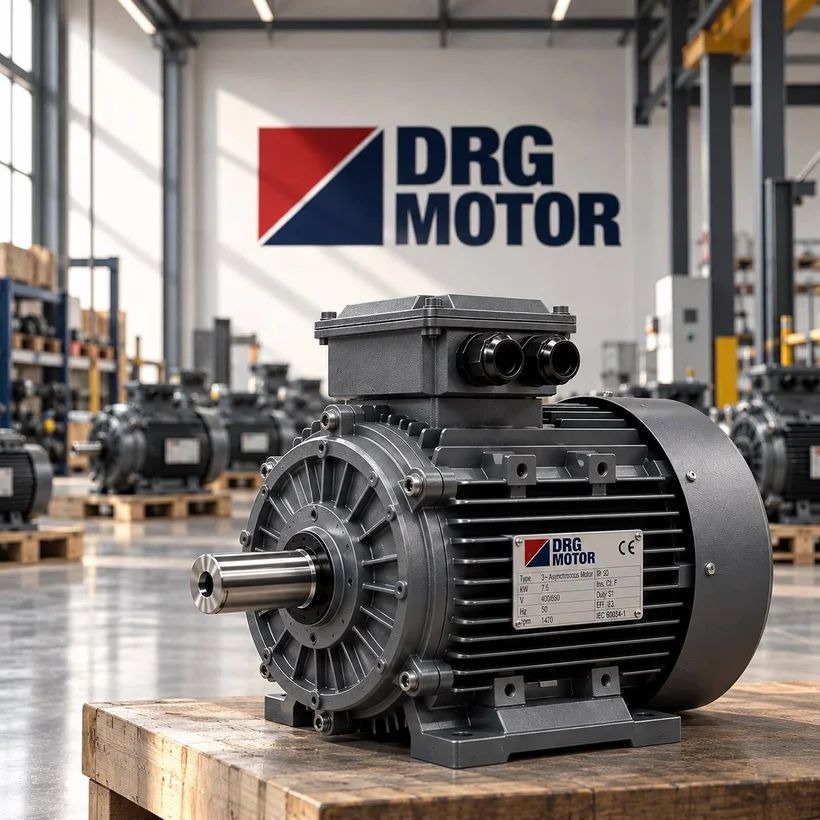
Screw compressors mostly use 2-pole (about 3000 rpm) or 4-pole (about 1500 rpm) motors. The compressor design decides which one is used; changing the pole count during a replacement is rarely a good idea. Depending on the drive type, the situation is as follows:
Belt drive
The diameter ratio between the motor pulley and the block pulley determines the speed of the screw block. The manufacturer may use the same block at different pressures (for example 8 and 10 bar) with different pulley sets. So when replacing the motor, keeping the pulley at the same diameter is in most cases the shortest way to preserve the compressor's flow and pressure ratings. Belt-driven models commonly use 2-pole motors, because they deliver the same power in a smaller frame.
Direct coupling (coupling or flange)
The motor turns the screw block directly through a coupling or an adapter bell housing. Block speed equals motor speed, so the new motor must have exactly the same pole count as the old one. On these machines the motor is often mounted with flange and feet (B35) or flange only (B5); flange diameter, spigot diameter and shaft length must match to the millimetre.
Gearbox drive
A fixed-ratio gear set sits between the motor and the block. Since speed cannot be adjusted by changing pulleys as in a belt system, the rated speed and flange connection of the new motor must be the same as the old one.
Pulley Calculation: Keeping the Block Speed
On a belt-driven compressor, the first step is to calculate the existing block speed. The formula is simple: n_block = n_motor × d_motor / d_block.
Example: Let the 37 kW 2-pole motor have a rated speed of 2960 rpm, a motor pulley of 200 mm and a block pulley of 160 mm. Block speed = 2960 × 200 / 160 = 3700 rpm. Belt speed v = π × 0.200 m × 2960 / 60 ≈ 31.0 m/s.
If the new motor's rated speed is 2950 rpm, the block turns at 2950 × 200 / 160 = 3687.5 rpm with the same pulleys; the 12.5 rpm difference is negligible in practice. The real risk is someone changing the pole count because "a 4-pole motor is quieter". To keep a block speed of 3700 rpm with a 1480 rpm motor, the equation 1480 × d / 160 = 3700 requires the motor pulley to grow to 400 mm. A pulley that size does not fit in most canopies, and the motor frame grows as well. In the store list, the 37 kW 2-pole motor has frame 200L and a rated torque of 119.4 Nm, while the 37 kW 4-pole motor has frame 225S and a rated torque of 237.9 Nm (check: 9550 × 37 / 2960 ≈ 119.4 Nm). Foot holes, shaft height and shaft diameter change; the shaft is 55 mm on frame 200L and 60 mm on a 4-pole 225S. In other words, a pole change is not a motor replacement but a small design change.
If you want to try the pulley and belt calculation with different diameters, you can use the speed and torque calculators on the electric motor calculators page.
Star-Delta or Drive? The Starting Side
Most fixed-speed screw compressors use star-delta starting. This method works well here, because the compressor starts with the inlet valve closed, that is, unloaded. In star connection, motor current and torque fall to one third compared with direct-on-line starting. As an example, the store list gives a 400 V rated current of 64.0 A for the 37 kW 2-pole motor; if its catalogue starting current ratio were 7, direct-on-line starting would draw about 448 A, whereas in star this value would drop to about 149 A.
The critical point for star-delta is the nameplate voltage: a motor that will be started this way on a 400 V network must be rated 400/690 V (Δ/Y). A motor rated 230/400 V is already connected in star on a 400 V network; star-delta cannot be applied to it. During replacement, photograph the cables coming from the six terminals and the link positions in the old motor's terminal box, and state the voltage clearly when ordering the new motor.
In variable-speed compressors, the motor is fed by a frequency inverter and the speed is adjusted to pressure demand. Here the points to watch are different: the fan on the motor shaft blows less air at low speed; the longer the cable between inverter and motor, the higher the voltage peaks reaching the winding; on larger frames, inverter-induced bearing currents can wear the bearing. When replacing the motor of an inverter-driven compressor, the speed range on the old nameplate and the inverter parameters (rated current, speed, pole count) must be updated for the new motor; otherwise the inverter protects the motor based on the wrong model.
Load–Idle Cycling and the Effect of Frequent Starts
On a fixed-speed compressor, the controller does not stop the motor as soon as pressure reaches the upper limit; it first runs it unloaded and stops it if no air demand arrives within a set time. This idle waiting time directly determines how many times per hour the motor starts. If the time is shortened too much, the motor stops and starts frequently; at each start the winding heats up with the starting current and the star-delta contactors wear.
After a motor replacement, it is useful to check these two settings:
- Do the permitted starts per hour and the idle waiting time in the controller match the values in the compressor manufacturer's manual?
- Has the gap between the lower and upper pressure limits been left too narrow? A narrow band makes the transition between load and idle more frequent.
If air demand fluctuates strongly during the day, the solution may be a larger air receiver or a system that adjusts speed to demand, not a larger motor. Going up one motor size does not solve frequent starting; it only brings a larger starting current.
Hot Enclosure, Cooling Air and Bearings
The nameplate ratings of standard motors are usually given for an ambient temperature of up to 40 °C and an altitude of 1000 m. Inside a closed compressor canopy, the air drawn in by the motor can exceed this limit. If overload trips start in the summer months, measure the air before blaming the motor: place a thermometer in front of the motor's fan cover and read the temperature while the compressor is on load. A clean canopy filter, a hot air exhaust duct in the compressor room and a fresh air inlet from outside are often more effective than replacing the motor.
The motor's own fan cover also fills with dust. If the grille on the cover is blocked, less air passes over the motor frame. Adding the cleaning of the fan cover and frame fins to the maintenance plan is a simple but effective measure.
On the bearing side, the drive-end bearing is decisive in belt drives and alignment in direct-coupled drives. The front and rear bearing types of the new motor are stated on the nameplate or in the catalogue; for regreasable bearings, the grease quantity and interval are also given on the nameplate. Too much grease is as harmful as too little: if the bearing housing is packed full, it heats up. On large belt-driven frames, it is worth asking at the quotation stage whether a bearing option rated for belt loads is available at the drive end.
Dimension, Flange and Pulley Fit When Replacing
The new motor fitting mechanically in place of the old one is as important as electrical compatibility. The dimensions to check are: shaft height (H), foot hole spacings (A and B), shaft diameter and length (D × E), key width, and for flanged models the flange outer diameter, spigot diameter and pitch circle of the holes. These dimensions are standard for motors with the same IEC frame number; however, older compressors may have non-IEC special frames. That is why measuring with a ruler is more reliable than trusting the nameplate.
On the pulley side, the bore of the old pulley must fit the new shaft; with the same frame number it usually does. Taper-bush pulleys can be adapted to different shaft diameters by changing the bush. If the belts need replacing, replace them as a set; running old and new belts together upsets load sharing.
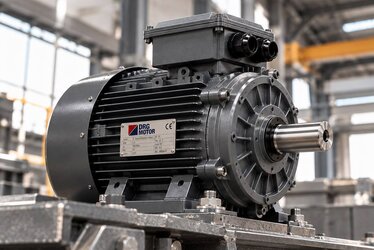
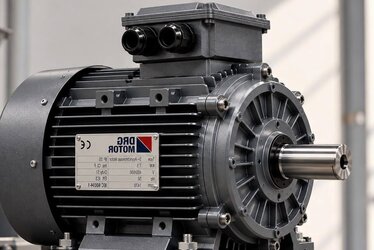
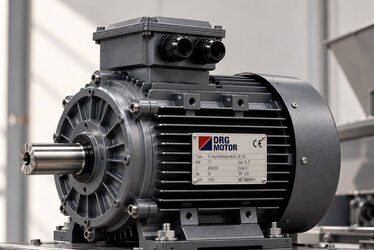
Some cast iron frame models from the store list in powers commonly used on screw compressors:
| Model | Power | Speed | IEC frame | Excl. VAT | Incl. VAT |
|---|---|---|---|---|---|
| DRG-160M2-2 | 15 kW | 3000 rpm | 160M | 25,740.00 TRY | 30,888.00 TRY |
| DRG-180M-2 | 22 kW | 3000 rpm | 180M | 38,709.00 TRY | 46,450.80 TRY |
| DRG-200L2-2 | 37 kW | 3000 rpm | 200L | 66,990.00 TRY | 80,388.00 TRY |
| DRG-225S-4 | 37 kW | 1500 rpm | 225S | 68,937.00 TRY | 82,724.40 TRY |
| DRG-250M-2 | 55 kW | 3000 rpm | 250M | 98,450.00 TRY | 118,140.00 TRY |
| DRG-250M-4 | 55 kW | 1500 rpm | 250M | 93,247.00 TRY | 111,896.40 TRY |
Prices are taken from the DRG Motor online store list dated 24.09.2026; a 3% discount applies to bank transfer/EFT payments, shipping is not included in the price and is paid by the buyer.
For other powers and speeds, see the list on the buy electric motors online page. If you want more detail on the torque needed at start-up, the article on high starting torque in compressors covers this topic separately; for high-speed options, you can also look at the article on 2-pole compressor motor supply.
Motor Replacement Checklist
Before removing the failed motor and before commissioning the new one, follow these steps in order:
- Take a clear photo of the old motor's nameplate: kW, speed, voltage and connection (Δ/Y), current, frame number, mounting arrangement.
- Note the cause of failure: burnt winding, bearing noise or overload trip? If it comes from the bearing or alignment, the same problem will recur in the new motor.
- Take the mechanical dimensions: H, A, B, D × E, key; if flanged, flange outer diameter, spigot diameter, number of holes and pitch circle.
- Write down the pulley diameters and the belt type/number; calculate the block speed with n_motor × d_motor / d_block.
- Photograph the connection in the terminal box and the star-delta cable sequence; confirm that the new motor's nameplate voltage suits the starting method.
- After fitting the new motor, check belt alignment with a straightedge or laser and set the belt to the tension recommended by the manufacturer.
- At first start, check the direction of rotation with a short jog; the screw block is sensitive to reverse rotation.
- Measure motor current on load and at idle with a clamp meter, and set the overload relay to the new motor's nameplate current.
- On an inverter-driven compressor, enter the new motor's nameplate data into the inverter and run motor identification if required.
- During the first week, check bearing temperature and belt tension once more.
Frequently Asked Questions
Is there an advantage in choosing a motor one size larger for a screw compressor?
Generally not. The power drawn by the screw block is determined by block speed and pressure; a larger motor does not increase flow. A larger motor draws a higher starting current and, since its frame may change, can make installation harder. Staying with the same power and pole count is the right choice in most cases.
Can I fit a 4-pole motor in place of a 2-pole motor?
Not on direct-coupled or gearbox-driven compressors; block speed would be halved. On belt-driven models, the pulley ratio would have to double and the frame grows. In practice, this change should only be made as a design change approved by the compressor manufacturer.
The new motor blows a fuse when switching from star to delta. What could be the cause?
The most common causes are a changeover time set too short or too long, and terminal cables connected in the wrong order. Leads connected in the wrong sequence create a phase difference at the changeover to delta and draw a high current. Compare the cable sequence with the photo of the old motor and set the timer relay to the moment the motor approaches rated speed.
Is IP55 enough for a compressor motor?
For motors inside a closed canopy, IP55 is a common and generally sufficient degree of protection. For compressors working in dusty and damp areas without a canopy, the terminal box gasket, cable gland and condensation drain should also be checked.
Send us your compressor's motor nameplate and pulley dimensions and we will determine the suitable model together: +90 (542) 666 11 11, [email protected] or our contact page.