English
 Le français
 Türkçe




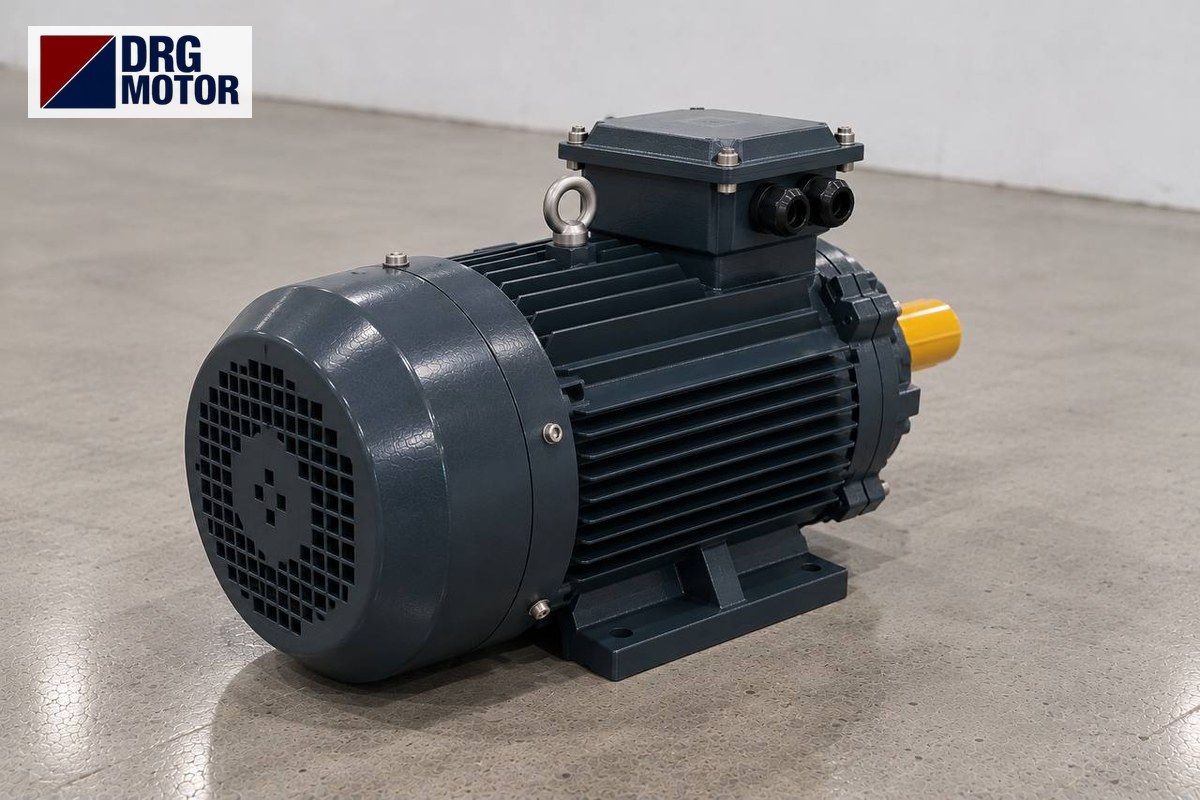

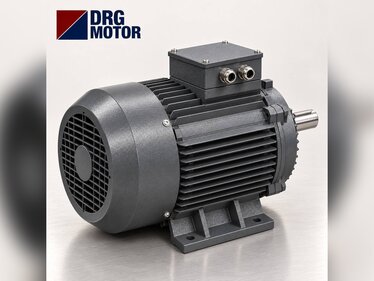
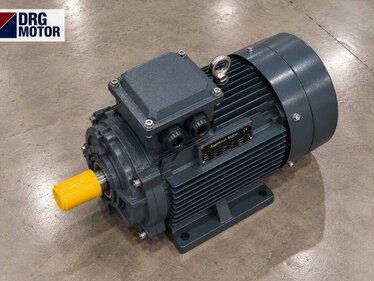
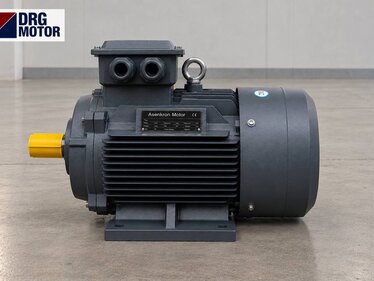
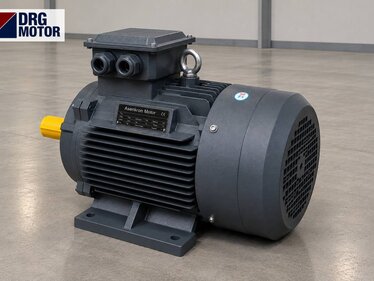
On a plastic washing line the centrifugal dryer (friction dryer) motor is usually a 4-pole, 1500 rpm class three-phase motor that drives the rotor by belt; the screw squeezer, also with a 4-pole motor, drives a slow, high-torque screw through a gearbox. Dryer motor power is typically 11–15 kW on small lines and 18.5–30 kW on high-capacity lines; squeezers commonly use 22–30 kW and above. These ranges are only a guide; the exact value is the machine builder's nameplate and data. As an example, the 18.5 kW DRG-180M-4 runs at 1470 rpm, draws 33.5 A at 400 V and delivers 120.2 Nm rated torque.
What stresses the motor differs between these two machines: on the dryer it is bringing a heavy rotor up to speed from standstill at every start, on the squeezer it is the sudden torque rise when wet flake packs the screw. Their common enemy is water and moisture. Below you will find the pulley and tip speed calculation, a starting time example, the torque calculation for the squeezer screw and the motor replacement steps. You can choose suitable models on the Buy Electric Motors Online page. In a wet environment, connection, earthing and starter panel work must be carried out by a qualified electrician.
Motors on the Line: Why the Dryer and the Squeezer Are Assessed Separately
A plastic washing line includes a shredder, friction washer, float-sink tank screws, centrifugal dryer, squeezer and pneumatic conveying fan. The shredder motor is a separate subject, covered in our plastic granulator motor article. This article focuses on the two dewatering machines at the end of the line:
| Machine | Load type | Drive | Typical poles |
|---|---|---|---|
| Centrifugal (friction) dryer | High inertia, long start | Belt and pulley | 4-pole (sometimes 2) |
| Screw squeezer | High torque, variable load | Gearbox + coupling | 4-pole |
| Conveying fan after dryer | Fan load | Direct-coupled | 2-pole |
Although the dryer and squeezer stand side by side on the same line, their motor selection logic is opposite: the dryer needs "starting torque to overcome inertia and overload protection that tolerates the starting time", while the squeezer needs "enough torque at the gearbox output and breakdown torque to withstand sudden overloads".
Centrifugal Dryer: Speed, Pulleys and Tip Speed
In a centrifugal dryer the paddles on a horizontal rotor throw wet flake against a screen and expel the water by centrifugal force. The drying effect is set by the tip speed of the rotor paddles: v = π · D · n / 60. Rotor speed is obtained from motor speed by the pulley ratio: i = nmotor / nrotor.
Example (rotor values are assumptions):
- Motor: DRG-180M-4, rated speed 1470 rpm
- Required rotor speed 1200 rpm → i = 1470 / 1200 ≈ 1.23
- With a 200 mm motor pulley, the rotor pulley is 200 × 1.225 ≈ 245 mm
- Rotor paddle tip diameter 600 mm → v = π × 0.6 × 1200 / 60 ≈ 37.7 m/s
If a 2-pole motor is chosen for the same rotor, the pulley ratio grows and the motor pulley gets smaller; a small pulley bends the belt more sharply and shortens belt life. That is why 4-pole motors are common on dryers. You can calculate pulley diameter and belt length with the pulley and belt calculator. Do not change the pulley ratio when replacing the motor; higher rotor speed strains the screen and rotor balance.
Starting Inertia: How Many Seconds Does the Dryer Take to Reach Speed?
The dryer rotor is heavy and at every start the motor has to bring this mass from zero to speed. Starting time is roughly t = J · ω / Tacc. Assumptions and calculation:
- Rotor + pulley inertia at the rotor shaft Jr = 8 kg·m² (assumption)
- Inertia referred to the motor shaft: J = Jr / i² = 8 / 1.225² ≈ 5.3 kg·m² (adding the motor's own rotor inertia lengthens the time slightly)
- Motor angular speed: ω = 2π × 1470 / 60 ≈ 153.9 rad/s
- Average motor torque during start ≈ 1.5 × Tn ≈ 180 Nm (assumption; for DRG-180M-4, Tn = 120.2 Nm, Ts/Tn = 2.0)
- Friction and windage load during start ≈ 30 Nm (assumption) → accelerating torque ≈ 150 Nm
- Starting time: t ≈ 5.3 × 153.9 / 150 ≈ 5.5 s
With direct-on-line starting the motor draws about 7.8 times rated current during this time: 33.5 × 7.8 ≈ 261 A. A standard overload relay usually tolerates this current for a few seconds, but if the rotor is heavier or wet material has stayed on the screen, the time lengthens and the overload trips at start. With star-delta starting the torque in star falls to about one third (120.2 × 2.0 / 3 ≈ 80 Nm); after subtracting the 30 Nm load, about 50 Nm of accelerating torque remains and the same calculation gives about 16 s. So the star-to-delta changeover time must be set after the motor approaches its speed. For a comparison of methods see the star-delta starting page; the general explanation of inertia is in our article on motor inertia and acceleration time.
Screw Squeezer: Torque, Gearbox and Overload
In a squeezer a conical screw compresses wet film and flake to remove water and often partially agglomerates the material with frictional heat. The screw turns slowly, so the motor is connected through a gearbox. Gearbox output torque: Tout ≈ Tmotor × i × k.
- Motor: DRG-200L-4, 30 kW, 1475 rpm, Tn = 194.2 Nm
- Screw speed 50 rpm (assumption) → gearbox ratio i = 1475 / 50 = 29.5
- Gearbox transmission factor k = 0.95 (assumption)
- Rated torque at the screw shaft ≈ 194.2 × 29.5 × 0.95 ≈ 5,442 Nm ≈ 5.4 kNm
If feeding is irregular, the screw suddenly fills with wet, dense material and torque rises above rated. The DRG-200L-4 has a breakdown torque ratio (Tmax/Tn) of 2.3; it handles short overloads, but under sustained overload the overload relay must act. A simple interlock linking the feed conveyor to the squeezer motor current (feed stops when current rises) protects the motor and gearbox. For gearbox output speed and torque, use the gearbox output speed and torque calculator.
Wet Environment: Water, Steam and Fibre Build-Up
DRG motors have IP55 protection and are protected against water jets. On a plastic washing line, besides splashing water, there are three extra risks:
- Humid air at the dryer outlet: the dryer's air and water discharge must not be directed at the motor; if the motor fan draws in this humid air, condensation inside the frame increases.
- Fibre and label paper build-up: label paper and plastic fibres stuck to the fan cover grille cut off cooling air; the motor heats up even at normal current. Check the grille at the end of each shift.
- Hose cleaning: when cleaning the line, do not aim pressurised water directly at the motor frame; terminal box cable entries should face down.
Wet flake collecting under the belt guard unbalances the pulley and adds load to the motor bearing. Open and clean the belt guard periodically.
Which DRG Motor? Model Table
| Model | Power / speed | Frame | Current 400 V |
|---|---|---|---|
| DRG-160M-4 | 11 kW / 1465 rpm | 160M cast iron | 20.4 A |
| DRG-160L-4 | 15 kW / 1465 rpm | 160L cast iron | 27.3 A |
| DRG-180M-4 | 18.5 kW / 1470 rpm | 180M cast iron | 33.5 A |
| DRG-180L-4 | 22 kW / 1470 rpm | 180L cast iron | 39.7 A |
| DRG-200L-4 | 30 kW / 1475 rpm | 200L cast iron | 53.8 A |
| DRG-160M2-2 | 15 kW / 2945 rpm | 160M cast iron | 26.5 A |
Key values of the 18.5 kW model used in the dryer example:
- Model: DRG-180M-4
- Power: 18.5 kW
- Rated speed: 1470 rpm
- Current 400 V / 380 V: 33.5 A / 35.3 A
- Rated torque: 120.2 Nm
- Ts/Tn · Tmax/Tn · Is/In: 2.0 · 2.3 · 7.8
- Shaft D×E: 48 × 110 mm
- Front bearing: 6311-C3
- Connection: 400/690 V, delta (Δ) at 400 V
Motor Replacement: Checklist
- Note power, speed, voltage, connection and current from the old motor's nameplate; do not change the pole number.
- Measure foot hole spacing (A×B), shaft height (H) and shaft D×E; on DRG-180M-4, A×B is 279 × 241 mm and H is 180 mm.
- On the dryer, transfer the motor pulley from the old motor as is; if the pulley hub does not fit the shaft diameter, the new pulley must have the same diameter.
- Check pulley alignment with a straightedge or laser and set belt tension to the belt manufacturer's value.
- On the squeezer, check coupling alignment (radial and angular); the gearbox input shaft and motor shaft must be on the same axis.
- Have the electrician make the connection, measure insulation resistance and set the overload relay to rated current (overload, fuse and contactor selection).
- Check the direction of rotation before fitting the belt; if the dryer rotor runs backwards, material is pushed towards the inlet instead of the outlet.
- On the first run, time the start with a stopwatch, measure the load current with a clamp meter and record the values.
Motors in This Power Range
- DRG-160L-4 – 15 kW – 1465 rpm – 160L cast iron
- DRG-180M-4 – 18.5 kW – 1470 rpm – 180M cast iron
- DRG-180L-4 – 22 kW – 1470 rpm – 180L cast iron
- DRG-200L-4 – 30 kW – 1475 rpm – 200L cast iron
Click to see current prices and order these motors nowSEE PRICES →
Frequently Asked Questions
What kW is a plastic drying machine motor?
On centrifugal dryers, motor power is typically 11–15 kW on small lines and 18.5–30 kW on high-capacity lines. The exact value depends on rotor length, capacity and the machine builder's data; the old motor's nameplate is the most reliable source.
How many amps does an 18.5 kW motor draw?
The DRG-180M-4 draws 33.5 A at 400 V and 35.3 A at 380 V at full load. With direct-on-line starting the current rises to 7.8 times rated, i.e. about 261 A.
Why does a centrifugal dryer trip the overload at start?
Because the rotor is heavy, the start takes long. Wet material left on the screen, a loose or overtightened belt, a star-delta changeover set too early and low supply voltage all lengthen the starting time. Measure the starting time and have the overload trip class selected accordingly.
Is a 4-pole or 6-pole motor used on a squeezer?
The common choice is a 4-pole motor plus gearbox; the screw speed is obtained through the gearbox ratio. A 6-pole motor needs a smaller gearbox ratio for the same screw speed but has a larger frame at the same power. To keep the existing gearbox input speed, do not change the old motor's pole number.
Send us the motor nameplate of the dryer or squeezer on your line and we will determine the right DRG model together: +90 (542) 666 11 11, [email protected], contact page. You can see all power and speed options among the 120 models in our online store.