English
 Le français
 Türkçe




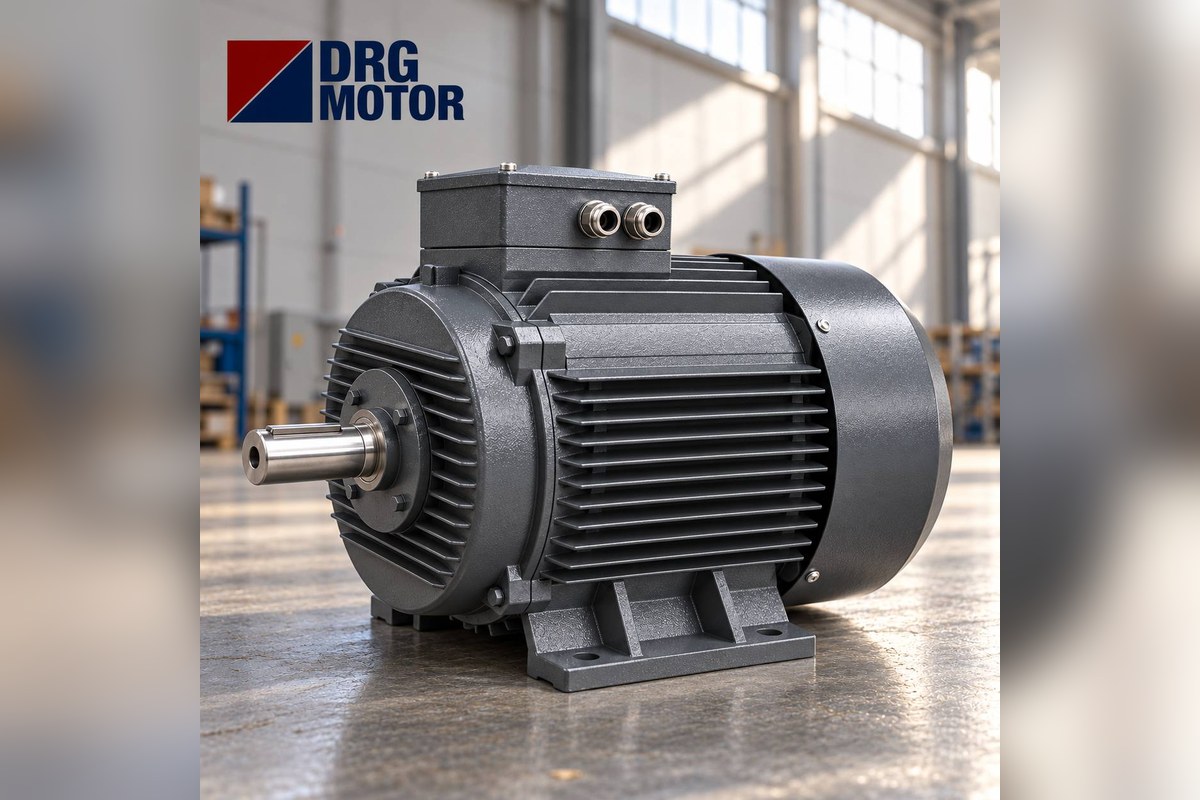

A piston compressor motor is determined not by the tank's litres but by the amount of air the block delivers (l/min) and the working pressure (bar): the same 450 l/min block needs about 3.55 kW of shaft power at 8 bar and 4.00 kW at 10 bar (so a 5.5 kW motor is needed instead of 4 kW), and this value does not change whether the tank holds 100 or 500 litres. A bigger tank only reduces how many times per hour the motor stops and starts. That is why the question "what kW motor for a 300-litre compressor" has no answer on its own; first you need to read the flow and pressure on the block label.
Choosing the motor by tank volume produces errors in two directions on site: an oversized motor is bought for a machine with a big tank but a small block, or an undersized motor is fitted to a small-tank, high-pressure machine and the overload keeps tripping. Motor connection, overload setting and the direction-of-rotation check must be done by a qualified electrician. You can find models matching your flow and pressure, with current prices, among the 120 models on the Buy Electric Motors Online page.
3 mistakes made when choosing a motor by tank volume
- Assuming "big tank, big motor": a 500-litre tank does not force the block to deliver more air or reach a higher pressure. The tank is a store; the motor load is set by the block and the pressure.
- Raising the pressure switch and keeping the same motor: raising the cut-out pressure from 8 to 10 bar significantly increases shaft power on the same block. The motor is overloaded and runs hot although the tank is unchanged.
- Thinking a bigger tank will solve an air shortage: if the plant consumes more air than the block delivers, the tank only lengthens the time it takes to empty; the compressor still runs without stopping. The solution is a bigger block and a motor to match.
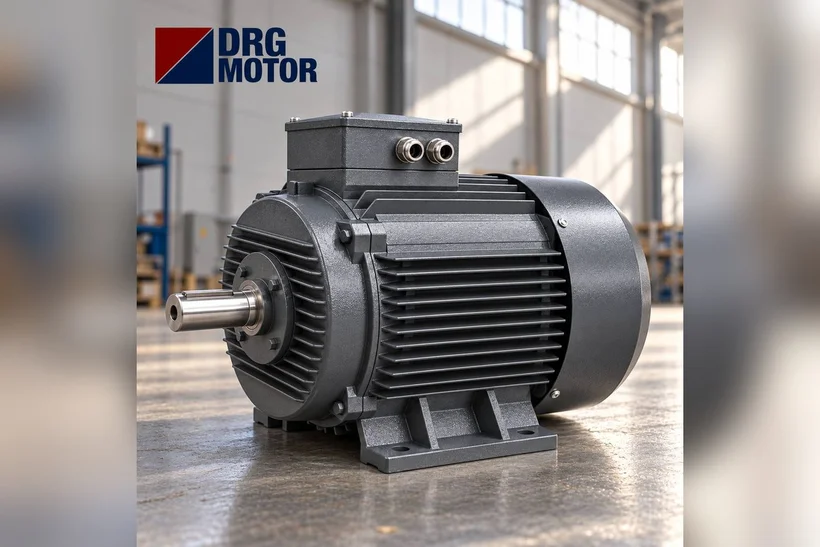
The two values that set motor power: flow and pressure
A block label may show two flow figures: the intake (theoretical, cylinder volume × speed) flow and the free air actually delivered. Motor sizing uses the intake flow, because the block works to compress that volume every revolution. For a single-stage piston block the required shaft power is found approximately from the adiabatic compression relationship:
P (kW) = [k/(k−1)] × p₁ × V̇ × [(p₂/p₁)^((k−1)/k) − 1] / η
Here k = 1.4 (air), p₁ = 1.013 bar absolute intake pressure, p₂ = outlet pressure + 1.013 bar, V̇ the intake flow (m³/s) and η an overall factor representing the block's mechanical and thermal losses. Unless the manufacturer gives η, we assume 0.65; the real value depends on the block. The table below is calculated with that assumption, and the motor is the first standard rating at least 1.1 times the calculated value:
| Flow / pressure | Calculated power | Motor | Current 400 V |
|---|---|---|---|
| 250 l/min / 8 bar | 1.97 kW | DRG-100L1-4 · 2.2 kW | 4.52 A |
| 450 l/min / 8 bar | 3.55 kW | DRG-112M-4 · 4 kW | 7.95 A |
| 450 l/min / 10 bar | 4.00 kW | DRG-132S-4 · 5.5 kW | 10.7 A |
| 650 l/min / 8 bar | 5.13 kW | DRG-132M-4 · 7.5 kW | 14.3 A |
| 900 l/min / 10 bar | 8.00 kW | DRG-160M-4 · 11 kW | 20.4 A |
The 450 l/min rows are the heart of the matter: same block, same tank, and when only the pressure rises from 8 to 10 bar the calculated power goes from 3.55 kW to 4.00 kW, so a 5.5 kW motor is needed instead of 4 kW. The formula is a check for a block with an unreadable label; the definitive value is the power stated by the block manufacturer.
Click to see current electric motor prices and order nowSEE PRICES →
What is the tank for? Calculating the number of starts
The tank stores air between the lower and upper settings of the pressure switch, so the motor does not start every time air is drawn. The motor starts when tank pressure falls to the lower limit and stops at the upper limit. The shortest run-stop cycle occurs when consumption is half the block's delivery and is found from:
Tmin (min) = 4 × Vtank (l) × Δp (bar) / [p₀ (bar) × q (l/min)]
q is the air delivered by the block, Δp the switch differential and p₀ = 1.013 bar atmospheric pressure. For a block delivering 450 l/min with a 2 bar switch differential:
| Tank volume | Shortest cycle | Max starts per hour |
|---|---|---|
| 100 l | 1.75 min | 34 |
| 200 l | 3.51 min | 17 |
| 300 l | 5.26 min | 11 |
| 500 l | 8.77 min | 7 |
The table clearly shows that the tank changes the starting frequency, not the motor power. With a 100-litre tank the motor can start more than 30 times an hour in the worst case; at each start the motor draws several times its rated current and the winding heats up. The 4 kW DRG-112M-4 draws a starting current of 7.8 times rated current direct-on-line. Frequent starting is solved not by a bigger motor but by a bigger tank or a wider switch differential.
Duty ratio: how long is the compressor on load?
The duty ratio is the plant's average air consumption divided by the air the block delivers. For example, if the plant consumes 300 l/min on average and the block delivers 450 l/min, the ratio is about 0.67; the compressor spends about 6.7 minutes of every 10 on load. As the ratio approaches 1 the compressor never stops, starts become fewer but heat builds up; if the ratio is very low the motor starts often at short intervals.
- Ratio close to 1: the block is too small. A bigger motor will not add air; a bigger block with a matching motor, or a second compressor, is needed.
- Medium ratio: motor and block are balanced; the tank should be large enough to keep starts reasonable.
- Very low ratio: the block is oversized; a larger tank or a wider switch differential reduces the number of starts.
Running the motor at its nameplate power with unobstructed fan cooling is how winding temperature is kept under control when the ratio is high. If the compressor sits in a closed cabinet, leave at least a hand's width of clearance in front of the fan cowl.
Checklist before buying a new motor
- Read the intake flow (l/min) and maximum pressure (bar) on the block label; the tank label is not enough for motor selection.
- Confirm the real cut-out pressure of the pressure switch on the gauge; if it has been raised from the factory setting, calculate with that pressure.
- Note the power and speed on the old motor's nameplate; if the speed changes, block speed and delivery change too.
- If the compressor is belt-driven, do not change the pulley ratio; higher block speed means more delivery and more power demand.
- If the panel uses star-delta starting, choose a motor with a 400/690 V nameplate (4 kW and above in the DRG range).
- Set the overload relay to the rated current on the new motor's nameplate; the overload, fuse and contactor selection tool helps with this.
- Check that the unloader valve vents the discharge line after stopping; starting against a pressurised line strains the motor.
Which DRG motor for a piston compressor?
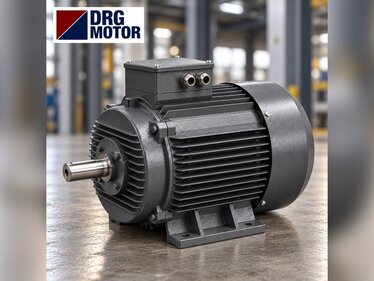
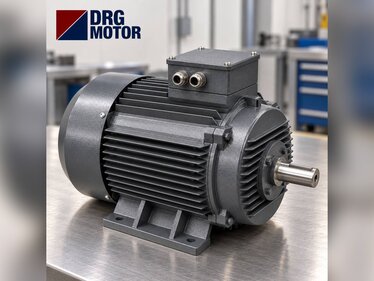
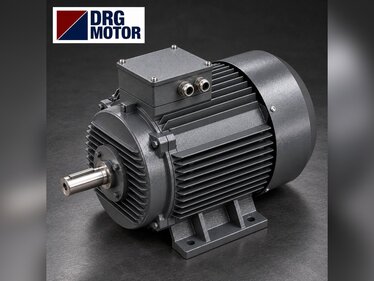
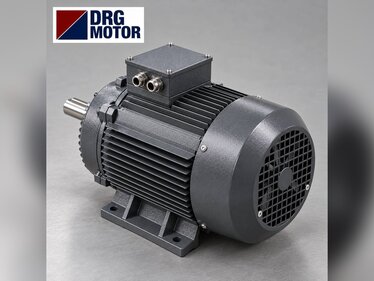
The vast majority of piston compressors run with a belt-driven 4-pole motor. The model most often seen on 450 l/min – 8 bar workshop compressors:
- Model: DRG-112M-4
- Power: 4 kW
- Rated speed: 1450 rpm
- Frame: 112M · cast iron
- Voltage: 400/690 V (Δ/Y)
- Current 400 V: 7.95 A
- cos φ: 0.82
- Rated torque: 26.3 Nm
- Starting torque: 2.2 × Tn
- Starting current: 7.8 × In
- Shaft D × E: 28 × 60 mm
- Bearing: 6206-ZZ-C3
DRG Motor is a manufacturer, supplier and seller of electric motors; DRG MOTOR motors are guaranteed against material and manufacturing defects for 2 years from the delivery date (warranty certificate). If your old motor burned out, find the cause with the steps in our article on why a compressor motor burns out before fitting the new one; we do not repeat its pulley and speed calculation here.
Motors in this power range
- DRG-100L1-4 – 2.2 kW – 1450 rpm – 100L cast iron
- DRG-112M-4 – 4 kW – 1450 rpm – 112M cast iron
- DRG-132S-4 – 5.5 kW – 1460 rpm – 132S cast iron
- DRG-132M-4 – 7.5 kW – 1460 rpm – 132M cast iron
- DRG-160M-4 – 11 kW – 1465 rpm – 160M cast iron
Click to see current prices and order these motors nowSEE PRICES →
Frequently Asked Questions
What kW motor does a 300-litre compressor need?
Motor power does not follow from tank volume. Look at the intake flow and working pressure on the block label: for example a 450 l/min – 8 bar block needs about 3.55 kW shaft power and runs with a 4 kW motor, whether the tank is 300 or 100 litres.
Does a bigger tank overload the compressor motor?
No. A bigger tank only lengthens the initial filling time and reduces the number of starts. The motor load is set by the block delivery and the cut-out pressure.
If I raise the pressure from 8 to 10 bar, is the motor still enough?
Shaft power rises on the same block. In the 450 l/min example it goes from 3.55 kW to 4.00 kW and a 4 kW motor reaches its limit. Do not exceed the pressure allowed by the block manufacturer either.
How many amps does a 4 kW compressor motor draw?
The 4-pole DRG-112M-4 draws 7.95 A at 400 V and 8.37 A at 380 V; direct-on-line starting current rises to 7.8 times rated current.
Send us a photo of the block and motor nameplates and we will choose the right DRG model for your flow and pressure together: Phone +90 (542) 666 11 11, e-mail [email protected], contact page. For all models and current prices, see Buy Electric Motors Online.