English
 Le français
 Türkçe




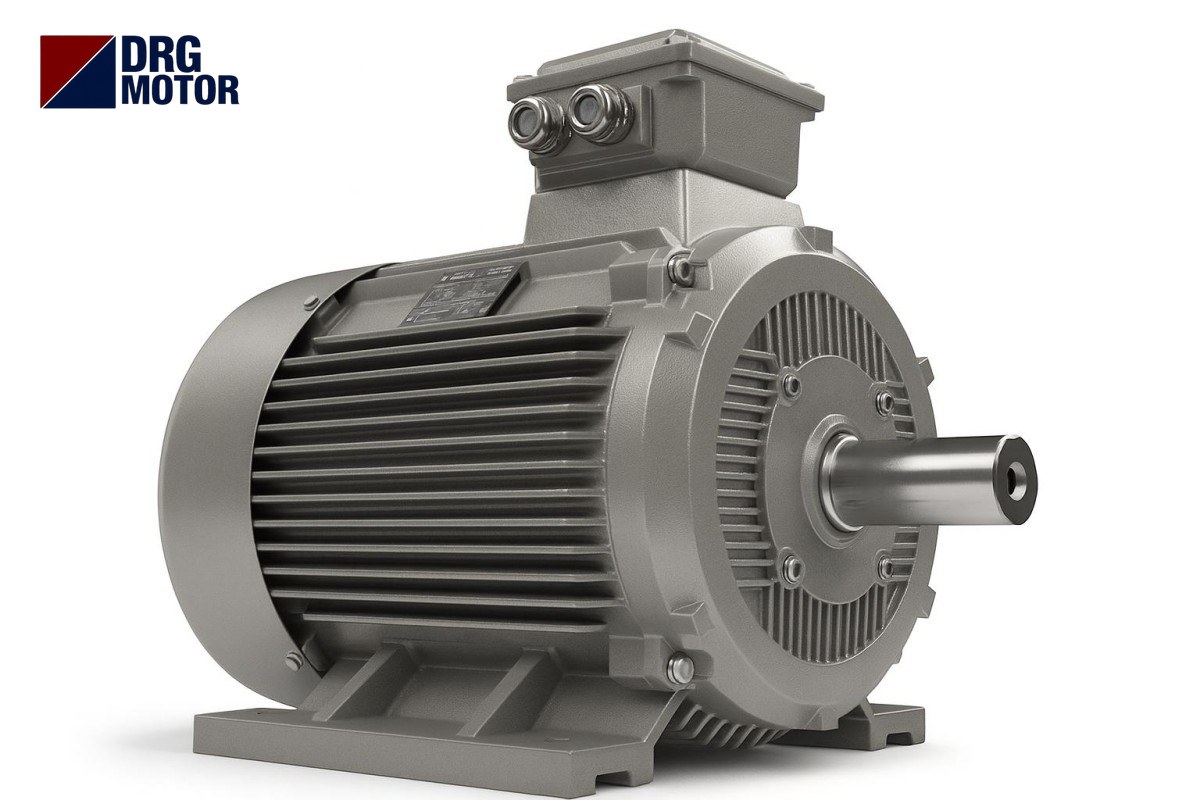

A piston compressor motor most often burns out because it starts against load: when the unloader valve or the check valve fails, the pump head and delivery pipe stay under pressure and the motor cannot overcome it at the next start. Frequent starting and stopping, an over-tight or slipping belt, a hot room with no airflow, phase loss and low voltage follow. For example, a 3 kW two-pole motor has a rated torque of 9.9 Nm and a starting torque 2.2 times that, about 21.8 Nm; with pressure trapped in the head this is not enough, and the motor struggles for seconds at a starting current of about 44.5 A at 400 V while the winding heats up.
Safety first: do not touch the compressor before draining the tank, switching off and locking out the panel, or without the belt guard fitted; removing and measuring the burnt motor and connecting the new one is a job for a qualified electrician. You can filter the replacement motor by poles, power and shaft size on the Buy Electric Motors Online page.
This article covers belt-driven piston workshop compressors. Replacing the motor on a screw compressor is a different job; for that see screw compressor motor selection and replacement.
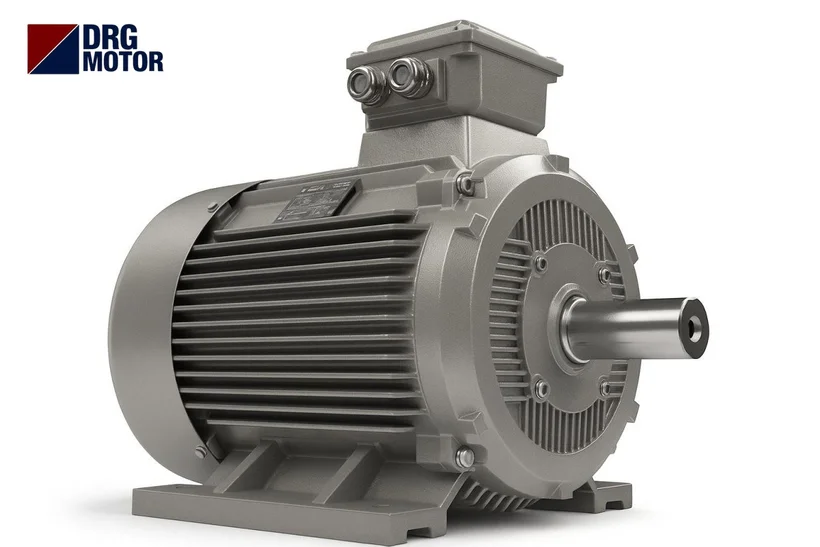
Six causes that burn a piston compressor motor
Find the cause before fitting the new motor; otherwise the second motor will go the same way. The table gives the trace each cause leaves and the lasting fix.
| Cause | How to recognise it | Remedy |
|---|---|---|
| Starting against load | No short air release from the pressure switch when the compressor stops; on restart the motor hums, accelerates slowly and trips the overload | Check the unloader valve and the check valve, replace if necessary |
| Frequent start-stop | The tank fills and empties quickly; the motor starts many times an hour | Fix air leaks, check the pressure switch differential, review tank volume against consumption |
| Belt too tight | The motor front (pulley side) bearing runs hot and noisy | Tension the belt to the deflection recommended by its maker |
| Belt loose / slipping | Squeal at start, hot pulley and belt dust | Tension the belt, replace worn belts as a set, check pulley alignment |
| Hot room with no airflow | Motor frame too hot to touch, fan cover clogged with dust | Leave space behind the fan cover, ventilate any cabinet, clean the fan cover |
| Phase loss / low voltage | The motor hums on two phases or current is above the nameplate; long extension cable | Phase-failure relay, calculate the cable size, measure voltage at the moment of starting |
Starting against load: testing the unloader and check valve
In a piston compressor, the air in the delivery pipe between head and tank must be released every time the motor stops. This is done by the small unloader valve connected to the pressure switch; it is the short “pss” you hear when the compressor stops. The check valve at the tank inlet prevents tank air from flowing back. If either fails, the piston has to move against full pressure at the next start.
The starting torque of an induction motor is limited: 2.2 times the rated torque on the DRG-100L-2 and 2.3 times on the DRG-100L2-4. If that limit is exceeded, the motor cannot accelerate and stays at starting current; on the DRG-100L-2 that is 7.8 times the rated current. The overload trips after a few attempts, but every attempt heats the winding a little more. Checks:
- Let the compressor stop on its own when the tank is full and listen for the release; if there is none, the unloader valve or its small pipe is blocked.
- If the release lasts for seconds and tank pressure drops, the check valve is leaking.
- With the motor stopped (power off, belt guard open), turn the pulley by hand; if it is very stiff under pressure, pressure has stayed in the head.
- In winter, cold oil also makes starting harder; choose compressor oil to the viscosity on the pump label.
Frequent start-stop, belt tension and room temperature
If air consumption empties the tank too quickly or hoses and fittings leak, the motor starts dozens of times an hour. The high current drawn at every start heats the winding; with short pauses the heat accumulates. If the compressor starts by itself at night, the installation is leaking; check the fittings with soapy water.
On the belt side both extremes are harmful. An over-tight belt constantly loads the bearing on the motor pulley side (6206-ZZ-C3 on the DRG-100L2-4); the bearing heats up, then gets noisy and the shaft starts to wobble. A loose belt slips at start, the pulley heats up and the motor draws high current for a long time without ever taking the load. If the pulleys are not in the same plane, the belt wears on its flanks.
Compressors are often placed in a corner, against a wall or inside a closed cabinet. The motor’s cooling air enters through the fan cover; if the back of the fan cover is against a wall or the cover is coated with oily dust, the motor overheats even at nameplate current.
Pulley diameter and compressor speed calculation
When replacing the motor, the compressor pump speed must be kept. The calculation is simple: pump speed = motor speed × motor pulley diameter / compressor (flywheel) pulley diameter. Belt speed is v = π × d × n / 60000 (d in mm, n in rpm, v in m/s).
Example (dimensions are assumptions; measure your own pulleys): with a 350 mm flywheel pulley and a 100 mm motor pulley, the DRG-100L-2 (3 kW, 2895 rpm) turns the pump at about 827 rpm. If a four-pole DRG-100L2-4 (1450 rpm) is fitted with the same pulleys, the pump drops to about 414 rpm and air delivery halves. To reach the same pump speed with the four-pole motor, the motor pulley must be about 200 mm; belt speed is then about 15.2 m/s in both solutions.
| Motor | Motor speed (rpm) | Motor pulley (mm) | Flywheel pulley (mm) | Compressor pump speed (rpm) | Belt speed (m/s) |
|---|---|---|---|---|---|
| DRG-100L-2 | 2895 | 100 | 350 | 827 | 15.2 |
| DRG-100L2-4 | 1450 | 100 | 350 | 414 | 7.6 |
| DRG-100L2-4 | 1450 | 200 | 350 | 829 | 15.2 |
| DRG-100L-2 | 2895 | 110 | 350 | 910 | 16.7 |
The last row shows a common mistake: enlarging the motor pulley to 110 mm “for more air” raises the pump speed to about 910 rpm. Since the power a piston compressor needs at the same pressure rises roughly in proportion to speed (assumption), the motor is loaded above its nameplate. Do not exceed the maximum speed on the pump label; you can repeat the calculation with the pulley and belt calculator.
1500 or 3000 rpm? Choosing the number of poles for a compressor
The safest route is to keep the number of poles of the old motor, so pulley and belt stay unchanged. Small workshop compressors commonly use a two-pole (3000 rpm class) motor with a small motor pulley; larger, slower pumps use a four-pole (1500 rpm class) motor.
- Shaft size: at 3 kW, two- and four-pole DRG motors have the same shaft (28×60 mm); the old pulley fits the new shaft. If the frame changes (e.g. 38×80 when moving to 132), the pulley hub has to be re-machined or a new pulley bought.
- Torque: at 3 kW, the rated torque of the four-pole motor is 19.8 Nm, against 9.9 Nm for the two-pole. The pulley ratio compensates; at the same pump speed, the pump sees the same torque.
- Pulley size: with four poles the motor pulley gets bigger; measure whether the guard and motor slide rail have room.
- Starting: DRG motors from 4 kW upwards have 400/690 V windings, run in delta on a 400 V supply and are suitable for star-delta starting; those up to 3 kW are 230/400 V and are started direct on line. See the options with the motor starting and star-delta tool.
DRG motors for compressors: torque and current table
The starting torque column is the catalogue rated torque multiplied by the Ts/Tn ratio; it shows how limited starting against load is. All values are DRG catalogue data; frames are cast iron.
| Model | kW | Speed (rpm) | Frame | Current 400 V (A) | Rated torque (Nm) | Starting torque (Nm, calculated) | Shaft D×E (mm) | Connection at 400 V |
|---|---|---|---|---|---|---|---|---|
| DRG-90L-2 | 2.2 | 2895 | 90L cast iron | 4.35 | 7.26 | 16 | 24×50 | Y (star) |
| DRG-100L-2 | 3 | 2895 | 100L cast iron | 5.71 | 9.9 | 21.8 | 28×60 | Y (star) |
| DRG-112M-2 | 4 | 2905 | 112M cast iron | 7.45 | 13.1 | 28.8 | 28×60 | Δ (delta) |
| DRG-132S2-2 | 7.5 | 2930 | 132S cast iron | 13.7 | 24.4 | 48.8 | 38×80 | Δ (delta) |
| DRG-100L1-4 | 2.2 | 1450 | 100L cast iron | 4.52 | 14.5 | 33.3 | 28×60 | Y (star) |
| DRG-100L2-4 | 3 | 1450 | 100L cast iron | 6.02 | 19.8 | 45.5 | 28×60 | Y (star) |
| DRG-112M-4 | 4 | 1450 | 112M cast iron | 7.95 | 26.3 | 57.9 | 28×60 | Δ (delta) |
| DRG-132S-4 | 5.5 | 1460 | 132S cast iron | 10.7 | 36 | 72 | 38×80 | Δ (delta) |
| DRG-132M-4 | 7.5 | 1460 | 132M cast iron | 14.3 | 49.1 | 98.2 | 38×80 | Δ (delta) |
Since a compressor works in a dusty environment with vibration, a cast iron frame is preferred; aluminium-frame models of the same power are also in the store.
First start-up checklist after replacing the motor
- Set the overload or motor protection breaker to the nameplate current: for the DRG-100L-2, 5.71 A at 400 V and 6.02 A at 380 V; for the DRG-100L2-4, 6.02 A at 400 V and 6.34 A at 380 V. Check overload and contactor sizes with the overload, fuse and contactor selection tool.
- Fit the terminal links for the nameplate voltage; a 230/400 V motor is star-connected on a 400 V supply.
- Compare the direction of rotation with the arrow on the pump and the direction of its cooling fan; a pump running backwards may not be lubricated.
- Bring the pulleys into one plane with a straightedge, tension the belt, fit the guard.
- Start with the tank empty, wait for it to stop when full and listen for the release; then watch a restart against a pressurised tank.
- Measure the current of all three phases with a clamp meter; it must be below nameplate and balanced.
- Note how often the compressor starts; if too often, fix the leak or tank problem.
Motors in this power range
The power ratings most often replaced on workshop compressors:
- DRG-100L-2 – 3 kW – 2895 rpm – 100L cast iron
- DRG-112M-2 – 4 kW – 2905 rpm – 112M cast iron
- DRG-100L2-4 – 3 kW – 1450 rpm – 100L cast iron
- DRG-112M-4 – 4 kW – 1450 rpm – 112M cast iron
- DRG-132S-4 – 5.5 kW – 1460 rpm – 132S cast iron
Click to see current prices and order these motors nowSEE PRICES →
Frequently Asked Questions
Why does my compressor motor struggle to start?
The most common reason is pressure trapped in the head: the unloader valve is not releasing or the check valve is leaking. Low voltage, a long thin extension cable and cold oil also make starting harder. Measure the voltage at the motor terminals at the moment of starting.
What speed should a compressor motor have?
The same number of poles as the old one. Two-pole motors are common on small workshop compressors (DRG-100L-2: 2895 rpm); if a four-pole motor (DRG-100L2-4: 1450 rpm) is fitted, the motor pulley must be roughly doubled to keep the pump speed.
How many amps does a 3 kW compressor motor draw?
The DRG-100L-2 draws 5.71 A at 400 V and 6.02 A at 380 V; the four-pole DRG-100L2-4 draws 6.02 A at 400 V. At start-up, the DRG-100L-2 current rises to 7.8 times the rated value, about 44.5 A.
My compressor motor keeps tripping the overload. What should I do?
Do not raise the overload setting. First check the unloader valve, belt tension, cleanliness of the fan cover and the voltage of all three phases; measure the running current. If it is above the nameplate, the pump or the pulley ratio is overloading the motor.
Send us a photo of the old motor’s nameplate, the pulley diameters and the shaft size, and we will find the right model together: phone +90 (542) 666 11 11, e-mail [email protected], contact page https://drgmotor.com/en/contact. DRG Motor is an electric motor manufacturer and supplier; you can order straight away from the 120 models in our online store.