English
 Le français
 Türkçe




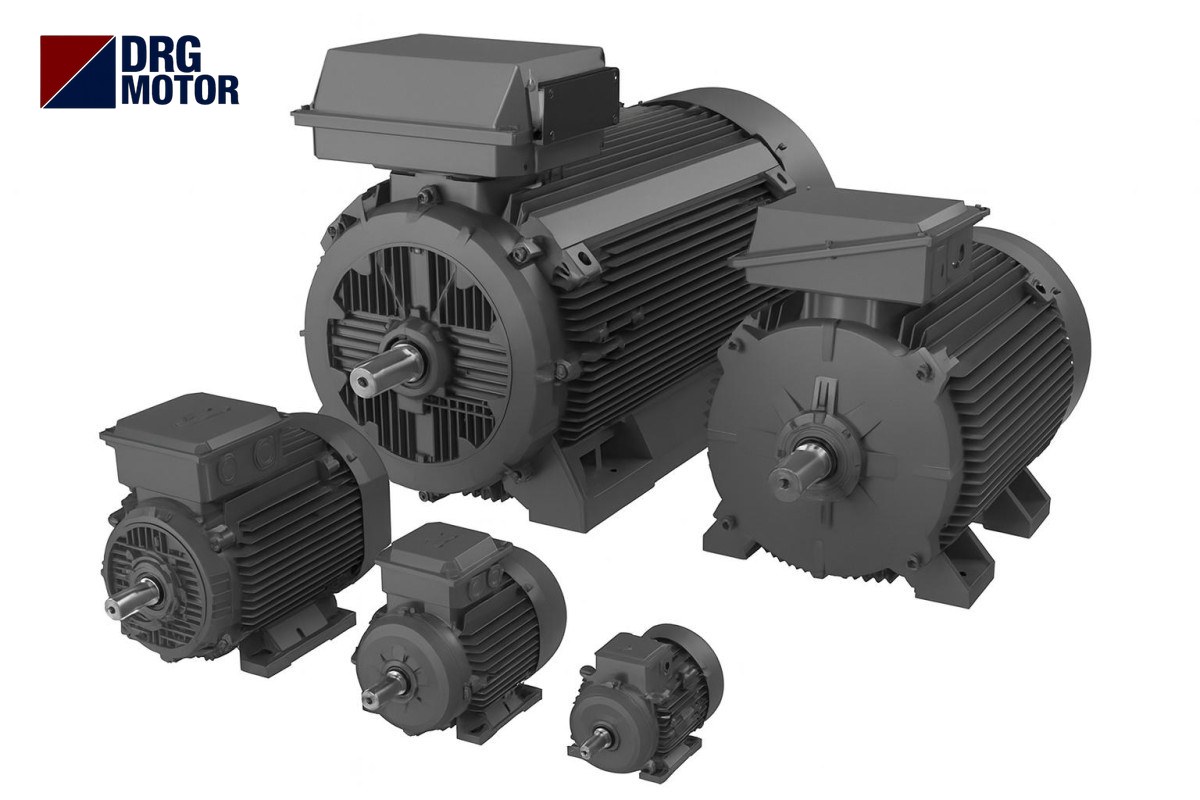

A hammer-type feed mill (feed grinder) almost always runs on a 2-pole motor: in the DRG catalogue the rated speed of this class is 2930–2960 rpm, and the hammers turn at that speed. Small farm-type grinders typically carry 5.5–15 kW, while grinders handling several tonnes per hour usually have 18.5–30 kW or more. A feed mixer (vertical or horizontal) is the opposite: it turns slowly and uses a 4-pole motor of about 1460 rpm through a gearbox. The exact power is on the machine nameplate and in the manufacturer's data; the ranges here are guidance and the calculations are examples with stated assumptions.
What really sets the grinder's power is throughput, screen hole size and grain type: grinding maize through a fine screen needs clearly more power than grinding barley through a coarse one on the same machine. In a mixer, power rises with hopper volume and mix density (molasses, oil, moisture). That is why, for most replacements, the safest route is to keep the kW and speed on the old motor's nameplate and only match the frame and shaft size.
Once you have picked a model, all frame and power options are on the Buy Electric Motors Online page; the motor needs of a complete feed plant are covered in our article on motor supply for feed mills and feed machines.
Feed grinding vs feed mixing: two machines, two different motors
The two machines stand side by side in the same plant, yet they expect completely different things from the motor:
| Feature | Hammer feed grinder | Feed mixer |
|---|---|---|
| Number of poles | 2 poles (≈3000 rpm class) | 4 poles (≈1500 rpm class) |
| Drive | Direct coupling or belt and pulley | Gearbox (mostly flange-mounted) or gearbox + chain |
| Load profile | Heavy rotor, long run-up, load varies with feeding | High torque at low speed, start with a full hopper |
| Critical value | Hammer tip speed, starting current | Mixer shaft torque, gear ratio |
| Mounting | B3 foot-mounted on a slide base | B5 flange (to the gearbox) or B3 |
Why 2 poles on a hammer grinder? Tip speed calculation
A hammer grinder breaks grain by impact, and the impact is set by the peripheral speed of the hammer tip: v = π·D·n/60. Take a rotor diameter (tip to tip) of 500 mm as an example:
- With DRG-160L-2 (2940 rpm): v = π × 0.5 × 2940 / 60 ≈ 77.0 m/s
- With DRG-160L-4 (1465 rpm): v = π × 0.5 × 1465 / 60 ≈ 38.4 m/s
On the same rotor a 4-pole motor halves the tip speed; grain circulates in the chamber before it is fine enough to pass the screen, throughput falls and the motor is loaded for nothing. So do not change the number of poles when replacing the motor. On large-diameter rotors the builder sometimes lowers the speed with belts; on such a machine measure the motor and machine pulley diameters and check the ratio with the pulley and belt calculator. On a direct-coupled grinder the coupling alignment and the shaft size (D×E) must match exactly.
From throughput to kW: an example with stated assumptions
A grinder's specific energy (kWh per tonne) depends on grain and screen; if it is not in the machine catalogue, no exact figure can be given without measuring. For the example assume 8 kWh per tonne and a target of 2 tonnes of maize per hour:
- Required shaft power ≈ 2 t/h × 8 kWh/t = 16 kW
- 15% margin for feed fluctuation and screen clogging: 16 × 1.15 ≈ 18.4 kW
- Next standard rating: 18.5 kW → DRG-160L-2
Check: the catalogue rated torque of DRG-160L-2 is 60.1 Nm; with P = T·n/9550, 9550 × 18.5 / 2940 ≈ 60.1 Nm, consistent with the data. If the assumed 8 kWh/t changes, the result changes linearly: the same calculation gives 15 kW at 6 kWh/t and 22 kW at 10 kWh/t. If the power on the old motor's nameplate falls in this range, go by the nameplate.
Starting a heavy rotor: star-delta and cabling
The hammer rotor and flywheel lengthen the run-up time, during which the motor draws several times its rated current. For DRG-160L-2 the catalogue starting current ratio is Is/In = 8.2: with a rated current of 32.5 A at 400 V, direct-on-line starting gives about 8.2 × 32.5 ≈ 266.5 A. With star-delta starting this drops to roughly one third, ≈ 89 A. Remember that starting torque also falls to one third, so the grinder should start empty (no feed) in star, and the feed gate should open only after switching to delta.
Star-delta requires the motor to run in delta at 400 V. In the DRG catalogue, models of 4 kW and above are wound 400/690 V (Δ/Y) and suit this method; models of 3 kW and below are wound 230/400 V, are connected in star on a 400 V supply and are started direct-on-line. See our motor starting methods and star-delta page for a detailed comparison.
Cable example (copper, PVC, indicative values): for a design current of 32.5 A × 1.25 ≈ 40.6 A, the table on our site shows 6 mm² (43 A) as sufficient. On a 40 m run with cos φ = 0.89 the voltage drop is ΔU = √3 × 32.5 × 0.04 × 3.08 × 0.89 ≈ 6.2 V, i.e. 1.5%. Keep in mind that star-delta needs two cables to the motor and that installation conditions change the result; use the motor cable size calculator with your own values and let an electrical engineer make the final call.
Motor and gearbox selection for a feed mixer
In a mixer the motor is defined by the torque and speed the mixing shaft needs. Example: the mixing shaft is to turn at 60 rpm and the builder specifies 7.5 kW. With the 4-pole DRG-132M-4 (1460 rpm, 49.1 Nm) the gear ratio is i = 1460 / 60 ≈ 24.3. Assuming a factor of 0.9 for gearbox losses, output torque ≈ 49.1 × 24.3 × 0.9 ≈ 1075 Nm. You can try the ratio and torque with your own values in the gearbox output speed and torque calculator.
Choosing a 2-pole motor for a mixer doubles the gear ratio needed for the same output speed and halves the motor torque; the risk of struggling when starting with a full hopper increases. On mixers that stop and start often with a full load, 4 poles and a B5 flange suited to the gearbox are the most common solution. On flange motors, match the gearbox flange dimensions (M, N, P) and the shaft D×E before ordering.
Dust, moisture and the fan cowl: motor life in a feed plant
Flour-fine dust flies around the grinding unit; it builds up on the fan cowl grille and between the housing fins and cuts off cooling. In dusty areas choose a motor with at least IP55 protection and confirm the protection rating when ordering; we cover this separately in IP55 motor selection for dusty areas. Make sure the fan cowl inlet is not too close to a wall or the grinder housing.
Checklist before replacing the motor
- Photograph the kW, speed, voltage and connection (Δ/Y) on the old motor's nameplate.
- Keep the number of poles: 2 poles on the grinder, usually 4 poles on the mixer.
- Measure shaft diameter and length (D×E); the coupling or pulley bore is machined to it.
- Check the foot hole spacing and shaft height (H) so the base holes do not change.
- On a flange-mounted mixer motor, note the M/N/P dimensions of the gearbox flange.
- Set the overload relay to the rated current on the motor nameplate.
- At 4 kW and above, confirm the star-delta panel matches the motor winding (400/690 V).
- Add the fan cowl and fins to a regular cleaning schedule.
Suitable DRG models for feed grinding and mixing
Values in the table come from the DRG catalogue (cast iron frame, 400 V). The first six rows are 2-pole options for hammer grinders, the last four are 4-pole options for mixers and geared drives.
| Model | Power (kW) | Rated speed (rpm) | Frame | Current 400 V (A) | Rated torque (Nm) | Is/In | Shaft D×E (mm) |
|---|---|---|---|---|---|---|---|
| DRG-132S2-2 | 7.5 | 2930 | 132S cast iron | 13.7 | 24.4 | 7.9 | 38×80 |
| DRG-160M1-2 | 11 | 2945 | 160M cast iron | 19.6 | 35.7 | 8.1 | 42×110 |
| DRG-160M2-2 | 15 | 2945 | 160M cast iron | 26.5 | 48.6 | 8.1 | 42×110 |
| DRG-160L-2 | 18.5 | 2940 | 160L cast iron | 32.5 | 60.1 | 8.2 | 42×110 |
| DRG-180M-2 | 22 | 2955 | 180M cast iron | 38.5 | 71.1 | 8.2 | 48×110 |
| DRG-200L1-2 | 30 | 2960 | 200L cast iron | 52.1 | 96.8 | 7.6 | 55×110 |
| DRG-132S-4 | 5.5 | 1460 | 132S cast iron | 10.7 | 36 | 7.9 | 38×80 |
| DRG-132M-4 | 7.5 | 1460 | 132M cast iron | 14.3 | 49.1 | 7.5 | 38×80 |
| DRG-160M-4 | 11 | 1465 | 160M cast iron | 20.4 | 71.7 | 7.7 | 42×110 |
| DRG-160L-4 | 15 | 1465 | 160L cast iron | 27.3 | 97.8 | 7.8 | 42×110 |
Motors in this power range
- DRG-132S2-2 – 7.5 kW – 2930 rpm – 132S cast iron
- DRG-160M2-2 – 15 kW – 2945 rpm – 160M cast iron
- DRG-160L-2 – 18.5 kW – 2940 rpm – 160L cast iron
- DRG-180M-2 – 22 kW – 2955 rpm – 180M cast iron
- DRG-132M-4 – 7.5 kW – 1460 rpm – 132M cast iron
- DRG-160L-4 – 15 kW – 1465 rpm – 160L cast iron
Click to see current prices and order these motors nowSEE PRICES →
Frequently Asked Questions
What kW motor does a feed grinder need?
Small farm-type hammer grinders usually have 5.5–15 kW, larger capacities 18.5–30 kW or more. The exact value is the machine nameplate and the builder's data; keep the nameplate power when replacing.
What speed should a feed grinder motor have?
Hammer grinders use 2-pole motors; in the DRG catalogue the rated speed of this class is 2930–2960 rpm. A 4-pole motor halves the hammer tip speed on the same rotor.
How many amps does a 7.5 kW feed grinder motor draw?
The 2-pole DRG-132S2-2 draws 13.7 A at 400 V and 14.4 A at 380 V at full load. At no load or light feeding the current stays below that.
Is a 1500 rpm motor used on a feed mixer?
Yes, mixers usually use a 4-pole (≈1500 rpm class) motor with a gearbox; for example DRG-132M-4 delivers 49.1 Nm at a rated speed of 1460 rpm.
Send us the power, speed, shaft and mounting data from your machine nameplate and we will pin down the matching DRG model together. Phone: +90 (542) 666 11 11 · E-mail: [email protected] · Contact page. For all models and ordering: Buy Electric Motors Online.