English
 Le français
 Türkçe




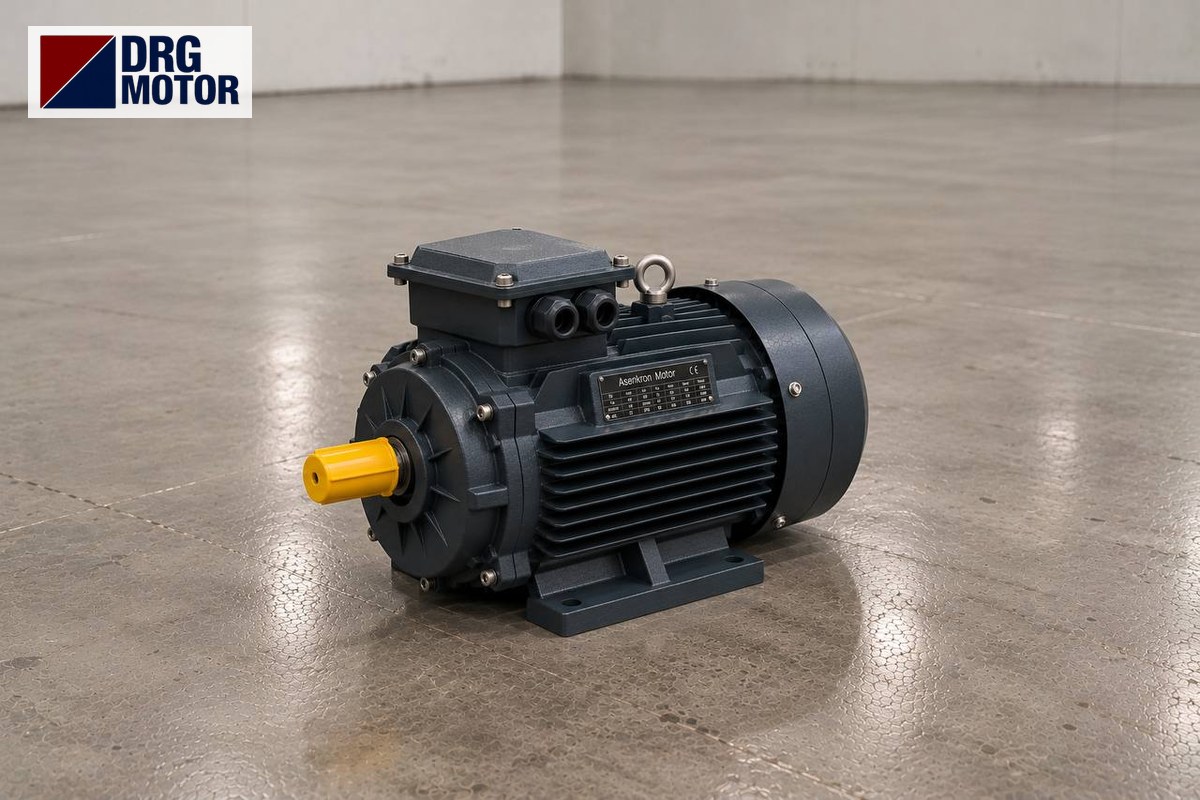

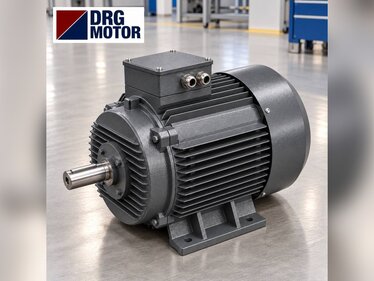
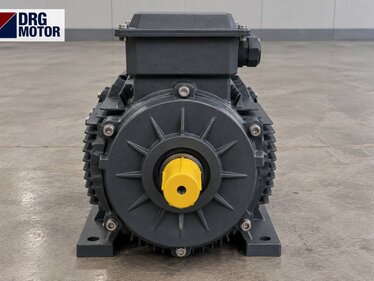
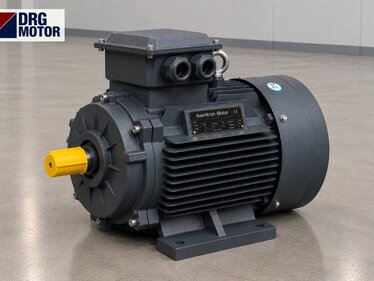
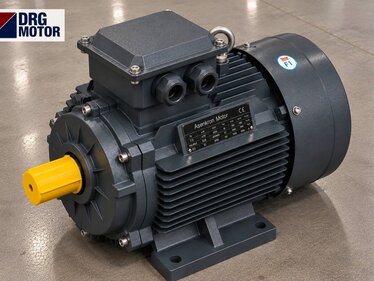
The pump motor of an industrial parts washing machine is usually a 2-pole (3000 rpm class), IP55 three-phase motor, and its power follows from the pump's flow and pressure using P = Q · Δp / η. For example, a washing system spraying 14.4 m³/h at 4 bar needs about 3 kW of shaft power; the standard motor that covers it is the 4 kW DRG-112M-2 (2905 rpm, 7.45 A at 400 V). On small cabinet machines the pump motor is typically 1.5–4 kW, and on multi-stage tunnel lines 5.5–11 kW per stage; the exact value is given by the pump label and the machine builder.
What wears out the pump motor in these machines is not the power itself but the environment: hot detergent water, steam rising when the cabinet door opens, moisture condensing as the machine cools overnight, and hot liquid leaking from the pump seal. Below you will find motor mounting by pump type, the power calculation, precautions against moisture and seal leakage, and the motor replacement steps; suitable models are on the Buy Electric Motors Online page. The connection, earthing and insulation measurement of a motor working in a wet environment must always be carried out by a qualified electrician.
Pump Type and Motor Mounting in a Washing Machine
Parts washing machines use pumps in four common layouts. The motor's mounting arrangement, shaft position and need for moisture protection change with the layout:
| Washing layout | Pump type | Motor mounting | Typical poles |
|---|---|---|---|
| Basket / rotary table spray | Horizontal centrifugal (close-coupled) | B5 or B35, horizontal | 2-pole |
| Immersion tank circulation | Vertical tank pump | B5 flange, vertical (V1) | 2- or 4-pole |
| High-pressure rinse | Multistage centrifugal | B5 flange, vertical or horizontal | 2-pole |
| Multi-stage tunnel line | Centrifugal per stage | B5 or B35, horizontal | 2-pole |
On vertical tank pumps the motor stands on the tank lid with the shaft pointing down (V1); this is where steam is most intense. On close-coupled horizontal pumps the pump casing bolts directly to the motor flange, and seal leakage reaches the motor end shield first. In both cases the motor itself is the same; the difference comes from mounting direction and protection details.
Calculating Pump Motor Power from Flow and Pressure
On a spray machine the flow is set by the number of nozzles and the flow per nozzle. The values in the example below are assumptions; on your own machine use the nozzle catalogue and the pressure gauge.
- 40 nozzles, 6 L/min per nozzle → Q = 240 L/min = 14.4 m³/h = 0.004 m³/s
- Working pressure Δp = 4 bar = 400,000 Pa
- Pump efficiency η = 0.55 (assumption for a small centrifugal pump)
- Shaft power: P = 0.004 × 400,000 / 0.55 ≈ 2,909 W ≈ 2.9 kW
- With a 10% margin ≈ 3.2 kW → next standard power up 4 kW (DRG-112M-2)
Check: T = 9550 · P / n = 9550 × 4 / 2905 ≈ 13.1 Nm; the catalogue rated torque of DRG-112M-2 is also 13.1 Nm. To calculate with your own values, use the pump and fan motor power calculator.
One behaviour of the centrifugal pump directly affects motor selection: when nozzles clog the flow drops and the motor is less loaded; when a nozzle falls off or a hose bursts the flow rises, pressure drops and the motor is more loaded. If the overload relay trips often, the first thing to check is a missing nozzle or a bypass valve left open. That is why, on a washing machine, going one power size up rather than selecting the motor right at the limit is a sound decision.
DRG models by pump power
| Model | Power / speed | Frame | Current 400 V |
|---|---|---|---|
| DRG-90L-2 | 2.2 kW / 2895 rpm | 90L cast iron | 4.35 A |
| DRG-100L-2 | 3 kW / 2895 rpm | 100L cast iron | 5.71 A |
| DRG-112M-2 | 4 kW / 2905 rpm | 112M cast iron | 7.45 A |
| DRG-132S1-2 | 5.5 kW / 2930 rpm | 132S cast iron | 10.1 A |
| DRG-132S2-2 | 7.5 kW / 2930 rpm | 132S cast iron | 13.7 A |
Aluminium-frame versions of the same models are also in the store; their electrical values are the same as those shown in the table.
Hot Water, Steam and Moisture: How to Protect the Motor
DRG motors have IP55 protection: they are protected against water jets from any direction, but they are not designed for immersion or for being hosed with pressurised water continuously. On a washing machine the real risk is not splashing water but condensation forming inside the motor frame. A motor that warms up during the day contracts the air inside as it cools overnight, draws in humid outside air, and water droplets form on the windings.
- Position the motor away from the steam vent and the side where the cabinet door opens.
- The terminal box cable entry should face down; water running along the cable from an upward-facing gland drips straight onto the terminals. Leave a drip loop (a downward-hanging loop in the cable) before the gland.
- On a vertical (V1) motor the fan cover faces up; fit a rain-hood type cover on top of the motor so that condensate dripping from above does not enter the fan cover.
- After a weekend or maintenance stop, have an electrician measure the winding insulation resistance before starting the machine; a low value indicates moisture in the winding.
- Do not wash the motor frame with pressurised water; wipe off detergent residue with a damp cloth.
For terminal box gasket and cable entry details, see our article on the motor terminal box: IP protection and cable entry.
How Gland and Mechanical Seal Leakage Affects the Motor
In a close-coupled pump the impeller is mounted on the motor shaft and the mechanical seal is only a few centimetres from the motor's front flange. When the seal wears, hot detergent water leaks along the shaft towards the motor end shield. If this liquid passes the bearing seal it washes out the bearing grease; alkaline additives in the detergent start corrosion on the bearing surfaces. The result is first a rustling noise, then heating and finally bearing seizure.
Early signs of leakage: white scale or detergent residue around the motor flange, constant wetness under the pump, rust stains on the motor end shield. When you see these signs, replace the seal immediately; leaving the motor running because "it still works" makes a bearing replacement unavoidable. On DRG motors the front bearing depends on the frame: 6205-ZZ-C3 on frame 90, 6206-ZZ-C3 on frames 100L and 112M, 6208-ZZ-C3 on frame 132. When replacing the bearing, use the same type and clearance class.
Vertical Mounting, Flange and Shaft Size
On the pump side the part carrying the motor is the lantern or bell housing; the new motor's B5 flange and shaft end must fit it exactly. For a motor to be used vertically (V1), state the mounting position in the order.
| Frame | Shaft D×E | Flange P / M / N | Hole S |
|---|---|---|---|
| 80 | 19 × 40 mm | 200 / 165 / 130 mm | 12 mm |
| 90S / 90L | 24 × 50 mm | 200 / 165 / 130 mm | 12 mm |
| 100L | 28 × 60 mm | 250 / 215 / 180 mm | 14.5 mm |
| 112M | 28 × 60 mm | 250 / 215 / 180 mm | 14.5 mm |
A practical conclusion follows from the table: frames 100L and 112M share the same B5 flange and shaft end (28 × 60 mm). So, if the pump allows it, you can upgrade a 3 kW pump motor to 4 kW without changing the lantern. Moving from frame 80 to frame 90, however, the flange stays the same but the shaft diameter rises from 19 mm to 24 mm, so the pump coupling or impeller hub changes. Dimension drawings are on the DRG motor technical drawings page.
Connection, Cable Size and Overload Setting
DRG motors of 3 kW and below are 230/400 V and connected in star (Y) on a 400 V supply; those of 4 kW and above are 400/690 V and connected in delta (Δ) at 400 V. Check the old motor's nameplate on this point as well: connecting a 230/400 V motor in delta at 400 V burns the winding quickly.
Example cable check (4 kW, DRG-112M-2, 30 m run, 1.5 mm² copper):
- Sizing current: 7.45 × 1.25 ≈ 9.3 A; the table value for 1.5 mm² cable is 18.5 A → sufficient.
- Voltage drop: ΔU = √3 × 7.45 × 0.03 × 12.1 × 0.88 ≈ 4.1 V → about 1.0% at 400 V (below the 3% limit).
For your own run length use the motor cable size calculator, and for the overload relay and fuse the overload, fuse and contactor selection page. Set the overload relay to the motor's rated current at 400 V (7.45 A at 4 kW); setting it higher leaves the motor unprotected when a nozzle comes off.
Pump Motor Replacement: Checklist
- Note power, speed, voltage, connection and current from the old motor's nameplate.
- Take the flange P / M / N, hole S and shaft D×E dimensions; determine the mounting position (horizontal or vertical V1).
- Check the pump seal; if it leaks, replace it together with the motor.
- Before fitting the motor, check that the pump shaft turns freely by hand (seizure from scale or deposits).
- Position the terminal box with the cable entry facing down, tighten the gasket and glands.
- Have the electrician make the connection (Y/Δ) and earthing and measure insulation resistance.
- The pump must not run dry: check the direction of rotation with a few seconds' run while the tank is full; if reversed, two phases are swapped.
- Measure the current with all nozzles fitted and compare it with the rated current; record the value in the maintenance log.
For the general rules of pump motor selection, see also our article on choosing a motor for a water pump.
Motors in This Power Range
- DRG-100L-2 – 3 kW – 2895 rpm – 100L cast iron
- DRG-112M-2 – 4 kW – 2905 rpm – 112M cast iron
- DRG-112M-2 – 4 kW – 2905 rpm – 112M aluminium
- DRG-132S1-2 – 5.5 kW – 2930 rpm – 132S cast iron
Click to see current prices and order these motors nowSEE PRICES →
Frequently Asked Questions
What kW should a parts washer pump motor be?
It is calculated from flow and pressure: P = Q · Δp / η. For 14.4 m³/h and 4 bar the result is about 2.9 kW, so a 4 kW motor is selected. Small cabinet machines commonly use 1.5–4 kW, tunnel lines 5.5–11 kW per stage; the exact value is on the pump label.
How many amps does a 4 kW pump motor draw?
The DRG-112M-2 draws 7.45 A at 400 V and 7.84 A at 380 V at full load. At start it rises up to 8.3 times the rated current; that is why fuse selection differs from the overload setting.
Why does a washing machine pump motor trip the overload?
The most common causes: a missing nozzle or burst hose (flow increases, the motor is overloaded), a bearing worn by seal leakage, a pump shaft stiffened by scale, low supply voltage and a wrong Y/Δ connection. Measure the current under load first.
Can a 4 kW motor replace a 3 kW pump motor?
At DRG, frames 100L (3 kW) and 112M (4 kW) share the same B5 flange and shaft end, so they fit mechanically. However, the 4 kW motor is connected in delta at 400 V and the overload is set to 7.45 A; also check on its label that the pump is suitable for this power.
Send us your pump motor's nameplate or flange dimensions and we will determine the right DRG model together: +90 (542) 666 11 11, [email protected], contact page. You can browse all pump motor options among the 120 models in our online store.