English
 Le français
 Türkçe

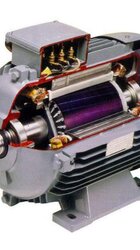

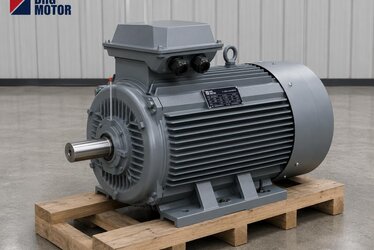
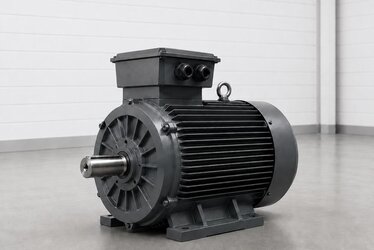
A greenhouse operator called us to replace the burned-out motor of a centrifugal pump that delivers water from a well to a storage tank. All they knew was the motor power: 11 kW. When asked about the speed, mounting type, flange size and the pump's nameplate data, the answer was "we don't know". Choosing the right pump motor takes more than knowing the power: the power the pump actually draws, speed matching, how the motor connects to the pump, the risk of dry running and water hammer, a humid pump room and a long cable run. In this article we cover them one by one with a worked example and a checklist.
Calculate the Power the Pump Needs at the Shaft
Pump power is calculated from the amount of water delivered and the height it is lifted to:
P = ρ · g · Q · H / ηpump
- ρ: liquid density (1000 kg/m³ for clean water)
- g: gravitational acceleration (9.81 m/s²)
- Q: flow rate (m³/s)
- H: total head (m) — geometric height + pipe and valve losses + required outlet pressure
- ηpump: pump efficiency at the operating point; read from the pump curve
The most common mistake is taking H as the tank height only. In a long, narrow pipe, friction losses can reach a significant part of the geometric height. To try the formula with your own values, you can use our electric motor calculators.
Worked example: centrifugal pump filling a storage tank
Line data: flow 60 m³/h, total head 40 m, efficiency read from the pump curve 0.72, clean water.
- Flow: 60 / 3600 = 0.01667 m³/s
- Shaft power: 1000 × 9.81 × 0.01667 × 40 / 0.72 ≈ 9083 W ≈ 9.08 kW
- Margin: with a 1.15 safety margin for pumps in this power range, 9.08 × 1.15 ≈ 10.45 kW
- Selection: the next standard rating up, an 11 kW, 3000 rpm motor
Density and end-of-curve check
If the same pump handles a liquid with a density of 1200 kg/m³ (brine, for example), power rises 1.2 times: 9.08 × 1.2 ≈ 10.9 kW. The 11 kW motor still looks sufficient, but the margin is almost gone; with the 1.15 margin the requirement becomes 12.5 kW, and you need to move to a 15 kW motor.
The second check is the end of the pump curve. In a centrifugal pump, the power drawn usually rises as flow increases. When the tank is empty, a pipe bursts or the discharge valve is fully open, the pump moves to the right-hand end of its curve. Check the motor not only against the design point but against the highest power value on the curve.
Matching 2900 and 1450 rpm in Centrifugal Pumps
On a 50 Hz supply, centrifugal pumps usually run with a 2-pole (about 2900 rpm) or 4-pole (about 1450 rpm) motor. The speed the pump was designed for is stated on its nameplate and curve; the motor is chosen for that speed, and a motor with a different speed is not fitted just because "one is lying around in the workshop".
Why? On the same pump, halving the speed halves the flow, cuts the head to a quarter and the power to an eighth. In the example above, a pump selected for 2900 rpm delivers 30 m³/h and only 10 m of head with a 1450 rpm motor; no water reaches the tank 40 m up. The reverse is more dangerous: fitting a 2900 rpm motor to a pump designed for 1450 rpm multiplies the power by eight, damaging both motor and pump.
The suction side also affects the choice of speed. If the pump draws from a well or from a tank below it, the risk of cavitation rises at high speed: pressure drops at the impeller inlet, water vaporises and erodes the impeller. For applications with a large suction lift, the pump manufacturer often recommends a lower-speed model, and the motor selection follows.
| Topic | 2900 rpm (2-pole) | 1450 rpm (4-pole) |
|---|---|---|
| Typical use | Booster sets, well-to-tank transfer, high head | High-flow circulation, irrigation, wastewater, viscous liquids |
| Pump size | Smaller impeller for the same duty | Larger impeller and casing |
| Wear and cavitation | Faster wear in sandy water | More tolerant of sandy and particle-laden water |
| Noise | Higher | Lower |
| Motor torque (same kW) | Lower | About twice as high |
Close-Coupled B5/B35 or Coupling-Driven B3?
How the pump and motor are joined determines the motor's mounting type:
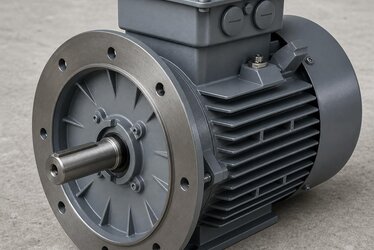
- Close-coupled pump (B5 or B35): The pump casing bolts directly to the motor flange, and the impeller sits on the motor shaft or on an extension fitted to it. Flange size (spigot diameter, bolt circle), shaft diameter and length, and key must match exactly. B35 has both feet and flange; on heavy pumps the motor is also fixed by its feet.
- Coupling-driven pump (B3): Pump and motor are foot-mounted on a common baseplate with a flexible coupling between them. Replacing the motor is easier, but shaft height (H) and foot hole spacing must match, and the unit must not be run before the coupling is aligned.
In a close-coupled design, the axial thrust produced by the impeller and the impeller's weight act directly on the motor bearings. The motor design the pump manufacturer specifies for this connection (bearing arrangement, shaft end) must therefore be kept. For vertical close-coupled pumps, the order should state that the motor will run shaft-down. In a coupling-driven design, the axial load is carried by the pump's own bearings; only the force from misalignment reaches the motor bearing. On a coupling-driven pump started without alignment, the motor bearing soon becomes noisy.
A common replacement mistake is buying a motor of "the same power" but with a different flange or shaft length for a close-coupled pump. Before ordering, send the old motor's nameplate together with the shaft and flange dimensions.
Protection Against Dry Running
If a centrifugal pump runs without water, the mechanical seal heats up and fails within minutes; the motor does not notice, because the load drops and the current falls. That is why a thermal overload relay does not catch dry running. Measures:
- A level float switch or level electrode in the well or suction tank.
- A pressure switch on the suction line; the pump stops when pressure drops.
- A current or power monitoring relay that stops the pump when motor current falls clearly below its normal value.
- Filling the pump casing and suction pipe with water before the first start.
Water Hammer and How the Motor Is Started
When a pump on a long discharge line stops suddenly, the water column flows back, the check valve slams shut and a sudden pressure rise occurs in the pipe. The pressure rise can be estimated as Δp = ρ · a · Δv. Taking, as an example, a wave speed a of 1000 m/s in steel pipe and a water velocity of 1.5 m/s: 1000 × 1000 × 1.5 = 1.5 MPa, about 15 bar. That is several times the 40 m (about 4 bar) line in the example.
- A controlled stop with a soft starter or drive reduces the surge during normal shutdown.
- During a power cut the motor cannot be controlled, so hydraulic measures such as a spring-loaded or slow-closing check valve and a surge vessel are needed.
- With star-delta starting, the short interruption at changeover can also cause fluctuation in the discharge line; on long lines this is assessed separately.
Humid Pump Rooms and Degree of Protection
Pump rooms are usually humid, cold and sometimes hosed down. A leaking seal can spray water onto the motor or its terminal box.
- Ask for at least IP55; outdoors and where exposed to rain, put a shelter over the motor.
- Position the terminal box with the cable entry facing down and tighten the cable glands.
- Standby pumps idle for long periods are at risk of condensation; check that the drain holes are at the bottom.
- Place the motor on a plinth rather than on the floor, so floor water cannot reach it.
Voltage Drop on a Long Cable Run
A pump at a wellhead or in a garden may be far from the panel. If the cable cross-section is too small, the motor runs at low voltage, draws more current and heats up; it also struggles at start-up.
Approximate voltage drop on a three-phase line: ΔU = √3 · I · L · cos φ / (κ · S). The rated current of the 11 kW, 3000 rpm motor in the example is 19.6 A at 400 V. With 120 m between panel and motor, cos φ 0.88 and κ = 56 for copper:
- 4 mm² cross-section: ΔU ≈ 16.0 V (about 4.0% of 400 V)
- 6 mm² cross-section: ΔU ≈ 10.7 V (about 2.7%)
- 10 mm² cross-section: ΔU ≈ 6.4 V (about 1.6%)
Since current at start-up is several times the rated value, the drop grows by the same ratio. On long runs, choosing a cross-section one step larger and having the connection approved by the electrical designer is the right approach.
Prices of 3000 rpm Motors for Pumps
Below is a selection of 2-pole cast iron three-phase motors often used on centrifugal pumps. For other powers and speeds, see our buy electric motors online page.
| Model | Power | Speed | Frame (IEC) | Rated current (400 V) | Excl. VAT | Incl. VAT |
|---|---|---|---|---|---|---|
| DRG-112M-2 | 4 kW | 3000 rpm | 112M | 7.45 A | 10,186.00 TRY | 12,223.20 TRY |
| DRG-132S1-2 | 5.5 kW | 3000 rpm | 132S | 10.1 A | 15,290.00 TRY | 18,348.00 TRY |
| DRG-132S2-2 | 7.5 kW | 3000 rpm | 132S | 13.7 A | 16,676.00 TRY | 20,011.20 TRY |
| DRG-160M1-2 | 11 kW | 3000 rpm | 160M | 19.6 A | 23,831.50 TRY | 28,597.80 TRY |
| DRG-160M2-2 | 15 kW | 3000 rpm | 160M | 26.5 A | 25,740.00 TRY | 30,888.00 TRY |
| DRG-160L-2 | 18.5 kW | 3000 rpm | 160L | 32.5 A | 32,230.00 TRY | 38,676.00 TRY |
Prices are taken from the DRG Motor online store list dated 24.09.2026; a 3% discount applies to bank transfer/EFT payments, shipping is not included in the price and is paid by the buyer.
For the other factors that affect the price of a pump motor, see our article on pump motor price factors.
Pump Motor Ordering Checklist
- Pump nameplate: flow, head, speed, pump power.
- Liquid pumped: clean water, a different density, sandy or particle-laden?
- Connection: close-coupled (B5/B35) or coupling-driven (B3)?
- Shaft diameter and length, key, flange size or shaft height and foot holes.
- Dry-run protection: level, pressure or current monitoring.
- Length of the discharge line and type of check valve (water hammer risk).
- Environment: enclosed pump room, outdoors, humidity; required degree of protection.
- Cable length and cross-section between panel and motor.
- Starting method: direct, star-delta, soft starter or drive.
Frequently Asked Questions
Is a motor with the same kW as on the pump nameplate enough?
The nameplate power usually refers to the pump's design point. Check the liquid density and the highest power at the right-hand end of the curve; if no margin is left, choose the next motor size up.
What happens if I fit a 1450 rpm motor to a 2900 rpm pump?
Flow halves and head drops to a quarter. In the 40 m line of the worked example, water does not reach the tank. The motor must have the speed the pump was designed for.
Does a thermal overload relay protect the motor during dry running?
No. During dry running, motor current falls and the thermal relay does not trip. Use a level float switch, pressure switch or undercurrent relay.
What should I watch for when replacing the motor of a close-coupled pump?
Flange size, shaft diameter and length, key and power must match exactly. Sharing the old motor's nameplate together with the shaft and flange dimensions makes it easier to identify the right model.
Send us a photo of your pump nameplate or your line data, and let us choose the right motor together: phone +90 (542) 666 11 11, e-mail [email protected] or our contact page.