English
 Le français
 Türkçe




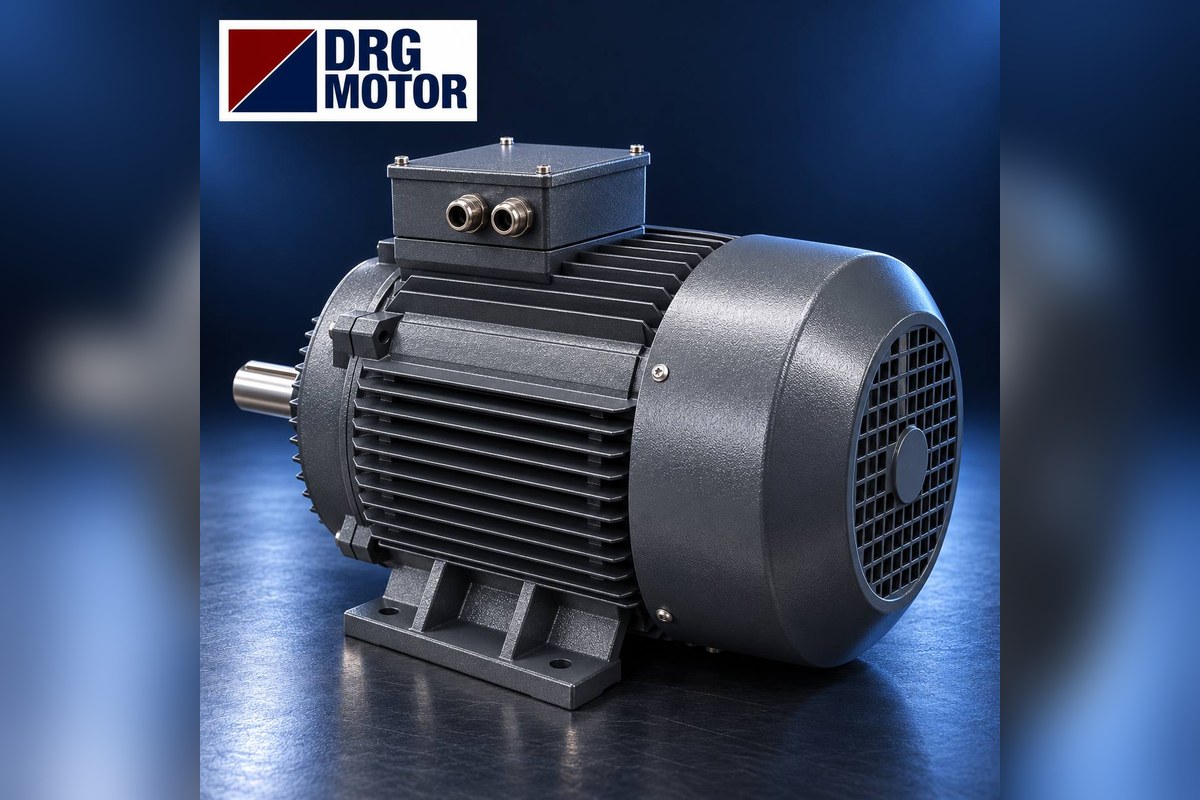

Which motor to buy to replace one whose nameplate has worn off or gone missing is found by measurement: the height from the underside of the feet to the shaft centre (H) gives the IEC frame, the speed measured with a tachometer gives the number of poles, and the frame + pole pair gives the motor’s likely power. For example, a motor with H measured at 112 mm and running at about 1450 rpm under load is a 112M-frame 4-pole motor; in the DRG catalogue the standard model in this frame is 4 kW. For the final decision, shaft diameter, foot holes and, if needed, the current drawn under load are also checked.
This method works for motors whose nameplate is painted over, rusted, removed or never existed. Some of the measurements (speed and current) are taken with the motor running: they must be made by a qualified electrician with suitable instruments; mechanical measurements are taken only on a stopped motor that has been switched off and locked out.
DRG Motor is a manufacturer, supplier and seller of electric motors. You can see the model matching the frame and speed you found straight away with the frame, power and speed filters on our Buy Electric Motors Online page. For motors with a readable nameplate, we explain what each line means in how to read a motor nameplate; here we cover the route to follow when there is no nameplate.
The 3 most common mistakes with an unlabelled motor
1. Guessing the frame by eye
The guess “this looks like a 5.5” is often wrong, because frames that look the same can carry different powers. In the DRG catalogue the standard 4-pole model in frame 112M is 4 kW, while the compact model in the same frame is 5.5 kW. Frame size alone does not give the power; pole count and current are also needed.
2. Measuring speed at no load and getting the poles wrong
An unloaded motor runs very close to synchronous speed; under load the speed drops slightly. To find the number of poles it makes no difference whether you measure at no load or under load, but to estimate power you need speed and current under load. Power cannot be estimated from no-load current alone.
3. Ordering without checking shaft and foot dimensions
Even if frame and power are identified correctly, an old motor’s shaft diameter or foot holes may differ from IEC dimensions. Before ordering, always measure shaft diameter D, shaft length E and foot hole spacing A×B.
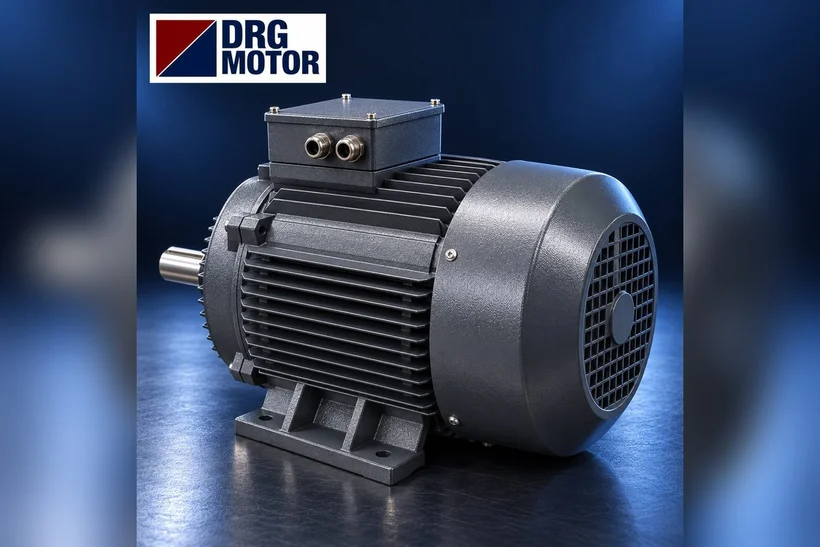
Step 1: Find the IEC frame from shaft height H
Leave the motor sitting on a flat floor or on its base. Measure the height from the underside of the feet to the shaft centre. If measuring to the shaft centre directly is awkward, measure to the top of the shaft and subtract half the shaft diameter:
H = (height from floor to top of shaft) − D / 2
Example: you measured 126 mm from the floor to the top of the shaft, and the shaft diameter is 28 mm. H = 126 − 14 = 112 mm. This shows the motor is frame 112. In the IEC series H values are fixed: 63, 71, 80, 90, 100, 112, 132, 160 mm and so on. If your value is within 1–2 mm of one of these, take that frame; if it falls in between, the motor may have been built to an old non-IEC standard.
Tell the frame letter (S, M, L) from the foot holes
There may be two frames with the same H. Measure the foot holes along the shaft (B): on frame 90, B of 100 mm means 90S and 125 mm means 90L; on frame 132, B of 140 mm means 132S and 178 mm means 132M; on frame 160, B of 210 mm means 160M and 254 mm means 160L. Check together with the cross-shaft spacing A and the shaft dimensions: frame 112M has A×B 190×140 mm and shaft 28×60 mm; frame 132S has A×B 216×140 mm and shaft 38×80 mm.
P and M on a flange motor
If the motor has no feet and is flange-only, H cannot be measured. Then measure the flange outside diameter P and the bolt pitch circle M. In the DRG catalogue the large flange (B5) is P 200 / M 165 mm on frame 90, P 250 / M 215 mm on frames 100L and 112M, and P 300 / M 265 mm on frames 132. If the holes are tapped and the flange does not exceed the frame diameter, it is a small flange; as its dimensions are not tabulated in the catalogue, send them to us for confirmation.
Step 2: Measure the speed and find the number of poles
With the motor running, use a contact tachometer in the centre hole at the shaft end, or a non-contact tachometer with reflective tape stuck on the shaft. The range the measured speed falls in gives the number of poles. The ranges are taken from the nominal speeds in the DRG catalogue:
- 2730–2982 rpm: 2 poles, synchronous speed 3000 rpm
- 1340–1490 rpm: 4 poles, synchronous speed 1500 rpm
- 855–992 rpm: 6 poles, synchronous speed 1000 rpm
With the speed you can also calculate slip (s): s = (synchronous speed − measured speed) / synchronous speed. For example, for a 4-pole motor measured at 1450 rpm, s = (1500 − 1450) / 1500 ≈ 0.033, i.e. about 3.3%. Slip increases with load and is close to zero at no load. If the speed under load is clearly below the candidate model’s catalogue speed, the motor may be running heavily loaded or overloaded.
Click to see current electric motor prices and order nowSEE PRICES →
Step 3: Read the likely power from the frame + pole table
The table below shows the power of the standard models in the DRG catalogue by frame and number of poles. Where a cell has two values, there are two models of different power in that frame and pole count; the current measurement in Step 4 tells them apart.
| Frame | 2-pole (3000) | 4-pole (1500) | 6-pole (1000) |
|---|---|---|---|
| 80 | 0.75 / 1.1 kW | 0.55 / 0.75 kW | 0.37 / 0.55 kW |
| 90S | 1.5 kW | 1.1 kW | 0.75 kW |
| 90L | 2.2 kW | 1.5 kW | 1.1 kW |
| 100L | 3 kW | 2.2 / 3 kW | 1.5 kW |
| 112M | 4 kW | 4 kW | 2.2 kW |
| 132S | 5.5 / 7.5 kW | 5.5 kW | 3 kW |
| 132M | – | 7.5 kW | 4 / 5.5 kW |
| 160M | 11 / 15 kW | 11 kW | 7.5 kW |
| 160L | 18.5 kW | 15 kW | 11 kW |
In the compact range a higher power fits in the same frame: 3 kW 2-pole in frame 90L (DRG-90L-2K), 5.5 kW 4-pole in frame 112M (DRG-112M-4K), 11 kW 4-pole in frame 132M (DRG-132M-4K). If your unlabelled motor is an old one, it may be one step lower in power than the table value; so the table is not a final answer but a list of “most likely candidates”.
Step 4: Decide between two candidates by measuring current
With the motor doing its normal job on the machine, measure the current in all three phases with a clamp meter and take the average. Compare the measured current with the candidates’ 400 V rated current:
- Frame 112M, 4-pole: DRG-112M-4 (4 kW) 7.95 A; DRG-112M-4K (5.5 kW) 10.7 A.
- Frame 100L, 4-pole: DRG-100L1-4 (2.2 kW) 4.52 A; DRG-100L2-4 (3 kW) 6.02 A.
If the measured current clearly exceeds the smaller candidate’s rated current (e.g. around 10.7 A average on a 112M motor), the load is more than the 4 kW model can carry and the larger candidate should be chosen. If the current stays below the smaller candidate’s rating, that model is sufficient. Because the current measurement shows the motor’s real requirement, it lets you choose correctly even without knowing the old motor’s power. You can also compare the candidates’ currents on the motor current chart page.
Note the supply voltage too
While measuring current, also measure the line-to-line voltage. Catalogue currents are for 400 V; on a network around 380 V the current will be slightly higher (8.37 A at 380 V for DRG-112M-4). Also look at the links in the terminal box: whether it is connected in star or delta is a clue as to whether the motor is 230/400 V or 400/690 V.
Measurement form: fill in this list before ordering
- Shaft height H (mm) and the frame derived from it
- Foot hole spacing A × B (mm) and hole diameter K
- Shaft diameter D × shaft length E (mm), key width F
- If flanged: P, M, N and hole type (through / tapped)
- Speed measured with a tachometer and the pole count found
- Three-phase current under load and line-to-line voltage
- Connection in the terminal box (star / delta) and number of terminals
- Frame material (cast iron / aluminium) and terminal box position
- Starting method in the panel (direct / star-delta / inverter)
Sending photos of the motor from the front, the side and with the terminal box open together with this form makes finding the right model easier. You can also verify your measurements yourself against the frame drawings on our technical drawings page.
Models commonly found among unlabelled motors
Most unlabelled motors identified by measurement are 4-pole and in the 90L–132S frame range. The candidates in this range are listed below:
| Model | Power / speed | Frame | Current 400 V |
|---|---|---|---|
| DRG-90L-4 | 1.5 kW / 1445 rpm | 90L cast iron | 3.3 A |
| DRG-100L2-4 | 3 kW / 1450 rpm | 100L cast iron | 6.02 A |
| DRG-112M-4 | 4 kW / 1450 rpm | 112M cast iron | 7.95 A |
| DRG-112M-4K | 5.5 kW / 1460 rpm | 112M aluminium | 10.7 A |
| DRG-132S-4 | 5.5 kW / 1460 rpm | 132S cast iron | 10.7 A |
- DRG-90L-4 – 1.5 kW – 1445 rpm – 90L cast iron
- DRG-100L2-4 – 3 kW – 1450 rpm – 100L cast iron
- DRG-112M-4 – 4 kW – 1450 rpm – 112M cast iron
- DRG-112M-4K – 5.5 kW – 1460 rpm – 112M aluminium
- DRG-132S-4 – 5.5 kW – 1460 rpm – 132S cast iron
Click to see current prices and order these motors nowSEE PRICES →
Frequently Asked Questions
How can I tell how many kW a motor without a nameplate is?
Measure shaft height (H) to find the frame and speed with a tachometer to find the number of poles; read the likely power from the frame and pole table. If there are two candidates in the same frame, a current measurement under load shows which it is.
Can I find the motor speed without a tachometer?
An exact value needs a tachometer. If you cannot measure, you can work back from the machine’s pulley ratio and the speed of the driven shaft; but this ignores belt slip and gives an approximate result.
How can I tell whether an unlabelled motor is 400 V or 230 V?
Open the terminal box: six terminals with links mean a three-phase motor. If it is connected in star on a 400 V network, it corresponds to a 230/400 V motor; if in delta, to a 400/690 V motor. This check should be done by a qualified electrician.
What kW is a motor with a 112 mm shaft height?
It is frame 112M. In the DRG catalogue this frame has standard models of 4 kW 2-pole, 4 kW 4-pole and 2.2 kW 6-pole, plus a 5.5 kW 4-pole compact model. Speed and current measurements make it clear which one it is.
You can send the measurement form and photos to +90 (542) 666 11 11 or [email protected]; all channels are on our contact page. For current models by frame and power, see the 120 models in our online store.