English
 Le français
 Türkçe




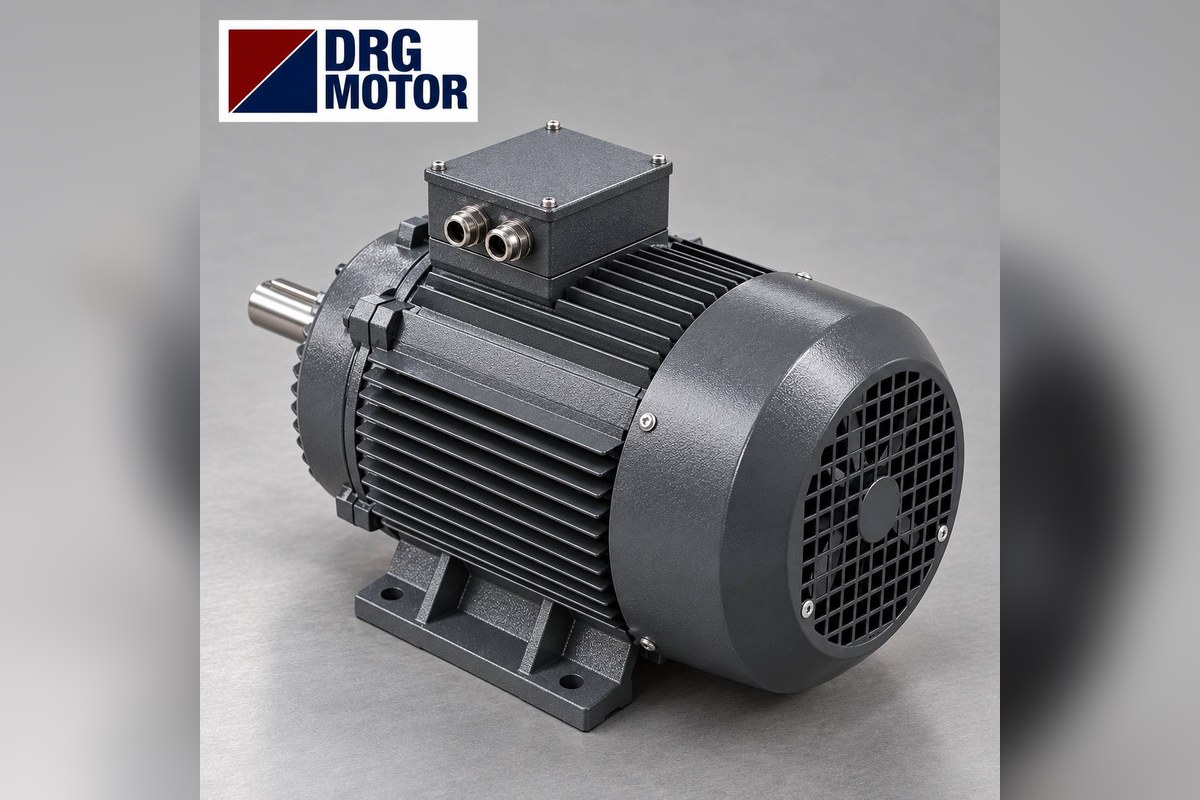

The electric motor of an imported machine is sourced in Türkiye as a 400 V 50 Hz IEC-frame three-phase motor, based on the nameplate power (converted to kW if it shows HP), the speed the machine needs and the shaft/mounting dimensions. On a machine built for 60 Hz, a 50 Hz motor runs about 17% slower; this difference is either compensated with the pulley ratio or accepted after checking its effect on the machine’s work. Dimensional differences (inch shaft, different foot holes) are solved with a coupling hub, pulley bushing or adapter plate.
The problem arises because most imported machines are built for a 60 Hz supply and voltages such as 460 V or 230 V. Isolate the supply at the panel before removing the motor; removal of the old motor, terminal connection of the new one and any change of protection settings in the panel must be done by a qualified electrician, because a motor connected to the wrong voltage can be damaged on its very first start.
DRG Motor is a manufacturer, supplier and seller of electric motors. Technical data and current prices of 120 models in cast iron, aluminium and compact frames are on the Buy Electric Motors Online page; with the steps below you can find the equivalent of your imported motor in that list yourself.
The 3 most common mistakes when replacing a motor on an imported machine
1. Reading HP as kW
A nameplate showing “10” is usually not 10 kW but 10 HP. One US horsepower is 0.746 kW; 10 HP is about 7.46 kW and its IEC equivalent is 7.5 kW. Taking HP for kW and buying an 11 kW motor increases the frame, changes the shaft diameter and the motor no longer fits the machine.
2. Searching for the nameplate speed as it is
A 60 Hz 4-pole motor shows values such as 1750–1760 rpm. At 50 Hz, 4-pole motors have a synchronous speed of 1500 rpm; in the DRG catalogue 4-pole rated speeds lie between 1340 and 1490 rpm. Searching for a “1750 rpm motor” leads nowhere: the right question is “4-pole motor, and do I need pulley compensation?”
3. Connecting a 60 Hz motor directly to a 400 V 50 Hz supply
A motor rated 380 V 60 Hz needs about 317 V at 50 Hz for the same magnetic flux; feeding it 400 V overheats the winding through excess flux. Keeping the old motor on the Turkish grid “because it runs” may end with a burnt winding in the first hot summer.
How do you translate an imported nameplate into 50 Hz terms?
The information on the plate is the same; only the units differ. The table below summarises what common nameplate entries mean when you order in Türkiye.
| On the plate | Meaning | Equivalent for ordering |
|---|---|---|
| HP | US horsepower, 0.746 kW | Convert to kW, IEC power step |
| RPM 1750 / 60 Hz | 4-pole, 60 Hz | 4-pole, 1500 rpm class |
| RPM 3500 / 60 Hz | 2-pole, 60 Hz | 2-pole, 3000 rpm class |
| 230/460 V | Dual-voltage winding | 230/400 or 400/690 for 400 V |
| FLA | Full-load current | Compare with new 400 V current |
| FRAME | Frame code | Match to IEC frame by dimensions |
| SF 1.15 | Service factor | Verify load by current |
The next table speeds up matching power steps. The kW value is calculated by multiplying by 0.746; the model column is the 4-pole (1500 rpm class) cast iron DRG motor.
| Plate (HP) | kW equivalent | IEC power | DRG model |
|---|---|---|---|
| 1 | 0.75 | 0.75 kW | DRG-802-4 |
| 2 | 1.49 | 1.5 kW | DRG-90L-4 |
| 5 | 3.73 | 4 kW | DRG-112M-4 |
| 7.5 | 5.59 | 5.5 kW | DRG-132S-4 |
| 10 | 7.46 | 7.5 kW | DRG-132M-4 |
| 15 | 11.19 | 11 kW | DRG-160M-4 |
Note: the equivalents of 7.5 HP (5.59 kW) and of 3 HP (2.24 kW, not in the table) are slightly above the IEC step (5.5 and 2.2 kW). In these two cases measure the old motor’s current under load with a clamp meter; if it runs close to the nameplate current, consider the next step up (7.5 and 3 kW).
Why do the CE mark and nameplate data matter?
The nameplate of the new motor, with its power, voltage, frequency and connection, becomes part of the machine’s technical file. After the replacement, add the photo of the new nameplate, its technical data and the warranty certificate to the machine’s file; it is the first document checked during a breakdown or an inspection. Do not throw away the old imported motor’s nameplate; keep it with the file.
Click to see current electric motor prices and order nowSEE PRICES →
Will a 60 Hz motor run on a 50 Hz supply?
In an induction motor the magnetic flux is set by the ratio of voltage to frequency (V/f). To run a motor designed for 60 Hz at the same flux on 50 Hz, the voltage must also be reduced in the 50/60 ratio, i.e. by about 17%. The “flux factor” in the table shows how many times the design flux the motor will see when connected to a 400 V 50 Hz supply.
| Nameplate | 50 Hz equivalent | Flux factor | Result at 400 V |
|---|---|---|---|
| 440 V / 60 Hz | 366.7 V | ×1.09 | Over-fluxed, heats up: do not connect |
| 460 V / 60 Hz | 383.3 V | ×1.04 | Close; check by current |
| 380 V / 60 Hz | 316.7 V | ×1.26 | Heavily over-fluxed: do not connect |
| 220 V / 60 Hz | 183.3 V | ×2.18 | Do not connect (low-voltage winding) |
Only the 460 V 60 Hz motor comes close to 400 V 50 Hz (×1.04); even then it is not a permanent solution until the current is measured and the load checked. Details on voltage tolerances are in our article motor operating voltage and frequency tolerances.
What happens to the machine if speed drops 17%? Pulley compensation
At 50 Hz the motor turns slower, so the machine slows down too. In fans and centrifugal pumps the flow falls with speed and the pressure with the square of speed; on a conveyor the belt speed falls, on a crusher the capacity. If speed matters, compensate with the pulley ratio.
Example: a motor rated 10 HP, 1760 rpm (60 Hz) is replaced by a DRG-132M-4 (7.5 kW, 1460 rpm). The machine must run as before.
- Required ratio: 1760 / 1460 ≈ 1.205
- If the motor pulley is 125 mm, the new motor pulley ≈ 125 × 1.205 ≈ 151 mm; or the machine pulley is reduced from 250 mm to ≈ 207 mm.
- Torque of the old motor: 7.46 kW × 9550 / 1760 ≈ 40.5 Nm. At the same machine speed the new motor must deliver ≈ 40.5 × 1.205 ≈ 48.8 Nm; the rated torque of the DRG-132M-4 is 49.1 Nm. The motor is at its limit but sufficient.
Enlarging the pulley also changes belt speed and the load on the motor shaft; check diameters and belt length with the pulley and belt calculator. Directly coupled machines (pumps, fans) have no pulley: either the lower speed is accepted or the frequency is raised with an inverter, which must stay within the motor and machine maker’s limits.
NEMA frame and inch shaft: how do you find the IEC equivalent?
On machines of American origin the motor body is identified by a NEMA frame code (e.g. “215T”); dimensions are in inches, and shaft height, foot hole spacing and shaft diameter do not match IEC frames one to one. That is why “which IEC frame equals 215T?” has no single right answer; the equivalent is found by measuring:
- Shaft height H: from the foot base to the shaft centre; it points to the nearest IEC frame (90, 100, 112, 132, 160 mm…).
- Shaft diameter and key: an inch shaft is handled with a metric coupling hub or pulley bushing; the part has to be re-machined to the new shaft diameter or replaced.
- Foot holes: if different, new holes in the base or an adapter plate.
- Flange: C-face (tapped hole) flanges resemble IEC B14 and large flanges resemble B5, but dimensions do not match; never order a flanged motor without measuring the spigot diameter.
As an example, the dimensions of the 7.5 kW 4-pole DRG motor are below; drawings of the other frames are on our technical drawings page.
- Model: DRG-132M-4
- Power: 7.5 kW
- Rated speed: 1460 rpm
- Frame: 132M cast iron
- Nameplate voltage: 400/690 V (Δ/Y)
- Current at 400 V: 14.3 A
- Shaft D×E: 38×80 mm
- Shaft height H: 132 mm
- Feet A×B: 216×178 mm
Steps to find the IEC equivalent: checklist
- Take a clear photo of the nameplate: HP/kW, RPM, V, Hz, FLA, FRAME, wiring diagram.
- Convert power to kW (HP × 0.746) and choose the IEC step.
- Find the number of poles from speed: 3500→2, 1750→4, 1150→6 poles.
- Decide what speed the machine needs: pulley compensation or accept lower speed?
- Measure shaft height, shaft diameter/length, key, foot holes and any flange.
- Check the panel: are contactor, overload relay and cable suited to the new motor’s 400 V current?
- Note the starting method (direct, star-delta, inverter); whether you need a 400/690 V motor depends on it.
- Mark the direction of rotation; check it uncoupled at the first start.
For the general logic of dimension matching see our article how to choose an equivalent electric motor; this article focuses only on the frequency, voltage and inch-dimension differences specific to imported machines.
What changes in the panel? Current comparison
The panel of an imported machine is usually set for 460 V or 230 V; in Türkiye a motor of the same power draws a different current at 400 V. The overload relay must be set to the new motor’s nameplate current. Below are 400 V currents of sample DRG models; for other ratings use the motor current chart.
| Model | Power / speed | Frame | Current 400 V |
|---|---|---|---|
| DRG-90L-4 | 1.5 kW / 1445 rpm | 90L cast iron | 3.3 A |
| DRG-112M-4 | 4 kW / 1450 rpm | 112M cast iron | 7.95 A |
| DRG-132M-4 | 7.5 kW / 1460 rpm | 132M cast iron | 14.3 A |
| DRG-160M-4 | 11 kW / 1465 rpm | 160M cast iron | 20.4 A |
DRG models up to 3 kW are 230/400 V and are connected in star at 400 V; from 4 kW they are 400/690 V and connected in delta at 400 V. If the old panel uses star-delta starting, the new motor must be 400/690 V.
DRG motors suited to imported machines
The models below are 4-pole (1500 rpm class) cast iron motors, the most frequent equivalents on 60 Hz 4-pole machines. For 2- and 6-pole equivalents use the speed filter in the store.
- DRG-802-4 – 0.75 kW – 1420 rpm – 80 cast iron
- DRG-90L-4 – 1.5 kW – 1445 rpm – 90L cast iron
- DRG-112M-4 – 4 kW – 1450 rpm – 112M cast iron
- DRG-132S-4 – 5.5 kW – 1460 rpm – 132S cast iron
- DRG-132M-4 – 7.5 kW – 1460 rpm – 132M cast iron
- DRG-160M-4 – 11 kW – 1465 rpm – 160M cast iron
Click to see current prices and order these motors nowSEE PRICES →
Frequently Asked Questions
Can a 60 Hz motor be used in Türkiye?
If the nameplate voltage is close to its 50 Hz equivalent (e.g. a 460 V 60 Hz motor on 400 V), it can be used for a short time, but speed drops by 17% and the current must be measured. A motor rated 380 V or 220 V 60 Hz must not be connected to a 400 V 50 Hz supply.
How many kW is a 10 HP motor?
In US horsepower, 10 HP is about 7.46 kW; its IEC equivalent is 7.5 kW. The 4-pole DRG equivalent is the DRG-132M-4 in frame 132M.
What is the equivalent of a 1750 rpm motor in Türkiye?
1750 rpm is the speed of a 4-pole motor at 60 Hz. In Türkiye the equivalent is a 4-pole, 1500 rpm class motor with a rated speed of 1340–1490 rpm according to the catalogue. If the same machine speed is needed, the pulley ratio is changed.
Can a metric-shaft motor replace an inch-shaft motor?
Yes, but the part mounted on the shaft (coupling hub, pulley) must be adapted to the new shaft diameter and key width. If the shaft height differs, the base needs shims or an adapter plate; do not order before verifying the dimensions.
You can send the nameplate photo and your measurements to +90 (542) 666 11 11 or [email protected]; all channels are on our contact page. For current prices and all models, see the 120 models in our online store.