 English
 Le français
 Türkçe

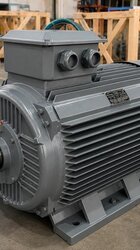
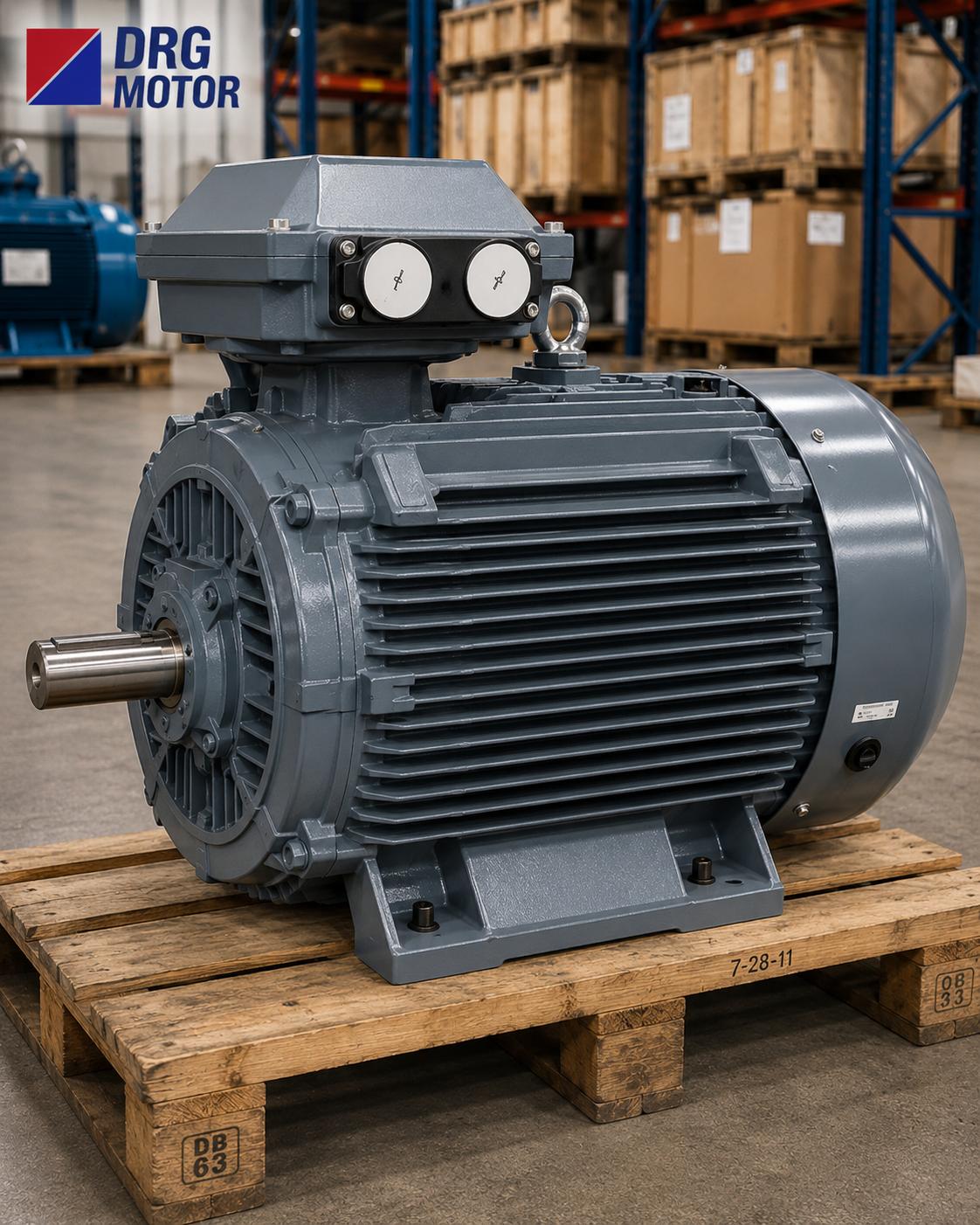

Crushers and stone crushing plants present some of the harshest operating conditions an industrial motor will ever face. The instant a hard rock enters a jaw or impact crusher, a sudden load spike hits the motor shaft, while constant dust, vibration, and ambient heat punish the frame all day long. This environment does not call for a standard motor; it demands a unit that delivers high starting torque, withstands impact through a cast iron frame, and seals out abrasive dust. At DRG Motor, our crusher motor supply focuses precisely on these requirements, delivering heavy-duty asynchronous motors to your plant quickly and reliably.
Why High Starting Torque Is Decisive in a Crusher
The crusher at the heart of a stone crushing line often has to rotate large inertial parts such as flywheels and eccentric shafts. When the motor comes to a stop and restarts, accelerating these masses requires a starting torque far above the rated value. Insufficient starting torque forces the motor to start slowly under strain, overheats the windings, and leads to premature failure over time. In the crusher motors we supply, high starting torque and high breakdown torque are top priorities, so the crusher engages even with a full hopper without stalling. In jaw crushers especially, the sudden resistance when a rock wedges between the jaws can only be overcome safely by a motor with adequate torque reserve. In impact (rotor-type) crushers, the rotor must maintain its high rotational inertia; here it is critical not only that the motor starts strongly but that it keeps running under load without dropping speed. Choosing the correct pole count (typically 4 or 6 poles) also directly affects this torque-speed balance and is determined according to crusher type at the supply stage. A motor that holds its rated speed under shock loading protects both the crushing chamber and the downstream equipment from uneven feeding.
Cast Iron Frame: Durability Against Impact and Vibration
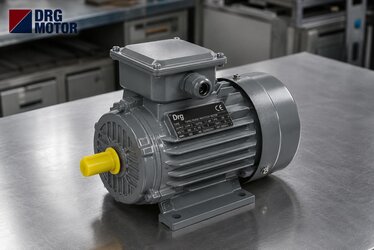
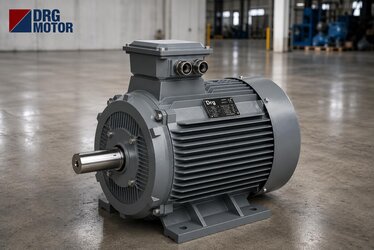
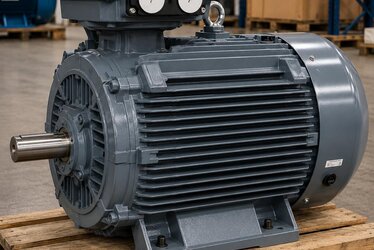
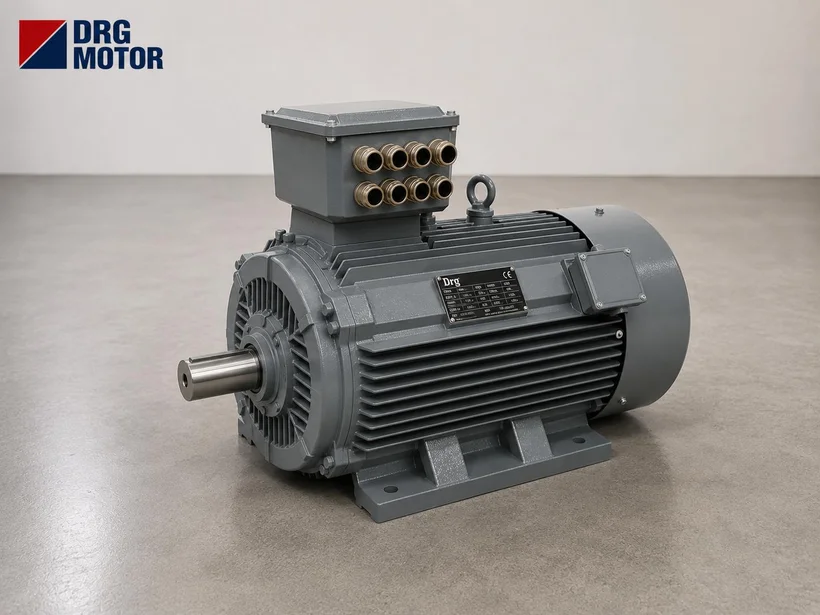
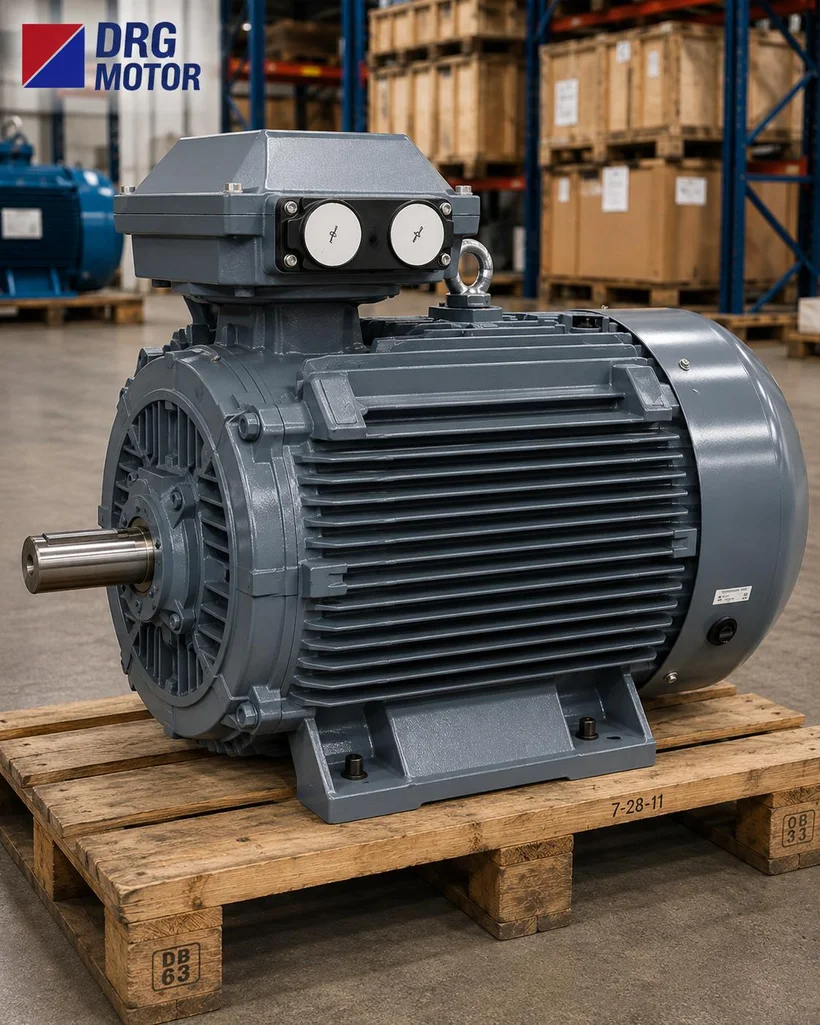
In stone crushing plants, the motor frame operates in a constant environment of vibration and mechanical shock. Aluminum-framed motors risk cracking, loosening, and early fatigue under these conditions, whereas a cast iron (grey cast iron) frame offers far greater mechanical strength. Thanks to its vibration-damping capacity, cast iron distributes the impacts reaching the shaft within its structure and reduces resonance. This extends bearing life, protects winding insulation, and keeps the frame geometry intact for years. In addition, cast iron motors resist loosening of mounting bolts under vibration thanks to their stiffer feet and flange seats; this reduces misalignment and the resulting wear on belts and couplings. A terminal box made of cast iron or a high-strength material further improves connection security under the impact and dust conditions found on site. The cast iron motors you can source from DRG sit in the heavy-duty class and suit all line equipment, including crushers, screens, and feed hoppers.
Protection Against Dust: IP55 and Higher Ingress Ratings
The density of mineral dust in the air at a stone crushing site is extremely high. This fine dust can enter a poorly protected motor, degrading winding insulation, wearing down bearings, and clogging cooling fins. For this reason, we recommend at least an IP55 ingress protection rating for crusher applications; this rating prevents harmful quantities of dust from entering and resists water jets from any direction. For more aggressive environments, IP56 or IP65 options can also be supplied. Beyond the protection rating, a surface coating that reduces dust accumulation and an easy-to-clean fin design are also decisive for field life.
- IP55: Baseline protection for standard stone crushing and crusher applications
- IP56 / IP65: Elevated protection for heavy dust, wash-down cleaning, and open-site conditions
- Tropicalized windings: Extra insulation against high humidity and temperature swings
Dust is a problem when it penetrates inside the motor, when it accumulates on the outer surface; a dust layer building up on the cooling fins blocks heat dissipation and causes the motor to overheat unnecessarily. For this reason, alongside regular field cleaning, supplying the right protection rating from the outset noticeably lowers long-term operating costs.
High Power (kW) Range and Correct Sizing
Depending on capacity, crushing plants require a wide power range. From small mobile crushers to large fixed plants, motor power typically varies from a few tens of kilowatts up to several hundred kilowatts. Correct sizing is critical for both energy efficiency and motor life; an undersized motor runs constantly overloaded and risks burnout, while an oversized motor is inefficient and costly. At DRG, we evaluate your crusher type, capacity, speed requirement, and service factor to recommend the most suitable power rating and pole count. Sizing considers instantaneous power, daily running hours, starting frequency, and seasonal ambient temperature; for plants operating at high temperature or high altitude, the motor's rated power is reassessed with an appropriate derating factor. This way, instead of a motor that looks powerful on the nameplate but falls short in field conditions, you receive a solution that performs at a realistic capacity. Drawing up a comprehensive supply plan for every motor on the line also simplifies both inventory and spare-part management.
Service Factor and Thermal Class Selection
In heavy-duty applications, a motor must withstand transient overloads beyond its nameplate power. Motors with a high service factor (SF) absorb short-term load spikes without endangering the windings, a major advantage in crusher conditions where rock suddenly jams. Likewise, motors with insulation thermal class F or H offer a wider temperature margin under high ambient heat and continuous load. In the motors we supply, we also offer a thermal protection option (PTC thermistor or thermal protector), enabling early warning and shutdown against unexpected overheating. These details prevent unplanned downtime and costly rewinding operations.
Matched Motor Solutions for the Crusher Line
A stone crushing plant is not just the crusher; feeders, conveyor belts, screens, and dust-collection fans all run on motors. At DRG, we provide a compatible motor set for the entire line, offering a single-source solution. A high-torque cast iron motor for the crusher, gearbox-compatible flanged motors for conveyors, vibration-resistant models for screens, and efficient options for fans are all considered within the same supply scope. To explore our broad product range and technical details, visit our stone crushing plant motors page. Working with a single supplier also simplifies technical support and warranty processes.
The DRG Motor Supply Advantage
As a B2B electric motor supplier across Turkey, we understand the speed expectations of the crusher and stone crushing sector. When a crusher stops, production stops entirely; that is why fast dispatch from stock and availability in critical power ratings are among our top priorities. After jointly determining the torque curve, ingress rating, and mounting type suited to your site, we finalize a project-specific quotation and delivery timeline. Spare-motor planning, periodic maintenance consultancy, and technical documentation are also part of the supply package we offer.
Mounting Type, Coupling, and Belt-Pulley Compatibility
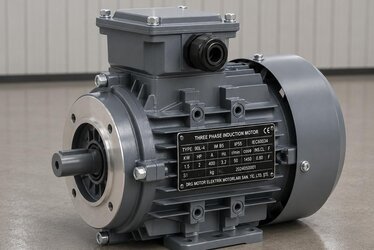
The performance of a crusher motor is not limited to its electrical values; arriving on site with the correct mounting type matters just as much. Foot-mounted (B3), flange-mounted (B5/B14), or combined mounting options are determined by the mechanical layout of the crusher. Since power in most stone crushing applications is transmitted through a belt-pulley or coupling, the shaft diameter and keyway dimensions must match the existing system exactly. An incorrect shaft size forces adapters or modifications, causing both lost time and alignment problems. Before supply, we clarify shaft dimensions, mounting holes, and rotation direction so the motor is delivered ready to install directly. In heavy-shock transmissions, choosing a flexible coupling or a correctly tensioned belt is another detail that directly affects motor life.
The Next Step: Let Us Identify the Right Motor for Your Crusher
There is no single right answer in crusher motor selection; the most efficient and long-lasting solution emerges when crusher type, capacity, speed, mounting, and environmental conditions are evaluated together. Share the technical details of the crusher at your plant with us, and we will prepare a tailored supply quotation for your high-torque cast iron motor needs. With a correctly sized, site-appropriate motor, you can lower your energy costs while minimizing unplanned downtime. For detailed pricing and stock information, get in touch with the DRG Motor team, and let us identify together the motor that will keep your crusher line running without interruption.