 English
 Le français
 Türkçe

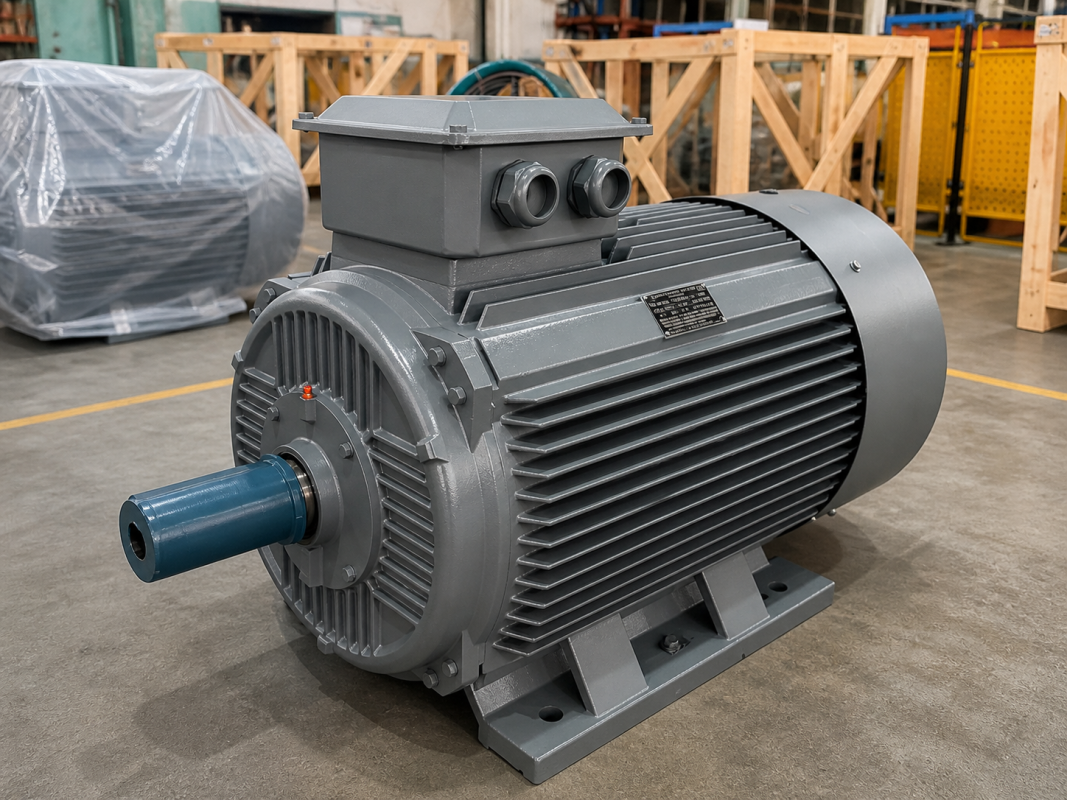

Knowing how fast an electric motor turns is the foundation of production quality and system safety in most applications. The motor's number of revolutions per minute (rpm) is one of the most fundamental quantities, showing both whether it is running correctly and how it is coping with the load. The tachometer is the device that measures this speed, and it carries many tasks, from keeping a belt speed constant to precise speed control in an inverter-driven system. In DRG AC asynchronous motors, setting up speed measurement correctly directly affects both performance and process repeatability. In this article we cover why speed measurement is needed, the types of tachometers, and the importance of speed feedback in inverter-driven systems.
What Is Speed (rpm)?
Speed expresses how many complete turns the motor shaft makes in one minute and is shown with the unit rpm, meaning "revolutions per minute." A motor's speed determines the rate at which it drives the load; the flow of a pump, the airflow of a fan, or the travel speed of a belt all depend directly on the motor speed. For this reason, knowing the speed is the first condition for controlling the process.
Why Is Speed Measurement Needed?
Speed measurement serves several different purposes: keeping the process at the desired speed, monitoring the motor's health, and providing feedback to the control system. If the speed is lower than expected, there may be an overload or slip problem; if it is high, there may be a loss of load or a control error. Therefore, speed is both a control variable and a diagnostic tool.
Synchronous Speed and Real Speed
The magnetic field of an AC asynchronous motor turns at synchronous speed, depending on the line frequency and the pole count. However, the rotor turns somewhat slower than this synchronous speed under load; this difference is called slip. For this reason, the speed written on the motor's nameplate, although close to the real operating speed, is not exactly the same as it. To see how synchronous speed is calculated, see our article on pole count and speed in electric motors.
Slip and Speed That Changes with Load
Slip is not constant; it increases as the motor is loaded. While the motor turns almost at synchronous speed at no load, the speed drops somewhat at full load. For this reason, knowing the real speed is not possible just by looking at the nameplate; measurement is required. Especially in variable-load applications, the speed constantly fluctuates, and the only way to capture this is with a tachometer.
What Is a Tachometer?
A tachometer is a device that measures the speed of a rotating shaft. It can make the measurement using different physical principles: some types contact the shaft directly, some work optically, and some count an electrical signal produced by the shaft. Which type is suitable depends on the measurement frequency, the desired accuracy, and the environmental conditions.
Contact (Mechanical) Tachometer
A contact tachometer measures speed by resting a small wheel or tip against the end of the rotating shaft. It is simple, portable, and useful for a quick check; it is frequently used to quickly verify a motor's speed during maintenance. However, because it requires contact, it is not suitable for continuous measurement and high accuracy; it brings friction and wear to the shaft.
Optical (Non-Contact) Tachometer
An optical tachometer sends light to a reflective tape stuck on the rotating shaft or pulley and counts the light reflected each turn. Because it does not contact the shaft, it creates no wear and can safely measure the speed of moving or hard-to-reach parts. It is a practical tool for a quick field check, but for continuous and permanent measurement the durability of the reflective tape can be a limiting factor.
Speed Measurement with an Encoder
The most common method of permanent and precise speed measurement is the encoder. An encoder is a device connected to the motor shaft that produces many electrical pulses each turn. By counting these pulses, the speed and direction of rotation are determined very precisely. The encoder is the fundamental component of control systems requiring continuous feedback and is at the heart of inverter-driven precise applications.
Incremental and Absolute Encoders
Encoders are basically divided into two groups. An incremental encoder produces pulses as it moves; it determines position by counting from the beginning of the movement. An absolute encoder, on the other hand, directly gives the real angular position of the shaft at any moment; the position information is not lost even when power is cut. While an incremental encoder is often sufficient for speed measurement, an absolute encoder is preferred in applications requiring precise positioning.
Pulse Count and Resolution
The number of pulses an encoder produces per turn determines the resolution of the measurement. A high pulse count makes it possible to capture even very small speed changes, which is critical for precise control. However, a resolution higher than necessary increases the signal processing load. The right resolution is selected according to the accuracy required by the application.
Click to see current electric motor prices and order nowSEE PRICES →
Speed Feedback in Inverter-Driven Systems
When a frequency inverter drives a motor, knowing the real speed determines the quality of the control. Without feedback, the inverter only estimates how much the motor is turning; when the load changes, the speed can deviate from the target. The real speed information from the encoder, on the other hand, gives the inverter the ability for closed-loop control, and the speed is kept on target regardless of the load. To see the difference between inverter control modes, our article on the difference between V/f and vector control in inverters is helpful.
Open-Loop and Closed-Loop Control
In open-loop control, the inverter estimates only according to the frequency it applies, without measuring the speed; this is simple and inexpensive but accuracy decreases at low speed and under variable load. In closed-loop control, the real speed from the encoder is continuously compared and corrected. This way, high torque and stable speed are obtained even at low speed. Precise applications usually require closed loop.
The Relationship Between Speed Information and Torque
Speed alone carries no meaning; power and torque must be evaluated together. A motor of the same power produces high torque at low speed and low torque at high speed. Speed measurement is the tool for controlling this balance. To grasp the relationship between power, torque, and speed, we recommend our article on power, torque, and speed in motors.
Speed Measurement and Process Quality
In many processes, product quality depends directly on speed. In an extrusion line, a winding machine, or a filling system, keeping the speed constant ensures that the products are consistent. If the speed fluctuates a little, product quality deteriorates. For this reason, in precise processes, speed measurement and feedback are the fundamental elements that secure quality.
Multiple-Motor Synchronization
In applications where multiple motors on a line must turn at the same speed, measuring each motor's speed is the precondition for synchronization. If one motor turns faster or slower than another, the product stretches or accumulates. Encoder feedback solves this problem by allowing the motors to work locked together.
Fault Diagnosis Through Speed Monitoring
Sudden or gradual changes in speed can be a harbinger of a mechanical problem. An unexpected drop in speed can indicate an overload, while a fluctuating speed can indicate a control or coupling problem. Monitoring speed data together with vibration and temperature data allows faults to be caught early. To complete the topic, see our article on motor vibration analysis (FFT spectrum).
Speed Estimation from Frequency
In inverter-driven systems, it is possible to get an idea about the speed even without a separate measuring device. The inverter knows which frequency it applies to the motor and calculates the theoretical synchronous speed from this frequency. However, this is only an estimate; the real speed differs from this value because of slip. As the load increases, the difference widens. Therefore, the estimate from frequency is useful as a rough indicator but does not replace real measurement where precise control is required.
Sensorless Vector Estimation
Modern inverters can estimate the speed even without an encoder by monitoring the motor's electrical behavior with a mathematical model. This method, called sensorless vector control, produces a value close to the real speed from current and voltage measurements. For many applications requiring moderate accuracy this is sufficient and eliminates the cost of an encoder. However, at very low speeds and where the highest accuracy is required, it cannot reach the accuracy provided by a real encoder.
Measurement Units and Conversion
Although speed is usually expressed in rpm, in some systems speed is also used as angular speed (radians/second) or peripheral speed (meters/second). In a motor driving a belt over a pulley or drum, what is often important is the linear speed of the belt; this is found by calculating the motor speed together with the pulley diameter. Correct unit conversion is necessary to accurately translate process targets into motor speed.
Overspeed Protection
In some applications it is dangerous for the motor to exceed a certain speed. In high-inertia loads or when the load suddenly lightens, the speed can rise more than expected. Speed measurement in this case also serves as overspeed protection; when the measured speed exceeds the safe limit, the system can stop the motor. This protection protects both the equipment and the operator against a possible accident risk and is especially valuable in lifting and rotating equipment applications.
The Difficulty of Measurement at Low Speed
At very low speeds, speed measurement becomes difficult, because the time between successive pulses lengthens and the measurement can become delayed or unstable. In this case a high-resolution encoder and a suitable measurement method are required. In applications requiring precise control at low speed, both the measurement hardware and the control algorithm must be selected to meet this challenge; otherwise the system behaves shakily and unstably at low speed.
Points to Consider in Tachometer Selection
The right tachometer selection depends on the purpose of the measurement. While a contact or optical handheld tachometer is sufficient for field checks, an encoder is required for continuous and precise control. The dust, vibration, and temperature of the environment also affect the selection; in harsh environments a durable, protected encoder should be preferred. The wrong selection brings either unnecessary cost or insufficient accuracy.
The Effect of Environmental Conditions
A tachometer or encoder is affected by the conditions of the environment in which it operates. Excessive dust, humidity, oil vapor, or high temperature can dirty the reflective tape of an optical tachometer or strain the electronics of an encoder. In such environments, an encoder with the appropriate protection class and a closed body should be preferred. If the environmental conditions are not taken into account from the start, the measuring device soon leads to unreliable data or failure. The right protection selection ensures that the speed measurement remains stable for a long time.
Maintenance and Calibration
The speed measurement system also requires regular maintenance. In optical tachometers, the cleanliness and integrity of the reflective tape, and in encoders, the tightness and alignment of the coupling, should be checked periodically. A connection that loosens over time or a sensor that becomes dirty can start producing erroneous speed information without being noticed. Handheld tachometers should occasionally be compared with a reference source to confirm their accuracy. These simple checks preserve trust in the measurement.
Mounting and Alignment
The correct operation of the encoder depends on it being connected to the shaft properly and aligned. Incorrect alignment leads to measurement error and premature wear of the encoder. Using a flexible coupling compensates for small offsets between the shaft and the encoder, increasing both measurement accuracy and device life. Isolation from vibration should also be considered during mounting.
Signal Cabling and Interference
Because the pulse signals from the encoder are weak, they must be protected against electromagnetic interference. Routing with a shielded cable, away from inverter cables, prevents signal losses and erroneous counts. Incorrect cabling carries corrupted speed information to the control system, negatively affecting the entire control. For this reason, signal cabling is a critical detail for the reliability of the system.
Speed Ramps and Smooth Transition
A motor suddenly reaching full speed or stopping abruptly both strains the mechanical parts and causes a jolt in the product. Speed measurement informs the control system of the real course of the speed, ensuring that smooth acceleration and deceleration ramps are correctly followed. Thanks to feedback, the system sees whether it actually follows the targeted ramp and corrects it if necessary. This both extends mechanical life and makes process transitions stable.
Feedback Delay
How quickly the speed information reaches the control system is also important. If the measurement and processing chain is slow, the control reacts late to the change in real speed, which can lead to oscillation in the speed. In applications requiring fast response, both the encoder and the control loop must be fast enough. If the feedback delay is ignored, the system behaves unstably in practice even if it appears correctly set up on paper. For this reason, measurement speed should be taken into account as much as accuracy.
Common Mistakes
The most common mistakes in speed measurement are mistaking synchronous speed for real speed, neglecting slip, misaligning the encoder, and routing the signal cable together with the inverter cables. In addition, giving up feedback in a precise application where open-loop control is not sufficient is a common mistake that reduces quality and stability.
Speed Measurement in Industrial Applications
In many industrial applications, from conveyors to cranes, from pumps to winding machines, speed measurement is the foundation of control and safety. A correctly set up speed measurement system improves both production quality and the motor's life. To examine our wide range of motors, take a look at our article on industrial electric motors.
DRG Motor for Precise Speed Control
Speed measurement and a correct tachometer or encoder are the foundation of running a motor at the desired speed and stability. Whether it is a simple field check or an inverter-driven closed-loop control system, the right measurement method determines the performance. DRG AC asynchronous motors are produced compatible with encoder feedback and inverter-driven precise control applications. To set up the speed control solution suitable for your application, explore our DRG electric motor products; let us determine the most suitable motor and feedback structure for your needs together.
DRG Electric Motors Suited to This Topic
The models below are available in the DRG Motor online shop. Click a model code to see its technical data, dimensions and current price, and order right away.
- DRG-90S-4 – 1.1 kW – 1445 rpm – aluminium frame
- DRG-100L2-4 – 3 kW – 1450 rpm – aluminium frame
- DRG-132S-4 – 5.5 kW – 1460 rpm – cast iron frame
- DRG-160M-4 – 11 kW – 1465 rpm – cast iron frame
Click to see current prices of all electric motors and order nowSEE PRICES →