 English
 Le français
 Türkçe

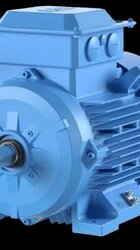
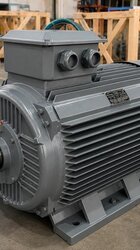
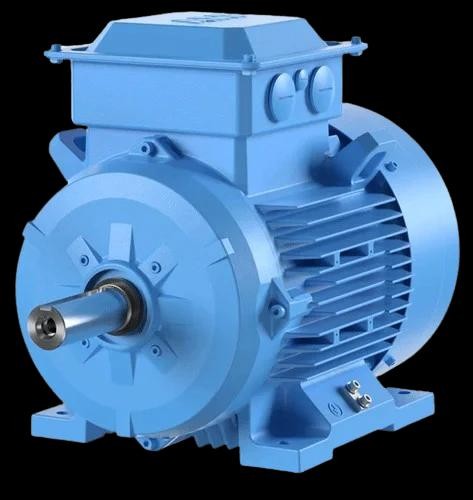

A three-phase induction motor works exactly as designed when all three phases are supplied with voltages of equal magnitude and a precise 120-degree phase angle between them. This balanced supply creates a smoothly rotating magnetic field in the stator, allowing the motor to run at its highest possible efficiency with the lowest vibration. In the real world, however, the voltage on one phase can differ from the others, and this condition is called voltage unbalance. A deviation of just a few percent may look harmless at first glance, but inside the motor it turns into far larger current imbalances, extra heating, and over time irreversible winding damage. When investigating why a motor heats up for no obvious reason, fails prematurely, or draws more energy than expected, voltage unbalance is very often the overlooked culprit. In this article we examine, from the DRG Motor engineering perspective, where voltage unbalance comes from, its physical effect on the motor, why derating (power reduction) is mandatory, and the practical measures that can be taken in the field. Our goal is to provide concrete information that both the technician learning the topic and the engineer optimizing a plant can put into practice.
What is voltage unbalance?
Voltage unbalance is the condition in which the phase voltages of a three-phase system are not equal to one another. In an ideal system the L1, L2, and L3 voltages all have the same effective value. In practice these values diverge because of load distribution, cable resistances, and grid conditions. Unbalance can arise from both magnitude (volt) differences and phase-angle deviation, but the type most frequently encountered and most easily measured in the field is magnitude unbalance.
How is unbalance calculated?
The most common method is to take the average of the three line voltages, find how much each phase deviates from this average, and divide the largest deviation by the average. The result is expressed as a percentage. For example, if the phases measure 400 V, 392 V, and 408 V, the average is 400 V, the largest deviation is 8 V, and the unbalance is 2 percent. Even this simple calculation gives critical information for the motor, because a 2 percent voltage unbalance translates into a much higher unbalance in current.
Negative-sequence current: the real problem
According to symmetrical-component theory, an unbalanced voltage system breaks down into three components: positive sequence, negative sequence, and zero sequence. The component that actually turns the motor is the positive sequence. The negative sequence, however, creates a magnetic field rotating opposite to the rotor's direction. This field induces a current in the rotor at almost twice the line frequency and releases only heat without producing any useful torque.
Why does a small unbalance create a large current difference?
The impedance the motor presents to the negative sequence is very low; this impedance is close to the locked-rotor impedance. As a result, even a small negative-sequence voltage produces a large negative-sequence current. The general engineering rule is that the unbalance in current is roughly 6 to 10 times the unbalance in voltage. In other words, a 2 percent voltage unbalance can mean a 12 to 20 percent current difference between phases.
The mechanism of overheating
Winding losses are proportional to the square of the current. When the current in one phase increases by 15 percent, the copper loss of that phase increases by roughly 32 percent. The most heavily loaded phase becomes the hottest spot in the motor, and the winding insulation ages fastest there. Moreover, the negative-sequence current heats the stator and rotor alike, so the total heat burden spreads throughout the motor rather than at a single point.
Insulation life and temperature
The generally accepted rule for insulation materials is that every sustained 10-degree rise in winding temperature roughly halves insulation life. Because voltage unbalance means continuous heating, a motor fed by an unbalanced supply that runs unnoticed can fail well below its design life. Unbalance is therefore not an instantaneous hazard but an insidious, cumulative source of damage.
Voltage unbalance, temperature rise, and derating table
The table below summarizes the approximate temperature rise in the motor winding and the recommended derating (power reduction) factor as voltage unbalance increases. These values represent a general engineering approach; for critical applications they should be evaluated according to the motor's actual load and ambient conditions.
| Voltage unbalance (%) | Approx. current unbalance (%) | Extra temperature rise | Recommended derating factor |
|---|---|---|---|
| 0 - 1 | 6 - 10 | Negligible | 1.00 (not required) |
| 2 | 12 - 20 | Noticeable rise | 0.95 |
| 3 | 18 - 30 | High | 0.88 |
| 4 | 24 - 40 | Very high | 0.82 |
| 5 | 30 - 50 | Critical | 0.75 |
As the table shows, running a motor at rated power with an unbalance above 2 percent is not safe; reducing power (derating) becomes mandatory. Our article on motor voltage, frequency tolerance, and derating explains this calculation step by step.
The importance of the 2 percent limit
In industrial practice, unbalance below 1 percent usually causes no problems. The range between 1 and 2 percent is the watch zone and needs to be monitored. Above 2 percent, derating is unavoidable and the source of the unbalance must be found and eliminated. With an unbalance above 5 percent, running the motor at rated power is strongly discouraged.
Efficiency loss
Negative-sequence current generates heat without doing useful work, so the motor's efficiency drops. More active power is drawn from the grid for the same mechanical output, and the energy bill rises. In a continuously running motor, even a few percent of efficiency loss means a significant increase in annual energy cost. Moreover, this loss costs money and dumps unnecessary heat into the motor and its surroundings. We examined in detail how efficiency loss arises and where energy escapes in our article on electric motor efficiency losses. For those who want to see the energy-saving potential numerically, our high-efficiency motor savings calculation article is also a useful guide.
Torque pulsation and vibration
The negative-sequence field creates a pulsation in the torque produced by the motor at twice the line frequency. This pulsation turns into mechanical vibration and noise. Bearings and the coupling are exposed to this additional strain. To reduce vibration-related problems, you can review our methods for reducing electric motor noise and vibration.
Relationship with phase loss
Voltage unbalance is a mild relative of phase loss. When one phase is completely lost, the unbalance approaches 100 percent and the motor burns out very quickly. Even if a phase does not fully break but weakens, the motor continues running under severe unbalance. That is why unbalance protection and phase-loss protection should be considered together. We addressed the topic of phase loss in electric motors in a separate article.
Main causes of unbalance
There are a few typical causes of voltage unbalance in the field. The most common is the uneven distribution of single-phase loads across the three phases. When lighting, office outlets, and small devices pile up on one phase, the voltage of that phase drops. The second frequent cause is loose or oxidized connection terminals; high contact resistance on one phase creates a voltage drop on that phase.
Grid- and transformer-related causes
Unbalanced loading of the distribution transformer, long supply cables with insufficient cross-section, a weakening fuse, or large single-phase loads connected to the grid all create unbalance. In some cases the problem is not in the motor but directly in the grid, and the solution must be sought on the supply side.
How is unbalance measured?
The simplest method is to measure the line voltages in turn while the motor is running and evaluate the difference between them. For a more thorough check, the current of each phase should also be measured, because the truly dangerous face of unbalance shows up in current. A difference that looks small on the voltage side may point to a far more striking picture on the current side. Therefore both voltage and current should be evaluated together, and one should never assume the motor is safe based on a single data point. For plants that want continuous monitoring, energy analyzers and monitoring systems are ideal; these show unbalance not just instantaneously but together with its change over time.
Early warning through continuous monitoring
Continuously monitoring voltage and current unbalance provides the opportunity to intervene before a problem turns into a fault. Modern monitoring systems generate an alarm when a set threshold is exceeded. We detailed this topic in our article on electric motor energy monitoring. Monitoring also makes energy-saving opportunities visible.
Protection relays
Voltage unbalance protection relays disconnect the motor when unbalance exceeds a set threshold. Used together with an overload relay, the motor is protected against both unbalance and overcurrent. Our article on electric motor overload protection explains these protection layers holistically.
The limit of the overload relay
A classic thermal overload relay looks at total current; it may not always detect the overheating of a single phase. For this reason, unbalance-sensitive protection elements complement the thermal relay, which cannot trip on mild but continuous unbalance. The two protections should be used together rather than in place of each other.
Periodic inspection of connections
The most frequent and most easily fixable cause of unbalance is loose connections. All connection points inside the panel and in the motor terminal box should be checked at intervals with a torque wrench, and oxidized surfaces should be cleaned. In an inspection with a thermal camera, a terminal that appears hot is usually a harbinger of unbalance.
Load balancing
Single-phase loads in the plant should be distributed as evenly as possible across the three phases. When a new single-phase load is added, the phase it will be connected to should be planned and the load on the phases kept balanced. This simple discipline prevents a significant portion of unbalance at its source.
Cable cross-section and distance
On long-distance supplies, selecting an adequate cable cross-section reduces voltage drop and therefore unbalance. Using cable of the same cross-section and length on every phase also preserves symmetry between phases. The right choice made at the design stage prevents many field problems from the outset.
The practice of derating
If the source of the unbalance cannot be eliminated in the short term, derating should be applied to protect the motor. This means running the motor at a load below its rated power. The table values can be used as a starting point; however, the permanent solution is always to eliminate the unbalance, while derating is a temporary protective measure.
The role of correct motor selection
A motor that is robustly designed, has a quality insulation class, and sufficient thermal reserve is more resilient to small unbalances. High-efficiency motors generally run with lower losses, so their thermal reserves are also wider. From this perspective, high-efficiency electric motors provide an advantage on unbalanced grids.
Caution in industrial applications
In continuously running industrial applications such as pumps, fans, compressors, and conveyors, the effect of unbalance is cumulative. On such critical lines, unbalance monitoring is almost mandatory. Our article on industrial electric motors addresses the requirements of these applications more broadly.
Including it in the maintenance plan
Voltage and current unbalance measurement should be a permanent item on the periodic maintenance checklist. Measurement values should be recorded and their change over time monitored. A slowly increasing unbalance is often an early sign of a loosening connection or a weakening fuse. Thanks to trend tracking, a problem that would one day become a clear fault is caught while it is still small and can be fixed cheaply.
Effect of unbalance on bearing life
The torque pulsation caused by the negative sequence wears the winding, then the mechanical transmission elements. The strain occurring at twice the line frequency creates an additional dynamic load on the bearings and disrupts the lubricating film. Over time, bearing clearances grow, noise rises, and this itself becomes a new source of vibration. Seeing unbalance only as an electrical problem is therefore misleading; its effect spreads throughout the entire mechanical structure of the motor.
Drift toward single-phasing
A severe voltage unbalance can drift toward a condition that approaches feeding the motor practically through two phases. In this case, the current drawn from the remaining phases rises rapidly and the motor reaches dangerous temperatures very quickly. The boundary between mild and severe unbalance is not clear-cut; therefore threshold values should be chosen conservatively and unbalance addressed before it grows.
Evaluation together with frequency change
Voltage unbalance evaluated on its own is incomplete; the line frequency and total voltage level also determine the motor's thermal load. When low voltage and unbalance come together, the effect compounds. For this reason it is necessary to see the motor's operating conditions holistically; voltage level, unbalance, and frequency tolerance should be considered together. We deepened this holistic approach in our article on voltage and frequency tolerance.
Avoiding measurement errors
The accuracy of the measuring instrument used when measuring unbalance is important. A low-quality multimeter may show a difference between phases that does not really exist or may hide the real difference. Measurements should be made with the same instrument, from the same points, and while the motor is under load. No-load measurements do not always reflect the real effect of unbalance.
Effect on power and torque
An unbalanced supply also reduces the maximum torque the motor can produce. Breakdown torque and starting torque decrease; motors starting under heavy load are strained. Understanding the relationship between power, torque, and speed helps to interpret correctly the effect of unbalance on performance. We addressed this fundamental relationship in our article on the power, torque, and speed relationship.
DRG Motor for balanced and safe solutions
Voltage unbalance is a phenomenon that silently shortens a motor's life when it runs unnoticed, yet can easily be brought under control with correct measurement, protection, and maintenance discipline. DRG Motor produces AC induction motors resilient to unbalanced grid conditions thanks to their wide thermal reserve and quality insulation; you can contact the DRG Motor engineering team for the right motor selection and protection configuration for your application. Alongside the right motor, the right protection and regular inspection eliminate all the risks that unbalance can create.