English
 Le français
 Türkçe




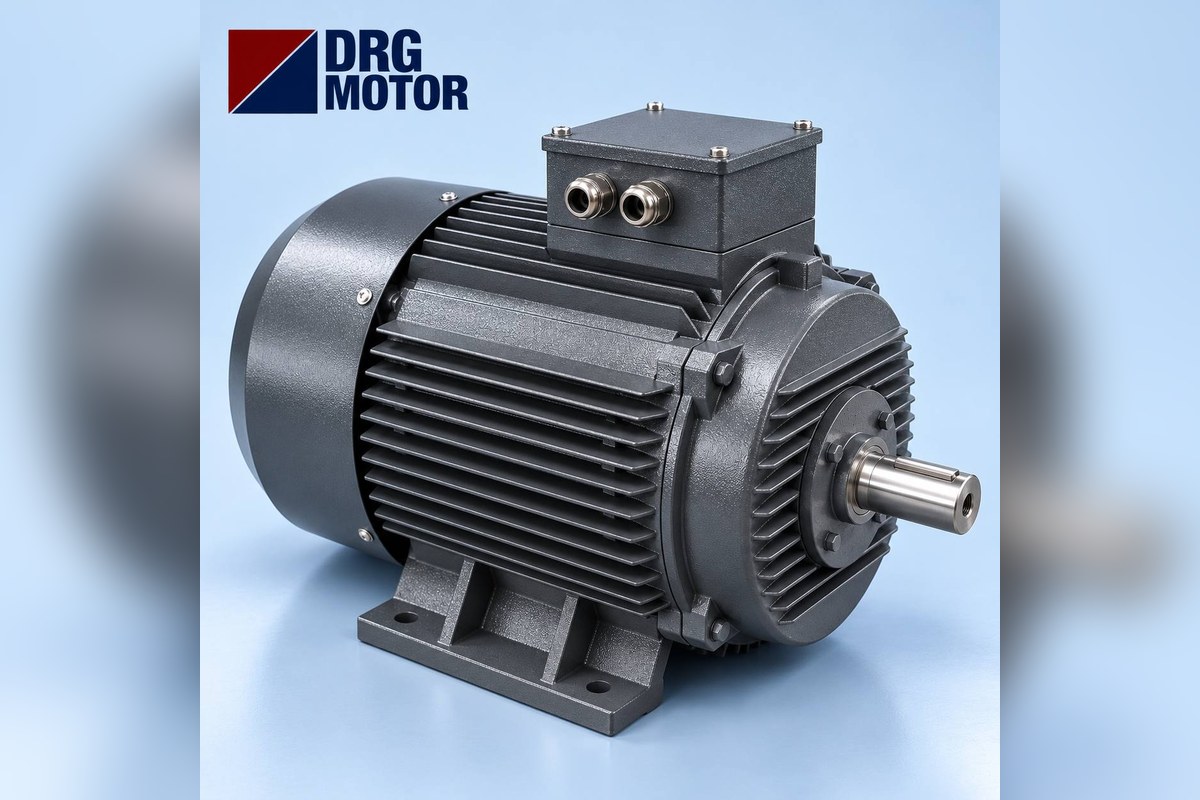

When a motor failure stops production, choosing an emergency electric motor starts with finding a motor of the same power, speed, frame (IEC shaft height), mounting arrangement and shaft size as the failed one; if these five items are right, the new motor fits without touching the base, coupling or pulley. If no exact equivalent is available, the safest temporary solution is one power step up in the same frame; the second option is the next frame up with a foot or flange adapter. A motor with a different number of poles in the same frame is not a solution, because it changes the machine speed. Model codes and technical data are on Buy Electric Motors Online.
Removal, measurement and connection work during a breakdown carries electrical risk: it must be done by a qualified electrician, with the motor supply isolated at the panel, locked off and tagged. If you are not sure the fault is really in the motor, first rule out fuses, overload relay and supply with the steps in our article Electric Motor Not Working: Step-by-Step Fault Finding. This article focuses on the first half hour after it is certain the motor must be replaced, and on choosing the right replacement.
What should be done in the first 30 minutes?
- Make it safe: isolate the supply, lock it off and confirm by measurement that it is dead.
- Photograph the nameplate: clean it if dirty; a photo taken with side lighting shows embossed text better. If there is no plate, move on to measuring.
- Note the mounting: is the motor foot-mounted (B3), flange-mounted (B5/B14) or both (B35/B34)?
- Measure shaft and fixing: shaft diameter D, shaft length E, key width; if foot-mounted, foot hole spacing A×B and shaft height H; if flanged, flange outer diameter P and pitch circle M.
- Check the panel: overload setting, starting method (direct, star-delta, drive) and cable size.
- Note the direction of rotation: the arrow on the pump or fan casing, or the machine’s working direction.
Once these six steps are done, the right motor can be discussed with the supplier in a single phone call. The most common outcome of an order placed with missing information is that the shaft or flange of the delivered motor does not match and the stoppage gets longer.
Which 8 items should you give the supplier by phone?
- 1. Power: kW (if the plate says HP, give that too).
- 2. Speed: the rated speed on the plate (e.g. 1460 rpm) or the synchronous speed class (1000/1500/3000).
- 3. Voltage and connection: 230/400 V or 400/690 V; is there star-delta in the panel?
- 4. Frame: IEC frame (e.g. 132M) or the measured shaft height H.
- 5. Mounting: B3, B5, B35, B14, B34 or vertical mounting.
- 6. Shaft: D × E and key width.
- 7. Flange size: if flanged, P, M and spigot diameter N.
- 8. Terminal box and cable entry: box position (top/side) and gland size.
Send the nameplate photo and the measurements in the same message. If the plate values and the measurements conflict (e.g. the plate says 7.5 kW but the foot spacing points to another frame), the motor may have been replaced before; trust the measurements.
Click to see current electric motor prices and order nowSEE PRICES →
If there is no exact equivalent, which temporary solution is safe?
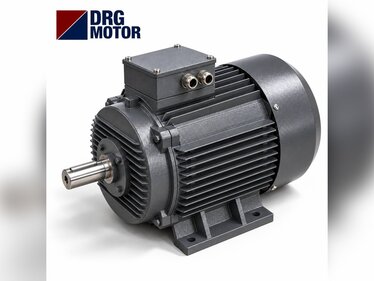
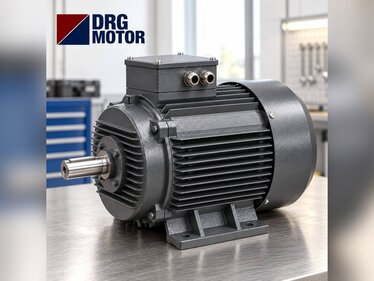
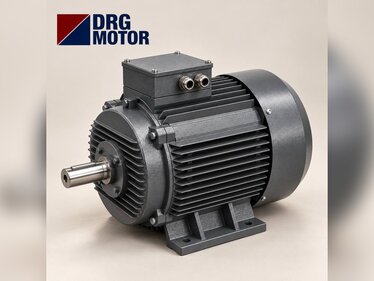
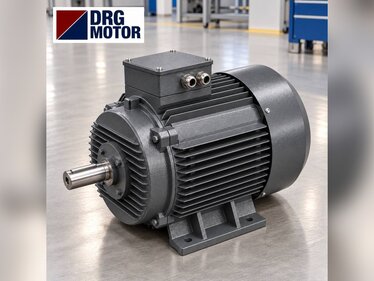
Take an example: the failed motor is a 7.5 kW, 1500 rpm, frame 132M foot-mounted motor (DRG-132M-4 class). The options that fit the same frame and their effect on the machine:
| Model | Power / speed | Frame | Current 400 V |
|---|---|---|---|
| DRG-132M-4 | 7.5 kW / 1460 rpm | 132M · cast iron | 14.3 A |
| DRG-132M-4K | 11 kW / 1465 rpm | 132M · aluminium (compact) | 20.4 A |
| DRG-132M1-6 | 4 kW / 968 rpm | 132M · cast iron | 8.99 A |
| DRG-132M2-6 | 5.5 kW / 968 rpm | 132M · cast iron | 12 A |
All four motors have 216 × 178 mm foot spacing, a 38 × 80 mm shaft and 6208-ZZ-C3 bearings, so they all fit the same base. But the result is not the same:
- Same frame, one power step up (suitable): the compact DRG-132M-4K is 11 kW and runs at 1465 rpm; the machine turns at the same speed. The motor draws current according to the load, but the overload relay is set to the new motor’s nameplate current (20.4 A) and the cable is checked against that current.
- Same frame, different poles (not suitable): DRG-132M1-6 and DRG-132M2-6 are in the same 132M frame but run at 968 rpm. The machine slows by about a third; pump pressure and flow, fan air and conveyor speed drop. Unless the pulley ratio is changed, this is not a solution.
- Next frame up (with adapter): the standard 11 kW DRG-160M-4 is in frame 160M: shaft height 160 mm, feet 254 × 210 mm, shaft 42 × 110 mm. An adapter plate on the base and a new coupling hub are needed.
Adapter flange for a flanged motor
On B5 flanged motors, moving to the next frame also changes the flange. According to the catalogue B5 table, frame 132 has flange outer diameter P 300 mm, pitch circle M 265 mm and spigot N 230 mm; frame 160 has P 350 mm, M 300 mm and N 250 mm. In this case you need an intermediate flange carrying the 132 flange on the machine side and the 160 flange on the motor side, plus a coupling that extends or steps the shaft. Machining the intermediate flange may take longer than waiting for an exact equivalent; decide accordingly.
What should be checked before start-up?
Whether temporary or permanent, these checks are made before running the new motor. You can do the overload and cable calculation with our overload relay, fuse and contactor selection and motor cable size calculator tools.
- Connection: on a 400 V grid a 400/690 V motor is connected in delta and a 230/400 V motor in star. With a star-delta panel the motor must be 400/690 V.
- Overload setting: set it to the new motor’s nameplate current; do not leave the old setting.
- Cable: with the cable tool’s factor of 1.25, the capacity needed for DRG-132M-4 is 17.9 A and 1.5 mm² (18.5 A) is enough; DRG-132M-4K needs 25.5 A and the first suitable size in the table is 4 mm² (34 A). Always check the existing cable when moving one power step up.
- Direction of rotation: check it with a brief jog before connecting the coupling; if reversed, swap two phases.
- Alignment: check shaft misalignment on a coupled drive and belt tension on a belt drive.
- First run: measure the three phase currents under load for a few minutes; if current exceeds the nameplate value, check the load and connection again.
The 3 most common mistakes when choosing an emergency motor
- "Fit whatever is on the shelf": a motor of the same frame but different poles from the store fits the base, but the machine runs at a different speed. Pump pressure falls, fan air drops; the fault seems solved while production losses continue.
- Leaving the overload at the old setting: after moving one power step up, the old setting stays below the new motor’s nameplate current and causes needless trips at start or full load; the reverse means missing protection.
- Connecting the coupling without checking direction: a pump running backwards or a one-way gearbox can be damaged quickly. Check direction before the coupling is connected.
How should spare motors be planned for critical machines?
The shortest way through an emergency is to be ready before it happens. List the machines whose stoppage halts production and write the 8 items above on a card for each one in advance; at the time of failure you send the card instead of measuring. Grouping machines that run on the same frame lets one spare motor cover several machines. A spare motor should be stored dry, in its packaging, and its shaft turned by hand at regular intervals. A detailed strategy on which machines need a spare is in our article on keeping spare motors to prevent production downtime.
DRG Motor is a manufacturer, supplier and seller of electric motors; dimensions of the 120 models in the online store are published frame by frame on the technical drawings page. DRG MOTOR motors are guaranteed against material and manufacturing defects for 2 years from the delivery date (warranty certificate). Delivery and freight terms are on the sales, delivery and return terms page; freight is handled by contracted freight and cargo companies and is paid by the buyer. Periodic instalment campaigns may be offered with Halköde; ask on WhatsApp for the current option (payment options).
Motors in this power range
The frame 132M options from the example and 160M for an adapter-based change; for other powers and frames, the 120 models in our online store are listed.
- DRG-132M-4 – 7.5 kW – 1460 rpm – 132M · cast iron
- DRG-132M-4K – 11 kW – 1465 rpm – 132M · aluminium (compact)
- DRG-132M1-6 – 4 kW – 968 rpm – 132M · cast iron
- DRG-132M2-6 – 5.5 kW – 968 rpm – 132M · cast iron
- DRG-160M-4 – 11 kW – 1465 rpm – 160M · cast iron
Click to see current prices and order these motors nowSEE PRICES →
Frequently Asked Questions
Can a higher-power motor replace a failed motor?
Yes; the motor draws power according to the load. The preferred choice is one power step up in the same frame. The overload is set to the new motor’s nameplate current and the cable size is checked against the new current.
Can a 1000 rpm motor replace a 1500 rpm motor?
Even in the same frame, the machine runs about a third slower. Pumps, fans and conveyors lose capacity; without changing the pulley ratio it is not recommended as a temporary solution.
Which motor replaces one with an unreadable nameplate?
Measure shaft height H and foot spacing A×B to find the frame and shaft D×E to find the connection; estimate power from the overload setting and cable size.
How many amps does a 7.5 kW 1500 rpm motor draw?
According to the DRG-132M-4 data, it draws 14.3 A at 400 V and 15 A at 380 V; its rated speed is 1460 rpm.
To send the nameplate photo and measurements and define the right replacement motor together, call +90 (542) 666 11 11, write to [email protected] or use our contact page. All models and current prices are listed on Buy Electric Motors Online.