English
 Le français
 Türkçe




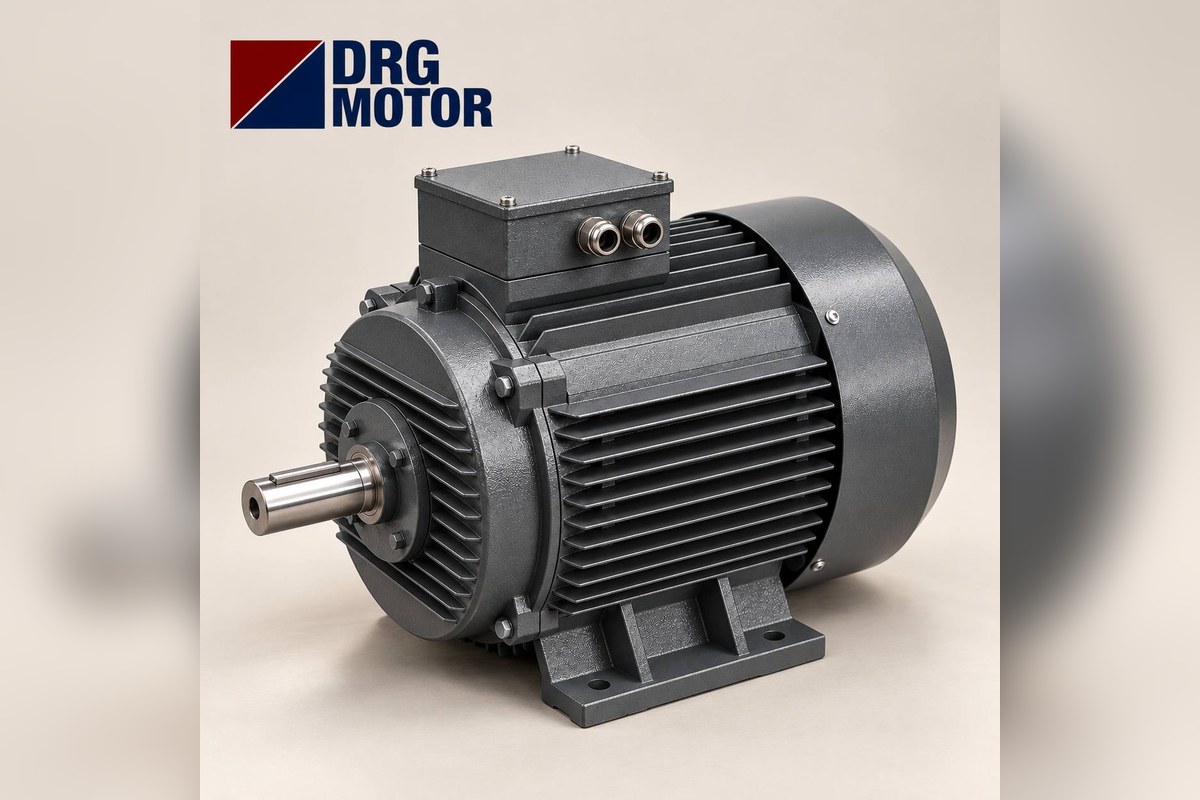

When choosing a new motor to replace an old three-phase motor, first take power and speed from the nameplate, then measure three things: shaft height H, foot hole spacing A×B and shaft diameter D. If these three match a frame in today’s IEC frame table, the new motor bolts into the same place; if not, the solution is an adapter plate, a base, or a change of coupling/pulley hub to suit the shaft. Electrically, an old “220/380 V Δ/Y” nameplate corresponds to today’s 230/400 V motor and a “380/660 V Δ/Y” nameplate to today’s 400/690 V motor; the connection stays the same.
Old motors are often longer and heavier than today’s motors and have a different end shield and cable entry layout; on some, even the shaft height does not follow the IEC series. That is why “buy the same kW and fit it” often leaves surprises for installation day on older machines. Before measuring, switch off and lock out at the panel; removing the old cables and connecting the terminals of the new motor must be done by a qualified electrician.
DRG Motor is a manufacturer, supplier and seller of electric motors; you can filter current cast-iron and aluminium models by frame, power and speed on our Buy Electric Motors Online page. For motors with a readable nameplate, our article on how to choose an equivalent electric motor is enough; this article focuses on the dimensional and nameplate differences specific to old-type motors.
The 3 most common mismatches between an old motor and a new one
1. Shaft height is not in the IEC series
On today’s motors shaft height H takes fixed values: 80, 90, 100, 112, 132, 160 mm and so on. On some old motors, or motors built to a different standard, this value may be an in-between dimension. The new motor is then either chosen one frame smaller with packing underneath, or one frame larger with the base machined. The shaft axis height of the driven machine decides which is appropriate.
2. Foot holes do not line up
Even with the same H, the foot hole spacing may differ. The IEC table also contains two frames with the same H: frames 132S and 132M both have H 132 mm and A 216 mm, but B is 140 mm on 132S and 178 mm on 132M. Measuring the old motor’s foot holes along the shaft and seeing which of these two values it is closest to is the quickest way to find the frame letter (S/M/L).
3. The voltage nameplate is misread
“220/380 V” on an old nameplate does not mean the motor will not run on today’s 400 V network. It means the motor is connected in star on a 380–400 V network; its present-day equivalent is a 230/400 V motor. Misreading it usually leads to the new motor being connected in delta and the overload tripping at first start.
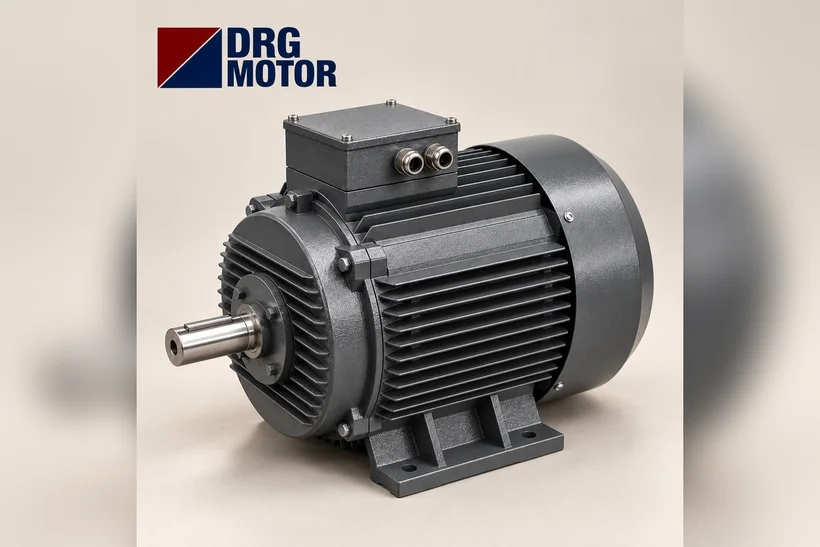
What does the voltage on an old nameplate correspond to today?
In Turkey the mains voltage used to be referred to as 220/380 V; today it is 230/400 V. Motor nameplates were updated accordingly. The table below shows the old marking, the connection on a 400 V network and today’s equivalent.
| Old nameplate | On a 400 V network | Today’s equivalent |
|---|---|---|
| 220/380 V Δ/Y | Star (Y) | 230/400 V Δ/Y |
| 380/660 V Δ/Y | Delta (Δ) | 400/690 V Δ/Y |
| 380 V Δ only | Delta (Δ) | 400/690 V Δ/Y |
| 380 V Y only | Star (Y) | 230/400 V Δ/Y |
The practical consequence: if the old motor runs on a star-delta starter, the new motor must be rated 400/690 V. In the DRG catalogue, models up to 3 kW are rated 230/400 V and models of 4 kW and above 400/690 V; for example DRG-112M-4 (4 kW) is connected in delta on a 400 V network. If the old motor is 3 kW or less and the panel has a star-delta starter, say so before ordering. For starting options, see our star-delta starting page.
Why is the current value slightly different?
The old nameplate gives the current at 380 V; the new catalogue gives both 380 V and 400 V values. For DRG-112M-4 it states 8.37 A at 380 V and 7.95 A at 400 V. Set the overload relay to the new motor’s nameplate and your network’s actual voltage, not to the old nameplate; you can use the overload, fuse and contactor selection tool for the setting range.
Click to see current electric motor prices and order nowSEE PRICES →
Finding the old motor’s IEC frame by measurement
To find the frame that will replace the old motor, measure H from the underside of the feet to the shaft centre, the foot hole spacing as A (across the shaft) and B (along the shaft), and the foot hole diameter as K. Then check two more dimensions for the installation space: frame diameter AC and overall length L. Old motors are usually longer; if the new motor has to fit into a recess in the machine body, length and diameter are decisive.
| Frame | H / foot hole K | Frame diameter AC | Overall length L |
|---|---|---|---|
| 80 | 80 / 4–Φ10 | 167 mm | 304 mm |
| 90L | 90 / 4–Φ10 | 182.4 mm | 361 mm |
| 100L | 100 / 4–Φ12 | 205.4 mm | 406 mm |
| 112M | 112 / 4–Φ12 | 230 mm | 394 mm |
| 132S | 132 / 4–Φ12 | 258.4 mm | 438 mm |
| 132M | 132 / 4–Φ12 | 258.4 mm | 476 mm |
| 160M | 160 / 4–Φ14.5 | 314 mm | 608 mm |
| 160L | 160 / 4–Φ14.5 | 314 mm | 652 mm |
An interesting detail in the table: the overall length of frame 112M (394 mm) is shorter than that of frame 100L (406 mm). Moving up one frame does not always mean a longer motor; in a tight space, compare both length and diameter of the two frames. Drawings of all frames are on our technical drawings page.
If the foot holes do not match: how to make an adapter plate
If the holes in the frame for the old motor do not match the new motor’s A×B, the cleanest solution is an adapter plate bolted on top of the frame. The plate is drilled to the old dimensions for the old holes and to the IEC dimensions for the new motor.
- Choose the plate thickness so that it also makes up the difference between the old and new H: plate thickness = H(old) − H(new). If the difference is zero or negative, the plate only converts the hole pattern and height is dealt with on the frame.
- Slot the new motor’s holes along the shaft so there is room to adjust the coupling or belt.
- Choose a plate thick enough not to flex; thin sheet amplifies vibration and spoils alignment.
- On a coupled drive, complete alignment with shims after fitting the plate and check it with a dial indicator.
Example: the old motor’s H was measured at 112 mm but its foot holes do not match 112M. A 112M motor is chosen and the plate is made purely as a hole converter (thickness difference 0). If the old motor’s H is 132 mm and the required power is covered by a 112M frame, the plate must be 20 mm thick or a riser of the same thickness must be placed underneath.
What changes at the shaft, cable entry and terminal box?
Shaft diameter and length
On IEC frames the shaft size depends on the frame: 28×60 mm on 100L and 112M, 38×80 mm on 132S and 132M, 42×110 mm on 160M and 160L. If the old motor’s shaft differs from these, the existing coupling hub or pulley will not fit the new shaft; the hub has to be machined to the new shaft diameter or replaced. So measure the shaft diameter with a calliper and the keyway width separately.
Terminal box and cable entry
Some old motors have only three terminals in the box with the connection fixed inside; new motors have a six-terminal block with links, and star or delta is made with the links. The cable entry may also change: in the DRG catalogue frame 100L uses 1 × M25×1.5, frames 112M and 132 use 2 × M32×1.5 metric entries. The old gland may not fit the new box; prepare a suitable metric gland in advance. Also check that the old cable’s cross-section suits the new motor’s current.
Terminal box orientation
Even if the box is on top on both the old and new motor, the cable entry direction may differ. If the cable ends up too short, pulling a new cable is safer than a joint.
Changeover day checklist
- Have kW, speed, voltage and connection been photographed from the old nameplate?
- Have H, A×B, K and D×E been measured and matched to the frame table?
- Does the panel use direct-on-line or star-delta starting? If star-delta, is the new motor 400/690 V?
- If an adapter plate or base is needed, has the thickness been calculated as H(old) − H(new)?
- Does the coupling hub or pulley suit the new shaft diameter?
- Does the cable gland fit the new terminal box’s metric entry?
- Has the overload relay been set to the new nameplate current?
- Was the direction of rotation checked uncoupled at first start?
Models most often chosen to replace old motors
Most old motors in workshops and factories are 1500 rpm (4-pole) in the 1.5–7.5 kW range. The cast-iron models below are the options most often considered for replacing old motors in this range:
| Model | Power / speed | Frame | Current 400 V |
|---|---|---|---|
| DRG-90L-4 | 1.5 kW / 1445 rpm | 90L cast iron | 3.3 A |
| DRG-100L2-4 | 3 kW / 1450 rpm | 100L cast iron | 6.02 A |
| DRG-112M-4 | 4 kW / 1450 rpm | 112M cast iron | 7.95 A |
| DRG-132S-4 | 5.5 kW / 1460 rpm | 132S cast iron | 10.7 A |
| DRG-132M-4 | 7.5 kW / 1460 rpm | 132M cast iron | 14.3 A |
- DRG-90L-4 – 1.5 kW – 1445 rpm – 90L cast iron
- DRG-100L2-4 – 3 kW – 1450 rpm – 100L cast iron
- DRG-112M-4 – 4 kW – 1450 rpm – 112M cast iron
- DRG-132S-4 – 5.5 kW – 1460 rpm – 132S cast iron
- DRG-132M-4 – 7.5 kW – 1460 rpm – 132M cast iron
Click to see current prices and order these motors nowSEE PRICES →
Frequently Asked Questions
Will a 220/380 volt motor run on a 400 volt network?
Yes. A motor marked 220/380 V Δ/Y runs on a 380–400 V network connected in star; its present-day equivalent is a 230/400 V motor. Connected in delta, the winding would see overvoltage.
Is a new motor of the same kW enough to replace an old one?
Electrically yes, if power and speed are the same; but shaft height, foot holes and shaft diameter must also match. If these three do not, an adapter plate or a coupling hub change is needed.
How do I find the frame number of an old motor?
Measure the height from the underside of the feet to the shaft centre (H); this value is the frame number (e.g. 112 mm → frame 112). The foot hole distance along the shaft (B) helps tell the S, M or L letter apart.
The old motor ran on star-delta; what should I watch for with the new one?
The new motor must be rated 400/690 V and able to run in delta on a 400 V network. A motor rated 230/400 V cannot be used with a star-delta starter.
You can send a photo of your old motor’s nameplate and its measurements to +90 (542) 666 11 11 or [email protected]; all channels are on our contact page. For current models and prices, see the 120 models in our online store.