English
 Le français
 Türkçe




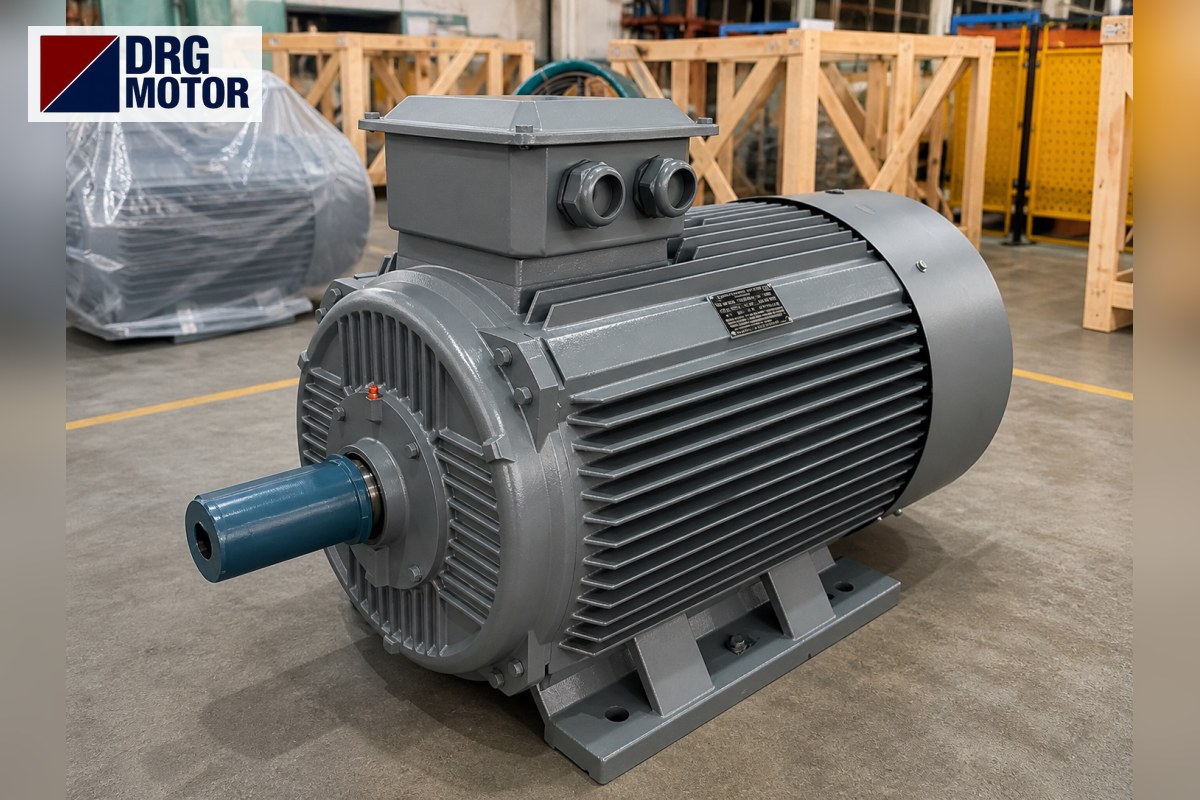

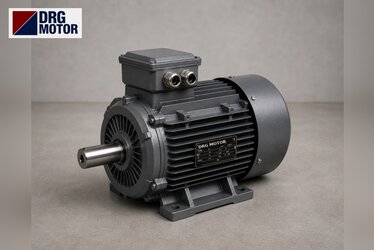
When choosing a 3-phase asynchronous motor, you reach the right model with six pieces of information: the power the load needs, the speed (pole count), the supply voltage and connection, the frame material, the mounting arrangement and the operating environment. For example, a load that needs 45 N·m at around 1450 rpm on the machine shaft comes to 6.83 kW; the next standard power is 7.5 kW and the 1500 rpm motor is the DRG-132M-4. This motor is wound for 400/690 V, is connected in delta (Δ) on a 380 V supply, draws 15.0 A at 380 V and has an IEC 132M frame.
Change one of the six steps and the model changes too: if the same 7.5 kW is needed at 3000 rpm, the frame drops to 132S; at 1000 rpm it grows to 160M. The steps below follow the same order as the filters for the 120 models on the Buy Electric Motors Online page, so you can narrow down the list at the end of each step. If you want to know how the motor works and how the rotor and stator are built, that is covered in What Is a Three-Phase Asynchronous Motor? Construction, Types and Applications; here we focus only on the buying decision. Always have the motor you choose connected and commissioned by a qualified electrician.
Step 1: Find the Load Power and Round Up to a Standard Rating
Motor power is the power the machine needs at its shaft. If the machine manufacturer gives it in kW, use it directly. If only torque and speed are known, this relationship is enough:
P (kW) = T (N·m) × n (rpm) ÷ 9550
In the introduction example, 45 × 1450 ÷ 9550 ≈ 6.83 kW. The standard power steps in the store run 5.5 – 7.5 – 11 kW; the first step above 6.83 kW is 7.5 kW. As a check, look at the rated torque of the DRG-132M-4: 49.1 N·m, which is above the 45 N·m the load needs. If the calculated value is very close to a step (e.g. 7.4 kW), consider the next step up; if the load is hard to start, also check the starting torque ratio (Ts/Tn). For the DRG-132M-4 this ratio is 2.0.
Step 2: Choose the Speed and Pole Count
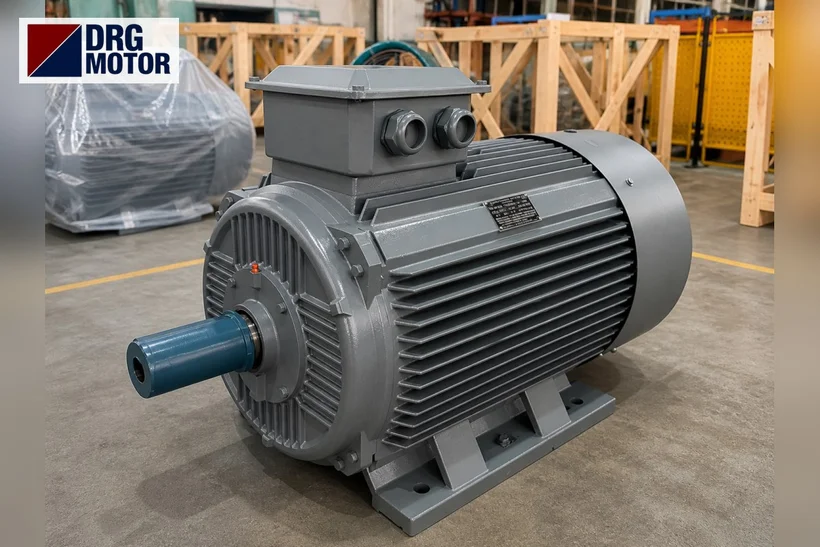
The speed is set by the machine the motor drives: directly coupled pumps and fans mostly run at 3000 or 1500 rpm, while machines driven through pulleys or a gearbox are usually designed around a 1500 rpm motor. At the same power, lower speed means higher torque and a larger frame. The three 7.5 kW options:
| Model | Synchronous / rated speed | Rated torque | Current (380 V) | cos φ | IEC frame | Shaft D×E |
|---|---|---|---|---|---|---|
| DRG-132S2-2 | 3000 / 2930 rpm | 24.4 N·m | 14.4 A | 0.88 | 132S | 38×80 mm |
| DRG-132M-4 | 1500 / 1460 rpm | 49.1 N·m | 15.0 A | 0.84 | 132M | 38×80 mm |
| DRG-160M-6 | 1000 / 970 rpm | 73.8 N·m | 16.2 A | 0.79 | 160M | 42×110 mm |
The table shows two things. First, when the speed halves, the torque roughly doubles (24.4 → 49.1 N·m); matching the machine's required speed with the motor speed is sounder than enlarging the pulley or gear ratio unnecessarily. Second, at the same power, cos φ falls and the current rises slightly as the pole count increases; that is why cable and protection should be chosen only after the pole count is settled.
Step 3: Set the Voltage and Connection for Your Supply
In Turkey the industrial supply is 380–400 V between phases. The two voltages on the motor nameplate tell you which connection to use on this supply:
- 230/400 V (Δ/Y): connected in star (Y) on a 380 V supply. In our store, all 43 models from 0.25 to 3 kW have this winding. Example: DRG-100L2-4, 3 kW, 6.34 A at 380 V.
- 400/690 V (Δ/Y): connected in delta (Δ) on a 380 V supply. The 77 models of 4 kW and above have this winding. Example: DRG-112M-4, 4 kW, 8.37 A at 380 V.
This distinction also determines the starting method. Star-delta starting requires the motor to run in delta at 380 V, so it is only used with motors wound for 400/690 V. The starting current ratio (Is/In) of the DRG-132M-4 is 7.5: with direct-on-line starting, the starting current is about 7.5 × 15.0 = 112.5 A; with star-delta, the line current falls to about a third of that, roughly 37.5 A. For the terminal link layout see 3-Phase Motor Wiring Diagram, and for a comparison of methods use the star-delta starting tool.
Step 4: Choose the Frame Material: Aluminium, Cast Iron or Compact
The first limit in frame selection is power: aluminium frames are offered from 0.25 to 11 kW, cast iron frames from 0.55 to 355 kW. 0.25 and 0.37 kW are aluminium only; 15 kW and above are cast iron only. Distribution of the 120 store models by power range:
| Power range | Number of models | Aluminium | Cast iron | Compact | Winding voltage |
|---|---|---|---|---|---|
| 0.25–1.1 kW | 24 | 15 | 9 | – | 230/400 V |
| 1.5–3 kW | 19 | 9 | 9 | 1 | 230/400 V |
| 4–11 kW | 26 | 12 | 12 | 2 | 400/690 V |
| 15–55 kW | 21 | – | 21 | – | 400/690 V |
| 75–355 kW | 30 | – | 30 | – | 400/690 V |
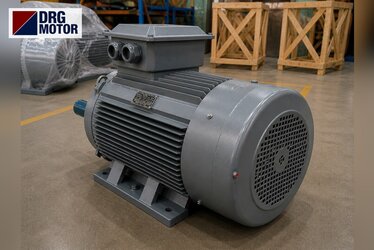
Between 0.55 and 11 kW the same model code exists in both frame materials with identical electrical values: the aluminium and cast iron DRG-132M-4 both run at 1460 rpm, draw 15.0 A and deliver 49.1 N·m. The decision depends on the environment. If light weight, easy handling and flange-suspended mounting matter, choose aluminium; if a robust frame is wanted in heavy industry with vibration, shocks or dust, choose cast iron (e.g. the cast iron DRG-132M-4).
The compact series (the “K” at the end of the code) delivers the same power in one frame size smaller: the DRG-132M-4K offers an 11 kW 1500 rpm motor in a 132M frame instead of the standard 160M and draws 21.5 A at 380 V. If the space in the machine or the existing mounting dimensions are based on a 132 frame, this option is worth considering.
Step 5: Define the Mounting Arrangement
The mounting code shows how the motor is fixed to the machine and is stated separately in the order:
- B3: foot-mounted, horizontal; bolted to a base. The most common arrangement for belt and coupling drives.
- B5: large flange, no feet; the motor is attached by its flange to a pump, gearbox or machine body. On a 132M frame the flange outside diameter is 300 mm, the pitch circle 265 mm and the spigot diameter 230 mm.
- B35: both feet and a B5 flange; the motor sits on a base and is also aligned by its flange.
- B14: small flange (tapped holes); used mostly at low power and on compact machines.
The store product pages list B3, B5, B14 and B35 mounting options; simply write the required arrangement in the order note. The foot hole spacing (A×B) and overall length (L) are in the dimension table on the product pages; for the DRG-132M-4, A×B is 216×178 mm and L is 476 mm.
Step 6: Check Protection, Cable Entry and Ambient Conditions
The last step is suitability for the place where the motor will run. The motors in our store have IP55 protection, and the product pages give an ambient temperature of −15…+40 °C and an altitude of ≤1000 m; for use outside these limits, consult us before ordering. Thermal protection (PTC / PT100) is listed as optional; it is worth considering for motors with frequent starts and stops or in hot environments. Cable entry also varies with the frame: the DRG-132M-4 has 2 × M32×1.5 gland entries and a 6208-ZZ-C3 bearing.
Once the motor is selected, cable size and protective devices are chosen according to the nameplate current. For a 15.0 A motor, you can use the motor cable size calculator and the overload, fuse and contactor selection tool, and compare the currents of different ratings in the motor current chart.
Final Check Before You Buy and Filtering in the Store
Once the six steps are done, finish the selection in two short moves: enter the result in the store filters, then tick off the list below before ordering.
Finding the model with the store filters
You can turn the result of the six steps into a list in the online store with four filters:
- Frame material: “3-phase cast iron (0.55–355 kW)” or “Aluminium frame (0.25–11 kW)”.
- Power: the standard rating found in Step 1 (e.g. 7.5 kW).
- Speed (poles): 3000 – 2p, 1500 – 4p or 1000 – 6p.
- Search (code, kW): direct search by frame code or power (e.g. “132M” or “7.5”).
If you do not know the power and speed, you can start with the electric motor selection guide, which produces a suggestion from application data.
10-point check
- Is the load's power requirement known in kW and rounded up to the next standard step?
- Is the motor's rated torque above the torque the load requires?
- Does the speed match the machine's required speed, and was the pulley or gear ratio calculated accordingly?
- Are the nameplate voltage (230/400 V or 400/690 V) and the connection at 380 V (Y or Δ) known?
- If star-delta starting is planned, is the motor wound for 400/690 V?
- Is the frame material suited to the environment (vibration, dust, handling)?
- Do the mounting code (B3, B5, B35, B14) and flange size fit the machine?
- Does the shaft diameter and length (D×E) match the coupling, pulley or gearbox bore?
- Are ambient temperature and altitude within −15…+40 °C and ≤1000 m?
- Were the cable size, overload relay and fuse chosen according to the nameplate current?
Motors Used in These Selection Examples
- DRG-132M-4 – 7.5 kW – 1500 rpm – aluminium, IEC 132M
- DRG-132M-4 – 7.5 kW – 1500 rpm – cast iron, IEC 132M
- DRG-132S2-2 – 7.5 kW – 3000 rpm – aluminium, IEC 132S
- DRG-160M-6 – 7.5 kW – 1000 rpm – aluminium, IEC 160M
- DRG-100L2-4 – 3 kW – 1500 rpm – aluminium, IEC 100L
- DRG-112M-4 – 4 kW – 1500 rpm – aluminium, IEC 112M
- DRG-132M-4K – 11 kW – 1500 rpm – compact aluminium, IEC 132M
Click to see current prices and order these motors nowSEE PRICES →
Frequently Asked Questions
How many amps does a 7.5 kW 3-phase motor draw?
The 1500 rpm DRG-132M-4 draws 15.0 A at 380 V and 14.3 A at 400 V. At the same power, the 3000 rpm DRG-132S2-2 draws 14.4 A at 380 V and the 1000 rpm DRG-160M-6 draws 16.2 A. Because current varies with pole count, choose the cable and overload relay using the nameplate value of the exact model.
Is a 3-phase induction motor connected in star or delta at 380 V?
It depends on the nameplate voltage. A motor marked 230/400 V is connected in star on a 380 V supply; a motor marked 400/690 V is connected in delta. In our store, models of 3 kW and below are wound for 230/400 V, models of 4 kW and above for 400/690 V. The connection should be made by a qualified electrician.
Should I choose an aluminium or a cast iron frame?
Between 0.55 and 11 kW both frames carry the same model code and the same electrical values; the choice depends on the environment. Choose aluminium when light weight and flange mounting matter, cast iron for vibration and heavy industrial conditions. From 15 kW upwards only cast iron is available.
Should I buy a 1500 rpm or a 3000 rpm motor?
Choose according to the speed the machine needs. At the same power, a 1500 rpm motor delivers roughly twice the torque of a 3000 rpm motor (49.1 N·m versus 24.4 N·m at 7.5 kW). Directly coupled high-speed pumps and fans use 3000 rpm; machines with pulleys or gearboxes mostly use 1500 rpm.
Send us the power, speed and mounting you have chosen and we will confirm the right model with you: +90 (542) 666 11 11, [email protected] or our contact page. You can browse all 3-phase asynchronous motors among the 120 models in our online store.