English
 Le français
 Türkçe




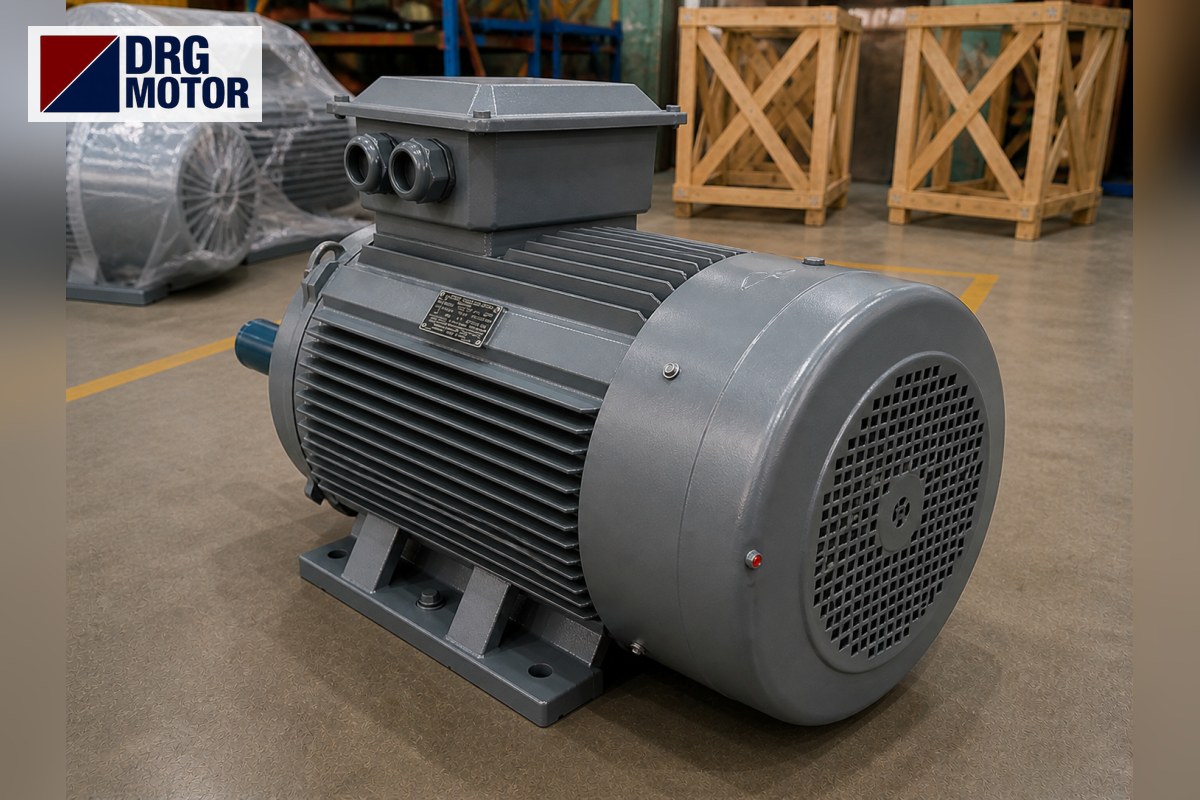

Three-phase asynchronous electric motors vary along seven separate axes: rotor design (squirrel cage or slip ring), housing material (aluminium or cast iron), frame size (standard or compact), number of poles (2, 4 or 6 poles; 3000, 1500 and 1000 rpm synchronous speed on a 50 Hz supply), mounting arrangement (B3, B5, B14, B35, V1), winding voltage (230/400 V or 400/690 V) and cooling method. The 120 models in our Buy Electric Motors Online section make this concrete: 38 aluminium models cover 0.25–11 kW, 82 cast iron models cover 0.55–355 kW, and 3 of them use a compact frame.
Naming the type correctly tells you whether the coupling, pulley and flange will still fit when you replace a motor. Of two motors rated 5.5 kW and 1500 rpm, the standard DRG-132S-4 has a Ø38 mm shaft while the compact DRG-112M-4K comes with a Ø28 mm shaft; the nameplate power is identical, yet the existing pulley will not fit the second motor. For the operating principle and the parts of an induction motor, see our article Three-Phase Asynchronous Motor: How It Works and Types; this guide deals only with the types and their consequences for selection.
Types of three-phase induction motors: seven distinctions in one table
The table below summarises what each classification axis changes and where it matters most. The store figures were counted from our product data.
| Classification axis | Types | What does it change? | Where is it used? |
|---|---|---|---|
| Rotor design | Squirrel cage · slip ring | Starting method, maintenance | Squirrel cage: pumps, fans, conveyors, compressors · Slip ring: older heavy drives started through rotor resistance |
| Housing material | Aluminium (0.25–11 kW) · cast iron (0.55–355 kW) | Weight, resistance to impact and vibration | Aluminium: machine building, light drives · Cast iron: crushers, mills, large pumps and fans |
| Frame size | Standard · compact (3 models) | Shaft diameter, length, shaft height | Compact: machines with limited mounting space |
| Number of poles | 2 poles (40 models) · 4 poles (41) · 6 poles (39) | Speed and shaft torque | 2 poles: centrifugal pumps · 4 poles: general drives · 6 poles: low speed without pulleys |
| Mounting | B3, B5, B14, B35, V1 | How the motor is attached to the machine | B3: base mounting · B5/B14: gearbox and pump flanges · V1: vertical drives |
| Winding voltage | 230/400 V (43 models) · 400/690 V (77 models) | Star/delta connection at 380 V, starting method | 400/690 V: lines with star-delta starting |
| Cooling | Surface cooling by own fan · separate fan | Heating behaviour at low speed | Separate fan: long periods at low speed on a drive |
Types by rotor design and cooling
Squirrel cage and slip ring rotor
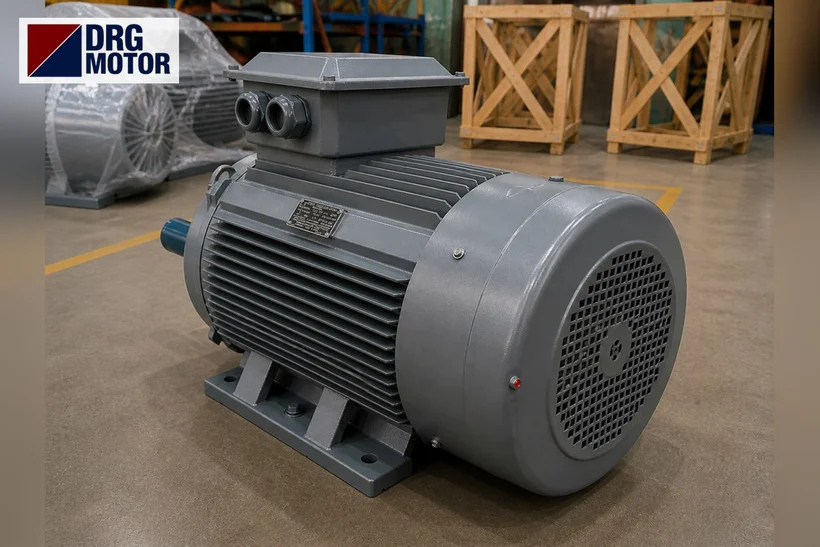
In a squirrel cage rotor the conductor bars are joined at both ends by short-circuit rings; no external connection is made to the rotor. The terminal box contains only the stator winding ends, and there are no wearing parts such as brushes or slip rings. Most three-phase motors used today on pumps, fans, conveyors and compressors are built this way, and where the starting current must be limited a star-delta starter, a soft starter or a drive is used.
In a slip ring (wound rotor) motor the rotor winding ends are brought out through slip rings and brushes; resistance is added to the rotor circuit at start to limit the current. These motors are found on older crane and crusher drives and need brush maintenance. Our store does not list slip ring models; if you replace one with a squirrel cage motor, determine the starting method again with the motor starting methods calculator.
Cooling method
A standard three-phase motor is air-cooled over its finned housing by its own fan on the rear shaft end; the product pages list this as IC 411 cooling. With this design the cooling air decreases together with shaft speed. If the motor will run at low speed on a frequency drive for long periods, a separate fan that works independently of speed should be considered.
Types by housing: aluminium, cast iron and compact frame
In our store, aluminium housing motors range from 0.25 kW to 11 kW and cast iron motors from 0.55 kW to 355 kW. Between 0.55 and 11 kW both housings are available for the same power and speed, with the same electrical data. For example, DRG-112M-4 aluminium and DRG-112M-4 cast iron both run at 1450 rpm at 4 kW, draw 7.95 A at 400 V and share the same 112M dimensions. The environment decides: aluminium for light machines and portable equipment, cast iron for crushers, mills and heavy pumps where impact, vibration and dust are severe. All models above 11 kW have a cast iron housing.
Compact frame three-phase motor
A compact motor delivers the same power in the next smaller IEC frame. The electrical data match the standard counterpart; shaft height, shaft size and length change:
| Power / speed | Standard model | Compact model | Frame (std → compact) | Shaft D×E (mm) | Overall length L (mm) | Current 400 V |
|---|---|---|---|---|---|---|
| 3 kW / 3000 rpm | DRG-100L-2 | DRG-90L-2K | 100L → 90L | 28×60 → 24×50 | 406 → 361 | 5.71 A |
| 5.5 kW / 1500 rpm | DRG-132S-4 | DRG-112M-4K | 132S → 112M | 38×80 → 28×60 | 438 → 394 | 10.7 A |
| 11 kW / 1500 rpm | DRG-160M-4 | DRG-132M-4K | 160M → 132M | 42×110 → 38×80 | 608 → 476 | 20.4 A |
A compact motor is an advantage in a newly designed machine with little space. When it replaces an existing motor, the base, coupling and pulley must be adapted because the shaft height and shaft diameter change.
Types by number of poles: 2, 4 and 6-pole motors
Synchronous speed is found with n = 120 × f / p (f: frequency, p: number of poles). At 50 Hz, 2 poles give 3000, 4 poles 1500 and 6 poles 1000 rpm; under load the motor runs slightly below this. At the same power, shaft torque rises as speed falls: M = 9550 × P / n. For three 4 kW aluminium models this relationship matches the catalogue data exactly:
| Model | Poles | Frame | Rated speed (rpm) | Rated torque (Nm) | Current 400 V (A) | cos φ |
|---|---|---|---|---|---|---|
| DRG-112M-2 | 2 | 112M | 2905 | 13.1 | 7.45 | 0.88 |
| DRG-112M-4 | 4 | 112M | 1450 | 26.3 | 7.95 | 0.82 |
| DRG-132M1-6 | 6 | 132M | 968 | 39.5 | 8.99 | 0.74 |
Two conclusions follow. First, the 6-pole motor delivers nearly three times the torque at the same power but moves up one frame size (132M). Second, cos φ falls and current rises as the number of poles increases; in a plant with many 6-pole motors, check the reactive power demand with the power factor correction calculator.
Types by mounting: B3, B5, B14, B35 and V1
The mounting code tells you how the motor is attached to the machine. B3 is a foot-mounted motor bolted to a base. B5 has a large flange whose holes lie outside the housing, and the motor hangs from the flange. B14 has a small (face) flange with tapped holes in the end shield and is used on compact gearbox and pump connections. B35 carries both feet and a B5 flange. V1 is a flange motor mounted vertically with the shaft pointing down, as on vertical pumps and mixers. The product pages list B3, B5, B14 and B35 options; the mounting type is stated in the order note.
With flange mounting, matching the frame code is not enough. According to the B5 table in the catalogue, frames 80 and 90S use the same flange (Ø165 mm pitch circle, Ø130 mm spigot) but have different shafts:
| Frame | Pitch circle M | Spigot N | Flange outer diameter P | Hole diameter S | Shaft D×E |
|---|---|---|---|---|---|
| 80 | 165 | 130 | 200 | 12 | 19×40 |
| 90S | 165 | 130 | 200 | 12 | 24×50 |
| 112M | 215 | 180 | 250 | 14.5 | 28×60 |
| 132S | 265 | 230 | 300 | 14.5 | 38×80 |
| 160M | 300 | 250 | 350 | 18.5 | 42×110 |
Dimensions are in mm. B14 small flange dimensions are not in this table; for B14 and other mounting dimensions see the technical drawings page.
Types by winding voltage: 230/400 V and 400/690 V motors
The dual voltage on a three-phase nameplate gives the winding voltage in delta and in star. On a 380–400 V supply a 230/400 V motor is connected in star (Y) and a 400/690 V motor in delta (Δ). In our store, 43 models from 0.25 to 3 kW have 230/400 V windings and 77 models from 4 to 355 kW have 400/690 V windings. For example, the 3 kW DRG-100L2-4 is connected in star at 380 V and draws 6.34 A, while the 4 kW DRG-112M-4 is connected in delta on the same supply and draws 8.37 A.
This distinction determines the starting method. With star-delta starting the motor must run in delta, so on a 380–400 V supply star-delta starting can only be used with 400/690 V motors. Small 230/400 V motors are started direct-on-line, with a soft starter or with a drive.
Pre-order type checklist
- Note the power, speed and winding voltage (230/400 V or 400/690 V) from the old motor's nameplate.
- Choose the housing material for the environment; above 11 kW the only option is cast iron.
- Measure shaft diameter and length (D×E); remember that a compact model has the shaft of the next smaller frame.
- Check the mounting type (B3, B5, B14, B35) and compare the flange pitch circle and spigot diameter.
- Set the number of poles by the speed of the driven machine; recalculate if the pulley ratio changes.
- For star-delta starting on a 380–400 V supply, select a 400/690 V model.
- If the motor will run at low speed on a drive for long periods, assess cooling separately.
- Check the cable entry: store models range from 1 × M20×1.5 to 3 × M63×1.5 glands.
For current, cable and protective device calculations, use our electric motor calculators.
Motors used as examples in this article
- DRG-112M-2 – 4 kW – 3000 rpm – aluminium, IEC 112M frame
- DRG-112M-4 – 4 kW – 1500 rpm – aluminium, IEC 112M frame
- DRG-132M1-6 – 4 kW – 1000 rpm – aluminium, IEC 132M frame
- DRG-112M-4K – 5.5 kW – 1500 rpm – aluminium compact, IEC 112M frame
- DRG-132S-4 – 5.5 kW – 1500 rpm – aluminium, IEC 132S frame
- DRG-132M-4K – 11 kW – 1500 rpm – aluminium compact, IEC 132M frame
- DRG-160M-4 – 11 kW – 1500 rpm – aluminium, IEC 160M frame
- DRG-90L-2K – 3 kW – 3000 rpm – cast iron compact, IEC 90L frame
- DRG-100L-2 – 3 kW – 3000 rpm – cast iron, IEC 100L frame
- DRG-200L-4 – 30 kW – 1500 rpm – cast iron, IEC 200L frame
Click to see current prices and order these motors nowSEE PRICES →
To filter every type by housing, power and speed, browse the 120 models in our online store.
Frequently Asked Questions
What are the types of induction motors?
By rotor: squirrel cage and slip ring; by housing: aluminium and cast iron; by size: standard and compact; by poles: 2, 4 and 6 poles; by mounting: B3, B5, B14, B35, V1; by winding voltage: 230/400 V and 400/690 V.
What is the difference between a B3 and a B35 motor?
B3 has feet only and is bolted to a base. B35 has a B5 large flange in addition to the feet, so the motor can be fixed both to a base and to the machine housing. Foot dimensions are the same in both types.
Aluminium housing or cast iron motor?
Between 0.55 and 11 kW both have the same electrical data. Choose aluminium for light machines and portable equipment, cast iron for heavy industry with impact, vibration and dust. Above 11 kW the store option is cast iron.
Can a compact motor replace a standard motor?
Not directly. Because a compact model delivers the same power in a smaller frame, its shaft height and shaft diameter differ; at 5.5 kW, for example, the shaft is Ø28 mm instead of Ø38 mm. The base, coupling or pulley must be adapted.
If you are unsure which type a motor belongs to, send us a nameplate photo and a description of the application: +90 (542) 666 11 11 · [email protected] · Contact page.