English
 Le français
 Türkçe




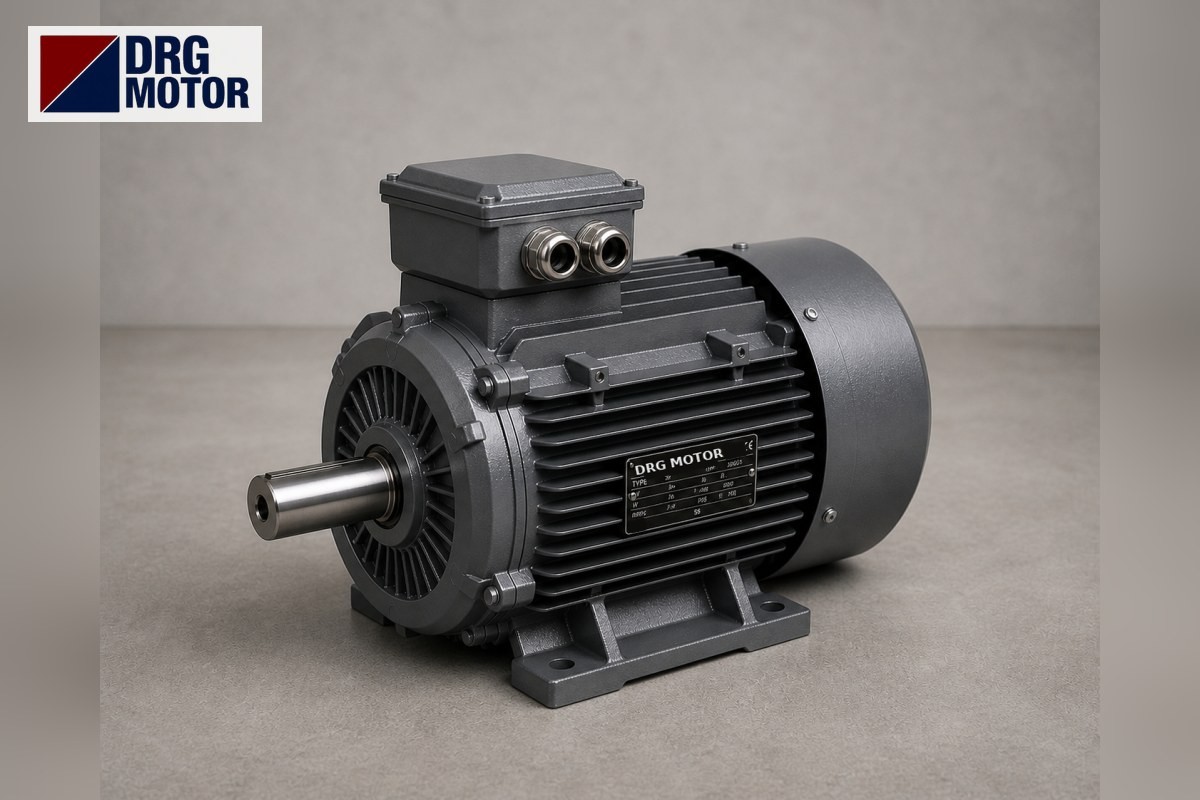

A first-class quality electric motor can be recognised from the motor itself, not from the seller's words: the nameplate is complete and matches the catalogue exactly, the frame casting is clean, the terminal box and cable entry match the catalogue, the bearing code is stated, the shaft and key dimensions are those on the drawing, the shaft turns freely by hand, the no-load sound is smooth, the three phase winding resistances are close to each other, the insulation measurement is clean and the load current does not exceed the nameplate current. The 12 checkpoints below explain step by step how to see this before buying and at delivery.
The first nine checks are made by eye, with a tape and a caliper; the last three are electrical measurements. Winding resistance, insulation and current measurements must be carried out by a qualified electrician: the motor must be de-energised, and the windings must be discharged after a megger test. The values in the examples are taken from the technical data of the models on our Buy Electric Motors Online page; DRG Motor is the supplier and seller of these motors.
No single measurement tells you whether a motor is good. Individually small signs, such as a missing earth screw, a gland thread that does not match the catalogue or a bearing code absent from the nameplate, together give a clear picture of how the motor was built and sold.
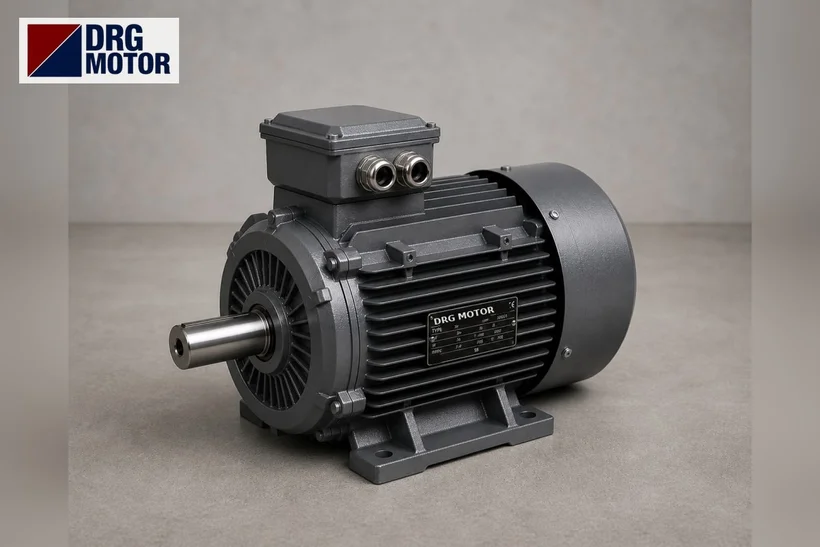
12 checkpoints: how to check and what it indicates
| Checkpoint | How to check | What it indicates |
|---|---|---|
| 1. Is the nameplate complete? | Check for power, voltage and connection, current, speed, frequency, cos φ, IP and insulation class and the model code. | An incomplete nameplate means the motor has no traceability. |
| 2. Do nameplate, catalogue and invoice match? | Compare the code and values on the nameplate line by line with the product page and the invoice. | A mismatch may mean the wrong model or a relabelled motor. |
| 3. Frame casting quality | Look for broken fins, cracks, porosity, burrs and filler under the paint. | Casting defects weaken heat dissipation and mechanical strength. |
| 4. Foot and mounting dimensions | Measure the A × B foot hole spacing and the H shaft height with a tape. | Catalogue-identical dimensions mean an equivalent motor can be swapped in without trouble. |
| 5. Terminal box and cable gland entry | Do the gasket, cover screws and number/thread of cable entries match the catalogue? | This is the first line of defence against dust and water. |
| 6. Terminal board and earthing | Are the U1-V1-W1 / W2-U2-V2 layout, the links and the earth screw in place? | A missing link or earth terminal leads to installation errors. |
| 7. Bearing type | Find the bearing code on the nameplate or in the catalogue (e.g. 6206-ZZ-C3). | The correct bearing code makes spare part supply easier. |
| 8. Shaft and key | Check the D × E shaft size with a caliper, the F key width and the G dimension; the shaft must have no impact marks. | An out-of-size shaft spoils the fit of couplings and pulleys. |
| 9. Fan and fan cover | Are the fan blades intact, does the cover rub on the fan, are the cover openings clear? | Fan damage directly affects cooling and vibration. |
| 10. Turning by hand, no-load noise and vibration | Turn the shaft by hand; run at no load and listen for rubbing, knocking and humming. | Irregular noise points to a bearing or balancing problem. |
| 11. Winding resistance balance | Remove the links and measure the resistance of the three phase windings with a low-resistance meter. | The three values should be close; a difference indicates a winding fault. |
| 12. Insulation and running current | Measure insulation resistance with a megger and the load current with a clamp meter. | Low insulation or current above the nameplate means the motor should not be accepted. |
Nameplate and catalogue: quality on paper (1–2)
The nameplate of a quality motor is legible, riveted to the frame and reads like a summary of the catalogue. It should show at least: model code, rated power (kW), voltage and connection (e.g. 230/400 V Δ/Y), rated current, rated speed, frequency, cos φ, IP protection class and insulation class. If the nameplate is a sticker that is starting to wear off, tracing the motor becomes difficult.
The second step is whether these values match the catalogue and product page. For DRG-132M-4 the catalogue values are: 7.5 kW, rated speed 1460 rpm, 15 A at 380 V, cos φ 0.84, voltage 400/690 V (Δ/Y). If the nameplate shows a clearly different current or speed for 380 V, the motor is either a different model or has been relabelled. We explain the order in which documents should be requested in our article Documents to Request When Buying an Electric Motor.
Frame, foot dimensions, terminal box and gland (3–6)
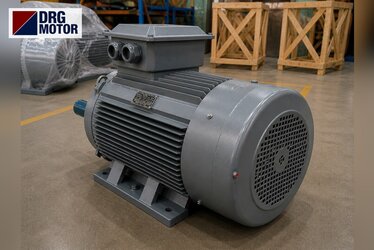
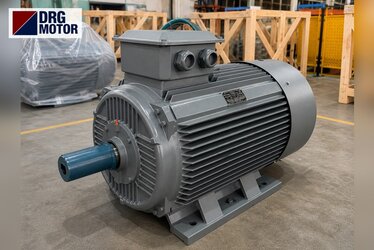
Frame casting: in our store aluminium frames cover 0.25–11 kW and cast iron frames 0.55–355 kW. In both materials the cooling fins should be even and unbroken, and the frame surface should have no cracks, porosity or filler hidden under the paint. On cast iron, the feet are cast with the frame; a hairline crack at the root of a foot can grow when the motor is bolted down and tightened.
Foot dimensions: for DRG-132M-4 the catalogue values are A × B = 216 × 178 mm, shaft height H = 132 mm and foot holes 4–Φ12. If your tape measurements match, the motor can be swapped with its equivalent in the same IEC frame without trouble.
Terminal box and gland: the cover gasket must be in place and flexible, and all cover screws present. The number of cable entries and the thread size must match the catalogue: the table below shows 1 × M20×1.5 on frame 80, 1 × M25×1.5 on frame 100, 2 × M32×1.5 on 112M and 132M, and 2 × M40×1.5 on 160M and 180L. A box whose thread does not match the catalogue either will not take the gland at all or needs an adapter that compromises sealing.
Terminal board: the six terminals (U1, V1, W1, W2, U2, V2), the star/delta links and the earth screw must all be present. The link nuts must not be stripped and the terminal board must not be cracked.
Bearing code: what does 6206-ZZ-C3 tell you? (7)
The bearing code is the small detail that says the most about a motor's mechanical quality. In our store, frames 63–132 use bearings with the ZZ-C3 suffix (e.g. 6204-ZZ-C3, 6206-ZZ-C3, 6208-ZZ-C3), while frame 160 and above use bearings with the C3 suffix but without ZZ (e.g. 6309-C3, 6311-C3).
- 62xx / 63xx: deep groove ball bearing series; the 63 series is for heavier loads at the same bore. The last two digits define the bore.
- ZZ: indicates metal shields on both sides of the bearing; they keep dust out and grease in.
- C3: indicates a radial internal clearance larger than normal; when the motor warms up, the shaft and rings expand and the C3 clearance absorbs this expansion.
On a motor with no bearing code on the nameplate or in the catalogue, finding a spare bearing means opening the motor. A clearly stated code matters for maintenance planning.
Shaft, key, fan and turning by hand (8–10)
The shaft diameter and length are measured with a caliper, and the key width and the key depth dimension (G) are checked. The manufacturing tolerance of the shaft is assessed against the catalogue and dimension drawing; what matters here is that the coupling or pulley fits neither forced nor loose. The shaft must have no dents, burrs or impact marks: a motor whose shaft end has been hit with a hammer may have a damaged bearing from day one.
| Model | Frame | IEC | Bearing | Cable entry | Shaft D × E (mm) | Key F (mm) | G (mm) |
|---|---|---|---|---|---|---|---|
| DRG-802-4 | aluminium | 80 | 6204-ZZ-C3 | 1 × M20×1.5 | 19 × 40 | 6 | 15.5 |
| DRG-100L2-4 | cast iron | 100L | 6206-ZZ-C3 | 1 × M25×1.5 | 28 × 60 | 8 | 24 |
| DRG-112M-4 | aluminium | 112M | 6206-ZZ-C3 | 2 × M32×1.5 | 28 × 60 | 8 | 24 |
| DRG-132M-4 | cast iron | 132M | 6208-ZZ-C3 | 2 × M32×1.5 | 38 × 80 | 10 | 33 |
| DRG-160M-4 | cast iron | 160M | 6309-C3 | 2 × M40×1.5 | 42 × 110 | 12 | 37 |
| DRG-180L-4 | cast iron | 180L | 6311-C3 | 2 × M40×1.5 | 48 × 110 | 14 | 42.5 |
The fan blades must not be broken or cracked, the fan cover must not rub on the fan and the air inlet openings must be clear. When you turn the shaft by hand, rotation should be smooth and quiet; sticking, a notchy feel or rubbing noise points to a bearing or rotor problem. Then run the motor briefly at no load: a steady hum is normal, knocking, whistling or periodic thumping is not. You can also feel vibration by touching the frame; if you have a measuring instrument, keep the values as the motor's first records.
Electrical measurements: winding resistance, insulation and current (11–12)
Winding resistance balance: the terminal links are removed and the resistance of the U1-U2, V1-V2 and W1-W2 windings is measured with an instrument capable of measuring low resistance. The absolute value depends on motor power; what matters is that the three values are very close. One phase clearly different from the others may indicate a winding fault, a loose connection or the beginning of a short circuit.
Insulation measurement: the insulation resistance between the windings and the frame is measured with a megger. For the test voltage and acceptance value, refer to the instrument instructions and the relevant standard; we cover the measurement and its interpretation in detail in our article Electric Motor Insulation Resistance (Megger) Test. This check is especially important for motors stored for a long time in damp conditions.
Nameplate current versus measured current: with the motor under load, the current in each phase is measured with a clamp meter. At full load, the measured current must not exceed the nameplate current for the supply voltage, and the three phase currents must be close to each other. It is normal for the meter to show a very high value momentarily at start-up; starting current is Is/In times the rated current.
| Model | kW | Connection at 380 V | 380 V (A) | 400 V (A) | 415 V (A) | cos φ | Is/In | Starting current at 380 V (A) |
|---|---|---|---|---|---|---|---|---|
| DRG-802-4 | 0.75 | Y (star) | 1.84 | 1.75 | 1.69 | 0.75 | 6.6 | 12.1 |
| DRG-100L2-4 | 3 | Y (star) | 6.34 | 6.02 | 5.8 | 0.82 | 7.6 | 48.2 |
| DRG-112M-4 | 4 | Δ (delta) | 8.37 | 7.95 | 7.66 | 0.82 | 7.8 | 65.3 |
| DRG-132M-4 | 7.5 | Δ (delta) | 15 | 14.3 | 13.7 | 0.84 | 7.5 | 112.5 |
| DRG-160M-4 | 11 | Δ (delta) | 21.5 | 20.4 | 19.7 | 0.85 | 7.7 | 165.6 |
| DRG-180L-4 | 22 | Δ (delta) | 41.8 | 39.7 | 38.3 | 0.86 | 7.8 | 326 |
Example: DRG-132M-4 has a rated current of 15 A at 380 V and an Is/In ratio of 7.5; at the moment of starting the current rises to about 15 × 7.5 = 112.5 A and falls as the motor accelerates. If at full load you measure a steady current clearly above 15 A at 380 V, the motor is overloaded, the supply voltage is low or the connection is wrong. For currents of other powers use the Motor Current Chart, and for overload relay setting the Overload Relay, Fuse and Contactor Selection tool.
5-minute quality checklist at delivery
- No transport damage on the packaging or frame; fan cover not dented.
- Nameplate legible; model code identical to order and invoice.
- Fins and feet unbroken; no traces of filler under the paint.
- Terminal box gasket, screws, links and earth screw complete.
- Number of cable entries and thread size match the catalogue.
- No impact marks on the shaft end; key in place; shaft turns smoothly by hand.
- Connection suits the network: in our store, models of 3 kW and below are connected in star at 380 V, 4 kW and above in delta.
- After installation, winding resistance, insulation and load current measured and recorded.
Example motors in this article
The product pages of the six models in the tables list rated currents, cos φ, torque ratios, bearing, cable entry and B3 mounting dimensions. For flange dimensions and detailed drawings, see the DRG Motor Technical and Product Catalogue.
- DRG-802-4 – 0.75 kW – 1500 rpm – aluminium
- DRG-100L2-4 – 3 kW – 1500 rpm – cast iron
- DRG-112M-4 – 4 kW – 1500 rpm – aluminium
- DRG-132M-4 – 7.5 kW – 1500 rpm – cast iron
- DRG-160M-4 – 11 kW – 1500 rpm – cast iron
- DRG-180L-4 – 22 kW – 1500 rpm – cast iron
Click to see current prices and order these motors nowSEE PRICES →
Frequently Asked Questions
How can you tell a quality electric motor?
A complete nameplate that matches the catalogue, clean frame casting, a terminal box and cable entry matching the catalogue, a stated bearing code, correct shaft dimensions, free rotation by hand, a smooth no-load sound, balanced winding resistance, a clean insulation measurement and a load current within the nameplate value are the concrete signs of quality.
What does ZZ-C3 mean on a motor bearing?
ZZ means the bearing has metal shields on both sides; C3 means the internal clearance is larger than normal. The C3 clearance absorbs the expansion of the shaft and rings when the motor warms up.
How many amps does a 7.5 kW motor draw?
The 4-pole 7.5 kW model DRG-132M-4 draws a rated current of 15 A at 380 V, 14.3 A at 400 V and 13.7 A at 415 V. At start-up the current briefly rises to 7.5 times this value.
How do you check a motor's winding resistance?
With the motor de-energised, the terminal links are removed and the resistance of the U1-U2, V1-V2 and W1-W2 windings is measured with a low-resistance meter. The three values are expected to be very close. The measurement should be made by a qualified electrician.
If the nameplate or dimensions of a motor you have received do not match the catalogue, send us a photo of the nameplate and your measured values and we will check them together. Phone: +90 (542) 666 11 11 · E-mail: [email protected] · Contact. You can review the technical data of all 120 models in our online store.