English
 Le français
 Türkçe

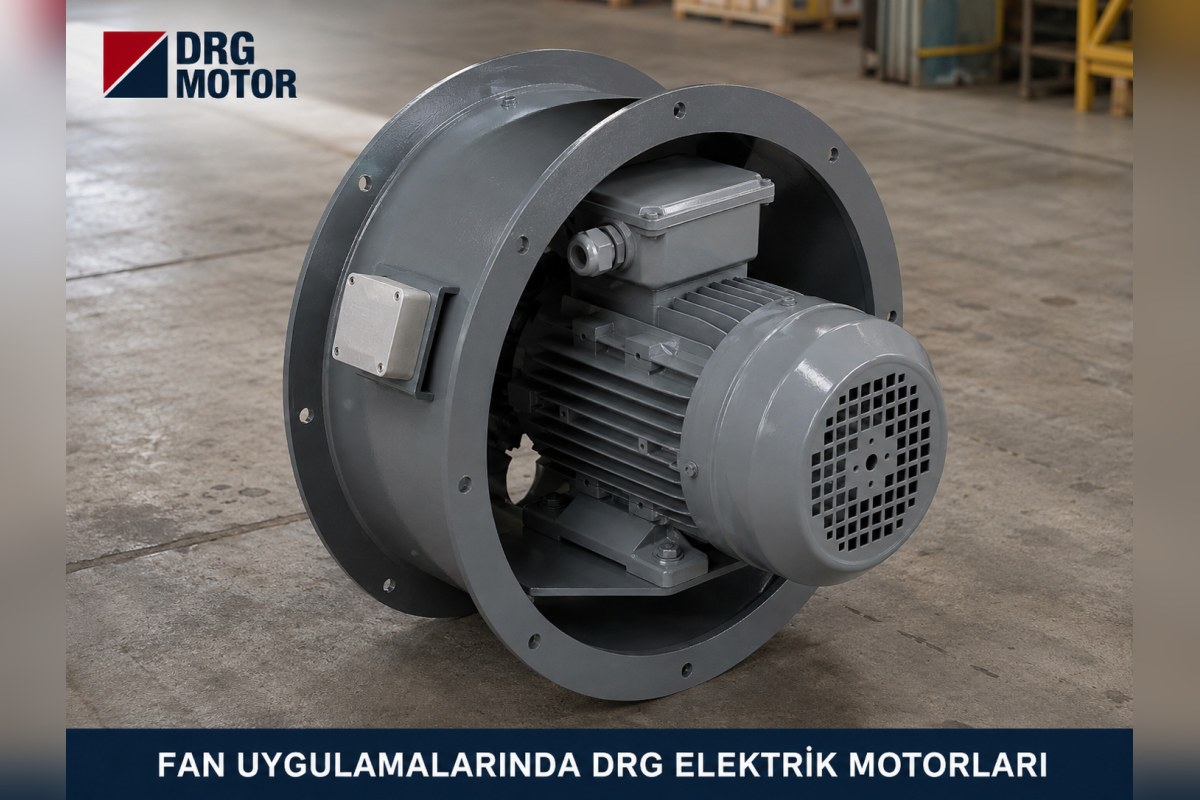

A ventilation fan motor is chosen differently depending on the fan type: in axial (wall and duct) fans the motor sits inside the airflow, the propeller is mounted directly on the shaft and a low-speed 4- or 6-pole motor is usually used; in radial (centrifugal) fans the motor stays outside the airflow, is foot- or flange-mounted and needs more power for the higher pressure. In both types power is calculated with P = Q × Δp / η_fan. For example, an axial wall fan moving 3600 m³/h at 150 Pa absorbs about 0.33 kW of shaft power and runs on the 0.55 kW DRG-801-4 with a rated speed of 1400 rpm; a radial roof extractor pushing the same airflow to 850 Pa needs 3 kW.
The difference comes from pressure. Axial fans move large volumes of air through short, low-resistance paths; radial fans are designed to overcome the resistance of filters, long ducts and hoods. That is why cooling, mounting orientation and flange type change with the fan type as much as motor power does. Before calculating, ask the fan manufacturer for airflow, total pressure, fan efficiency and fan speed.
Below we cover the differences between the two fan types from the motor's point of view, three example calculations, the diameter–speed relationship and airflow control with a drive. You can find models in the right power and speed, with current prices, on our Buy Electric Motors Online page.
Axial vs radial fan: what changes on the motor side?
Both fan types do the same job — moving air — but they put the motor in very different conditions. The main differences:
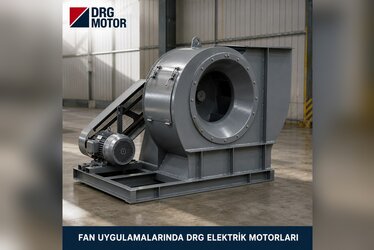
- Motor position and cooling. In an axial fan the motor sits in front of or behind the propeller, in the middle of the airflow; the air passing over the frame helps cool it. In a radial fan the motor is outside the volute, has no contact with the airflow and is cooled only by its own rear fan.
- Nature of the air handled. Because the motor of an axial fan is inside the airstream, hot, greasy, dusty or humid air flows straight over it. On lines handling such air, a radial fan or a belt-driven arrangement that keeps the motor out of the airflow is preferred.
- Connection. In an axial fan the propeller is usually fitted directly on the motor shaft and the motor is fixed to a support ring by its flange or feet. In a radial fan the impeller can sit directly on the shaft or on a separate shaft driven by belts.
- Pressure and power. At the same airflow a radial fan produces much higher pressure; since power is proportional to pressure, motor power rises noticeably.
Mounting orientation: B3, B5, B14 and vertical operation
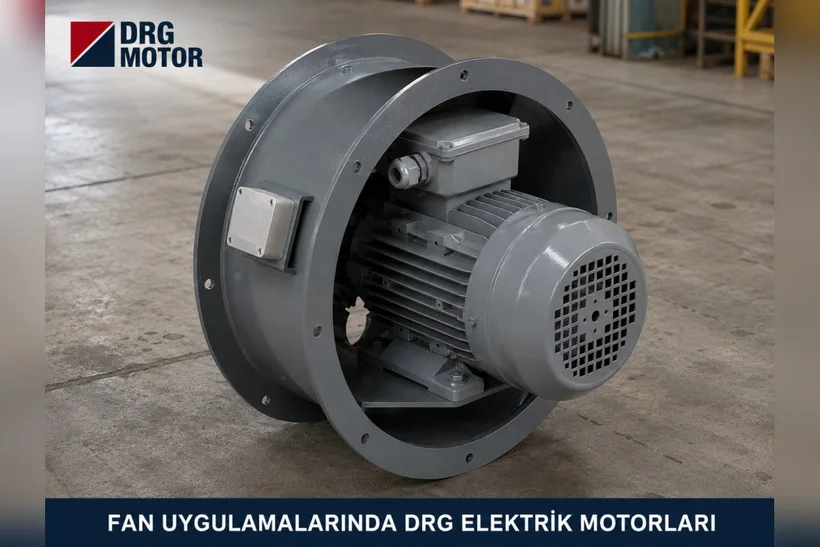
In axial wall fans the motor is horizontal; the propeller is fitted to the shaft and the motor to the wall plate or support arms. In axial duct fans the motor sits inside the tubular casing on support legs. In roof-type axial fans the motor runs vertically: flange mounting with the shaft pointing down is called V1. In vertical mounting the bearings also carry axial load; state before ordering that the motor will run vertically and whether a rain canopy is needed on the fan cover.
Flanges fall into two main groups. The B5 large flange has a wide bolt circle with bolts passing through holes in the flange. The B14 small flange is a smaller flange machined into the motor's front end shield with tapped holes, and saves space on light axial fans. B14 dimensions are not included in our catalogue table, so confirm the size with us when choosing this flange. Catalogue B5 dimensions, as an example: DRG-801-4 (80 frame) flange outer diameter 200 mm, bolt circle 165 mm, spigot 130 mm, shaft 19×40 mm; DRG-100L1-4 (100L frame) flange outer diameter 250 mm, bolt circle 215 mm, spigot 180 mm, shaft 28×60 mm. On radial fans, B3 foot-mounted motors are common in belt-driven layouts and B5 flange motors in compact extractors where the impeller sits directly on the shaft.
Ventilation fan motor power calculation: three examples
The calculation is the same for both fan types: P (kW) = Q (m³/s) × Δp (Pa) / (η_fan × 1000). Q is airflow, Δp the total pressure rise at the operating point and η_fan the fan efficiency read from the fan manufacturer's curve. The result is shaft power; a safety margin is added and the next standard rating is chosen. To try your own values, use our pump and fan motor power calculator.
Example 1 – Axial wall fan for a warehouse
3600 m³/h = 1.0 m³/s, 150 Pa, fan efficiency 0.45: P = 1.0 × 150 / (0.45 × 1000) = 0.33 kW. For a small axial fan, with a 1.30 margin, 0.43 kW; the choice is the 0.55 kW 4-pole DRG-801-4. Its rated current at 400 V is 1.31 A.
Example 2 – Axial duct fan for a production workshop
9000 m³/h = 2.5 m³/s, 350 Pa, fan efficiency 0.60: P = 2.5 × 350 / (0.60 × 1000) = 1.46 kW; with a 1.20 margin, 1.75 kW. The choice is the 2.2 kW DRG-100L1-4 (100L frame, 1450 rpm, 4.52 A at 400 V).
Example 3 – Radial roof extractor for a paint shop
7200 m³/h = 2.0 m³/s, 850 Pa because of the filters, fan efficiency 0.68: P = 2.0 × 850 / (0.68 × 1000) = 2.50 kW; with a 1.15 margin, 2.88 kW. The choice is the 3 kW DRG-100L2-4 (1450 rpm, cos φ 0.82). A radial fan with the motor outside the airflow was chosen here so that paint-laden, solvent-bearing air does not pass over the motor.
| Fan application | Airflow (m³/h) | Pressure (Pa) | Fan efficiency (η_fan) | Shaft power (kW) | Safety margin | Required (kW) | Selected model | Power / speed | Current at 400 V (A) | Order |
|---|---|---|---|---|---|---|---|---|---|---|
| Axial wall fan (warehouse) | 3600 | 150 | 0.45 | 0.33 | 1.30 | 0.43 | DRG-801-4 | 0.55 kW / 1400 rpm | 1.31 | See Prices |
| Axial duct fan (workshop) | 9000 | 350 | 0.60 | 1.46 | 1.20 | 1.75 | DRG-100L1-4 | 2.2 kW / 1450 rpm | 4.52 | See Prices |
| Radial roof extractor (paint shop) | 7200 | 850 | 0.68 | 2.50 | 1.15 | 2.88 | DRG-100L2-4 | 3 kW / 1450 rpm | 6.02 | See Prices |
Balancing fan diameter and speed
As the propeller gets larger, the peripheral speed of the blade tip rises: v = π × D × n / 60. At the same speed, airflow grows with the cube of diameter and power with its fifth power; a propeller going from 500 mm to 630 mm delivers about 2.0 times the airflow at the same speed but needs 3.2 times the power. That is why large propellers are driven by low-speed (4- or 6-pole) motors, while 2 poles can be used on small propellers.
| Propeller / impeller diameter (m) | Model | Poles | Rated speed (rpm) | Blade tip speed (m/s) |
|---|---|---|---|---|
| 0.40 | DRG-711-2 | 2 | 2750 | 57.6 |
| 0.40 | DRG-801-4 | 4 | 1400 | 29.3 |
| 0.63 | DRG-90L-4 | 4 | 1445 | 47.7 |
| 1.00 | DRG-132S-6 | 6 | 968 | 50.7 |
The table shows that a 400 mm propeller on a 2-pole motor reaches more than twice the tip speed it has on a 4-pole motor. Using the 6-pole DRG-132S-6 on a large 1 m axial fan keeps the tip speed close to the 2-pole value of the small propeller. The motor must match the speed the propeller was designed for; fitting a faster motor can exceed both the power limit and the propeller's mechanical limit.
Noise and speed
Most of the noise of a ventilation fan comes not from the motor but from blade tip speed and air turbulence. Since tip speed rises in proportion to speed, delivering the same airflow with a large propeller at low speed is quieter than spinning a small propeller fast. This is why 4- or 6-pole motors are preferred for ventilation in offices, schools and hotels. On the motor side, bearing condition, balance and correct alignment affect sound; vibration is a sign to check propeller balance and fixing bolts.
Airflow control with a drive and motor cooling at low speed
Ventilation demand changes during the day; lowering speed with a frequency drive instead of throttling with a damper reduces power with the cube of speed. The 2.50 kW shaft power of the radial extractor in Example 3 changes roughly as follows with drive frequency:
| Drive frequency (Hz) | Approx. fan speed (rpm) | Airflow ratio | Power ratio | Shaft power (kW) |
|---|---|---|---|---|
| 50 | 1450 | 1.00 | 1.000 | 2.50 |
| 45 | 1305 | 0.90 | 0.729 | 1.82 |
| 40 | 1160 | 0.80 | 0.512 | 1.28 |
| 35 | 1015 | 0.70 | 0.343 | 0.86 |
| 30 | 870 | 0.60 | 0.216 | 0.54 |
| 25 | 725 | 0.50 | 0.125 | 0.31 |
Because torque on a fan load also falls with the square of speed, the motor usually does not overheat at low speed. Still, the motor's own fan slows down too, so there is less cooling air. In an axial fan the motor sits in the airstream and gets some extra cooling; a radial fan offers no such help. For motors that will run at very low frequency for long periods, monitor frame temperature and set a minimum frequency if needed. You can check the frequency–torque–power relationship with our VFD frequency, torque and power calculator.
Pre-order checklist: axial or radial?
- Is the fan type known: axial wall, axial duct, roof type or radial (centrifugal)?
- Have airflow (m³/h), total pressure (Pa), fan efficiency and fan speed been obtained from the fan manufacturer?
- Is the air hot, greasy, dusty or solvent-laden? If so, does the motor stay out of the airflow?
- Mounting: horizontal or vertical (V1); B3 foot, B5 large flange or B14 small flange?
- Does the propeller hub match the motor shaft diameter (e.g. 19 mm for DRG-801-4) and key size?
- Are propeller diameter and motor speed compatible; is the tip speed within the fan manufacturer's limit?
- Will a drive be used; have a minimum frequency and motor cooling been considered?
- For outdoor motors, have the protection degree (generally IP55) and a rain canopy been specified?
What determines the price of a ventilation fan motor?
Technically, the price of a ventilation fan motor depends on power (kW), number of poles, frame material (aluminium or cast iron), IEC frame size and mounting arrangement (B3, B5, B14, vertical operation). So first fix the fan type and power, then choose the model. Models that stand out in the examples and in ventilation applications:
- DRG-801-4 – 0.55 kW – 1400 rpm – 80 aluminium
- DRG-711-2 – 0.37 kW – 2750 rpm – 71 aluminium
- DRG-90L-4 – 1.5 kW – 1445 rpm – 90L aluminium
- DRG-100L1-4 – 2.2 kW – 1450 rpm – 100L aluminium
- DRG-100L2-4 – 3 kW – 1450 rpm – 100L aluminium
- DRG-132S-6 – 3 kW – 968 rpm – 132S aluminium
- DRG-132M-4 – 7.5 kW – 1460 rpm – 132M aluminium
Click to see current prices and order these motors nowSEE PRICES →
For all power and speed options, browse the 120 models in our online shop. Our Ventilation Fan Motor article, which covers frame, protection and maintenance in general, complements this guide; to compare current values, see the motor current chart.
Frequently Asked Questions
What speed should an axial fan motor have?
It depends on propeller diameter. Small axial fans use 2- or 4-pole motors (e.g. DRG-801-4: 1400 rpm), large propellers around 1 m use 6-pole motors (e.g. DRG-132S-6: 968 rpm). The right speed is the one the propeller was designed for.
How many kW motor does a ventilation fan need?
It depends on airflow and pressure: P = Q × Δp / η_fan. A 3600 m³/h axial wall fan at 150 Pa needs about 0.33 kW and runs on a 0.55 kW motor; a radial extractor delivering the same airflow at 850 Pa needs 3 kW.
Can an axial fan motor be mounted vertically?
Yes. In roof-type axial fans the motor runs vertically, and flange mounting with the shaft down is known as V1. State vertical operation when ordering so that bearing axial load and rain protection of the motor can be assessed.
Does a fan motor overheat at low speed on a frequency drive?
Because fan torque falls quickly with speed, overheating is not a problem in most cases; however, the motor's own fan also slows down, so frame temperature should be monitored for long operation at very low frequency and a minimum frequency set on the drive.
To choose the right motor for your fan together, call +90 (542) 666 11 11, write to [email protected] or use our contact page.