English
 Le français
 Türkçe




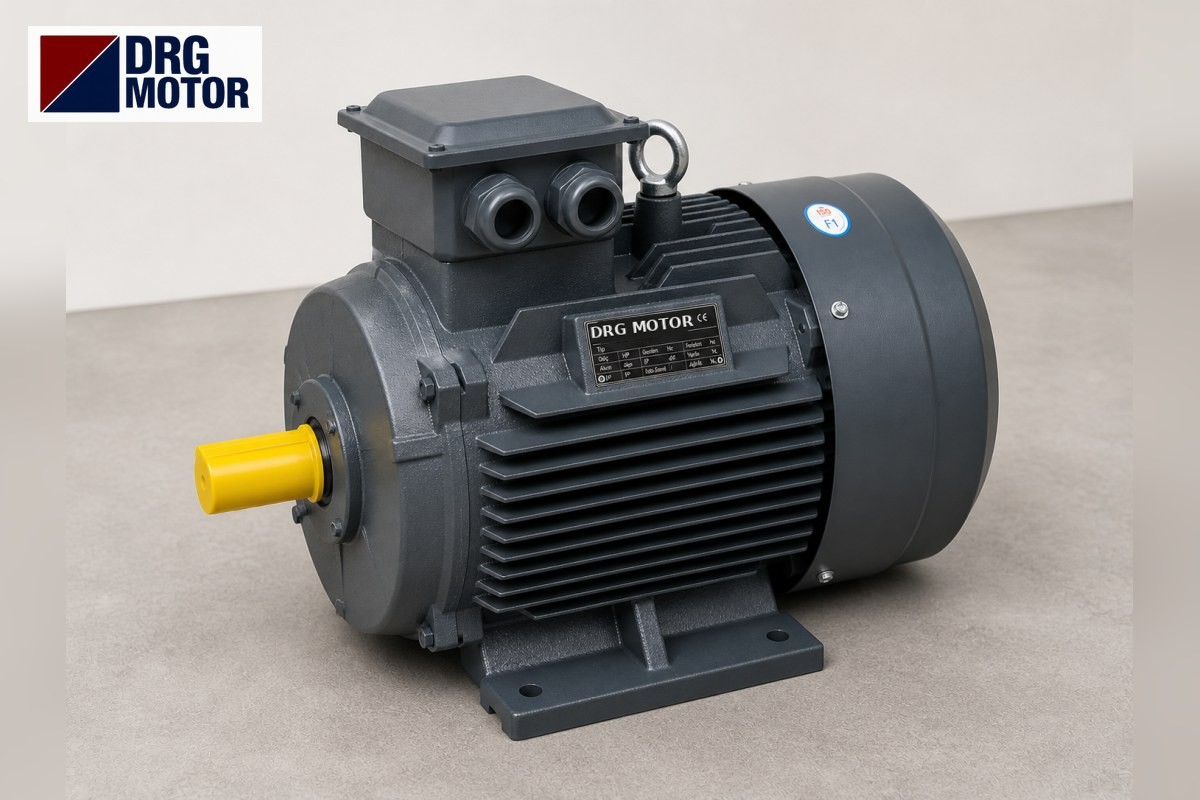

A geared motor is a three-phase electric motor combined with a gearbox that lowers its speed and raises its torque; choosing one correctly comes down to three values: motor power, output speed = rated motor speed ÷ gear ratio, and a motor flange and shaft that match the gearbox input exactly. For example, the 4 kW, 4-pole DRG-112M-4 runs at 1450 rpm at full load; with a 40:1 gearbox the output is 1450 ÷ 40 = 36.25 rpm. The side of this motor that mounts to the gearbox is the B5 flange of an IEC 112M frame: flange outside diameter P 250 mm, spigot diameter N 180 mm, shaft 28×60 mm.
Change one of these three values and the others change too. Choose the same 4 kW as a 6-pole motor and the speed drops to 968 rpm, the frame grows to 132M and the gearbox input now needs a 300 mm flange and a 38 mm shaft. DRG Motor does not sell gearboxes; you source the gearbox from its own manufacturer or dealer, and you select the electric motor that fits it from the 120 models on the Buy Electric Motors Online page by frame, pole count and mounting. Load torque and service factor calculations are not covered here; you will find them step by step in How to Select a Motor Gearbox: Torque, Ratio and Service Factor.
What Parts Make Up a Geared Motor?
From a purchasing point of view, a geared motor is three separate items, each with a different party responsible for it:
- Electric motor: defines power (kW), rated speed, voltage and frame size. This is the part DRG sells.
- Gearbox: connects to the machine through its ratio, gear type and output shaft or flange. It is chosen from the gearbox manufacturer's catalogue.
- Mechanical interface: the surface where the motor flange seats on the gearbox input cover and the motor shaft enters the input bore (with a key). In systems with a separate coupling, this interface is the coupling and baseplate.
Most mistakes happen in the third item: the motor and the gearbox are each chosen correctly, but the input flange was ordered for a different frame, so the two parts will not fit together.
Gearbox Types and How They Affect Motor Selection
The gear design of the gearbox directly affects how the motor is positioned and which pole count makes sense. The table below summarises the types from the motor side:
| Gearbox type | Input–output axis | What to watch on the motor side |
|---|---|---|
| Helical (parallel or inline) | Parallel / same axis | The motor extends in line with the gearbox; the machine needs length allowance. Commonly paired with a 4-pole motor at medium ratios. |
| Worm | 90° | Gives a high ratio in a single stage; gear friction causes more heating and losses, so motor power is chosen on the basis of the gearbox catalogue data. |
| Bevel (helical-bevel) | 90° | The motor sits at a right angle to the machine; in tight spaces, the overall length (L) and the terminal box orientation become important. |
| Planetary | Same axis | Carries high torque in a small volume; the motor flange and shaft tolerance must match the adapter dimensions exactly. |
Choosing the gearbox type is the gearbox manufacturer's job; on the motor side, the information required from you is always the same: power, rated speed, IEC frame, flange type and shaft size.
From Output Speed to Pole Count: Ratio Table
For the ratio calculation, use the rated speed on the nameplate, not the synchronous speed (3000/1500/1000 rpm). 1500 ÷ 40 gives 37.5 rpm, but with a 4 kW 4-pole motor the real output is 36.25 rpm. The table below shows the gear ratio needed for 10, 20 and 40 rpm output, using the rated speed of three 4 kW motors from our store:
| Model | Poles | Rated speed (rpm) | Ratio for 10 rpm | Ratio for 20 rpm | Ratio for 40 rpm |
|---|---|---|---|---|---|
| DRG-112M-2 | 2 | 2905 | 290.5 | 145.25 | 72.6 |
| DRG-112M-4 | 4 | 1450 | 145 | 72.5 | 36.25 |
| DRG-132M1-6 | 6 | 968 | 96.8 | 48.4 | 24.2 |
The practical takeaway: at low output speeds a 2-pole motor needs a very high ratio, which means more gear stages and a larger gearbox. A 6-pole motor reduces the ratio but enlarges the motor frame and flange. That is why 4-pole motors are the most common choice for geared drives; 6 poles make sense when the ratio has to come down and frame size is not a problem.
Worked example: a mixer that needs 35 rpm at the output
Consider a mixer for which the load calculation has already called for a 4 kW motor; the target output speed is 35 rpm.
- 4 poles (DRG-112M-4, 1450 rpm): required ratio 1450 ÷ 35 ≈ 41.4. If the gearbox catalogue offers 40:1, the output is 1450 ÷ 40 = 36.25 rpm, about 3.6% above target.
- 6 poles (DRG-132M1-6, 968 rpm): required ratio 968 ÷ 35 ≈ 27.7. If the catalogue offers 28:1, the output is 968 ÷ 28 ≈ 34.57 rpm, about 1.2% below target.
Both solutions work in terms of speed. The decision is made on the flange side: the 4-pole solution needs a gearbox with an IEC 112 input (P 250 mm, 28 mm shaft), the 6-pole solution one with an IEC 132 input (P 300 mm, 38 mm shaft). To test the ratio and output torque numerically, use the gearbox output speed and torque calculator.
Flange and Shaft Fit on the Motor Side: Same Power, Different Input
Writing “4 kW motor” on a gearbox order is not enough; the gearbox input is machined for a frame number. The table below matches the B5 flange dimensions from the DRG catalogue with the motors mentioned in this article:
| Model | Power | Rated speed | IEC frame | Flange P / M / N (mm) | Hole S (mm) | Shaft D×E (mm) | Key F (mm) |
|---|---|---|---|---|---|---|---|
| DRG-90L-4 | 1.5 kW | 1445 rpm | 90L | 200 / 165 / 130 | 12 | 24×50 | 8 |
| DRG-112M-4 | 4 kW | 1450 rpm | 112M | 250 / 215 / 180 | 14.5 | 28×60 | 8 |
| DRG-132M1-6 | 4 kW | 968 rpm | 132M | 300 / 265 / 230 | 14.5 | 38×80 | 10 |
| DRG-132S-4 | 5.5 kW | 1460 rpm | 132S | 300 / 265 / 230 | 14.5 | 38×80 | 10 |
| DRG-112M-4K (compact) | 5.5 kW | 1460 rpm | 112M | 250 / 215 / 180 | 14.5 | 28×60 | 8 |
P: flange outside diameter, M: pitch circle diameter, N: spigot diameter. Two details in the table are very useful in the field:
- Changing poles changes the flange: switching a 4 kW drive from 4 poles to 6 poles means moving from a 250 mm flange to a 300 mm flange and from a 28 mm shaft to a 38 mm shaft. If you plan to change the pole count on an existing gearbox, check the input dimensions first.
- A compact frame keeps the existing input: the standard 5.5 kW 4-pole motor is a 132S frame; the compact DRG-112M-4K delivers the same power in a 112M frame. If a gearbox with an IEC 112 input has to go from 4 kW to 5.5 kW, it can solve the problem without changing the input flange; confirm in the gearbox catalogue that the gearbox can carry this power.
The DRG catalogue does not include a B14 (small flange) dimension table; for gearboxes with a B14 input, send us the gearbox input dimensions and we will match the motor to them. For how to measure the spigot diameter and the B5/B14 difference in detail, see How to Choose a Flange Motor for a Gearbox: B5 and B14 Connections.
Checklist Before Ordering a Geared Motor
- Are the target output speed and the motor power from the load calculation known?
- Was the ratio calculated with the rated speed rather than the synchronous speed (e.g. 1450 rpm, not 1500)?
- Does the IEC frame number on the gearbox input cover match the motor frame (112M motor → IEC 112 input)?
- Is the flange type right: B5 (large flange with through holes) or B14 (small flange with tapped holes)?
- Do the motor shaft D×E and key width F match the gearbox input bore (e.g. 28×60 mm, 8 mm key)?
- In the mounting position (horizontal, vertical, motor up/down), do the terminal box and cable entry remain accessible?
- Are the supply voltage and connection known? In our store, models of 3 kW and below are wound for 230/400 V, models of 4 kW and above for 400/690 V.
- Was motor protection (overload relay, fuse, contactor) chosen according to the nameplate current? The overload, fuse and contactor selection tool makes this easier.
Technical Factors That Determine Geared Motor Prices
The total cost of a geared motor consists of two separate items, and DRG covers only the electric motor. On the motor side, the technical factors that determine the price are:
- Power (kW): the main factor that sets the winding and frame size.
- Pole count: at the same power, a 6-pole motor moves up to a larger frame than a 4-pole one (132M instead of 112M at 4 kW).
- Frame material: aluminium (0.25–11 kW) or cast iron (0.55–355 kW).
- Mounting: B3, B5, B35 or B14; the flange choice is stated in the order note.
- Compact frame: a separate model for applications that need the same power in one frame size smaller.
The gearbox side is quoted by the gearbox manufacturer according to ratio, type and torque capacity. You can see the current motor prices on the product pages and in the list of 120 models in our online store.
Motors Suited to Geared Drives
- DRG-90L-4 – 1.5 kW – 1500 rpm (rated 1445) – aluminium, IEC 90L
- DRG-112M-4 – 4 kW – 1500 rpm (rated 1450) – aluminium, IEC 112M
- DRG-112M-2 – 4 kW – 3000 rpm (rated 2905) – aluminium, IEC 112M
- DRG-132M1-6 – 4 kW – 1000 rpm (rated 968) – aluminium, IEC 132M
- DRG-132S-4 – 5.5 kW – 1500 rpm (rated 1460) – aluminium, IEC 132S
- DRG-112M-4K – 5.5 kW – 1500 rpm (rated 1460) – compact aluminium, IEC 112M
Click to see current prices and order these motors nowSEE PRICES →
Frequently Asked Questions
How do you calculate the output speed of a geared motor?
Divide the rated speed on the motor nameplate by the gear ratio. A 4-pole motor running at 1450 rpm gives 36.25 rpm with a 40:1 gearbox and 72.5 rpm with a 20:1 gearbox. A calculation based on the synchronous speed (1500 rpm) overstates the output.
Will a B5 flange motor fit any gearbox?
No. A gearbox input is machined for a specific IEC frame. The B5 flange of a 112M frame motor has a 250 mm outside diameter, a 180 mm spigot and a 28 mm shaft; it will not fit a gearbox with an IEC 132 input without an adapter. Compare flange dimensions and shaft diameter before ordering.
How many poles should a geared motor have?
The pole count is a balance between ratio and frame size. A 2-pole motor needs a very high ratio at low output speeds; a 6-pole motor reduces the ratio but brings a larger frame and flange at the same power. Decide based on the target speed and the gearbox input; for the load torque calculation, see our dedicated guide.
Can a more powerful motor be fitted to an existing gearbox?
Only if the gearbox input size and torque capacity allow it. For example, if an IEC 112 input needs 5.5 kW instead of 4 kW, the compact DRG-112M-4K connects with the same 112M flange and 28 mm shaft, whereas the standard 5.5 kW 4-pole motor moves up to a 132S frame. Confirm the power the gearbox can carry in the gearbox manufacturer's catalogue.
Share your gearbox input dimensions and target output speed, and we will match a suitable motor with you: +90 (542) 666 11 11, [email protected] or our contact page. For other calculations, see the electric motor calculators page, and browse all motors in the Buy Electric Motors Online category.