English
 Le français
 Türkçe




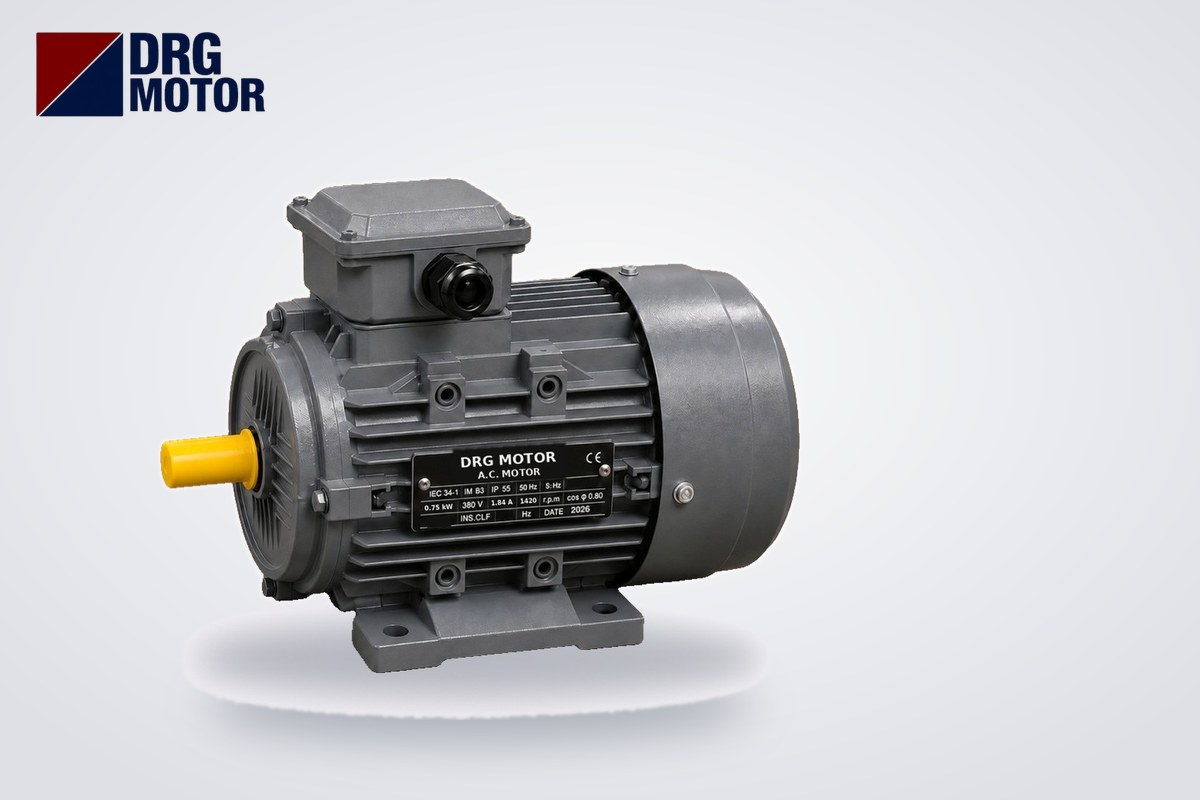

On a 380 V supply at full load, a 1500 rpm (4-pole) three-phase motor draws approximately: 0.37 kW → 0.97 A, 0.55 kW → 1.38 A, 0.75 kW → 1.84 A, 1.1 kW → 2.61 A. 3000 rpm (2-pole) models draw slightly less (0.94 / 1.31 / 1.72 / 2.43 A) and 1000 rpm (6-pole) models slightly more (1.09 / 1.5 / 2.03 / 2.83 A). These are catalogue values; the In printed on your own motor's nameplate always takes priority.
In small motors the current is driven less by power than by power factor (cos φ). Below 1 kW the magnetising current makes up a larger share of the total current than in big motors, so the amps per kW come out higher. Because cos φ drops as the pole count rises, a 6-pole motor draws the most current at the same power. The table below brings together the 12 aluminium-frame motors between 0.37 and 1.1 kW from the 120 models in our online shop.
2, 4 and 6-pole current table for 0.37 – 1.1 kW motors
The currents are full-load values of a 230/400 V rated motor connected in star (Y) on 380 V and 400 V supplies. The starting current column is calculated by multiplying the catalogue Is/In ratio by the 380 V current (the current drawn at the first instant of direct-on-line starting).
| Power (kW) | Model | Synchronous / rated speed (rpm) | cos φ | Current 380 V (A) | Current 400 V (A) | Is/In | Starting current 380 V (A) | IEC frame |
|---|---|---|---|---|---|---|---|---|
| 0.37 | DRG-711-2 | 3000 / 2750 | 0.81 | 0.94 | 0.89 | 6.1 | 5.7 | 71 |
| 0.37 | DRG-712-4 | 1500 / 1340 | 0.75 | 0.97 | 0.92 | 5.2 | 5.0 | 71 |
| 0.37 | DRG-801-6 | 1000 / 890 | 0.7 | 1.09 | 1.04 | 4.7 | 5.1 | 80 |
| 0.55 | DRG-712-2 | 3000 / 2750 | 0.82 | 1.31 | 1.24 | 6.1 | 8.0 | 71 |
| 0.55 | DRG-801-4 | 1500 / 1400 | 0.75 | 1.38 | 1.31 | 5.2 | 7.2 | 80 |
| 0.55 | DRG-802-6 | 1000 / 890 | 0.72 | 1.5 | 1.43 | 4.7 | 7.1 | 80 |
| 0.75 | DRG-801-2 | 3000 / 2880 | 0.82 | 1.72 | 1.64 | 7 | 12.0 | 80 |
| 0.75 | DRG-802-4 | 1500 / 1420 | 0.75 | 1.84 | 1.75 | 6.6 | 12.1 | 80 |
| 0.75 | DRG-90S-6 | 1000 / 935 | 0.71 | 2.03 | 1.93 | 6 | 12.2 | 90S |
| 1.1 | DRG-802-2 | 3000 / 2880 | 0.83 | 2.43 | 2.31 | 7.3 | 17.7 | 80 |
| 1.1 | DRG-90S-4 | 1500 / 1445 | 0.76 | 2.61 | 2.48 | 6.8 | 17.7 | 90S |
| 1.1 | DRG-90L-6 | 1000 / 945 | 0.73 | 2.83 | 2.69 | 6 | 17.0 | 90L |
From 0.55 kW upwards the same models are also available with a cast iron frame; their electrical values (current, cos φ, speed, Is/In) are identical to the aluminium version, only the frame material differs. To look up other ratings, use the motor current chart tool.
Why does a small motor draw more amps per kW?
Part of the current a motor takes from the supply transfers power to the shaft; another part only circulates to build the magnetic field (reactive current). In small frames the air gap and winding layout make the magnetic circuit relatively demanding, so the reactive share grows and cos φ falls. A concrete comparison from the data:
- 0.37 kW, 4-pole (DRG-712-4): cos φ 0.75, ≈2.62 A per kW
- 1.1 kW, 4-pole (DRG-90S-4): cos φ 0.76, ≈2.37 A per kW
- 11 kW, 4-pole (DRG-160M-4): cos φ 0.85, ≈1.95 A per kW
- 0.37 kW, 6-pole (DRG-801-6): cos φ 0.7, ≈2.95 A per kW
That is why the "kW × 2 = amps" rule of thumb used for large motors underestimates the current at small ratings. Apparent power confirms the picture: for a 0.75 kW, 4-pole motor S = √3 × 380 V × 1.84 A ≈ 1.21 kVA. While the shaft power is 0.75 kW, the apparent power taken from the supply is clearly higher; for systems fed by a small generator or UPS, size by this kVA value and by the starting current, not by kW.
230/400 V nameplate: star on 380 V, delta on 230 V three-phase
Every DRG model in this power range is rated 230/400 V (Δ/Y). On the 380–400 V three-phase supply used in Turkey the motor is connected in star (Y) and draws the currents in the table. If the three-phase supply has 230 V between phases (some older installations or drives with a 230 V three-phase output), the motor is connected in delta (Δ); the line current then rises to about √3 times the 400 V current. Example: a 0.75 kW, 4-pole motor draws 1.75 A at 400 V and ≈3.0 A in delta at 230 V (calculated with the 400/230 ratio). The same calculation gives ≈4.3 A for 1.1 kW, 4-pole.
That is why the links in the terminal box matter: a 230/400 V motor connected in delta on a 380 V supply draws excessive current and overheats quickly. Running a three-phase motor from a single-phase 220 V socket with a capacitor is not recommended because of torque loss and heating.
Starting current and several small motors on one line
The Is/In ratio of small motors is between 4.7 and 7.3, so a 1.1 kW motor started direct-on-line draws ≈17.7 A at the first instant. With a single motor this is no problem, but small motors usually work together. Take a conveyor line with 0.55 kW (DRG-801-4), 0.75 kW (DRG-802-4) and 1.1 kW (DRG-90S-4), all 4-pole.
- All three at full load: 1.38 + 1.84 + 2.61 = 5.83 A
- 1.1 kW starting while the other two run: 17.7 + 1.38 + 1.84 ≈ 21.0 A
- All three starting together: 7.2 + 12.1 + 17.7 ≈ 37.1 A
Simultaneous starting raises the peak current seen by the common supply fuse by about 1.8 times. Adding a few seconds of sequential starting to the control circuit is a better solution than oversizing the main fuse. To size the protection devices use the overload relay, fuse and contactor selection tool, and for the supply cable the motor cable size calculator; the cross-section depends on cable length and installation method.
Fan, pump and conveyor: which speed, which current?
At small ratings the speed choice also changes the current. Shaft torque is calculated with T = 9550 × P / n and matches the data exactly:
- Fans and extractors: 3000 rpm is common for small direct-coupled fans. 0.75 kW DRG-801-2: 2880 rpm, 2.49 Nm, 1.72 A.
- Centrifugal pumps: small circulation and transfer pumps use 2 and 4 poles. At 0.55 kW, DRG-712-2 draws 1.31 A and DRG-801-4 1.38 A.
- Conveyors and geared drives: 4 poles are usually the first choice. 1.1 kW DRG-90S-4: 1445 rpm, 7.27 Nm, 2.61 A.
- Slow mixers and feeders: 1.1 kW DRG-90L-6: 945 rpm, 11.1 Nm but 2.83 A; 0.40 A more than the 2-pole model of the same power.
As speed falls, torque rises, and current also climbs a little because cos φ drops. Always know the motor's pole count when sizing the panel and cable.
Measuring currents below 1 amp correctly with a clamp meter
The 0.97 A of a 0.37 kW motor is read with only a few digits of resolution even on the lowest range of many clamp meters, so the relative error grows. Methods that work in the field:
- One conductor: Clamp a single phase conductor, not the outer sheath of the cable. If all three phases pass through the jaws the reading will be close to zero.
- Turns trick: Pass the conductor through the jaws 5 times and divide the reading by 5. For a 0.97 A motor the display shows ≈4.85 A; this reduces the low-range error.
- Measure all three phases: A marked difference between phases can point to supply imbalance, a loose terminal or a winding problem.
- Note the load: On small motors the no-load current can be relatively close to the full-load current; this alone is not a sign of a fault. Measure under real load before drawing conclusions.
- True-RMS meter: If the motor is fed from a frequency drive, measure on the motor side of the drive with a True-RMS clamp meter.
Overload setting and commissioning checklist
The most common mistake with small motors is an overload relay whose setting range does not cover the motor current: for a motor drawing 0.97 A, the relay's range must include this value and the setting must be brought to the nameplate In.
- Is the nameplate 230/400 V and the supply 380–400 V? Are the links in star?
- Is the overload set to the nameplate In (e.g. 1.84 A for DRG-802-4)?
- If several motors share a line, are their starts sequenced?
- Is the direction of rotation correct? Reverse rotation changes current and flow on fans and pumps.
- Under load, are the three phase currents close to each other and within the nameplate value?
- Has the cable cross-section been checked against line length with the calculator?
To see how the same calculation is done at a larger rating, read our article how many amps does a 4 kW motor draw.
Motors in this power range
Frequently chosen models between 0.37 and 1.1 kW (product pages include the dimension drawing and all values):
- DRG-712-4 – 0.37 kW – 1500 rpm – 71 frame, aluminium
- DRG-801-4 – 0.55 kW – 1500 rpm – 80 frame, aluminium
- DRG-802-4 – 0.75 kW – 1500 rpm – 80 frame, aluminium
- DRG-90S-4 – 1.1 kW – 1500 rpm – 90S frame, aluminium
- DRG-802-2 – 1.1 kW – 3000 rpm – 80 frame, aluminium
- DRG-90L-6 – 1.1 kW – 1000 rpm – 90L frame, aluminium
- DRG-802-4 – 0.75 kW – 1500 rpm – 80 frame, cast iron
- DRG-90S-4 – 1.1 kW – 1500 rpm – 90S frame, cast iron
Click to see current prices and order these motors nowSEE PRICES →
Frequently Asked Questions
How many amps does a 0.37 kW motor draw?
At 380 V full load: 0.94 A for the 2-pole model, 0.97 A for 4-pole and 1.09 A for 6-pole. On direct-on-line starting it draws 4.7–6.1 times this value at the first instant.
How many amps does a 0.55 kW motor draw?
At 380 V: 1.31 A (2-pole), 1.38 A (4-pole), 1.5 A (6-pole). On a 400 V supply the values are 1.24, 1.31 and 1.43 A respectively.
How many amps does a 1.1 kW motor draw?
At 380 V: 2.43 A (2-pole), 2.61 A (4-pole), 2.83 A (6-pole). The direct-on-line starting current of the 4-pole model is ≈17.7 A.
Will a 0.75 kW three-phase motor run on 220 volts?
On a three-phase supply with 230 V between phases the motor runs connected in delta and draws ≈3.0 A (4-pole). Running it from a single-phase 220 V socket with a capacitor is not recommended because of torque loss and heating; with a single-phase supply, a suitable drive or a single-phase motor should be considered.
Send us your motor's nameplate data or describe the application (fan, pump, conveyor) and we will choose the right model together: phone +90 (542) 666 11 11, e-mail [email protected], contact page drgmotor.com/en/contact. All models are listed on the Buy Electric Motors Online page.