English
 Le français
 Türkçe




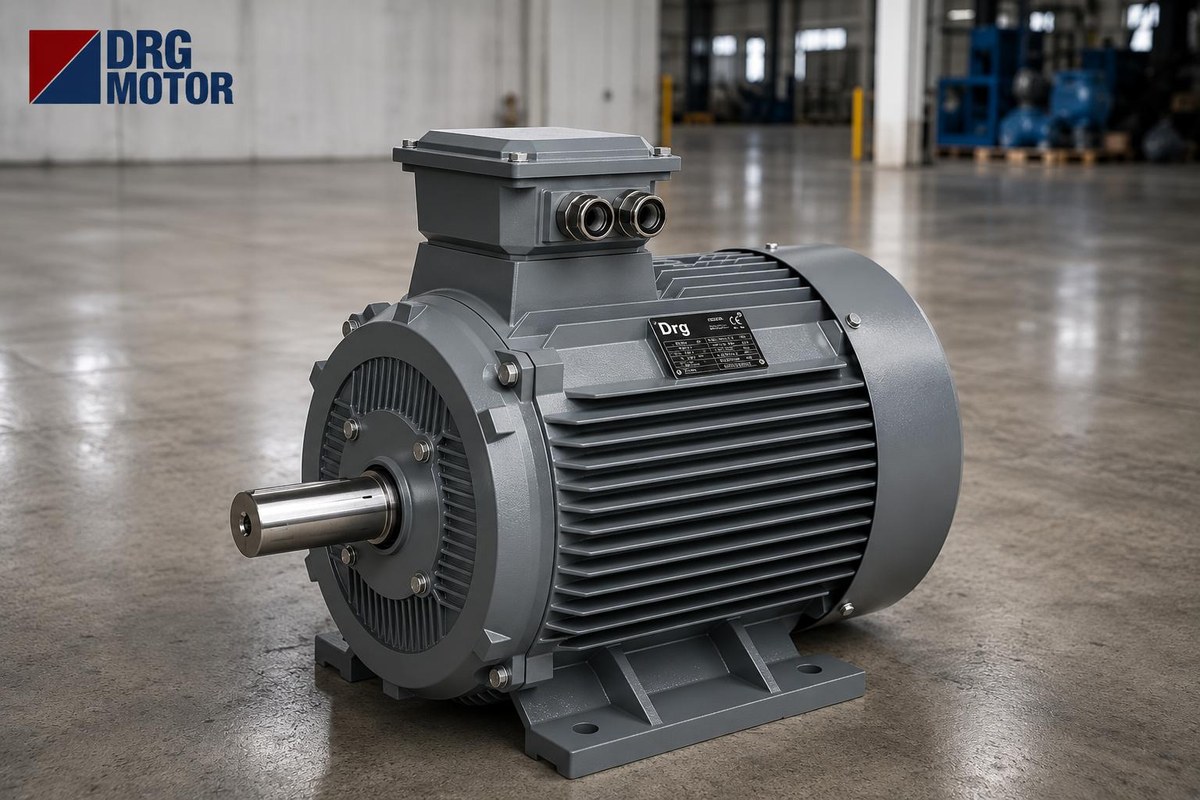

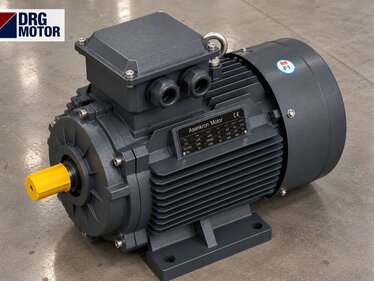
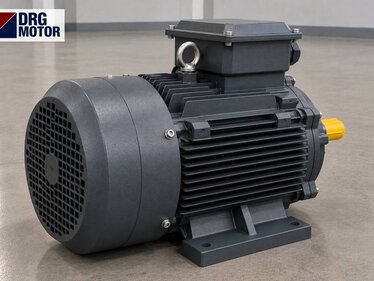
In stone crushing and screening plants, the pole number of a 50 HP (37 kW) motor is chosen according to the torque the machine needs: the 2-pole DRG-200L2-2 delivers 119.4 Nm, the 4-pole DRG-225S-4 237.9 Nm and the 6-pole DRG-250M-6 358.7 Nm of rated torque. Power is the same for all three; what changes is the speed and torque at which that power reaches the shaft. Crusher and screen drives most often use the 4-pole model. Product pages and current prices for all three models are on our Buy Electric Motors Online page.
As the pole number increases, torque grows but so does the motor: at 37 kW the 2-pole is in a 200L frame, the 4-pole in 225S and the 6-pole in 250M. So the pole decision is made together with base frame dimensions, pulley diameter and shaft diameter, not on speed alone. Below we compare the three models in one table, then use a crusher pulley example to show how the choice is made in practice.
2, 4 and 6-Pole 37 kW Motor Comparison Table
| Feature | DRG-200L2-2 2-pole | DRG-225S-4 4-pole | DRG-250M-6 6-pole |
|---|---|---|---|
| Rated speed | 2960 rpm | 1485 rpm | 985 rpm |
| Rated torque | 119.4 Nm | 237.9 Nm | 358.7 Nm |
| Starting torque (Ts/Tn) | 2.0 → 238.8 Nm | 2.0 → 475.8 Nm | 2.0 → 717.4 Nm |
| Breakdown torque (Tmax/Tn) | 2.3 → 274.6 Nm | 2.3 → 547.2 Nm | 2.1 → 753.3 Nm |
| IEC frame | 200L | 225S | 250M |
| Shaft D×E | 55×110 mm | 60×140 mm | 65×140 mm |
| Bearing | 6312-C3 | 6313-C3 | 6314-C3 |
| Current 400 V | 64 A | 66.1 A | 68.1 A |
| Store | See Prices | See Prices | See Prices |
Starting and breakdown torques in the table are obtained by multiplying the rated torque by the ratio (e.g. 237.9 × 2.0 = 475.8 Nm). Although the 6-pole model's breakdown ratio (2.1) is lower than the others, its absolute value is the highest.
Where Does Torque Come From? The 9550 × P / n Calculation
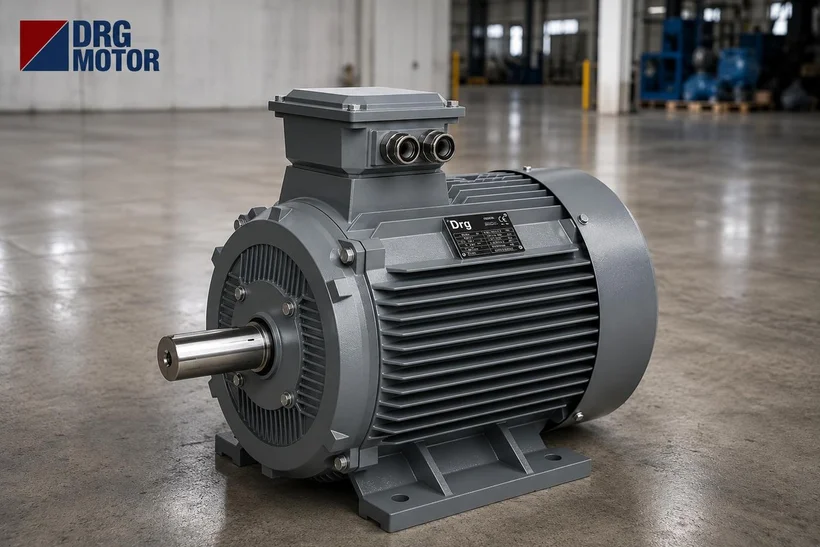
A motor's rated torque is power divided by rated speed: T = 9550 × P(kW) / n(rpm). For the 4-pole model, 9550 × 37 / 1485 = 237.9 Nm, identical to the catalogue value. The same formula shows that halving the speed doubles the torque. That is exactly the difference between the 2-pole motor's 119.4 Nm at 2960 rpm and the 4-pole's 237.9 Nm.
The crusher itself usually turns much more slowly than any of these speeds. A belt drive or gearbox bridges the gap, and motor torque is multiplied by the transmission ratio. In other words, the pole choice does not change the torque reaching the crusher; it changes the size of the transmission. To see speed and torque conversion with your own values, use the pulley and belt calculator.
Example: Which Pole Number for a 300 rpm Jaw Crusher?
Assume the crusher shaft must turn at 300 rpm and the motor pulley is 180 mm. The required ratio and crusher pulley diameter for the three motors are as follows (belt slip and losses neglected):
| Motor | Ratio (n / 300) | Crusher pulley (with 180 mm motor pulley) | Belt speed |
|---|---|---|---|
| DRG-200L2-2 | 9.87 | ≈ 1776 mm | 27.9 m/s |
| DRG-225S-4 | 4.95 | ≈ 891 mm | 14.0 m/s |
| DRG-250M-6 | 3.28 | ≈ 591 mm | 9.3 m/s |
Neglecting losses, torque at the crusher shaft is about 1178 Nm in all three cases, because power and crusher speed are fixed. The difference lies in the transmission: the 2-pole needs a pulley of roughly 1.8 m and belt speed rises to 27.9 m/s, close to the permissible belt speed limit. With 6 poles the pulley shrinks but the motor moves up a frame size. That is why 4 poles (891 mm pulley, 14.0 m/s) is the most balanced option for crushers.
Choosing Pole Number by Machine in a Crushing and Screening Plant
Jaw and impact crushers
Crushers accelerate slowly because of the heavy flywheel and rotor, and torque spikes momentarily when stone jams during operation. The critical value here is breakdown torque: 547.2 Nm on the 4-pole model. If that limit is exceeded, the motor stalls and the overload trips. On a flywheel crusher, motor pulley and number of belts should be chosen so the belts do not slip up to breakdown torque.
Vibrating screen and belt conveyor
On eccentric-shaft screens and belt conveyors the load is present at start too: if material is left on the belt, the motor starts loaded. That makes the starting torque ratio (2.0) important. Conveyors usually use a geared 4-pole motor; for gearbox selection see our geared motor selection guide. Motor groups by plant type are on the stone crushing plant motors page.
Sand washing and dust suppression pump
The natural place for the 2-pole model in the plant is the centrifugal pump. Pumps feeding sand washing screens and dust suppression lines are coupled directly to the motor, and the impeller is designed for a speed around 2960 rpm. High starting torque is not needed here; the pump starts with low torque and torque rises with the square of speed. Taking the same 37 kW from a 4-pole motor on the crusher and a 2-pole on the pump therefore means keeping two different frames (200L and 225S) on site; take this into account when planning spare motors. To find pump power from flow and head, use the pump and fan motor power calculator.
Starting Under Load: What Happens to Torque in Star-Delta?
The 37 kW motors are wound for 400/690 V (Δ/Y) and can be started star-delta on a 400 V network. In the star position, however, both current and torque drop to about one third. On the 4-pole model, starting torque falls from 475.8 Nm to about 158.6 Nm, which is 0.67 times rated torque. A crusher full of material or a loaded belt may not accelerate with that torque. Two rules apply in practice: the crusher starts empty and feeding begins only after the motor reaches full speed; if a loaded start is unavoidable, consider a soft starter or a frequency inverter. Compare starting methods with the star-delta starting tool. Panel and connection work must be carried out by a qualified electrician.
37 kW Crusher Motor Checklist Before Installation
- Write down the required machine shaft speed and the pulley/gearbox ratio; choose the pole number from that.
- Check base frame foot hole dimensions for the motor frame: A×B 318×305 mm for 200L, 356×286 mm for 225S, 406×349 mm for 250M.
- Machine the pulley bore to the motor shaft diameter (55, 60 or 65 mm).
- Calculate belt speed; on a 2-pole motor a large pulley raises belt speed quickly.
- Confirm whether the crusher will start empty; for a loaded start, plan a method other than star-delta.
- Check belt tension at installation and again after the first running hours; excessive tension wears the bearing.
- In dusty areas, close the terminal box gasket and cable glands tightly.
Technical Factors That Affect the Price of a 50 HP Motor
At 37 kW, frame size is the main price driver: since the 2-pole is in 200L, the 4-pole in 225S and the 6-pole in 250M, material quantity and bearing size (6312-C3 → 6314-C3) grow with the pole number. Mounting type (B3 foot, B5 flange, B35), protection class and special requests such as a long shaft or double shaft end are also reflected in the price. All models in this rating have cast iron frames. For current prices, see the product pages and our online store.
Motors in This Rating (50 HP / 37 kW)
- DRG-200L2-2 – 37 kW – 2960 rpm – 200L cast iron
- DRG-225S-4 – 37 kW – 1485 rpm – 225S cast iron
- DRG-250M-6 – 37 kW – 985 rpm – 250M cast iron
Click to see current prices and order these motors nowSEE PRICES →
Frequently Asked Questions
What is the torque of a 37 kW motor in Nm?
Rated torque depends on the poles: 119.4 Nm at 3000 rpm, 237.9 Nm at 1500 rpm and 358.7 Nm at 1000 rpm. Starting torque is 2.0 times rated torque on all three.
What is the rpm of a 50 HP motor?
By pole number, rated 2960 rpm (2-pole), 1485 rpm (4-pole) or 985 rpm (6-pole). Synchronous speeds are 3000, 1500 and 1000; the difference is slip.
Should a stone crusher use a 4-pole or 6-pole motor?
For belt drives, 4 poles are sufficient in most cases; pulley diameter and belt speed stay reasonable. 6 poles are preferred where a very low machine speed is needed and the base frame suits the 250M frame.
How many amps does a 37 kW motor draw?
64–68.1 A at 400 V and 67.4–71.7 A at 380 V. For cable sizing with this current, read our 37 and 45 kW cable size article.
For help selecting a model for a crusher or screen drive, contact us at +90 (542) 666 11 11 or [email protected], or via our contact page. For all models, visit Buy Electric Motors Online.