English
 Le français
 Türkçe




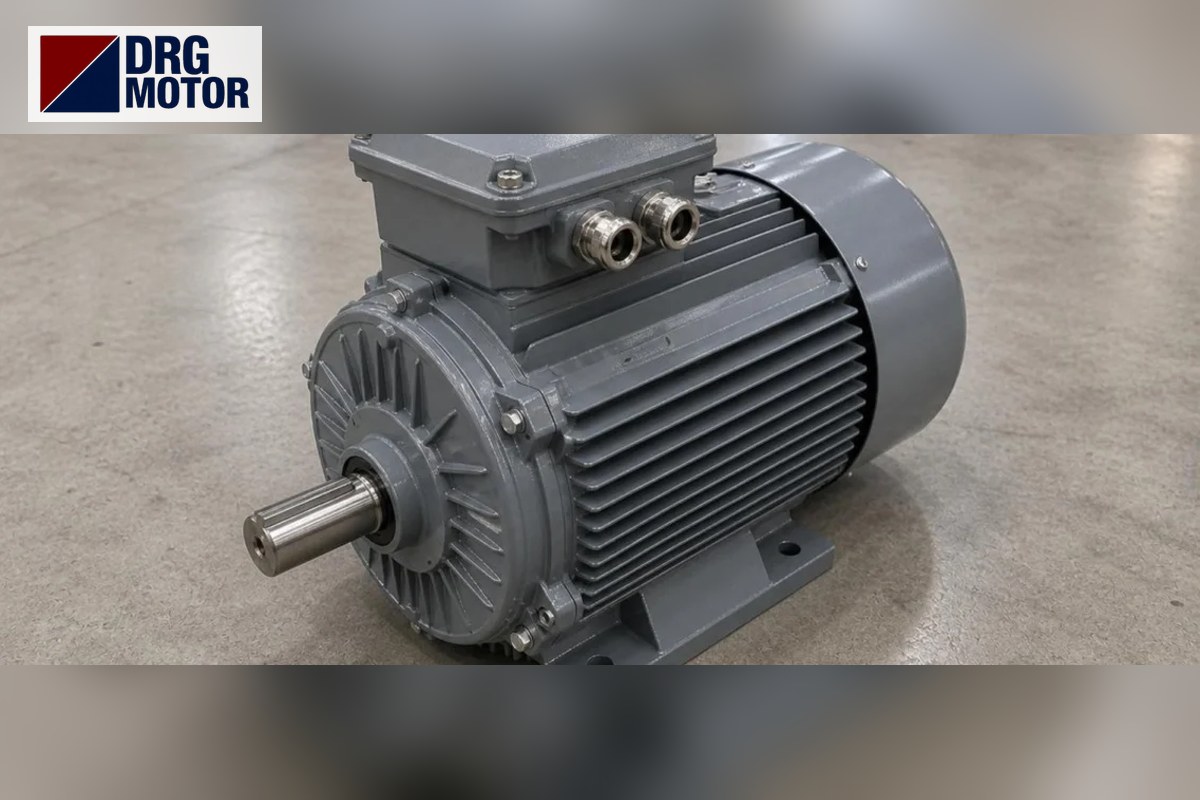

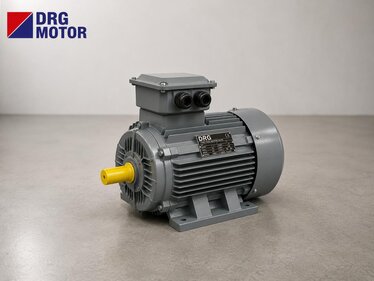
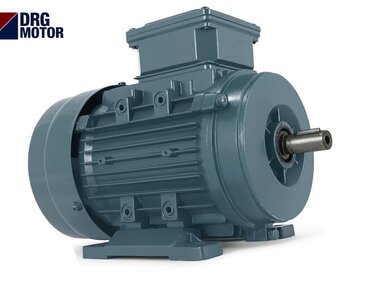
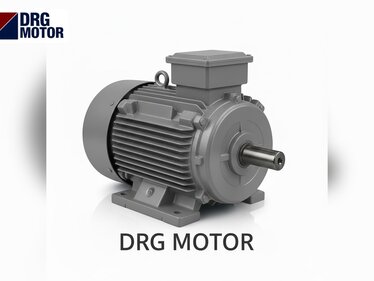
The motor people search for as a "20 HP 1500 rpm motor" is the 15 kW, 4-pole, cast-iron three-phase motor listed in the DRG catalogue as DRG-160L-4. At full load its shaft turns at 1465 rpm, delivers 97.8 Nm rated torque and draws 28.8 A on a 380 V supply; at 400 V the figure is 27.3 A and at 415 V 26.3 A. The 400/690 V rating on the nameplate means the motor runs in delta (Δ) on a 380–400 V network.
"1500 rpm" is the synchronous speed; under load the rotor lags slightly behind the magnetic field, and on this model the difference equals roughly 2.3% slip. Use 1465 rpm, not 1500, when sizing pulleys or a gearbox. The frame letter matters too: in this series the 160M frame with the same 160 mm shaft height is the 11 kW size, while 15 kW moves to the 160L frame with a longer foot spacing.
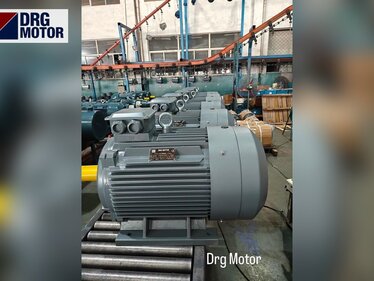
This page brings together the data sheet of the DRG-160L-4, manufactured and supplied by DRG Motor, its B3 foot-mounting dimensions and how these values are used on conveyor and mixer drives. For current prices and ordering, go to the product page in the Buy Electric Motors Online category.
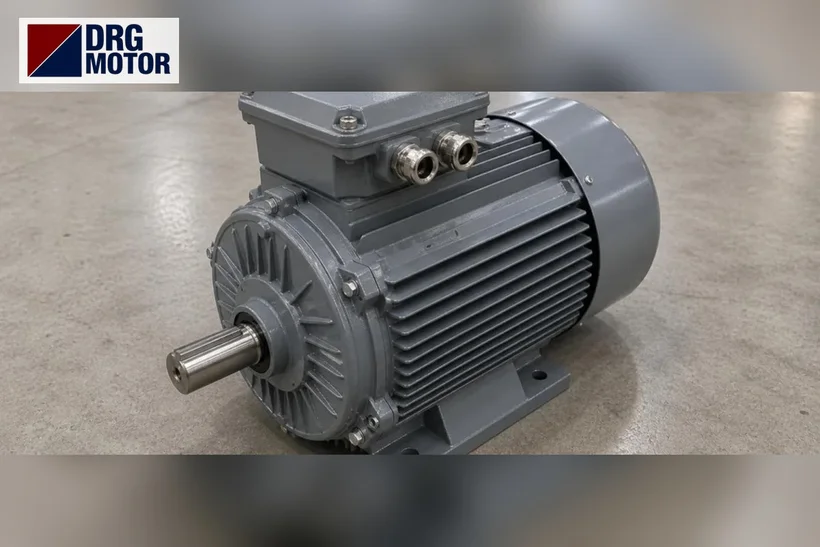
DRG-160L-4 electrical data sheet
The values below are taken one-to-one from the 15 kW 4-pole row of the DRG catalogue. Panel, cable and protection selection is based on this table.
| Quantity | Value | What it is used for on site |
|---|---|---|
| Rated power | 15 kW (20 HP) | Mechanical power at the shaft |
| Rated speed | 1465 rpm | Pulley and gear ratio calculation |
| Current 380 / 400 / 415 V | 28.8 / 27.3 / 26.3 A | Overload setting and cable size |
| cos φ | 0.86 | Reactive power and compensation |
| Rated torque | 97.8 Nm | Whether the load can be turned |
| Starting torque Ts/Tn | 2.2 | Breaking away a loaded belt |
| Breakdown torque Tmax/Tn | 2.3 | Margin for momentary overload |
| Starting current Is/In | 7.8 | Fuses and starting method |
| Voltage / connection at 380 V | 400/690 V (Δ/Y) / Δ delta | Terminal links |
| Cable entry | 2 × M40×1.5 | Gland size |
| Bearing | 6309-C3 | Spare parts planning |
The catalogue torque can be checked with the formula: T = 9550 × P / n = 9550 × 15 / 1465 ≈ 97.8 Nm. The equation also shows that the speed on the nameplate is the full-load speed; at no load the motor gets very close to 1500 rpm.
B3 foot-mounting dimensions (mm)
For foot (B3) mounting, check the dimensions below before drilling the base frame. The values match the olculer_mm data on the product card.
| Code | Meaning | DRG-160L-4 | DRG-160M-4 (11 kW, for comparison) |
|---|---|---|---|
| A | Foot hole spacing (across) | 254 | 254 |
| B | Foot hole spacing (lengthwise) | 254 | 210 |
| C | Shaft shoulder to front foot hole | 108 | 108 |
| D × E | Shaft diameter × shaft length | 42 × 110 | 42 × 110 |
| F | Key width | 12 | 12 |
| H | Shaft centre height | 160 | 160 |
| K | Foot hole | 4–Φ14.5 | 4–Φ14.5 |
| AC / AD | Frame diameter / terminal box height | 314 / 251 | 314 / 251 |
| L | Overall length | 652 | 608 |
The only differences are B and L: on the 160L frame the lengthwise hole spacing and the overall length are both 44 mm longer. Shaft, key, shaft height and frame diameter are identical. So when a conveyor driven by an 11 kW 160M motor is upgraded to 15 kW, the coupling or pulley stays the same; only the rear foot holes move 44 mm back, or slotted holes are cut in the base.
What does 97.8 Nm mean on a conveyor or mixer?
A 4-pole motor usually drives low-speed machines such as belt conveyors, screw conveyors, agitators and mixers through a gearbox or a belt and pulleys. The calculation has two steps: output speed = motor speed ÷ ratio, output torque ≈ motor torque × ratio (theoretical value, losses excluded).
Example 1 – Belt conveyor with gearbox
With a gearbox of ratio i = 25, the output speed is 1465 ÷ 25 ≈ 58.6 rpm and the theoretical output torque 97.8 × 25 ≈ 2445 Nm. With a 400 mm drum, belt speed is π × 0.4 × 58.6 ÷ 60 ≈ 1.23 m/s. The actual torque is found by deducting the gearbox's own losses from its catalogue.
Example 2 – Belt-driven mixer
With a 150 mm motor pulley and a 300 mm mixer pulley, the mixer shaft turns at 1465 × 150 ÷ 300 ≈ 732 rpm and the theoretical torque doubles to about 195.6 Nm. To try other diameters use the pulley and belt calculator, and for geared solutions the gearbox output speed and torque calculator. Gearbox types and flange matching are covered separately in our geared motor selection guide.
Starting with a loaded belt: 2.2× torque, 7.8× current
If a conveyor stops with material on it, the next start must overcome both friction and the inertia of the load. The DRG-160L-4 has a starting torque of 2.2 times rated, i.e. about 215 Nm at direct-on-line start, and a breakdown torque of about 225 Nm. This margin is enough for the loaded start of most horizontal conveyors.
The cost is current: with Is/In = 7.8, about 225 A is drawn at the moment of starting on 380 V. On sites with a weak transformer, star-delta or a soft starter is considered; however, because torque also drops to one third in star, a star-delta start with a loaded belt may struggle. When direct-on-line starting is possible at 15 kW is discussed in detail in our article can 11 and 15 kW motors be started direct-on-line?
Why only a cast-iron frame at 15 kW?
In the DRG series the aluminium frame is offered up to 11 kW; the 15 kW 4-pole motor comes only with a cast-iron frame. In practice this means: on the 160L frame the bearing is 6309-C3 and the shaft 42 mm, and the radial load from belt tension or coupling misalignment is transferred through the feet into the base. A cast-iron frame limits flexing around the feet under this load and is more tolerant of bolt loosening on vibrating conveyor frames. In dusty environments (cement, feed, sand), keeping the cooling fins clean is still essential; dust packed between the fins raises winding temperature.
Installation and commissioning checklist
- Measure the base hole spacing as A = 254 mm, B = 254 mm; the hole is Φ14.5 mm.
- Shaft height 160 mm: if needed, place thin sheet shims under the feet to align with the gearbox input shaft.
- The coupling or pulley bore must be 42 mm with a 12 mm keyway, seated along the full 110 mm shaft length.
- Leave the terminal links in delta (Δ); a star connection on a 380–400 V line leaves the motor underpowered.
- Set the overload relay to 28.8 A on a 380 V line.
- Cable entries are 2 × M40×1.5; select glands for the cable outer diameter.
- On the first run, check the direction of rotation before fitting belt or coupling; if it is wrong, swap two phases.
- Have the electrical connection and protection settings done by a qualified electrician.
DRG motors around 20 HP
If you need the same power at another speed, or the neighbouring power step, look at these models:
- DRG-160L-4 – 15 kW – 1465 rpm – 160L cast iron
- DRG-160M-4 – 11 kW – 1465 rpm – 160M cast iron
- DRG-180M-4 – 18.5 kW – 1470 rpm – 180M cast iron
- DRG-160M2-2 – 15 kW – 2945 rpm – 160M cast iron
- DRG-180L-6 – 15 kW – 978 rpm – 180L cast iron
The technical factors that set the price are power, number of poles (speed), frame material, mounting (B3, B5 flange or B35) and protection rating; the current figure is shown on each product's own page.
Click to see current prices and order these motors nowSEE PRICES →
Frequently Asked Questions
How many amps does a 20 HP 1500 rpm motor draw?
The DRG-160L-4 draws 28.8 A at 380 V and 27.3 A at 400 V at full load. Current falls as load decreases; the no-load value is clearly below the full-load current.
Which frame does a 15 kW 1500 rpm motor come in?
In this series the 15 kW 4-pole motor is in the 160L frame; shaft height is 160 mm and shaft diameter 42 mm. The 160M frame belongs to 11 kW in the same series.
What is the shaft diameter of a 20 HP motor?
The DRG-160L-4 shaft is 42 × 110 mm with a 12 mm key. Moving to 18.5 kW at the same speed, the 180M frame has a 48 mm shaft.
Does a 20 HP motor need star-delta starting?
Not necessarily; it depends on whether the supply can handle the starting current (about 225 A at 380 V) and on the starting torque of the load. On a conveyor that starts loaded, torque drops to one third in star, so a soft starter should also be considered.
If you have a question about the DRG-160L-4 or another 1500 rpm model, call +90 (542) 666 11 11 or write to [email protected]; all channels are on our contact page. For other powers and speeds, browse the 120 models in our online store.