English
 Le français
 Türkçe




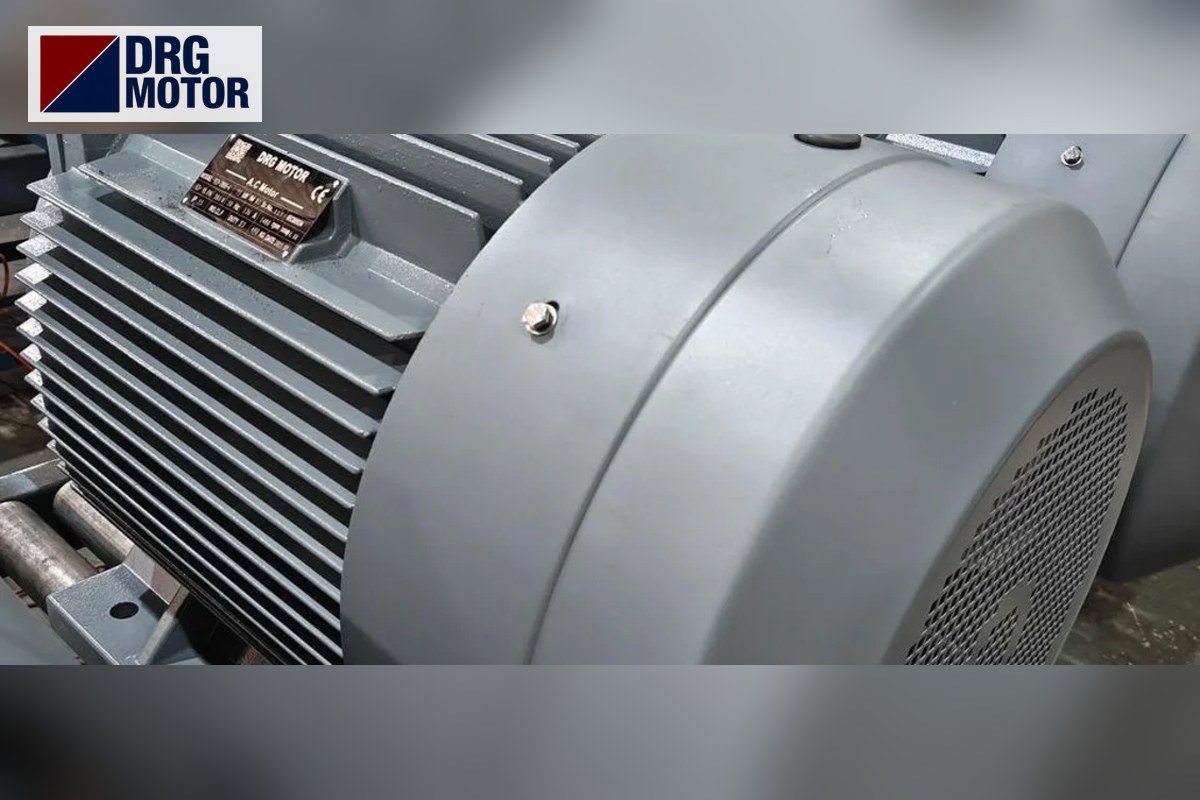

The "1450 rpm" label corresponds to the motors from 1.1 kW to 4 kW in DRG's 4-pole range: at 1.1 and 1.5 kW the plate reads 1445 rpm, at 2.2, 3 and 4 kW exactly 1450 rpm. From 5.5 kW onward rated speed climbs step by step; 7.5 kW reads 1460, 22 kW 1470, 37 kW 1485 and 75 kW 1486 rpm. The table below gathers these values for 16 models in one place.
Knowing this table pays off especially in pulley and gearbox calculations. Anyone who calculates with the synchronous speed of 1500 gets an output speed 3.4% too high on a 1450 rpm motor; on large motors the error shrinks but never disappears. The correct approach is to put the rated speed from the plate of the chosen model into the formula.
Each listed model has its product page in the Buy Electric Motors Online category; use the links in the table for current information and ordering.
Rated speed by kW in the 4-pole range
Values are taken directly from DRG catalogue data. Rated torque is the turning force delivered to the shaft at full load and is used together with speed in pulley and gearbox calculations.
| Model | kW / HP | IEC frame | Rated speed | Rated torque | Current at 400 V | Shop |
|---|---|---|---|---|---|---|
| DRG-90S-4 | 1.1 / 1.5 | 90S | 1445 rpm | 7.27 Nm | 2.48 A | See Prices |
| DRG-90L-4 | 1.5 / 2 | 90L | 1445 rpm | 9.91 Nm | 3.3 A | See Prices |
| DRG-100L1-4 | 2.2 / 3 | 100L | 1450 rpm | 14.5 Nm | 4.52 A | See Prices |
| DRG-100L2-4 | 3 / 4 | 100L | 1450 rpm | 19.8 Nm | 6.02 A | See Prices |
| DRG-112M-4 | 4 / 5.5 | 112M | 1450 rpm | 26.3 Nm | 7.95 A | See Prices |
| DRG-132S-4 | 5.5 / 7.5 | 132S | 1460 rpm | 36 Nm | 10.7 A | See Prices |
| DRG-132M-4 | 7.5 / 10 | 132M | 1460 rpm | 49.1 Nm | 14.3 A | See Prices |
| DRG-160M-4 | 11 / 15 | 160M | 1465 rpm | 71.7 Nm | 20.4 A | See Prices |
| DRG-160L-4 | 15 / 20 | 160L | 1465 rpm | 97.8 Nm | 27.3 A | See Prices |
| DRG-180M-4 | 18.5 / 25 | 180M | 1470 rpm | 120.2 Nm | 33.5 A | See Prices |
| DRG-180L-4 | 22 / 30 | 180L | 1470 rpm | 142.9 Nm | 39.7 A | See Prices |
| DRG-200L-4 | 30 / 40 | 200L | 1475 rpm | 194.2 Nm | 53.8 A | See Prices |
| DRG-225S-4 | 37 / 50 | 225S | 1485 rpm | 237.9 Nm | 66.1 A | See Prices |
| DRG-225M-4 | 45 / 60 | 225M | 1485 rpm | 289.4 Nm | 80.2 A | See Prices |
| DRG-250M-4 | 55 / 75 | 250M | 1485 rpm | 353.7 Nm | 97.6 A | See Prices |
| DRG-280S-4 | 75 / 100 | 280S | 1486 rpm | 482 Nm | 129 A | See Prices |
Two compact options are not in the same table: DRG-112M-4K (5.5 kW, 112M frame) and DRG-132M-4K (11 kW, 132M frame). Their rated speed is the same as their standard counterparts: 1460 and 1465 rpm respectively.
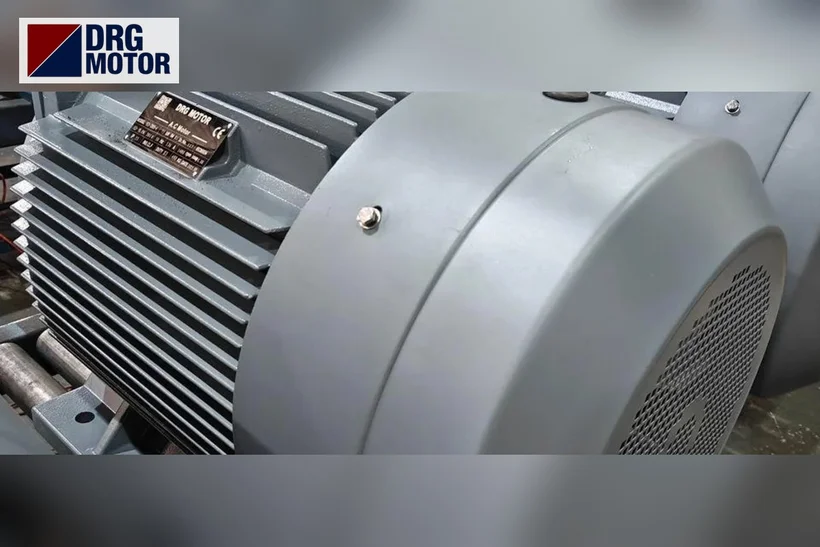
How to read speed and the other values on a motor nameplate
The speed on the plate is not read on its own; it gains meaning together with the frequency and connection data on the same line. On the DRG-112M-4 the plate shows: 4 kW, 400/690 V (Δ/Y), 50 Hz, 7.95 A at 400 V, cos φ 0.82 and 1450 rpm. "400/690 V Δ/Y" means that on a 400 V supply the windings are connected in delta; 690 V star is only used where such a supply exists.
The speed value was measured at 50 Hz, rated voltage and full load. Connected to a 60 Hz supply the synchronous speed rises to 1800 and the plate figure no longer applies; on a motor driven by a frequency inverter speed changes in proportion to the set frequency. The plate current is the starting point for the overload relay setting; the current drawn at start is Is/In times this value (7.8 times on the 112M-4).
Use rated speed, not 1500, in pulley calculations
In a belt drive, machine speed = motor speed × motor pulley diameter / machine pulley diameter. Example: with a 1450 rpm motor, a 100 mm motor pulley and a 250 mm machine pulley, the machine turns at 580 rpm. Do the same calculation with 1500 and you get 600 rpm; the difference is 3.4%. On a mixer that may not matter, but on a screw conveyor or a dosing machine it shifts hourly capacity by the same proportion.
It also works the other way round: if the target machine speed is known, the required pulley ratio = rated speed / target speed. A machine needing 580 rpm requires 1450 / 580 = 2.5. Diameters and belt length are found quickly with the pulley and belt calculator.
Gearbox output speed and torque example
In a geared drive, output speed = rated speed / gear ratio (i). If a DRG-180L-4 (22 kW, 1470 rpm) motor is coupled to an i = 30 gearbox, the output is 49 rpm. Theoretical output torque is motor torque × i, i.e. 142.9 × 30 ≈ 4287 Nm; found before deducting gear losses, this value is an upper limit and the real figure is lower according to the loss ratio in the gearbox catalogue.
Had 1500 rpm been assumed with the same ratio, the output would have been calculated as 50 rpm. If belt speed, bucket count or cycle time is set according to this number, the difference can be measured on site. Our article on conveyor belt motor and gearbox ratio sizing uses the same method step by step; for a quick result the gearbox output speed and torque calculator is ready.
Why does speed reach 1486 at higher power?
In the 4-pole range slip falls as power rises: a motor running 3.33% below synchronous speed at 4 kW lags by only 0.93% at 75 kW. One indicator is rotor frequency (f2 = s × f): at 1450 rpm rotor currents alternate at 1.67 Hz, on the 1486 rpm DRG-280S-4 at 0.47 Hz. A low rotor frequency also means low rotor losses.
In practice: on a large motor speed varies very little as load changes. This keeps fan and pump flow more stable; but if you replace a 1486 rpm motor with a 1450 rpm one, even though both belong to the same "1500 rpm" class, the machine slows by about 2.4% (1450 / 1486 = 0.976).
Commissioning and speed verification checklist
- Check that the plate frequency is 50 Hz and that the connection suits the supply voltage (on a 400 V supply Δ for 4 kW and above, Y for 3 kW and below).
- Verify direction of rotation with a short bump at first start; a fan or pump motor running backwards is loaded needlessly.
- Measure with a tachometer at full load: a speed clearly below the plate signals overload or low voltage.
- Measure phase currents with a clamp meter and compare with the plate current; if phases differ noticeably, check the connection.
- Redo the pulley or gearbox calculation with the plate rated speed; do not reuse an old calculation made with 1500.
- Set the overload relay to the plate current.
Technical features that affect the price of 1450 rpm motors
The main price factors are power, IEC frame size (from 90S to 280S), housing material (aluminium and cast iron up to 11 kW, cast iron only from 15 kW), mounting arrangement (B3 foot, B5 flange, B35) and protection class. At 5.5 and 11 kW a compact frame option is also worth considering. The current price of each model is on its product page; you can compare the whole range among the 120 models in our online shop.
Motors in this power range
- DRG-90L-4 – 1.5 kW – 1445 rpm – 90L
- DRG-100L2-4 – 3 kW – 1450 rpm – 100L
- DRG-112M-4 – 4 kW – 1450 rpm – 112M
- DRG-132M-4 – 7.5 kW – 1460 rpm – 132M
- DRG-160M-4 – 11 kW – 1465 rpm – 160M
- DRG-180L-4 – 22 kW – 1470 rpm – 180L
Click to see current prices and order these motors nowSEE PRICES →
Frequently Asked Questions
How many poles does a 1450 rpm motor have?
Four. Synchronous speed at 50 Hz is 1500 rpm; the 1450 on the plate is the actual shaft speed remaining after full-load slip.
In which ratings is a 1450 rpm motor available?
In the DRG range 2.2, 3 and 4 kW are exactly 1450 rpm; 1.1 and 1.5 kW are 1445 rpm. At higher ratings the same 4-pole motors run between 1460 and 1486 rpm.
Is a 1450 rpm motor the same as a 1500 rpm motor?
Yes, both are the same 4-pole class. 1500 is the synchronous speed, 1450 the rated speed on the plate; the market uses both terms for the same motor.
How many amps does a 4 kW 1450 rpm motor draw?
DRG-112M-4 draws 8.37 A at 380 V, 7.95 A at 400 V and 7.66 A at 415 V.
If you would like help with a pulley ratio or gearbox selection, call +90 (542) 666 11 11 with your machine's target speed, write to [email protected] or use the contact form page. The full 4-pole range is on the Buy Electric Motors Online page.