English
 Le français
 Türkçe




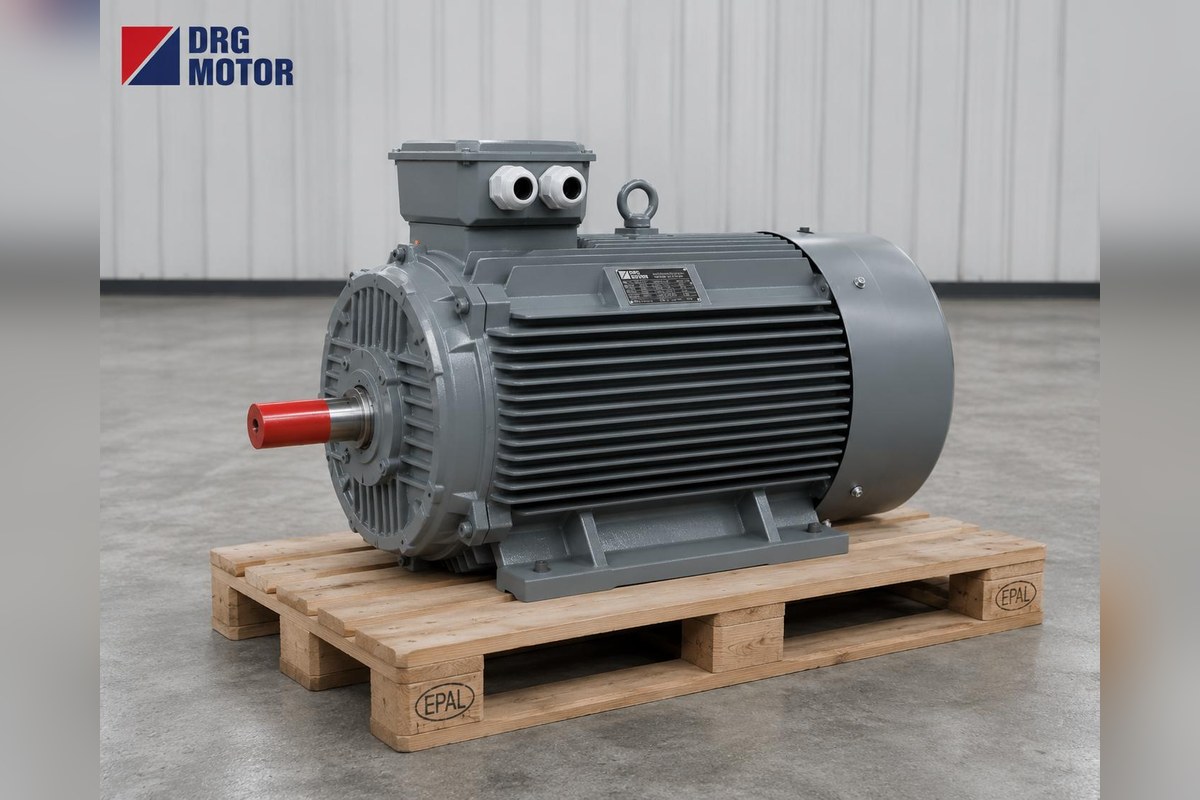

On the market, "2800 rpm" refers to small 2-pole three-phase motors with a synchronous speed of 3000 rpm. In DRG data the actual plate speeds of this class are: 0.25 kW 2730, 0.37 and 0.55 kW 2750, 0.75 and 1.1 kW 2880 rpm. No model reads exactly 2800; the term is a rounded name for this group between 2730 and 2880.
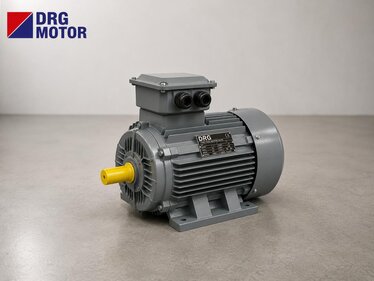
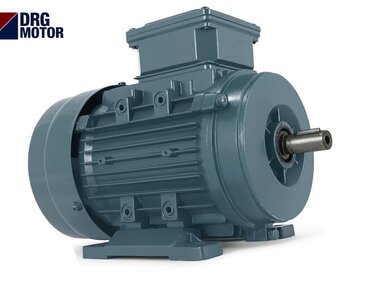
These motors are mostly used on small centrifugal pumps, circulation pumps, high-pressure washer units, duct fans and grinding benches. All are wound for 230/400 V (Δ/Y) and connected in star on a 400 V supply. As power rises from 0.25 to 1.1 kW speed also climbs by about 150 rpm; because this changes flow and absorbed power on pumps and fans, it must be taken into account when changing models.
All models are on the Buy Electric Motors Online page, and product details are behind the links in the table below.
2-pole DRG models in the "2800 rpm" class
| Model | kW / HP | Frame | Rated speed | cos φ | Current at 400 V | Is/In | Shop |
|---|---|---|---|---|---|---|---|
| DRG-632-2 | 0.25 / 0.37 | 63 aluminium | 2730 rpm | 0.81 | 0.64 A | 5.5 | See Prices |
| DRG-711-2 | 0.37 / 0.5 | 71 aluminium | 2750 rpm | 0.81 | 0.89 A | 6.1 | See Prices |
| DRG-712-2 | 0.55 / 0.75 | 71 aluminium / cast iron | 2750 rpm | 0.82 | 1.24 A | 6.1 | See Prices |
| DRG-801-2 | 0.75 / 1 | 80 aluminium / cast iron | 2880 rpm | 0.82 | 1.64 A | 7 | See Prices |
| DRG-802-2 | 1.1 / 1.5 | 80 aluminium / cast iron | 2880 rpm | 0.83 | 2.31 A | 7.3 | See Prices |
0.25 and 0.37 kW are aluminium only. From 0.55 kW the same code also comes in a cast iron version; electrical values are identical for both housings. The starting current ratio rises with power from 5.5 to 7.3, so the 1.1 kW motor draws 7.3 times its rated current at start.
Synchronous 3000, so why 2730–2880 on the plate?
In a 2-pole motor the magnetic field turns at 3000 revolutions per minute at 50 Hz (120 × 50 / 2). The rotor cannot catch it; the difference is needed to produce torque. In a small frame rotor resistance is relatively high, so the difference is large: 270 rpm (9.0%) at 0.25 kW, 250 rpm (8.33%) at 0.37–0.55 kW, 120 rpm (4.0%) at 0.75–1.1 kW.
The notable point is the jump from 2750 to 2880 rpm between frame 71 and frame 80. In frame 80 the rotor lamination stack and bar section grow and slip halves. That is why the 0.75 and 1.1 kW motors sharing the same 80 frame have the same plate speed.
The difference between 2750 and 2880 rpm on pumps and fans
Centrifugal pumps and fans follow the affinity laws: flow changes in direct proportion to speed, head with the square of speed, and shaft power demand with the cube of speed. Fitting the 2880 rpm DRG-801-2 to the same pump instead of the 2750 rpm DRG-712-2 gives a ratio of 2880 / 2750 = 1.047.
- Flow rises by about 4.7%.
- Head (or fan pressure) rises by about 9.7%.
- The power the pump demands at the shaft rises by about 14.9%.
In practice: fitting a faster motor of the same power to a pump that already struggles at 0.55 kW is no solution; the power demand rises too. Moving to 0.75 kW here is already one step up and provides a load margin. The other way round, replacing a 2880 rpm motor with a 2750 rpm one lowers flow and pressure. To find the required motor power from flow and head, use the pump and fan motor power calculator.
B5 flange dimensions of small pump motors
Most pumps in these ratings are bolted directly to the motor by a flange. The flange on the pump casing must match the motor's B5 flange. B5 (FF) values from the DRG catalogue are below; all dimensions in mm.
| Frame | Ratings (2-pole) | P flange OD | M bolt circle | N spigot | S hole | T spigot depth | Shaft D×E |
|---|---|---|---|---|---|---|---|
| 63 | 0.25 kW | 140 | 115 | 95 | 10 | 3 | 11×23 |
| 71 | 0.37 / 0.55 kW | 160 | 130 | 110 | 10 | 3.5 | 14×30 |
| 80 | 0.75 / 1.1 kW | 200 | 165 | 130 | 12 | 3.5 | 19×40 |
When renewing the motor without changing the pump, measure P and M first: 140/115 mm points to frame 63, 160/130 mm to frame 71, 200/165 mm to frame 80. The shaft must match too; the 14 mm shaft of frame 71 and the 19 mm shaft of frame 80 are not interchangeable.
Half the torque: 2-pole versus 4-pole at the same power
At the same power a 2-pole motor turns about twice as fast as a 4-pole one and gives half the torque. At 0.75 kW the DRG-801-2 delivers 2.49 Nm while the 4-pole DRG-802-4 delivers 5.04 Nm. Check by formula: 9550 × 0.75 / 2880 = 2.49 Nm.
That is why a 2800 rpm motor is not used without a pulley or gearbox on loads that need high torque at low speed, such as small piston compressors, mixers or conveyors. A detailed application comparison of the two classes is in our article on the 2-pole vs 4-pole motor difference.
Starting current and protection setting
Starting current is the product of rated current at 400 V and the Is/In ratio: 0.64 × 5.5 = 3.52 A at 0.25 kW, 0.89 × 6.1 = 5.43 A at 0.37 kW, 1.24 × 6.1 = 7.56 A at 0.55 kW, 1.64 × 7.0 = 11.48 A at 0.75 kW and 2.31 × 7.3 = 16.86 A at 1.1 kW. This current flows during the few seconds of start-up with the pump primed.
The overload relay is set to the plate current; fuse and contactor are chosen to carry the starting current. Use the overload relay, fuse and contactor selection page for setting ranges. Connection and panel work must be done by a qualified electrician.
Checklist for choosing a motor for a small pump or fan
- Speed on the pump or fan plate: around 2750 or around 2880? Account for the affinity effect when changing.
- Mounting: P, M, N dimensions for a flanged (B5) pump casing; shaft height for foot mounting (B3).
- Shaft: frame 63 11×23, frame 71 14×30, frame 80 19×40 mm.
- Connection: star (Y) on a 400 V supply, delta (Δ) on a 230 V three-phase supply.
- Direction of rotation: check the arrow on the pump casing at first start.
- Environment: for damp, outdoor or vibrating locations consider the cast iron housing from 0.55 kW upward.
Technical factors that set the price of 2800 rpm motors
In this class price is set by power, IEC frame (63, 71, 80), housing material (aluminium or cast iron), mounting arrangement (B3, B5, B35) and protection class. At the same power a 2-pole motor often fits a smaller frame than a 4-pole one. Current prices are on the product pages and in the list of 120 models in our online shop.
Motors in this power range
- DRG-632-2 – 0.25 kW – 2730 rpm – 63 aluminium
- DRG-711-2 – 0.37 kW – 2750 rpm – 71 aluminium
- DRG-712-2 – 0.55 kW – 2750 rpm – 71 aluminium (cast iron)
- DRG-801-2 – 0.75 kW – 2880 rpm – 80 aluminium (cast iron)
- DRG-802-2 – 1.1 kW – 2880 rpm – 80 aluminium (cast iron)
Click to see current prices and order these motors nowSEE PRICES →
Frequently Asked Questions
How many poles does a 2800 rpm motor have?
Two. Its synchronous speed at 50 Hz is 3000 rpm; on DRG's small ratings the plate speed is between 2730 and 2880 rpm.
How many amps does a 2800 rpm 0.75 kW motor draw?
DRG-801-2 draws 1.72 A at 380 V, 1.64 A at 400 V and 1.58 A at 415 V.
Is a 2800 rpm motor the same as a 2900 rpm motor?
The pole count is the same; both are in the 3000 rpm class. "2800" is used for small ratings (up to 1.1 kW), "2900" for 2-pole motors of 1.5 kW and above.
Is a 2800 rpm motor suitable for a booster pump?
Most small centrifugal booster sets run on a 2-pole motor. Choose a motor with the same speed and power as the pump plate, and check the flange size in the table above.
To find the right model for your pump or fan together, reach us at +90 (542) 666 11 11 or [email protected], or visit the contact page. All 2-pole motors are in the Buy Electric Motors Online category.