English
 Le français
 Türkçe




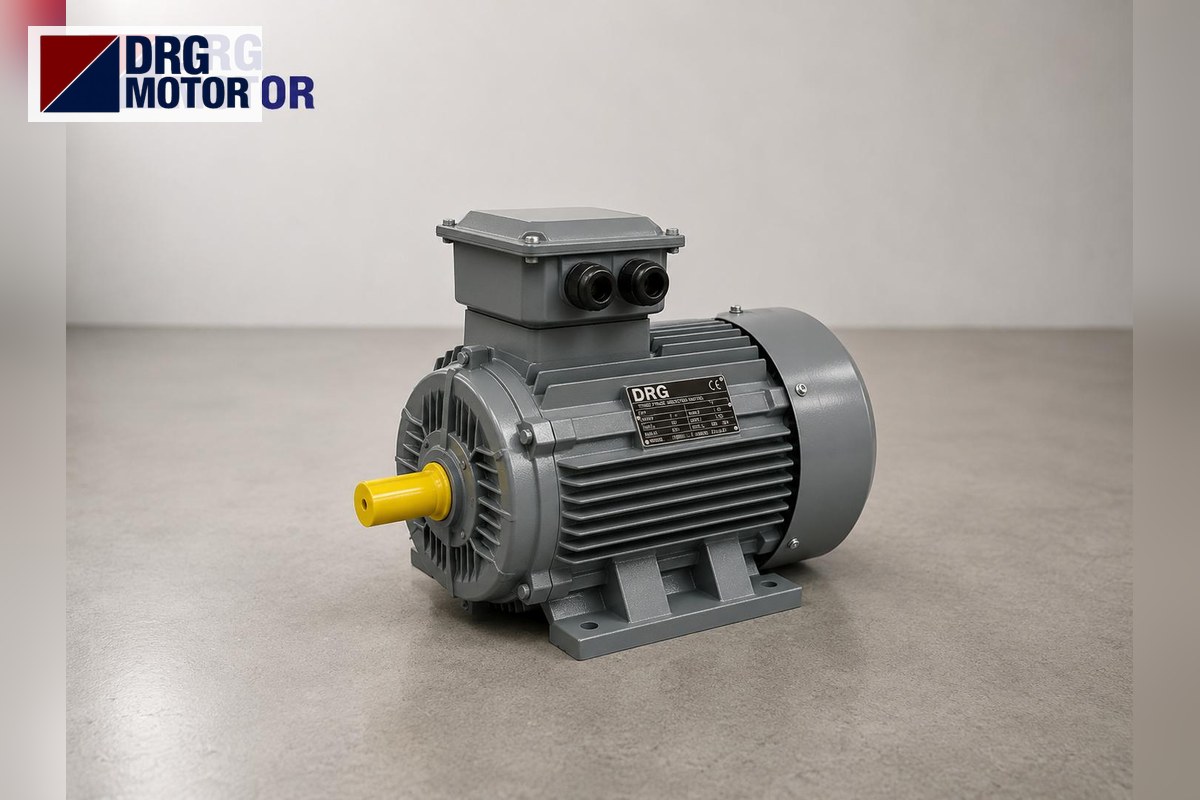

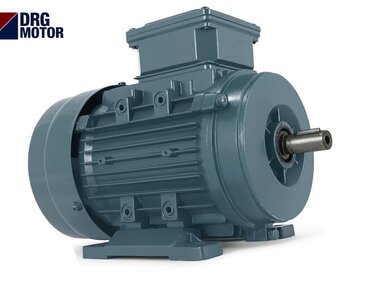
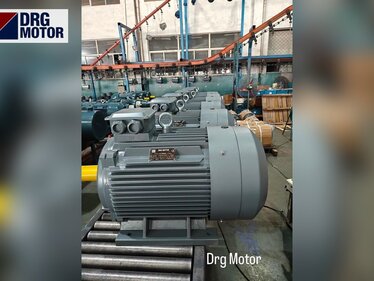
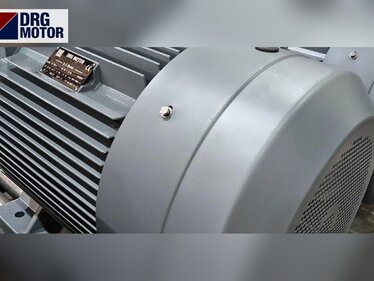
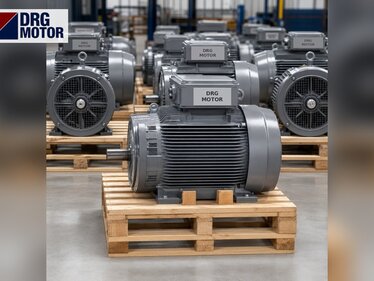
When people ask for a “2.2 kW 2800 rpm motor”, the product they mean is the 2-pole, 90L-frame three-phase motor coded DRG-90L-2 in the DRG catalogue. At full load this motor runs at 2895 rpm, draws 4.58 A at 380 V and delivers 7.26 Nm from its 24 mm shaft. It is a power class designed for loads that need to turn fast, such as centrifugal pumps, booster sets and fans. You can find the aluminium and cast iron versions on the Buy Electric Motors Online page.
So why do listings say 2800? The term comes from small 2-pole motors. In our catalogue the 0.37–0.55 kW models in frame 71 run at 2750 rpm, and the 0.75–1.1 kW models in frame 80 at 2880 rpm. From frame 90 upwards slip decreases and rated speed rises to 2895. In other words, 2800 is a class name; for ordering and calculations, the nameplate value of 2895 is what counts. Coupling the motor to a pump or fan and making the electrical connection must be done by a qualified electrician.
2800, 2895 and 3000: the difference between three numbers
The rotating field of a 2-pole motor turns at 120 × 50 / 2 = 3000 rpm on 50 Hz; this is the synchronous speed. At full load the rotor of the DRG-90L-2 lags 105 rpm behind it. Slip is (3000 − 2895) / 3000 = 3.5%. A motor actually running at 2800 rpm would have 6.7% slip; that value is seen on smaller motors, not in the 2.2 kW class.
In practice this matters for one reason: the curves in pump and fan catalogues are mostly drawn for a speed of around 2900. The DRG-90L-2's rated speed of 2895 rpm matches these curves directly. When it replaces an old motor whose nameplate says 2800, the pump turns slightly faster; the effect is calculated below.
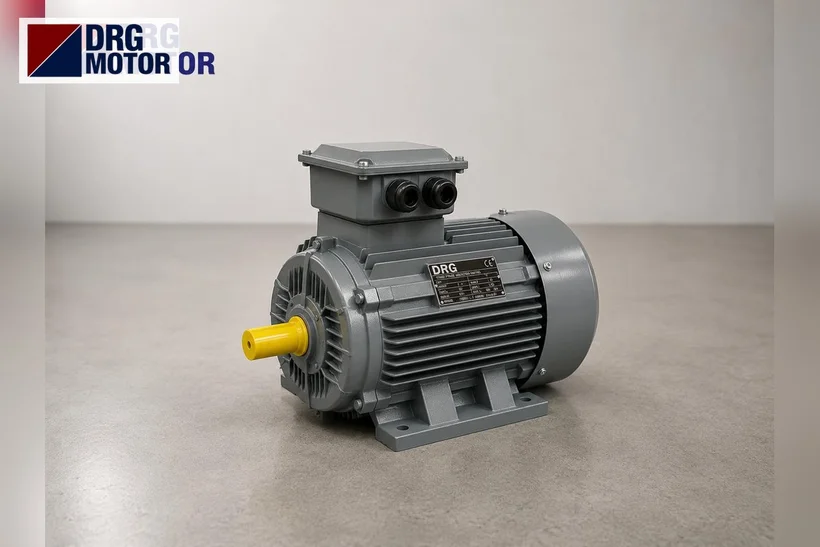
DRG-90L-2 technical data sheet
| Feature | Value | What it means in practice |
|---|---|---|
| Power | 2.2 kW (3 HP) | Shaft output power |
| Rated speed | 2895 rpm | Speed to use when reading the pump/fan curve |
| Current 380 / 400 / 415 V | 4.58 / 4.35 / 4.19 A | Overload relay is set to this value |
| cos φ | 0.85 | For power factor correction calculations |
| Rated torque | 7.26 Nm | 9550 × 2.2 / 2895 ≈ 7.26 Nm |
| Ts/Tn · Tmax/Tn | 2.2 · 2.3 | Adequate margin when starting against a full pipe |
| Is/In | 7.6 | Inrush current on direct start ≈ 34.8 A |
| Voltage / connection | 230/400 V (Δ/Y) | Star on a 380–400 V supply |
| Frame / H | 90L / 90 mm | Aluminium or cast iron |
| Bearing | 6205-ZZ-C3 | Double-shielded (ZZ) ball bearing with C3 clearance |
| Cable entry | 1 × M25×1.5 | Cable gland selection |
Current values transfer directly to the overload setting. In a 380 V installation the overload relay is set to 4.58 A. The 34.8 A inrush at start-up lasts only a short time; the motor protection breaker or fuse should be selected for this peak. You can find suitable protection devices with the overload, fuse and contactor selection tool.
Is 2.2 kW enough for a centrifugal pump?
Pump shaft power is calculated with P = ρ × g × Q × H / ηpump. In the formula, ρ is water density (1000 kg/m³), g is gravitational acceleration (9.81 m/s²), Q is flow, H is head and ηpump is pump efficiency as a decimal. In the examples below, pump efficiency is an assumption taken from the pump's own catalogue.
| Flow Q (m³/h) | Head H (m) | Pump efficiency (assumed) | Required shaft power | Status vs 2.2 kW |
|---|---|---|---|---|
| 18 | 25 | 0.62 | 1.98 kW | Suitable, 11% margin |
| 15 | 30 | 0.60 | 2.04 kW | Suitable, 8% margin |
| 12 | 35 | 0.55 | 2.08 kW | Borderline, 6% margin |
| 20 | 25 | 0.60 | 2.27 kW | Insufficient, next power up |
The calculation tells us that a 2.2 kW 2-pole motor suits typical building booster and irrigation pumps in the range of roughly 12–18 m³/h flow and 25–35 m head. If the required power exceeds 2.2 kW, consider the 3 kW compact DRG-90L-2K with the same foot dimensions, or the 100L-frame DRG-100L-2. To calculate with your own values, use the pump and fan motor power calculator.
What happens when it replaces an old 2800 rpm motor?
Affinity laws apply to centrifugal pumps and fans: flow varies with speed, pressure with the square of speed and power with the cube of speed. The speed ratio is 2895 / 2800 = 1.034. Therefore:
- Flow increases by about 3.4%.
- Head increases by about 6.9%.
- Power absorbed by the pump or fan increases by about 10.5%.
For example, a fan drawing 1.9 kW with the old motor will draw about 2.1 kW with the new one. That is still below 2.2 kW. But if the old motor was already running at full load, the new motor may be overloaded. After commissioning, measure the current in all three phases; at 380 V it must not exceed 4.58 A. If it does, throttle the flow with the valve or reduce the fan blade angle. We cover motor selection for radial fans separately in our article on centrifugal fan motor selection.
B3 foot-mounted or B5 flange-mounted?
On close-coupled pumps the motor is bolted to the pump casing by its flange, using B5 mounting. On coupled pumps and belt-driven fans the motor is fixed to a baseframe by its feet, using B3 mounting. If the pump cannot carry the motor's weight on its own, or extra support is needed for alignment, feet and flange are combined: B35 mounting. Both sets of DRG-90L-2 connection dimensions are below.
| B3 foot (mm) | Value | B5 flange (mm) | Value |
|---|---|---|---|
| A – transverse foot hole spacing | 140 | P – flange outer diameter | 200 |
| B – longitudinal foot hole spacing | 125 | M – bolt circle diameter | 165 |
| C – shaft shoulder to foot hole | 56 | N – spigot diameter | 130 |
| H – shaft height | 90 | S – flange hole diameter | 12 |
| K – foot hole | 4–Φ10 | T – spigot depth | 3.5 |
| D × E – shaft | 24 × 50 | LA – flange thickness | 12 |
| F – key width | 8 | DH – shaft end thread | M8X19 |
The most common mistake on close-coupled pumps is completing the order without checking shaft length and spigot diameter. Because the impeller sits on the shaft end, the 24 × 50 mm shaft and 130 mm spigot must match exactly. Technical drawings for other frames are on our technical drawings page.
Installation and first start-up checklist
- Confirm that the nameplate shows 2.2 kW, 2895 rpm and 230/400 V.
- On a 380–400 V supply, star links must be fitted in the terminal box.
- Fill the pump casing with water before the first start; running dry damages the seal.
- Compare the direction of rotation with the arrow on the pump casing; in reverse, flow is very low.
- On a coupled drive, check with a straightedge or dial indicator that motor and pump shafts are on the same axis.
- Set the overload relay to 4.58 A for 380 V.
- Measure the three phase currents during operation; the difference between them should be small.
- On fan applications, check blade balance and vibration; imbalance at high speed wears bearings quickly.
Motors in this power class
- DRG-90L-2 – 2.2 kW – 2895 rpm – 90L aluminium
- DRG-90L-2 – 2.2 kW – 2895 rpm – 90L cast iron
- DRG-90S-2 – 1.5 kW – 2895 rpm – 90S aluminium
- DRG-90L-2K – 3 kW – 2895 rpm – 90L compact cast iron
- DRG-100L-2 – 3 kW – 2895 rpm – 100L aluminium
Click to see current prices and order these motors nowSEE PRICES →
Frequently Asked Questions
How many amps does a 2.2 kW 3000 rpm motor draw?
At full load the DRG-90L-2 draws 4.58 A at 380 V, 4.35 A at 400 V and 4.19 A at 415 V. On direct-on-line starting, inrush current is about 7.6 times this value.
What is the shaft diameter of a 2.2 kW pump motor?
On the 90L frame the shaft is 24 mm in diameter and 50 mm long, with an 8 mm key. On the B5 flange the spigot diameter is 130 mm and the bolt circle 165 mm.
Is a motor marked 2800 rpm the same as a 2895 rpm motor?
Both are 2-pole motors with a synchronous speed of 3000 rpm. The 2895 rpm motor turns the pump about 3.4% faster and the pump draws about 10.5% more power; measuring the current after commissioning is a sufficient check.
How many kW is a 3 HP booster pump motor?
3 HP corresponds to 2.2 kW. Booster pumps usually run with a 2-pole motor turning at about 2900 rpm; the DRG-90L-2 is in this class.
DRG Motor is a manufacturer and supplier of three-phase electric motors. For your pump or fan application, call +90 (542) 666 11 11, write to [email protected] or use our contact page. For all power and speed options, browse the 120 models in our online store.