English
 Le français
 Türkçe




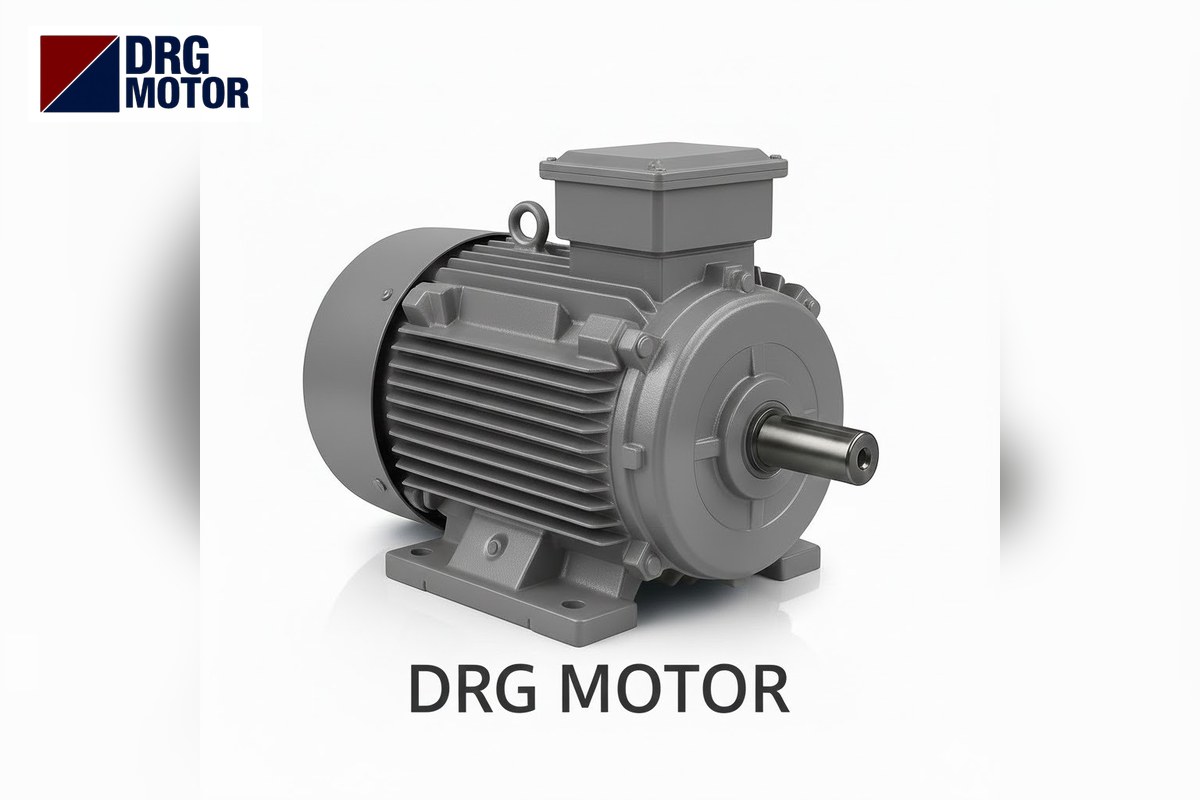

The motor people search for as a “3 kW 1400 rpm motor” is the 4-pole, 100L-frame three-phase motor coded DRG-100L2-4 in the DRG catalogue. Its nameplate does not say 1400 but 1450 rpm; on a 380 V supply it draws 6.34 A at full load and delivers 19.8 Nm of rated torque at the shaft. The aluminium and cast iron versions share identical electrical values. Product pages and current prices for both frames are listed under Buy Electric Motors Online.
“1400 rpm” is the common market name for 4-pole motors whose synchronous speed is 1500 rpm. The label comes from small motors that really do run near 1400: in our catalogue the 0.55 kW DRG-801-4 runs at exactly 1400 rpm and the 0.75 kW DRG-802-4 at 1420 rpm. As power increases, slip decreases, and at 3 kW the rated speed rises to 1450. Connecting the motor to the mains, changing terminal links or reversing rotation must always be done by a qualified electrician; the values in this article are for selection and checking.
1400 or 1450? What the nameplate number means
The magnetic field of an induction motor rotates at a speed set by supply frequency and pole count: ns = 120 × f / p = 120 × 50 / 4 = 1500 rpm. The rotor never catches up with this speed; to produce torque it has to lag slightly behind the field. The difference is called slip, and for the DRG-100L2-4 it is (1500 − 1450) / 1500 = 3.3%.
A motor of the same power actually running at 1400 rpm would be operating at 6.7% slip. Because the share of rotor losses turned into heat grows in proportion to slip, such high slip is not expected in the 3 kW class. In short, the product searched for as “3 kW 1400 rpm” and the one whose catalogue says 1450 belong to the same class; what really matters is not confusing a 4-pole motor with a 2-pole (3000 rpm) or 6-pole (1000 rpm) model. We cover the effect of pole count on the machine separately in our article on the difference between 2-pole and 4-pole motors.
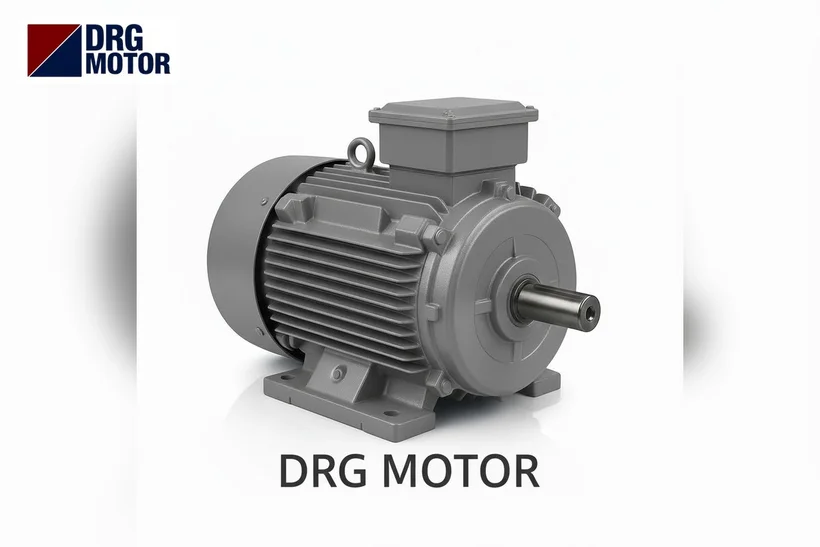
DRG-100L2-4 nameplate and catalogue data
The values below are the rated quantities shown on the motor's label and in our catalogue. This table is sufficient for panel calculations, overload settings and machine design.
| Quantity | DRG-100L2-4 |
|---|---|
| Power | 3 kW (4 HP) |
| Poles / synchronous speed | 4 poles / 1500 rpm |
| Rated speed | 1450 rpm |
| Voltage | 230/400 V (Δ/Y) — star (Y) on a 380 V supply |
| Current 380 V / 400 V / 415 V | 6.34 A / 6.02 A / 5.8 A |
| Power factor (cos φ) | 0.82 |
| Rated torque | 19.8 Nm |
| Starting torque ratio (Ts/Tn) | 2.3 |
| Breakdown torque ratio (Tmax/Tn) | 2.3 |
| Starting current ratio (Is/In) | 7.6 |
| IEC frame / shaft height | 100L / 100 mm |
| Bearing | 6206-ZZ-C3 |
| Cable entry | 1 × M25×1.5 |
| Housing material | Aluminium or cast iron |
The figures in the table confirm each other. The torque formula gives 9550 × 3 / 1450 = 19.76 Nm, consistent with the catalogue's 19.8 Nm. At start-up the motor can deliver 2.3 times rated torque, i.e. about 45.5 Nm. With direct-on-line starting, the inrush current is 7.6 × 6.34 ≈ 48 A; this peak lasts a few seconds and is taken into account when selecting fuses. The 230/400 V rating shows that the motor is connected in star on Turkey's 380–400 V grid; delta connection is only for supplies with 230 V between phases. For comparison with other ratings, our motor current chart provides a ready list.
What does a 50 rpm difference change on the machine?
If an old motor's nameplate really says 1400 and it is replaced by a DRG-100L2-4, the machine shaft will turn faster by a ratio of 1450 / 1400 = 1.036, about 3.6%. This difference is not noticeable on most drives but changes the calculation for some loads.
Fans and centrifugal pumps
For these loads, flow varies with speed, pressure with the square of speed and absorbed power with the cube of speed. A 3.6% speed increase raises pressure by about 7.3% and shaft power by about 11.1%. If the old motor was running at its limit, measure the new motor's current with a clamp meter after commissioning; at 380 V it must not exceed 6.34 A.
Geared conveyors and mixers
Output speed rises in the same proportion as motor speed. For example, with a 1/25 gearbox the old motor gives 1400 / 25 = 56 rpm and the new motor 1450 / 25 = 58 rpm; belt speed also increases by 3.6%. For a non-critical line the difference is acceptable; otherwise recheck the ratio with the gearbox output speed and torque calculator.
Belt and pulley drives
In a belt drive, the original speed can be restored by reducing the motor pulley by one size. You can find the required diameter with the pulley and belt calculator by entering a rated speed of 1450.
Choosing between aluminium and cast iron housings
Both versions of the DRG-100L2-4 have the same current, torque, speed and mounting dimensions; the difference is the housing material. The aluminium DRG-100L2-4 is lighter, which makes installation easier on flange-mounted pumps, gearbox inputs and portable machines. The cast iron DRG-100L2-4 offers a shell more resistant to impact and vibration; it is preferred for workshop, agricultural and construction machinery operating in dust, moisture and heavy-duty conditions.
To make the choice easier, ask one question: will the motor stand on a base, or will it hang from the body of a machine? On a base in a vibrating environment cast iron makes more sense; on a flange connection where weight matters, aluminium does. In both cases the shaft, foot and flange dimensions stay the same.
100L frame dimensions: foot and flange mounting
The most frequent question in replacement jobs is whether the new motor will fit the old base. When a DRG-100L2-4 replaces any IEC motor with a 100L frame, the foot holes and shaft height remain the same.
| Dimension | Meaning | mm |
|---|---|---|
| H | Shaft centre height | 100 |
| A | Distance between foot holes (transverse) | 160 |
| B | Distance between foot holes (longitudinal) | 140 |
| C | Shaft shoulder to first foot hole | 63 |
| K | Foot holes | 4–Φ12 |
| D × E | Shaft diameter × shaft length | 28 × 60 |
| F | Key width | 8 |
| AC | Housing diameter | 205.4 |
| AD | Shaft centre to top of terminal box | 166 |
| L | Overall length | 406 |
For a flange-mounted (B5) order, the 100L frame flange dimensions in our catalogue are: flange outer diameter P 250 mm, bolt circle M 215 mm, spigot diameter N 180 mm, hole diameter S 14.5 mm, spigot depth T 4 mm, flange thickness LA 13 mm. In B35 mounting, where feet and flange are ordered together, both tables apply.
Pre-order checklist
- Is the power on the old motor's nameplate really 3 kW (4 HP)? If it is 2.2 kW or 4 kW, the frame changes.
- If the nameplate speed is between 1400 and 1460, the motor is 4-pole; values close to 3000 or 1000 indicate another pole count.
- Mounting type: foot (B3), flange (B5) or both (B35).
- Does the 28 × 60 mm shaft with 8 mm key fit the pulley or coupling hub to be fitted?
- Is the supply 380–400 V three-phase? At this voltage the connection is star.
- Housing material: aluminium or cast iron depending on environment and mounting.
- If the load is a fan or pump, has the effect of the speed increase on shaft power been calculated?
Other models in the 3 kW class
If you need a different speed at the same power, or the next power step, consider these models:
- DRG-100L2-4 – 3 kW – 1450 rpm – 100L aluminium
- DRG-100L2-4 – 3 kW – 1450 rpm – 100L cast iron
- DRG-100L-2 – 3 kW – 2895 rpm – 100L aluminium
- DRG-90L-2K – 3 kW – 2895 rpm – 90L compact cast iron
- DRG-132S-6 – 3 kW – 968 rpm – 132S aluminium
- DRG-112M-4 – 4 kW – 1450 rpm – 112M aluminium
Click to see current prices and order these motors nowSEE PRICES →
Frequently Asked Questions
How many amps does a 3 kW 4-pole motor draw?
At full load the DRG-100L2-4 draws 6.34 A at 380 V, 6.02 A at 400 V and 5.8 A at 415 V. At no load and partial load the current stays below these values; with direct-on-line starting a short inrush of about 48 A occurs.
Can a 1450 rpm motor replace a 1400 rpm motor?
Yes. Both are 4-pole motors with a synchronous speed of 1500 rpm. The machine will run about 3.6% faster; on fans and pumps shaft power rises by about 11%, so measuring the new motor's current after commissioning is a sufficient check.
Is a 3 kW electric motor connected in star or delta?
The DRG-100L2-4, rated 230/400 V, is connected in star (Y) on a 380–400 V three-phase supply. Delta is used only on supplies with 230 V between phases; the connection must be made by a qualified electrician.
What is the shaft diameter of a 3 kW 1500 rpm motor?
On the 100L frame the shaft is 28 mm in diameter and 60 mm long, with an 8 mm key. Shaft height is 100 mm and the foot holes are spaced 160 × 140 mm.
DRG Motor is a manufacturer and supplier of three-phase electric motors. For questions, call +90 (542) 666 11 11, write to [email protected] or use our contact page. To see all models, browse the 120 models in our online store.