English
 Le français
 Türkçe




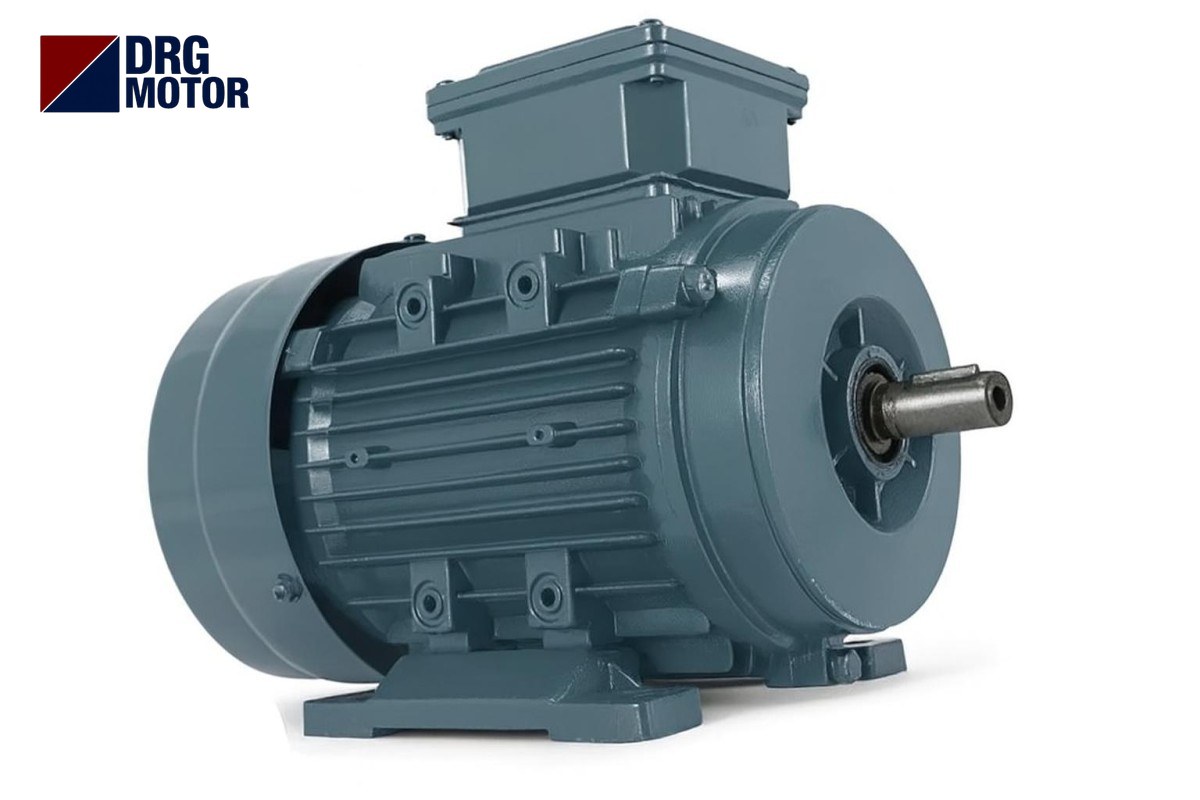

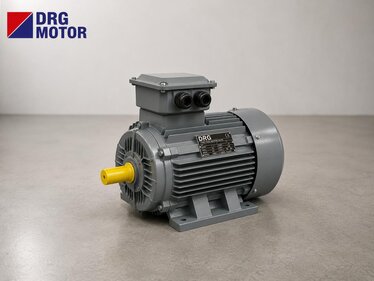
The motor asked for on the market as a “7.5 kW 1450 rpm motor” corresponds to the DRG-132M-4 in our catalogue, and its rated full-load speed is not 1450 but 1460 rpm. With a synchronous speed of 1500 rpm, the rotor turns 40 revolutions behind the field; this 2.7% slip is the price of producing 49.1 Nm of torque at the shaft. The aluminium and cast iron versions are listed on the Buy Electric Motors Online page.
Speed is not a fixed number: at no load the motor comes very close to 1500, it drops as load increases, and it only reaches the nameplate value of 1460 at full load. That is why using the rated speed on the nameplate, instead of a rounded market value such as “1450”, brings pulley, gearbox or belt-speed calculations a few revolutions closer to reality. Below we work through slip, torque and output-speed calculations step by step for this motor.
Synchronous speed, rated speed and slip
The rotating field of a four-pole stator turns at ns = 120 × 50 / 4 = 1500 rpm on a 50 Hz supply. If the rotor reached this speed, no current would be induced in its bars and no torque would be produced. Slip is calculated as follows:
s = (ns − n) / ns = (1500 − 1460) / 1500 = 0.0267 → 2.7%
The frequency of the rotor current is also proportional to slip: 0.0267 × 50 Hz ≈ 1.33 Hz. In other words, at full load a very low-frequency current, oscillating slightly more than once per second, flows in the rotor bars. The difference between the market figure of 1450 and the catalogue value of 1460 is only 10 rpm (about 0.7%); however, those 10 revolutions equal a quarter of the slip. So if the result feeds into sensitive calculations such as pulley diameter or belt speed, the correct number is 1460.
How does speed change as load decreases?
In the normal operating region, slip depends roughly linearly on load. On that assumption, the speed and torque of the DRG-132M-4 at different loads can be estimated as below. The table is an approximate calculation from rated values, not a measurement.
| Load | Shaft power | Approx. speed | Approx. torque |
|---|---|---|---|
| 25% | 1.875 kW | 1490 rpm | 12.0 Nm |
| 50% | 3.75 kW | 1480 rpm | 24.2 Nm |
| 75% | 5.625 kW | 1470 rpm | 36.5 Nm |
| 100% | 7.5 kW | 1460 rpm | 49.1 Nm |
The table has a practical consequence: the speed you measure with a tachometer roughly tells you how heavily the motor is loaded. If the shaft turns at around 1485, the motor is running below half load; if it drops clearly below 1460, overload, low voltage or mechanical binding should be investigated. In that second case the current also exceeds the rated 15.0 A at 380 V. We compared how current changes at 1500 and 3000 rpm in our article how many amps does a 7.5 kW motor draw.
Low supply voltage lowers speed too
Slip is affected not only by load but also by voltage. With constant load torque, slip varies roughly in inverse proportion to the square of voltage. Assuming the rated speed is given at 400 V, the same load at 380 V raises slip from 2.7% to about 3.0% and speed falls to around 1456. When voltage drops to 360 V, speed is about 1451. The motor then draws more current to do the same work. A “1450 rpm” reading on site is sometimes a sign not of the motor but of a weak supply line; evaluate speed readings together with a voltage measurement at the terminals.
The torque formula: 9550 × P / n
Shaft torque is calculated from power and speed: T = 9550 × P(kW) / n(rpm). For the DRG-132M-4, 9550 × 7.5 / 1460 = 49.06 Nm, the same as the catalogue's 49.1 Nm. Using the rounded market value of 1450 would give 49.40 Nm. The difference is small, but when comparing a calculated figure with the catalogue it helps to know why they differ.
The same formula also shows the starting and breakdown limits. On this model the starting torque ratio is Ts/Tn = 2.0, so the motor starts from standstill with about 98.2 Nm. With a breakdown torque ratio of Tmax/Tn = 2.3, it can momentarily handle loads up to about 112.9 Nm while running. Beyond that, speed drops sharply and the motor stalls. On machines with heavy starting (a loaded belt, a full mixer), first check whether the 98 Nm starting torque covers the load's breakaway torque.
Calculating output speed with pulleys
In a belt drive, output speed is found with n2 = n1 × d1 / d2, where d1 is the motor pulley diameter and d2 the machine pulley diameter. Torque at the output shaft increases by the same ratio as the pulleys (belt losses neglected).
| Motor pulley d1 (mm) | Machine pulley d2 (mm) | Output speed (with 1460) | Incorrect calculation with 1500 | Output torque |
|---|---|---|---|---|
| 100 | 200 | 730 rpm | 750 rpm | 98.2 Nm |
| 112 | 280 | 584 rpm | 600 rpm | 122.8 Nm |
| 125 | 400 | 456 rpm | 469 rpm | 157.1 Nm |
| 200 | 160 | 1825 rpm | 1875 rpm | 39.3 Nm |
The third and fourth columns show a common mistake: when the calculation uses synchronous speed (1500), output speed comes out about 2.7% too high at every ratio. On fans or pumps, whose power rises with the square and cube of speed, this deviation can cause the chosen pulley to overload the motor. Find pulley diameters with the pulley and belt calculator by entering a rated speed of 1460.
Output speed with a gearbox
With a gearbox the calculation is the same; the gearbox reduction ratio simply replaces the pulley ratio. For example, a 1/20 gearbox gives 1460 / 20 = 73 rpm, and the output shaft sees 49.1 × 20 = 982 Nm, excluding gearbox losses. At 1/40 the output is 36.5 rpm and ideal torque is 1964 Nm. The real value is lower by the gearbox losses. Check in the gearbox catalogue that it can withstand this torque and verify the ratio with the gearbox output speed and torque calculator. We worked through ratio selection for belt conveyors in our article on conveyor belt motor selection.
If the speed needs to change
The speed of a 4-pole motor on the mains is fixed; if a different speed is needed there are three options:
- Change the pulley or gearbox ratio: the simplest way to adjust output speed without changing the motor.
- Use a frequency inverter: speed changes in proportion to frequency. At 40 Hz, for example, synchronous speed becomes 1200 rpm. Below rated frequency the motor runs at constant torque, above it at roughly constant power. For the calculation you can use the VFD frequency-torque-power calculator.
- Choose a motor with a different pole count: 1000 rpm requires a 6-pole motor, 3000 rpm a 2-pole motor.
The DRG-132M-4 is rated 400/690 V; on a 380–400 V supply it is connected in delta (Δ) and is suitable for star-delta starting. Terminal connection and drive settings must be carried out by a qualified electrician.
Speed measurement and checklist
- Note the rated speed on the nameplate (1460 rpm) and use this value in calculations.
- Measure speed with an optical tachometer at the shaft end, after the motor has warmed up and the load has settled.
- Compare the measured speed with the load table: clearly below 1460 indicates overload or low voltage.
- Measure phase currents at the same time; at 380 V they must not exceed 15.0 A.
- Make sure synchronous speed (1500) is not used in the pulley calculation.
- Check that gearbox output torque does not exceed the gearbox rating.
- With a frequency inverter, allow for the drop in torque above rated frequency.
Motors in this power class
- DRG-132M-4 – 7.5 kW – 1460 rpm – 132M aluminium
- DRG-132M-4 – 7.5 kW – 1460 rpm – 132M cast iron
- DRG-132S2-2 – 7.5 kW – 2930 rpm – 132S aluminium
- DRG-160M-6 – 7.5 kW – 970 rpm – 160M cast iron
- DRG-132S-4 – 5.5 kW – 1460 rpm – 132S aluminium
Click to see current prices and order these motors nowSEE PRICES →
Frequently Asked Questions
What is the actual speed of a 7.5 kW 4-pole motor?
The rated full-load speed of the DRG-132M-4 is 1460 rpm. At no load it approaches 1500; “1450 rpm” is a rounded market figure used for motors in this class.
How much torque does a 7.5 kW motor produce?
Rated torque is 9550 × 7.5 / 1460 ≈ 49.1 Nm. At start-up it delivers 2.0 times that (about 98 Nm), and at the breakdown limit 2.3 times (about 113 Nm).
What is the slip of a 1450 rpm motor?
A 4-pole motor running at 1450 rpm has a slip of (1500 − 1450) / 1500 = 3.3%. The DRG-132M-4's rated slip is (1500 − 1460) / 1500 = 2.7%.
Should 1500 or 1460 be used in pulley calculations?
The rated speed of 1460 should be used. Calculating with 1500 overstates output speed by about 2.7%; for example, a 100/200 mm pulley pair gives 750 rpm instead of 730.
DRG Motor is a manufacturer and supplier of three-phase electric motors. For questions about your calculations, call +90 (542) 666 11 11, write to [email protected] or use our contact page. For other power ratings and speeds, browse the 120 models in our online store.