English
 Le français
 Türkçe




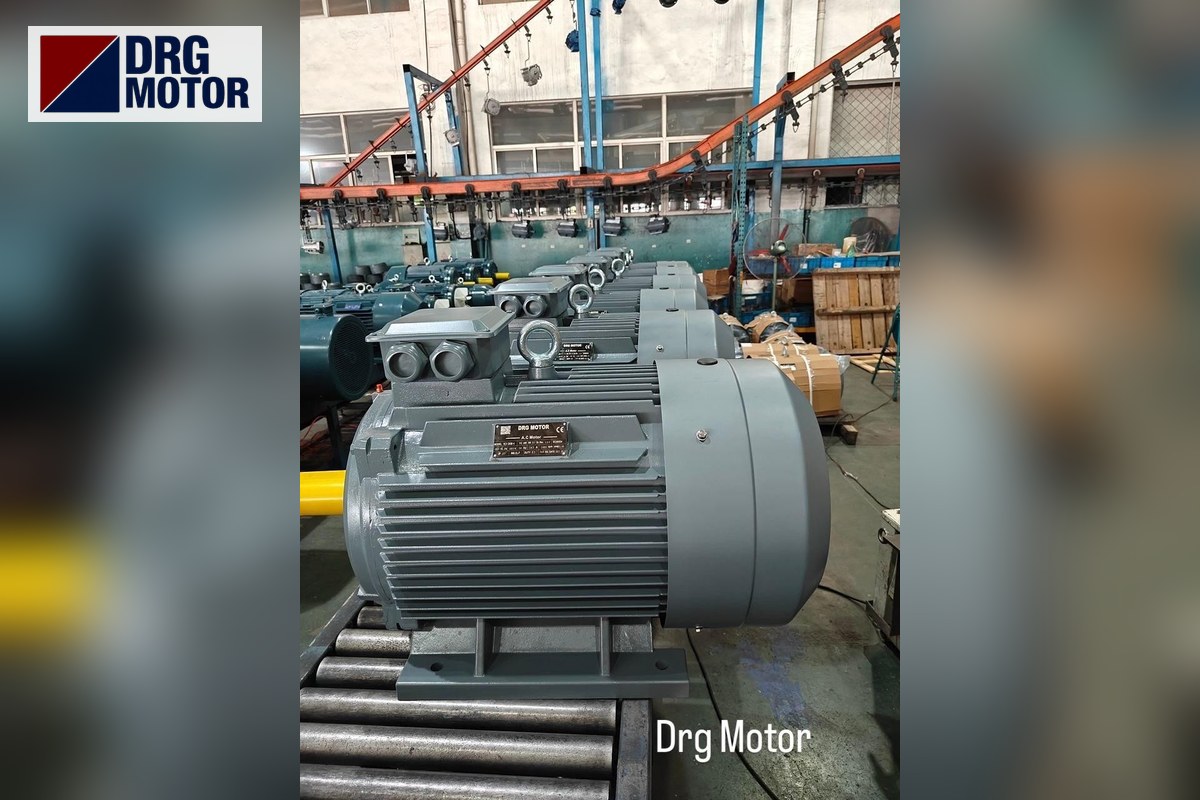

Two-pole three-phase motors of 1.5 kW and above are sold on the market as "2900 rpm", and in DRG data their plate speeds live up to the name: 2895 at 1.5–3 kW, 2905 at 4 kW, 2930 at 5.5–7.5 kW, 2945 at 11–15 kW, 2955 at 22 kW and 2975 rpm at 75 kW. The only exception is the 18.5 kW 160L frame, which at 2940 rpm sits slightly behind the previous step. Synchronous speed is 3000 rpm in every case.
The main fields of use for these motors are centrifugal pumps, fire-fighting and booster sets, centrifugal fans, compressors and high-speed machine tools. High speed delivers the same power from a smaller frame with lower torque; in return, bearings, noise and balance matter more than on 4-pole motors. Alongside the table, this article focuses on those three topics.
Each listed model has its own product page in the Buy Electric Motors Online category.
Rated speed, bearing and shaft of 1.5–75 kW 2-pole motors
| Model | kW | Frame | Rated speed | Ts/Tn | Bearing | Shaft D×E (mm) | Shop |
|---|---|---|---|---|---|---|---|
| DRG-90S-2 | 1.5 | 90S | 2895 rpm | 2.2 | 6205-ZZ-C3 | 24×50 | See Prices |
| DRG-90L-2 | 2.2 | 90L | 2895 rpm | 2.2 | 6205-ZZ-C3 | 24×50 | See Prices |
| DRG-100L-2 | 3 | 100L | 2895 rpm | 2.2 | 6206-ZZ-C3 | 28×60 | See Prices |
| DRG-112M-2 | 4 | 112M | 2905 rpm | 2.2 | 6206-ZZ-C3 | 28×60 | See Prices |
| DRG-132S1-2 | 5.5 | 132S | 2930 rpm | 2 | 6208-ZZ-C3 | 38×80 | See Prices |
| DRG-132S2-2 | 7.5 | 132S | 2930 rpm | 2 | 6208-ZZ-C3 | 38×80 | See Prices |
| DRG-160M1-2 | 11 | 160M | 2945 rpm | 2 | 6309-C3 | 42×110 | See Prices |
| DRG-160M2-2 | 15 | 160M | 2945 rpm | 2 | 6309-C3 | 42×110 | See Prices |
| DRG-160L-2 | 18.5 | 160L | 2940 rpm | 2 | 6309-C3 | 42×110 | See Prices |
| DRG-180M-2 | 22 | 180M | 2955 rpm | 2 | 6311-C3 | 48×110 | See Prices |
| DRG-200L1-2 | 30 | 200L | 2960 rpm | 2 | 6312-C3 | 55×110 | See Prices |
| DRG-200L2-2 | 37 | 200L | 2960 rpm | 2 | 6312-C3 | 55×110 | See Prices |
| DRG-225M-2 | 45 | 225M | 2965 rpm | 2 | 6313-C3 | 55×110 | See Prices |
| DRG-250M-2 | 55 | 250M | 2970 rpm | 2 | 6314-C3 | 60×140 | See Prices |
| DRG-280S-2 | 75 | 280S | 2975 rpm | 1.8 | 6314-C3 | 65×140 | See Prices |
Up to 11 kW every rating comes in aluminium and cast iron housings, from 15 kW in cast iron only. At 3 kW there is also the compact DRG-90L-2K, which fits a 90L frame instead of 100L; its speed and current match the standard model (2895 rpm).
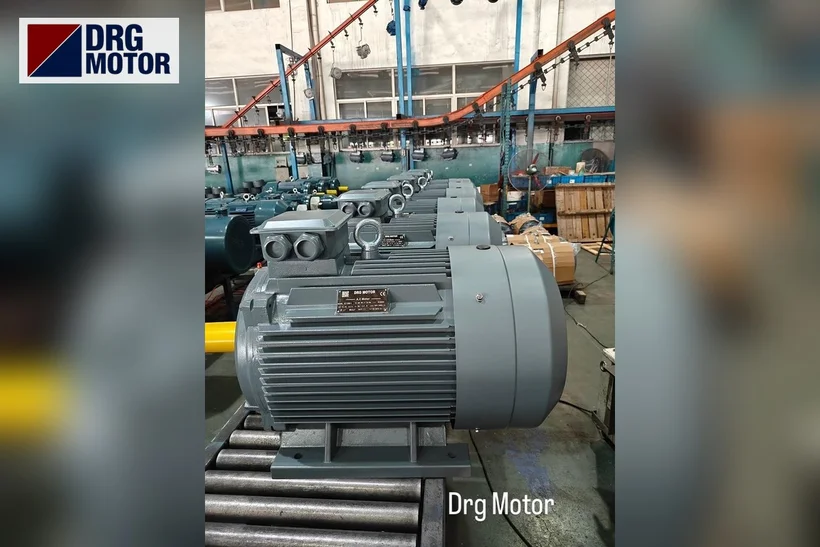
Why does speed approach 2975 as power rises?
Slip shrinks in a large motor: a motor running 3.5% below synchronous speed at 1.5 kW lags by 1.5% at 22 kW and 0.83% at 75 kW. The low resistance of a large rotor means less speed loss at the same proportional load. That is why load changes barely move the speed of a large 2-pole motor; pump or fan flow stays steady as long as supply frequency is constant.
The starting torque ratio (Ts/Tn) moves the other way: 2.2 up to 4 kW, 2.0 between 5.5 and 55 kW, 1.8 at 75 kW. Since centrifugal pumps and fans need little torque at low speed these ratios are sufficient; but if a large 2-pole motor is to drive a machine that is heavily loaded at start, such as a loaded belt or a piston compressor, check the starting condition separately.
Bearings and shaft at high speed: why is a 2-pole motor different?
The speed a bearing can carry falls as its diameter grows. That is why, on large frames, 2-pole motors use smaller bearings and thinner shafts than their 4-pole siblings on the same frame. Three examples from DRG data:
| Frame | 2-pole: shaft D | 4-pole: shaft D | 2-pole: bearing | 4-pole: bearing |
|---|---|---|---|---|
| 225M | 55 mm | 60 mm | 6313-C3 | 6313-C3 |
| 250M | 60 mm | 65 mm | 6314-C3 | 6314-C3 |
| 280S | 65 mm | 75 mm | 6314-C3 | 6317-C3 |
Torque is another reason for the thinner shaft: at the same power a 2-pole motor delivers about half the torque. At 11 kW the DRG-160M1-2 gives 35.7 Nm, the 4-pole DRG-160M-4 71.7 Nm. Practical consequence: from frame 225M upward the shaft size of 2-pole and 4-pole motors differs, so coupling and pulley hubs are not interchangeable.
Practices that protect bearing life at high speed
In the 3000 rpm class the main causes of bearing damage are misalignment, excessive belt tension and incorrect grease quantity. Up to frame 132, ZZ (shielded) bearings are greased for life; from frame 160 open C3 bearings are used and the regreasing interval must be followed. In a belt drive, a small pulley with high tension puts the greatest load on the drive-end bearing; on pumps and fans a direct coupling is preferred wherever possible.
Noise and vibration: what to watch at 2900 rpm
In a 2-pole motor the cooling fan and rotor turn twice as fast; air noise and the vibration caused by a small imbalance are clearly greater than on a 4-pole motor. Vibration frequency equals rotational speed: about 49 Hz at 2955 rpm. If this frequency is close to the natural frequency of the base or frame the motor sits on, resonance occurs and noise rises sharply.
The remedies are simple: mount the motor on a rigid, flat base; check coupling alignment with a dial indicator; make sure the pump or fan impeller is balanced; support pipework so it does not load the motor-pump unit. In booster rooms near dwellings, anti-vibration mounts and flexible pipe connectors reduce noise transmission.
How to size a 2900 rpm motor for a pump
The power a centrifugal pump demands at the shaft is P = ρ × g × Q × H / pump efficiency. Example: for a pump with Q = 60 m³/h, H = 40 m and pump efficiency 0.7, hydraulic power is 1000 × 9.81 × (60 / 3600) × 40 = 6.54 kW and shaft power 6.54 / 0.70 = 9.34 kW. The next standard rating is 11 kW; the DRG-160M1-2 suits this pump.
Pump curves are usually drawn for 2900 rpm. Because the DRG motor turns at 2945 rpm, the operating point shifts slightly to the right on the curve; flow and head come out a little higher than the curve value. To try the figures with your own pump use the pump and fan motor power calculator, and if you plan to lower speed with a frequency inverter, the VFD frequency, torque and power calculator. For motor selection specific to centrifugal fans see our article on centrifugal fan motor selection.
Installation checklist for a 2900 rpm motor
- Compare the speed on the pump/fan curve with the motor rated speed; the difference changes flow and power demand.
- From frame 225M upward the shaft of a 2-pole motor is smaller than a 4-pole one: choose the coupling hub accordingly.
- Align the coupling with a dial indicator; at high speed even a small misalignment wears the bearing.
- On frame 160 and above (open C3 bearings) put the regreasing interval in the maintenance plan.
- The base must be rigid and flat; reinforce it if there are signs of resonance (noise rising at a particular speed).
- 4 kW and above are wound for 400/690 V: delta (Δ) or star-delta starting on a 400 V supply; the connection must be made by a qualified electrician.
Technical factors that set the price of 2900 rpm motors
The main price factors are power, IEC frame (from 90S to 280S), housing material (aluminium or cast iron up to 11 kW, cast iron above), mounting arrangement (B3, B5, B35) and protection class. A compact frame option exists at 3 kW. Current prices are listed on each product page and among the 120 models in our online shop.
Motors in this power range
- DRG-90L-2 – 2.2 kW – 2895 rpm – 90L
- DRG-112M-2 – 4 kW – 2905 rpm – 112M
- DRG-132S2-2 – 7.5 kW – 2930 rpm – 132S
- DRG-160M1-2 – 11 kW – 2945 rpm – 160M
- DRG-180M-2 – 22 kW – 2955 rpm – 180M
- DRG-200L1-2 – 30 kW – 2960 rpm – 200L
Click to see current prices and order these motors nowSEE PRICES →
Frequently Asked Questions
How many poles does a 2900 rpm motor have?
Two. Synchronous speed at 50 Hz is 3000 rpm; on DRG's 1.5–75 kW models the plate speed is between 2895 and 2975 rpm.
How many amps does a 2900 rpm 11 kW motor draw?
DRG-160M1-2 draws 20.6 A at 380 V and 19.6 A at 400 V; its starting current ratio is 8.1.
Is a 2900 rpm motor noisier than a 1450 rpm motor?
Generally yes: because fan and rotor turn twice as fast, air noise and vibration are more noticeable. A rigid base, correct alignment and a balanced impeller reduce the difference considerably.
Is it a problem if the pump curve is for 2900 rpm and the motor turns at 2945 rpm?
No, but flow, head and power demand rise slightly. Leave a small margin when sizing the motor power.
If you would like to choose the right 2-pole model for your pump or fan together, call +90 (542) 666 11 11, write to [email protected] or use our contact page. All models are on the Buy Electric Motors Online page.