English
 Le français
 Türkçe

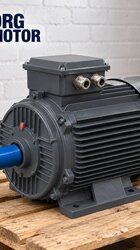

A 15 kW, 1500 rpm (4-pole) three-phase motor draws 28.8 A at 380 V; with the 1.25 factor this becomes a 36.0 A design current, and the smallest copper cable in the table that carries it is 6 mm² (43 A). For an 11 kW 4-pole motor, 21.5 A → 26.9 A lands on 4 mm² (34 A). Using the rule of the calculator on our site, the example gG fuse that rides through the starting surge is 63 A for the 15 kW 4-pole motor and 40 A for the 11 kW 4-pole motor. These are example figures for a run of roughly 30 m, a single circuit and about 30 °C ambient; an electrical engineer should confirm them for the installation method, grouping and ambient temperature.
Both values change with three things: the number of poles (at the same power a 6-pole motor draws more current), the cable length (voltage drop can push the size up) and how the fuse and the cable fit together. The third point is what sets this article apart: a larger fuse prevents nuisance tripping at start-up, but once the fuse is bigger, the question becomes which device protects the cable. You can see the full nameplate data and motor options model by model on the Buy Electric Motors Online page.
We covered the motor current and the starting current in detail in how many amps does a 15 kW motor draw; here we turn that current into a cable size and a fuse rating.
How Many Amps Do 11 and 15 kW Motors Draw? Starting Values for the Calculation
Cable and fuse sizing starts from the rated current (In) on the nameplate, not from an estimate based on power. The table below lists the 380 V and 400 V currents and the starting current of 2-, 4- and 6-pole 11 and 15 kW motors. Starting current is calculated as Is = In × (Is/In).
| Model | Power | Rated speed | cos φ | In 380 V | In 400 V | Is/In | Starting current Is (380 V) |
|---|---|---|---|---|---|---|---|
| DRG-160M1-2 | 11 kW | 2945 rpm | 0.89 | 20.6 A | 19.6 A | 8.1 | ≈ 166.9 A |
| DRG-160M-4 | 11 kW | 1465 rpm | 0.85 | 21.5 A | 20.4 A | 7.7 | ≈ 165.6 A |
| DRG-160L-6 | 11 kW | 970 rpm | 0.8 | 23.1 A | 22.0 A | 7.2 | ≈ 166.3 A |
| DRG-160M2-2 | 15 kW | 2945 rpm | 0.89 | 27.9 A | 26.5 A | 8.1 | ≈ 226.0 A |
| DRG-160L-4 | 15 kW | 1465 rpm | 0.86 | 28.8 A | 27.3 A | 7.8 | ≈ 224.6 A |
| DRG-180L-6 | 15 kW | 978 rpm | 0.81 | 30.9 A | 29.3 A | 7.3 | ≈ 225.6 A |
Two conclusions follow from the table. First, at the same power the current rises as speed falls: at 15 kW the 2-pole motor draws 27.9 A and the 6-pole motor 30.9 A. Second, the starting current is 7 to 8 times the rated current, and this is the value that drives fuse selection. All these motors are rated 400/690 V (Δ/Y); on a 380 V network they are connected in delta. For the currents of other ratings you can use the motor current chart tool.
What Cable Size Does a 15 kW Motor Need?
The first step is current-carrying capacity: calculate the design current Id = In × 1.25 and choose the smallest size whose rating in the table is equal to or greater than that figure. For a 15 kW 4-pole motor: 28.8 A × 1.25 = 36.0 A. A 4 mm² cable carries 34 A in the table, so it is not enough; 6 mm² carries 43 A and is the first suitable size.
| Motor | In (380 V) | Design current (×1.25) | Smallest size | Cable current rating |
|---|---|---|---|---|
| 11 kW 2-pole | 20.6 A | 25.8 A | 4 mm² | 34 A |
| 11 kW 4-pole | 21.5 A | 26.9 A | 4 mm² | 34 A |
| 11 kW 6-pole | 23.1 A | 28.9 A | 4 mm² | 34 A |
| 15 kW 2-pole | 27.9 A | 34.9 A | 6 mm² | 43 A |
| 15 kW 4-pole | 28.8 A | 36.0 A | 6 mm² | 43 A |
| 15 kW 6-pole | 30.9 A | 38.6 A | 6 mm² | 43 A |
The subtle case is the 15 kW 2-pole motor: its 34.9 A design current exceeds the 34 A rating of 4 mm² by only 0.9 A. That small gap invites the comment "4 mm² will do", but the table value applies to a single circuit at 30 °C; if the cable is grouped with others in a trunking or runs through a hot roof space, its capacity falls. Since the motor does not use a neutral, the run is 3 phases + protective earth (PE); the typical description for 15 kW is a 4×6 mm² cable. To try your own values, use the motor cable size calculator.
Does Voltage Drop on a 30, 60 or 120 m Run Change the Cable Size?
The size found from current is sufficient for short runs. As the run gets longer, voltage is lost in the cable resistance, so the second check is voltage drop. Formula: ΔU = √3 × I × (L/1000) × R × cos φ, and as a percentage %ΔU = ΔU / U × 100. Example: 15 kW 4-pole motor, 60 m, 6 mm² (R = 3.08 Ω/km): ΔU = 1.732 × 28.8 × 0.06 × 3.08 × 0.86 ≈ 7.93 V, i.e. 2.09% of 380 V.
| Motor and cable size | 30 m | 60 m | 120 m |
|---|---|---|---|
| 11 kW 4-pole – 4 mm² | 4.38 V (1.15%) | 8.76 V (2.30%) | 17.51 V (4.61%) |
| 11 kW 4-pole – 6 mm² | 2.92 V (0.77%) | 5.85 V (1.54%) | 11.70 V (3.08%) |
| 11 kW 4-pole – 10 mm² | 1.74 V (0.46%) | 3.48 V (0.91%) | 6.95 V (1.83%) |
| 15 kW 4-pole – 6 mm² | 3.96 V (1.04%) | 7.93 V (2.09%) | 15.86 V (4.17%) |
| 15 kW 4-pole – 10 mm² | 2.36 V (0.62%) | 4.71 V (1.24%) | 9.42 V (2.48%) |
| 15 kW 4-pole – 16 mm² | 1.48 V (0.39%) | 2.96 V (0.78%) | 5.92 V (1.56%) |
The general limit used in the calculator for the supply run is 3%. With that limit, 4 mm² is enough up to about 78 m and 6 mm² up to about 116 m for the 11 kW 4-pole motor; for the 15 kW 4-pole motor, 6 mm² is enough up to about 86 m and 10 mm² up to about 145 m. On a 120 m run both ratings need 10 mm²; at 11 kW, 6 mm² overshoots the limit slightly at 3.08%.
What Fuse Rating Does an 11 or 15 kW Motor Need?
A motor fuse is chosen for the starting surge, not for the rated current. A 15 kW 4-pole motor draws about 224.6 A for a few seconds at start-up; a 32 A fuse may blow during that surge. That is why the overload relay, fuse and contactor selection tool on our site suggests a gG fuse of roughly 1.6–2 times In for direct-on-line starting; the calculation takes 1.75 × In and rounds up to the next standard fuse rating.
| Motor | In (380 V) | 1.6 × In | 2 × In | Tool's example gG rating | Starting current Is |
|---|---|---|---|---|---|
| 11 kW 2-pole | 20.6 A | 33.0 A | 41.2 A | 40 A | ≈ 166.9 A |
| 11 kW 4-pole | 21.5 A | 34.4 A | 43.0 A | 40 A | ≈ 165.6 A |
| 11 kW 6-pole | 23.1 A | 37.0 A | 46.2 A | 50 A | ≈ 166.3 A |
| 15 kW 2-pole | 27.9 A | 44.6 A | 55.8 A | 50 A | ≈ 226.0 A |
| 15 kW 4-pole | 28.8 A | 46.1 A | 57.6 A | 63 A | ≈ 224.6 A |
| 15 kW 6-pole | 30.9 A | 49.4 A | 61.8 A | 63 A | ≈ 225.6 A |
This table is an example calculation, not a definitive value. Whether a fuse blows at start-up depends on the starting time and the fuse's time-current curve, so the final rating must be checked against the fuse manufacturer's device tables. aM (motor protection) fuses withstand starting better and can be chosen closer to In. If a miniature circuit breaker is used, the curve type matters: a 40 A type B breaker trips instantly between 120 and 200 A, and the ~165 A starting current of an 11 kW motor falls right into that band. If you experience unexplained tripping at start-up, go through the checks in why an electric motor trips the fuse.
Cable and Fuse Coordination: Which Device Protects the Cable?
When you increase the fuse, an often overlooked situation appears: in the 15 kW 4-pole example the cable is 6 mm², rated 43 A, while the fuse is 63 A. That fuse does not protect the cable against overload; under a sustained 50 A load the fuse will not blow, but the cable will heat up. In motor circuits the task is shared:
- Overload protection: provided by the overload relay or motor protection circuit breaker set to the motor's rated current (28.8 A). Since this setting is below the cable rating (43 A), the cable is protected indirectly as well.
- Short-circuit protection: the fuse's job. The fuse must clear the fault current fast enough to avoid damaging the cable; this is verified by comparing the fuse's breaking characteristic with the cable's short-time withstand.
- If there is no overload relay: when the run is protected by the fuse alone, the cable must be sized to the fuse, i.e. the cable rating must be equal to or greater than the fuse rating.
Sizes chosen by the last rule grow noticeably: a 40 A fuse needs 6 mm² (43 A), a 50 A fuse needs 10 mm² (60 A) and a 63 A fuse needs 16 mm² (80 A). In practice, when the motor circuit is built with an overload relay plus fuse, the size chosen from current can be used; on a socket or sub-board feeder protected only by a fuse, the cable is enlarged to match the fuse.
How Do Cable Size and Fuse Change with Star-Delta Starting?
Since 11 and 15 kW motors run in delta at 380 V, they are suitable for star-delta starting. In that case two separate 3-core cable sets run to the motor, and each set carries the winding current, i.e. In/√3. For the 15 kW 4-pole motor that is 28.8 / 1.732 ≈ 16.6 A, with a design current of ≈ 20.8 A, so by current-carrying capacity 2.5 mm² (25 A) per set appears sufficient; check voltage drop separately on long runs. In this arrangement the overload relay is set to In/√3 ≈ 16.6 A, not to In. The fuse, however, sits ahead of the contactors and sees the line current, so it does not change: it is still chosen from the motor line current and starting behaviour.
Checklist Before Panel Assembly
- Read the rated current In on the motor nameplate; calculate from the nameplate, not from a power-based estimate.
- Check the nameplate voltage: a 400/690 V motor is connected in delta on a 380 V network.
- Find the design current with In × 1.25 and pick the size from the cable table.
- Measure the run length; calculate voltage drop for runs over 60 m.
- Note where the cable is grouped in trunking or passes through hot areas; derating is done by an engineer's calculation.
- Choose a fuse that carries the starting current and confirm it with the manufacturer's time-current curve.
- Set the overload relay to In (In/√3 with star-delta); confirm that the relay provides overload protection for the cable.
- Compare the terminal box cable entry (2 × M40×1.5 on these models, 2 × M32×1.5 on the compact 132-frame model) with the cable outer diameter.
11 and 15 kW Motor Options
- DRG-160M1-2 – 11 kW – 3000 rpm – cast iron 160M frame
- DRG-160M-4 – 11 kW – 1500 rpm – cast iron 160M frame
- DRG-132M-4K – 11 kW – 1500 rpm – compact aluminium 132M frame
- DRG-160M2-2 – 15 kW – 3000 rpm – cast iron 160M frame
- DRG-160L-4 – 15 kW – 1500 rpm – cast iron 160L frame
- DRG-180L-6 – 15 kW – 1000 rpm – cast iron 180L frame
Click to see current prices and order these motors nowSEE PRICES →
For other power, speed and frame options, browse the 120 models in our online shop.
Frequently Asked Questions
What size cable do I need for a 15 kW motor?
A 15 kW 4-pole motor draws 28.8 A at 380 V; with the 1.25 factor, the 36.0 A design current calls for a 6 mm² copper cable (43 A). On runs beyond about 86 m, move up to 10 mm² to stay within the 3% voltage drop limit. Grouping and ambient temperature derating should be done by an electrical engineer.
What fuse rating does an 11 kW motor need?
The rated current of an 11 kW 4-pole motor is 21.5 A and its starting current is about 165.6 A. For direct-on-line starting, a gG fuse is chosen at roughly 1.6–2 times In; the tool's example calculation gives 40 A. Confirm the exact rating in the fuse manufacturer's device table.
Can a 15 kW motor run on a 4 mm² cable?
It is not recommended. The design current is 34.9 A for the 2-pole model and 36.0 A for the 4-pole model, and both exceed the 34 A rating of 4 mm². Even if the cable seems fine for a short time, it heats up under sustained load and in a hot environment.
Why is a motor fuse larger than the motor current?
Because the motor draws 7 to 8 times its rated current for a few seconds at start-up. The fuse must carry that surge yet open quickly on a short circuit. Overload protection is provided not by the fuse but by an overload relay set to the motor current.
For help choosing an 11 or 15 kW motor and sizing its cable and fuse, call us on +90 (542) 666 11 11, write to [email protected] or use our contact page.