English
 Le français
 Türkçe




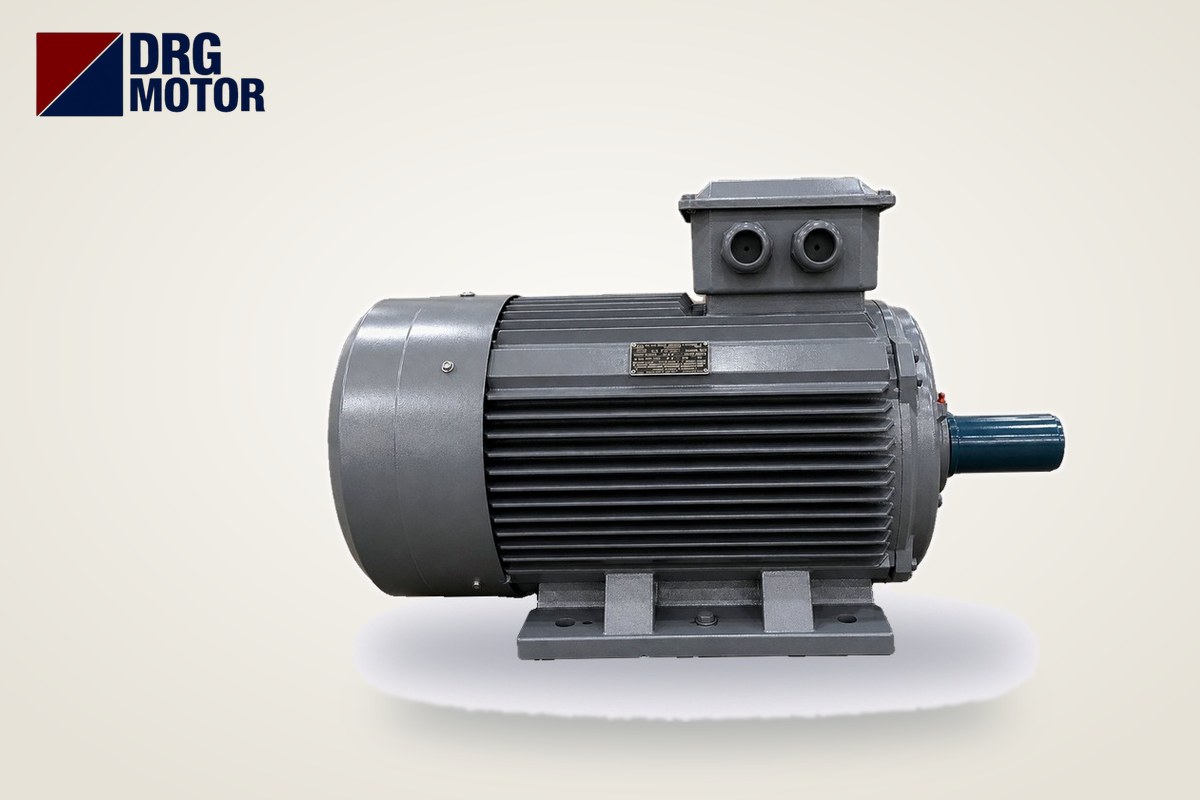

A 15 kW, 1500 rpm three-phase motor draws about 28.8 A at full load on a 380 V supply; at 400 V the figure is 27.3 A. At the same power, the 3000 rpm motor draws 27.9 A and the 1000 rpm motor 30.9 A. With direct-on-line starting, the current at the moment of starting rises to 7.8 times this value: about 224.6 A for the 1500 rpm model. With star-delta starting, this peak line current theoretically falls to one third, about 74.9 A.
The nameplate current applies when the motor delivers the full 15 kW at the shaft. If the motor is lightly loaded, the measured current falls; if the supply voltage is low, it rises; and because cos φ decreases as the number of poles increases, the current at the same power goes up. Panel design needs both values: the rated current (In) for the overload relay and cable, and the starting current (Is) for the circuit breaker, fuses, generator and transformer.
All current, cos φ and torque values in this article are taken from the technical data of the 15 kW cast iron motors listed on our Buy Electric Motors Online page; you can repeat the calculations with your own motor's nameplate values using the same method.
Rated and Starting Current of a 15 kW Motor: 2, 4 and 6 Pole Table
In the table below, In is the nameplate current and Is is the current drawn at the moment of direct-on-line starting, calculated as Is = In × (Is/In). All three motors have 400/690 V windings and are connected in delta (Δ) on a 380–400 V supply.
| Model | Synchronous speed | Rated speed | cos φ | In 380 V | In 400 V | Is/In | Is 380 V (calculated) | Rated torque |
|---|---|---|---|---|---|---|---|---|
| DRG-160M2-2 | 3000 rpm | 2945 rpm | 0.89 | 27.9 A | 26.5 A | 8.1 | ≈ 226.0 A | 48.6 Nm |
| DRG-160L-4 | 1500 rpm | 1465 rpm | 0.86 | 28.8 A | 27.3 A | 7.8 | ≈ 224.6 A | 97.8 Nm |
| DRG-180L-6 | 1000 rpm | 978 rpm | 0.81 | 30.9 A | 29.3 A | 7.3 | ≈ 225.6 A | 146.5 Nm |
The notable point is that the starting currents of the three models are very close to each other (226.0 A, 224.6 A and 225.6 A). The 6-pole motor has a higher rated current but a lower Is/In ratio; in the end, the peak load placed on the supply is roughly the same. Rated torque, however, increases markedly as speed decreases: 97.8 Nm for the 1500 rpm motor.
Checking with the Formula: Where Does the 28.8 A on the Nameplate Come From?
In a three-phase motor, line current is found with I = P / (√3 · U · cos φ · η). Here P is shaft power (W), U is line voltage (V), and η is the factor stated on the motor nameplate that gives the ratio between shaft power and the electrical power drawn from the supply. Reversing the formula is more instructive: electrical power drawn from the supply Pel = √3 · U · I · cos φ.
- For DRG-160L-4: √3 × 380 V × 28.8 A × 0.86 ≈ 16.30 kW is drawn from the supply.
- The power delivered at the shaft is 15 kW; the difference of about 1.30 kW is winding, iron and friction losses and turns into heat.
- Apparent power: √3 × 0.38 kV × 28.8 A ≈ 19.0 kVA. For generator or transformer sizing, this kVA value is used, not kW.
When the voltage changes, current changes in inverse proportion. Moving the 28.8 A at 380 V to 400 V gives 28.8 × 380 / 400 ≈ 27.36 A, consistent with the 27.3 A in the catalogue. To compare different power ratings quickly, you can use our motor current chart page.
How Is Starting Current Calculated?
Starting current is the current drawn at the instant power is first applied to a stationary motor. The catalogue does not give it directly in amps but as the Is/In ratio. The calculation is a single line:
Is = In × (Is/In) = 28.8 A × 7.8 ≈ 224.6 A (380 V, DRG-160L-4). On a 400 V supply, the same calculation gives 27.3 × 7.8 ≈ 212.9 A.
This current falls quickly as the motor picks up speed and drops to the nameplate current as it approaches rated speed. How long starting takes depends more on the load than on the motor: a fan running unloaded reaches speed quickly, while a machine with a heavy flywheel or a full mixer draws starting current for longer. If you are curious about the physics of why starting current is so high, see our article why is the starting current of an electric motor high; here we focus only on the numbers.
Effect of Direct-On-Line Starting on the Supply
With direct-on-line starting (DOL), the motor sees full supply voltage the moment the contactor closes. For a 15 kW motor, this briefly means an apparent power of about √3 × 0.38 kV × 224.6 A ≈ 147.9 kVA, 7.8 times the 19.0 kVA of normal operation. On site, the consequences look like this:
- Voltage dip: On a long or undersized supply line, voltage drops at the moment of starting; lighting on the same line flickers and sensitive devices may reset.
- Generator supply: If the generator cannot supply the starting kVA, voltage and frequency collapse and the motor cannot reach speed. When choosing a generator, look at the starting kVA, not the rated kVA.
- Protective devices: The motor protection circuit breaker or fuse must not trip at a starting current of around 224.6 A, yet must protect the motor at a running current of around 28.8 A. The overload relay is set to the nameplate current (28.8 A).
- Mechanical shock: Starting torque is 2.2 times rated torque (about 215.2 Nm); the coupling, belt and gearbox take this shock at every start.
In a plant close to a strong transformer with infrequent starts, direct-on-line starting of a 15 kW motor usually causes no problem. With a weak line, a generator or frequent starts, you should switch to one of the methods below; also check your distribution company's connection conditions.
Why Does Starting Current Fall to One Third with Star-Delta Starting?
DRG 15 kW motors have 400/690 V windings; that is, their running connection on a 380–400 V supply is delta, and they are suitable for star-delta starting. At start, the windings are connected in star. Each winding then sees 1/√3 of the delta voltage, so the winding current also falls to 1/√3. In delta, the line current is √3 times the winding current, whereas in star the line current equals the winding current. Multiplying the two effects, the starting current drawn from the line becomes 1/√3 × 1/√3 = 1/3.
- Direct-on-line starting: ≈ 224.6 A
- Star-delta, star stage: ≈ 224.6 / 3 ≈ 74.9 A
The price is torque: torque falls by the same ratio. The starting torque of the DRG-160L-4 is about 215.2 Nm, falling to about 71.7 Nm in star. For a fan, pump or empty conveyor starting unloaded, this is sufficient; on a machine that starts loaded, the motor may fail to reach speed in star, and a high current surge occurs at the changeover to delta. The changeover should be made when the motor approaches its rated speed. For the contactor arrangement and timer relay setting, you can use our star-delta starting tool.
Soft Starter and Frequency Drive: A Brief Comparison
Soft starter
It ramps the voltage from a value close to zero up to supply voltage and holds the current at a set limit. Torque falls roughly with the square of the current. Example: if the current limit is set to 3 times In, i.e. 86.4 A, the starting torque becomes about 215.2 × (86.4 / 224.6)² ≈ 31.8 Nm. This is a rough approximation, but it shows why setting the current limit too low leaves the motor unable to reach speed.
Frequency drive (inverter)
Because it lowers frequency together with voltage, the motor can produce torque close to rated torque at start with a current close to rated current. It is the method with the lowest starting surge and also provides speed control. When choosing a drive, look at current, not the kW rating: the drive's rated output current must not be less than the motor's nameplate current of 28.8 A (380 V).
Checklist Before Energising a 15 kW Motor
- Is the nameplate voltage 400/690 V? On a 380–400 V supply the terminal links must be in delta (Δ); in a star-delta panel the links are removed and all six ends are taken to the panel.
- Does the overload relay have a range that includes 28.8 A (27.3 A at 400 V), and is it set to the nameplate current?
- Does the circuit breaker or fuse have a characteristic that will not trip at the starting current of around 224.6 A?
- Has the cable size been checked for line length and installation conditions with the motor cable size calculator?
- Cable entry: the 160 frame has 2 × M40×1.5 gland positions; are the correct glands and blanking plugs ready?
- If supplied by a generator, can the starting kVA (≈ 147.9 kVA with direct-on-line starting) be supplied?
- At first start-up, was the current of all three phases measured with a clamp meter? A clear difference between phases points to a supply or connection problem.
Motors at This Power
The three cast iron 15 kW models in our store:
- DRG-160M2-2 – 15 kW – 3000 rpm – 160M cast iron
- DRG-160L-4 – 15 kW – 1500 rpm – 160L cast iron
- DRG-180L-6 – 15 kW – 1000 rpm – 180L cast iron
Click to see current prices and order these motors nowSEE PRICES →
To see other powers and speeds, browse the 120 models in our online store.
Frequently Asked Questions
How many amps does a 15 kW motor draw?
At 380 V and full load, the 1500 rpm model draws 28.8 A, the 3000 rpm model 27.9 A and the 1000 rpm model 30.9 A. At 400 V the values are 27.3 A, 26.5 A and 29.3 A respectively.
How many amps does a 15 kW motor draw in star-delta?
In the star stage, the starting current drawn from the line is one third of that with direct-on-line starting: 224.6 / 3 ≈ 74.9 A for the 1500 rpm motor. After switching to delta and reaching speed, the current rises with load up to the nameplate value of 28.8 A.
What should the overload relay of a 15 kW motor be set to?
The overload relay is set to the motor's nameplate current: 28.8 A for the 1500 rpm model at 380 V. If, in a star-delta panel, the overload relay is connected in the winding branch, the setting is 1/√3 of the nameplate current; check where the relay is connected.
How many amps does a 15 kW motor draw at no load?
No-load current is not given in the catalogue and varies from motor to motor; it is clearly lower than rated current but does not fall in proportion to shaft power, because magnetising current is drawn even without load. For this reason, deriving a load percentage from a no-load measurement is misleading; the real comparison should be made under load against the nameplate current.
For technical information on 15 kW motor selection, starting method or panel design, you can reach us on +90 (542) 666 11 11 or at [email protected], use our contact page, or order directly from the Buy Electric Motors Online page.