English
 Le français
 Türkçe




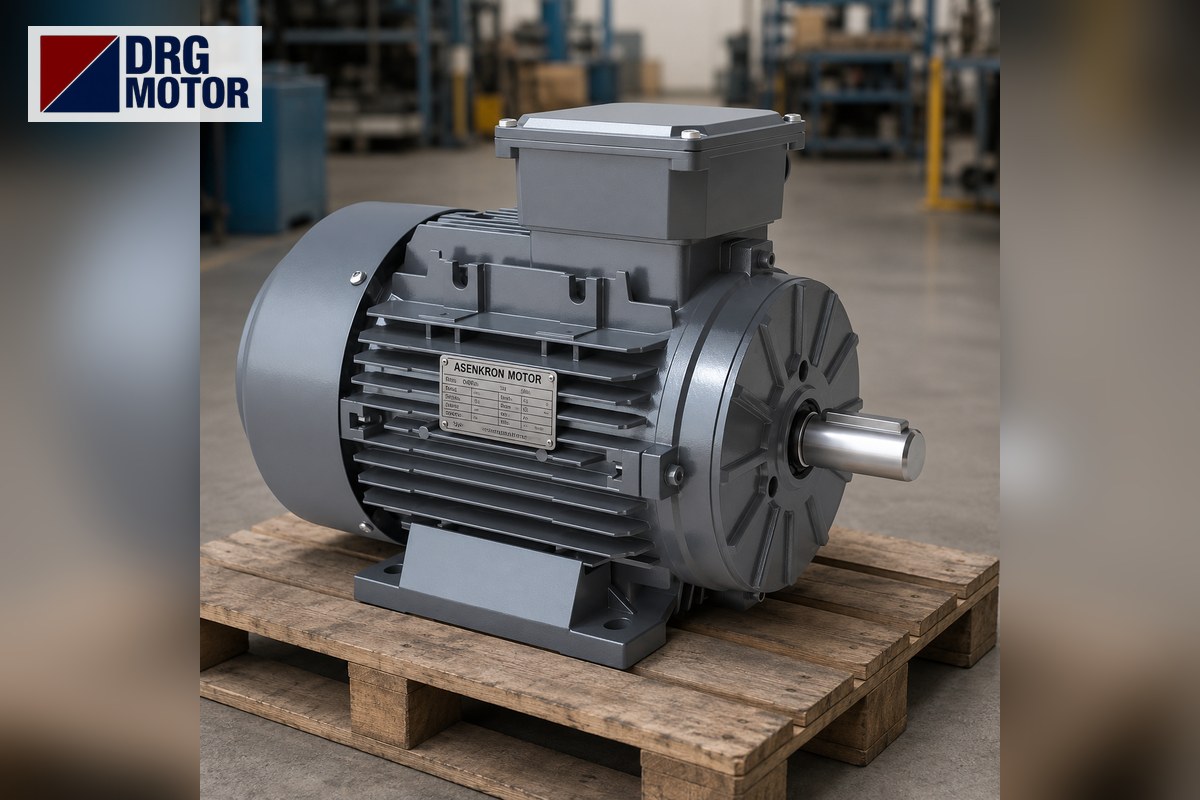

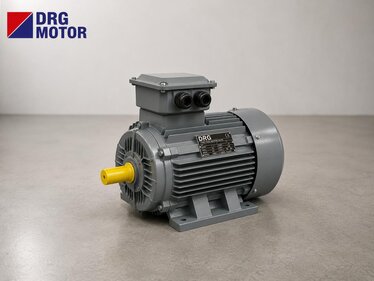
Short answer: in the 10 HP (7.5 kW), 3000 rpm class DRG's model is the DRG-132S2-2. This 2-pole motor in a 132S frame runs at 2930 rpm at full load, draws 13.7 A at 400 V and produces 24.4 Nm of torque at the shaft. That torque is roughly half of what a 1500 rpm motor of the same power delivers; 3000 rpm is therefore for loads that want speed rather than torque: centrifugal pumps, high-pressure fans, directly coupled generators and grinding spindles.
If your load is a slow-running mechanism that starts heavily (conveyor, mixer, crusher), this motor is the wrong choice; the same 7.5 kW should be taken in a 4-pole frame. To see all power and speed options on one screen, use the Buy Electric Motors Online page.
Which loads need 3000 rpm? Decision table
Speed selection starts with the driven machine, not with the motor. If the machine's own operating speed is around 2900, the motor is coupled directly; otherwise a pulley or gearbox is needed in between, and every intermediate element means losses, maintenance and alignment work.
| Load type | Is 3000 rpm suitable? | Reason |
|---|---|---|
| Single-stage centrifugal pump | Yes | The impeller is designed for around 2900; direct coupling |
| High-pressure centrifugal fan | Yes | Pressure rises with the square of speed; high pressure from a small impeller |
| Grinding / sanding spindle | Yes | Peripheral speed is directly proportional to rpm |
| Belt conveyor, screw conveyor | No | Needs high torque and low speed; the gearbox ratio grows |
| Mixer, feed mixer | No | Loaded shaft at start; 24.4 Nm rated torque is borderline |
| Piston compressor | Usually no | The compressor head mostly runs at low speed via belts |
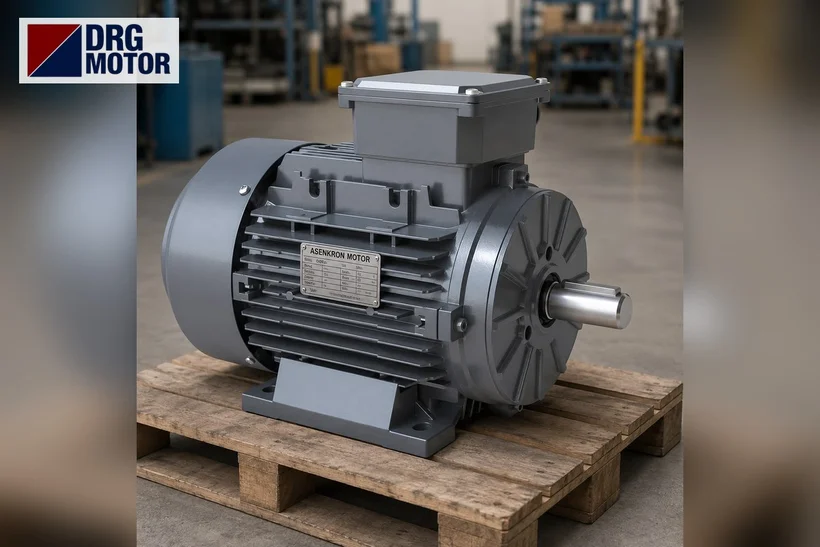
DRG-132S2-2 catalogue values
The values come from the DRG catalogue; electrical and dimensional values are the same for the aluminium and cast iron versions.
Electrical
- Power: 7.5 kW / 10 HP, 2 poles, synchronous 3000 rpm, rated 2930 rpm
- Winding voltage 400/690 V; on 380–400 V networks the terminals are linked in delta
- Rated current: 14.4 A at 380 V · 13.7 A at 400 V · 13.2 A at 415 V
- cos φ: 0.88
- Starting current ratio Is/In: 7.9 (about 108 A at 400 V with direct-on-line start)
Mechanical
- Rated torque 24.4 Nm; starting ratio Ts/Tn 2.0; breakdown ratio Tmax/Tn 2.3
- Bearing: 6208-ZZ-C3 · Cable entry: 2 × M32×1.5
- Shaft: 38 × 80 mm, key 10 mm · Shaft height H: 132 mm
The torque value is confirmed by calculation: 9550 × 7.5 / 2930 ≈ 24.4 Nm. Slip is (3000 − 2930) / 3000 ≈ 2.3%. You can see what the current means for cabling and protection in the overload, fuse and contactor selection tool.
Same 7.5 kW, two different torques: 2930 and 1460 rpm side by side
Since power = torque × speed, halving the speed doubles the torque. The table below shows this difference using DRG's two 7.5 kW models:
| Value | DRG-132S2-2 (2-pole) | DRG-132M-4 (4-pole) |
|---|---|---|
| Rated speed | 2930 rpm | 1460 rpm |
| Rated torque | 24.4 Nm | 49.1 Nm |
| Starting torque (Ts/Tn × Tn) | ≈ 48.8 Nm | ≈ 98.2 Nm |
| Current, 400 V | 13.7 A | 14.3 A |
| cos φ | 0.88 | 0.84 |
| Is/In | 7.9 | 7.5 |
| IEC frame / overall length L | 132S / 438 mm | 132M / 476 mm |
| Foot spacing B | 140 mm | 178 mm |
Two practical conclusions follow. First, because the 2-pole motor has a higher cos φ, it draws slightly less current at the same power. Second, the frame is shorter: the 3000 rpm motor fits in a 132S frame while the 1500 rpm motor needs a 132M. If you put this model in place of an old 4-pole motor, the foot holes will not line up (140 mm instead of 178 mm for B). To avoid repeating our article on how many amps a 7.5 kW motor draws, which covers the current difference in detail, we deal only with the torque side here.
Power calculation for a centrifugal pump: is 7.5 kW enough?
The power the pump asks for at its shaft follows from P = ρ · g · Q · H / ηp (ηp: pump efficiency, read from the pump maker's curve). Example: 60 m³/h flow, 30 m head, pump efficiency 0.70.
- Q = 60 / 3600 = 0.0167 m³/s
- P = 1000 × 9.81 × 0.0167 × 30 / 0.70 ≈ 7.0 kW
A shaft power of 7.0 kW is close to the limit of a 7.5 kW motor; in a system that drifts to the right of the pump curve (higher flow, lower head) the motor may be overloaded. In that case the next size up, the 11 kW DRG-160M1-2, should be considered. The pump and fan motor power calculator is ready for your own values.
If you drove the same pump at 1500 rpm
According to the affinity laws, flow is proportional to speed, head to the square of speed and power to the cube of speed. With a speed ratio of 1460 / 2930 ≈ 0.50, the same pump gives about 30 m³/h flow, 7.5 m head and 0.87 kW power. In other words, a pump selected for 3000 rpm drops to a quarter of the required head when driven by a 4-pole motor; the pump sets the speed, not the motor.
Points to watch in fan applications
In fans, 3000 rpm gives high pressure with a small impeller diameter; in return, peripheral speed, noise and sensitivity to imbalance also increase. Points to watch on this model:
- If the fan impeller is mounted directly on the motor shaft, the shaft is 38 × 80 mm and the key 10 mm; the impeller hub must be machined accordingly.
- Impeller imbalance at 2930 rpm causes far greater bearing load than at 1460 rpm; balance the impeller before mounting the motor.
- For a flanged fan housing, the B5 flange of the 132 frame applies: P 300, M 265, N 230, S 14.5 mm.
- In ducted systems, starting with the damper closed reduces the starting load on the fan motor.
For the general logic of power and speed selection for centrifugal fans, see our article on scroll fan motor selection.
132S frame dimensions: a quick reference before ordering
Dimensions for foot (B3) mounting: shaft height H 132 mm, transverse foot spacing A 216 mm, longitudinal foot spacing B 140 mm, shaft shoulder to foot hole C 89 mm, foot holes 4–Φ12, frame diameter AC 258.4 mm, shaft axis to top of terminal box AD 203 mm, overall length L 438 mm. B5 flange is used for flanged pump housings, and B35 mounting is preferred when combined with a foot base. Technical drawings are available on the motor technical drawings page.
Selection checklist
- Is the speed required on the machine's (pump/fan) nameplate around 2900?
- Does the pump shaft power stay below 7.5 kW even at the far right of the operating point?
- Is the shaft loaded at start? If so, are 24.4 Nm rated and ≈ 48.8 Nm starting torque enough?
- 400 V supply: delta connection, overload setting about 13.7 A.
- Has the ≈ 108 A drawn at 400 V on direct-on-line start been allowed for on the panel and transformer side?
- If the old motor was a 132M, has the foot spacing difference (140 / 178 mm) been resolved on the base?
- If there is outdoor exposure, humidity or vibration, has a cast iron housing been chosen?
Motors at this power
- DRG-132S2-2, 7.5 kW, 2-pole at 2930 rpm, 132S aluminium
- DRG-132S2-2, 7.5 kW, 2-pole at 2930 rpm, 132S cast iron
- DRG-132M-4, 7.5 kW, 4-pole at 1460 rpm, 132M cast iron (for torque-hungry loads)
- DRG-160M1-2, 11 kW, 2-pole at 2945 rpm, 160M cast iron (next pump size up)
Click to see current prices and order these motors nowSEE PRICES →
As an electric motor manufacturer and supplier, DRG Motor offers every power step of the 2-pole series with full catalogue values; browse them on the 120-model online store page.
Frequently Asked Questions
How many amps does a 10 HP 3000 rpm motor draw?
The DRG-132S2-2 draws 13.7 A at 400 V, 14.4 A at 380 V and 13.2 A at 415 V at full load. When switched straight onto the line the current jumps to about 7.9 times the rated value.
Can a 3000 rpm motor do the same job as a 1500 rpm motor?
Not at the same power: a 7.5 kW motor gives 24.4 Nm at 3000 rpm and 49.1 Nm at 1500 rpm. If the motor speed is not matched to the load, pump pressure drops or a slow load fails to start.
Which frame is a 7.5 kW 2-pole motor?
At DRG the 7.5 kW 2-pole motor uses the 132S frame; shaft 38 × 80 mm, shaft height 132 mm, overall length 438 mm.
What rpm motor is fitted to a centrifugal pump?
The speed written on the pump's nameplate; most single-stage centrifugal pumps are designed for around 2900 and are coupled directly to a 2-pole motor.
Send a photo of the pump nameplate or fan drawing to [email protected] or call +90 (542) 666 11 11; other channels are listed on the contact page.