English
 Le français
 Türkçe

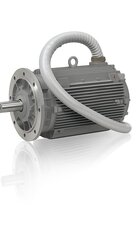
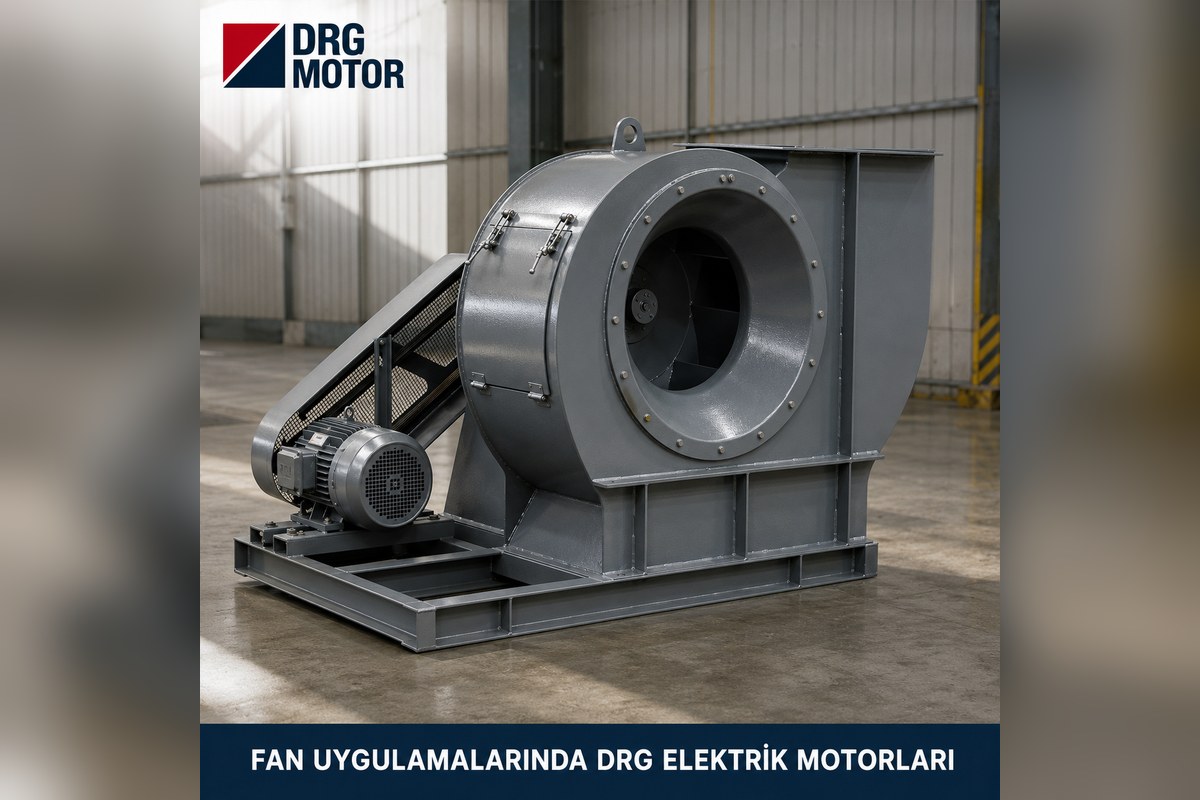

The motor power for a centrifugal (snail-shell or radial) fan is found from the fan's airflow and pressure with P = Q × Δp / η_fan, plus a safety margin that depends on the fan type; the speed is chosen to match the speed the impeller was designed for: direct-drive small and medium fans mostly use 2-pole motors (≈3000 rpm), while large-diameter and belt-driven fans use 4-pole motors (≈1500 rpm). For example, a dust extraction fan that needs 5400 m³/h at 2200 Pa absorbs about 4.71 kW of shaft power; with the margin, a 5.5 kW DRG-132S1-2 with a rated speed of 2930 rpm is sufficient.
This result is not fixed: if the same impeller turns faster, airflow rises in proportion to speed, pressure with the square of speed and absorbed power with the cube of speed. That is why even a small change in pulley ratio can overload the motor; conversely, a fan with a restricted duct or a throttled damper runs below its nameplate power. When selecting the motor, have the operating point supplied by the fan manufacturer at hand (airflow, static pressure, fan speed and fan efficiency).
Below we work through the calculation step by step for three different centrifugal fans and explain the speed and mounting decisions. You can find models that match your result, along with current prices, among the 120 three-phase models on our Buy Electric Motors Online page.
What kind of load is a centrifugal fan for the motor?
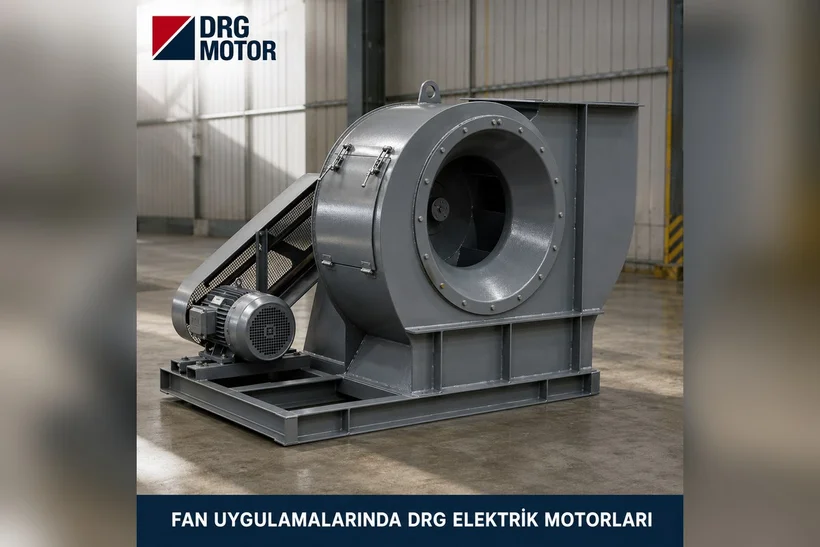
The snail-shell fan takes its name from its spiral housing. Air enters through the inlet on the impeller axis, is accelerated between the blades by centrifugal action, is converted into pressure in the volute housing and leaves through the outlet on the circumference. Forward-curved impellers deliver high airflow at low pressure and are found in kitchen hoods and air handling units; backward-curved and radial-blade impellers produce higher pressure and are used in dust and chip extraction lines, boilers and drying ovens.
Three characteristics matter for the motor:
- Load torque rises with the square of speed. At start the fan demands almost no torque; torque climbs quickly as the rated speed is approached. The starting torque of an induction motor is therefore rarely a problem for a fan; the real issue is the inertia of a heavy impeller.
- Power falls as airflow falls. When the outlet damper of a centrifugal fan is throttled, absorbed power decreases; the minimum is reached with the damper closed. The starting strategy is based on this.
- The operating point depends on the system. Duct length, filter loading and damper position determine the real airflow; motor power is calculated for that point.
How do you calculate radial fan motor power?
The power the fan gives to the air is airflow multiplied by the total pressure rise. The power drawn from the motor shaft is this value divided by the fan efficiency:
P (kW) = Q (m³/s) × Δp (Pa) / (η_fan × 1000)
- Q: airflow. Fan catalogues usually give m³/h; divide by 3600 to convert to m³/s.
- Δp: total pressure rise at the operating point (Pa) — the sum of duct, filter, cyclone and hood losses.
- η_fan: fan efficiency. It varies with impeller type and operating point; do not guess it, take it from the fan manufacturer's curve.
The result is the shaft power. A safety margin is added on top: the operating point can shift as filters clog or ducts change, and belt losses and changes in air density also need allowance. Oversizing is not right either; an induction motor running at low load has a lower power factor (cos φ) and needs more compensation. To try the calculation yourself, use our pump and fan motor power calculator.
Three worked examples: from kitchen hood to boiler fan
Example 1 – Small kitchen hood fan
Airflow 2160 m³/h = 0.6 m³/s, pressure 500 Pa, fan efficiency given by the fan manufacturer 0.60. Shaft power = 0.6 × 500 / (0.60 × 1000) = 0.50 kW. For small fans the margin is kept a little wider; multiplying by 1.25 gives 0.63 kW. The next standard rating is 0.75 kW: for this fan, whose impeller is mounted directly on the motor shaft, the 80 frame DRG-801-2 with a rated speed of 2880 rpm is suitable. Its rated current at 400 V is 1.64 A.
Example 2 – Medium dust (workshop chip) extraction fan
Airflow 5400 m³/h = 1.5 m³/s, pressure 2200 Pa, fan efficiency 0.70. Shaft power = 1.5 × 2200 / (0.70 × 1000) = 4.71 kW; with a 1.15 margin, 5.42 kW. The choice is the 5.5 kW 2-pole DRG-132S1-2: rated speed 2930 rpm, current at 400 V 10.1 A, cos φ 0.88. When the result is very close to a standard rating, ask the fan manufacturer to confirm the operating point again; pressure can rise as the filter bags fill.
Example 3 – Large boiler (combustion air) fan
Airflow 21600 m³/h = 6.0 m³/s, pressure 3200 Pa, fan efficiency 0.78. Shaft power = 6.0 × 3200 / (0.78 × 1000) = 24.6 kW; with a 1.15 margin, 28.3 kW. For a fan of this size with a heavy impeller, the 4-pole 30 kW DRG-200L-4 (200L cast iron frame, 1475 rpm, 53.8 A at 400 V) is selected. Four poles keep the tip speed of a large impeller within reasonable limits and allow direct drive without belts.
The table below summarises the models that stand out in these examples and in similar centrifugal fan applications, with catalogue values:
| Model | Power (kW) | Rated speed (rpm) | Frame | Current at 400 V (A) | cos φ | Is/In | Shaft Ø×length (mm) | Order |
|---|---|---|---|---|---|---|---|---|
| DRG-801-2 | 0.75 | 2880 | 80 aluminium | 1.64 | 0.82 | 7 | 19×40 | See Prices |
| DRG-90S-2 | 1.5 | 2895 | 90S aluminium | 3.06 | 0.84 | 7.6 | 24×50 | See Prices |
| DRG-112M-4 | 4 | 1450 | 112M aluminium | 7.95 | 0.82 | 7.8 | 28×60 | See Prices |
| DRG-132S1-2 | 5.5 | 2930 | 132S aluminium | 10.1 | 0.88 | 8.3 | 38×80 | See Prices |
| DRG-132S-4 | 5.5 | 1460 | 132S aluminium | 10.7 | 0.83 | 7.9 | 38×80 | See Prices |
| DRG-132S2-2 | 7.5 | 2930 | 132S aluminium | 13.7 | 0.88 | 7.9 | 38×80 | See Prices |
| DRG-160M-4 | 11 | 1465 | 160M cast iron | 20.4 | 0.85 | 7.7 | 42×110 | See Prices |
| DRG-180L-4 | 22 | 1470 | 180L cast iron | 39.7 | 0.86 | 7.8 | 48×110 | See Prices |
| DRG-200L-4 | 30 | 1475 | 200L cast iron | 53.8 | 0.86 | 7.3 | 55×110 | See Prices |
Fan laws: 2-pole, 4-pole or pulley drive?
For the same impeller, when speed (n) changes, three quantities change at different rates: Q ∝ n, Δp ∝ n², P ∝ n³. This relationship drives two decisions.
Number of poles. The motor must run at the speed the impeller was designed for. If a small impeller designed for a 2-pole motor is driven by a 4-pole motor, airflow halves and pressure drops to a quarter; the reverse is dangerous for both impeller and motor, because the power demand rises eightfold. Large-diameter impellers run at low speed, i.e. with 4 (or if needed 6) poles, because of mechanical limits and noise.
Belt drive or direct drive? With direct drive the fan speed equals the motor's rated speed, with no belt maintenance or losses. A belt drive lets you set the fan speed to a value other than 3000 or 1500 rpm, at the cost of belt tensioning and bearing load. For the pulley ratio, see our pulley and belt calculator.
Example: a fan running at 1450 rpm through pulleys from a 4 kW 4-pole DRG-112M-4 absorbs 3.6 kW of shaft power when measured. If the fan speed is raised to 1600 rpm with a new pulley for more suction, the ratio is 1.103: airflow rises 1.10 times, pressure 1.22 times and power 1.34 times. The new power is 3.6 × 1.34 ≈ 4.84 kW, which exceeds the 4 kW motor. This change should only be made by replacing the motor with the 5.5 kW DRG-132S-4.
Mounting: B3 foot, B5 flange and shaft size
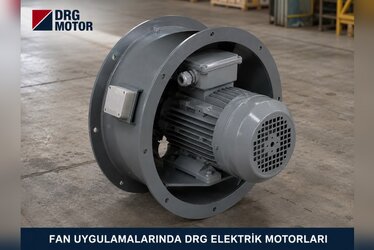
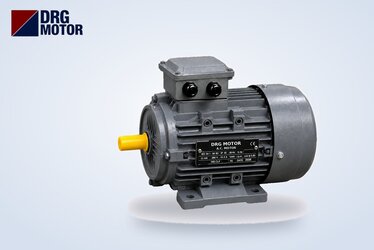
Two mounting arrangements are common on centrifugal fans. A B3 (foot-mounted) motor sits horizontally on a base; it is preferred for belt-driven fans and layouts where heavy impellers have their own bearings. A B5 (large flange) motor is bolted to a flange on the fan housing and the impeller is fitted directly onto the motor shaft; this is common on compact hood and extraction fans. For applications that need both feet and flange, there is the B35 arrangement.
The impeller hub bore must match the motor shaft diameter, and the flange on the fan housing must match the motor flange dimensions. Catalogue dimensions of the motors in the examples:
| Model | IEC frame | Shaft height H (mm) | Shaft D×E (mm) | Key F (mm) | B5 flange outer Ø P (mm) | Bolt circle M (mm) | Spigot N (mm) | Flange hole S (mm) |
|---|---|---|---|---|---|---|---|---|
| DRG-801-2 | 80 | 80 | 19×40 | 6 | 200 | 165 | 130 | 12 |
| DRG-112M-4 | 112M | 112 | 28×60 | 8 | 250 | 215 | 180 | 14.5 |
| DRG-132S1-2 | 132S | 132 | 38×80 | 10 | 300 | 265 | 230 | 14.5 |
| DRG-200L-4 | 200L | 200 | 55×110 | 16 | 400 | 350 | 300 | 18.5 |
For dusty extraction lines, outdoor roof fans and boiler rooms, IP55 protection against dust and water jets is the level generally specified. Check the terminal box position and cable entry (e.g. 2 × M32×1.5 for DRG-132S1-2) against the layout of the fan housing.
Starting: damper closed, current under control
Because a centrifugal fan absorbs minimum power at zero airflow, it is started with the outlet or inlet damper closed; the damper is opened once the motor reaches rated speed. If it starts with the damper open, the motor has to carry the full air load while accelerating the heavy impeller, the run-up time lengthens and the overload protection may trip.
Starting current is read from the Is/In ratio in the catalogue. For DRG-200L-4 the rated current at 400 V is 53.8 A and Is/In is 7.3; with direct-on-line starting the inrush is about 393 A. Since this motor is rated 400/690 V (Δ/Y), it runs in delta on a 400 V supply and is suitable for star-delta starting; in star the starting current falls to about one third, ≈131 A. Small motors rated 230/400 V (Δ/Y) (e.g. DRG-801-2), on the other hand, are connected in star at 400 V, so star-delta cannot be used. For details, see our star-delta starting page.
Pre-order checklist for a centrifugal fan motor
- Operating point from the fan manufacturer: airflow (m³/h), total pressure (Pa), fan speed and fan efficiency.
- Has P = Q × Δp / η_fan been calculated and a safety margin added?
- Is the fan speed compatible with the motor's number of poles (direct drive), or has the pulley ratio been calculated?
- Mounting: B3 foot, B5 flange or B35; does the flange size match the fan housing?
- Do the shaft diameter and length match the impeller hub, and has the key size been checked?
- Supply voltage and connection: a 230/400 V motor runs in star at 400 V, a 400/690 V motor in delta.
- Starting method: direct-on-line, star-delta or drive; is a closed-damper start possible?
- Environment: dust, humidity, hot air, outdoor; protection degree and terminal box orientation.
What determines the price of a centrifugal fan motor?
The technical factors that set the price of a fan motor are power (kW), number of poles, frame material (aluminium or cast iron), IEC frame size and mounting arrangement (B3, B5, B35). So first fix the power and speed with the calculation above, then choose the model. Models that match the calculation:
- DRG-801-2 – 0.75 kW – 2880 rpm – 80 aluminium
- DRG-90S-2 – 1.5 kW – 2895 rpm – 90S aluminium
- DRG-132S1-2 – 5.5 kW – 2930 rpm – 132S aluminium
- DRG-132S-4 – 5.5 kW – 1460 rpm – 132S aluminium
- DRG-160M-4 – 11 kW – 1465 rpm – 160M cast iron
- DRG-180L-4 – 22 kW – 1470 rpm – 180L cast iron
- DRG-200L-4 – 30 kW – 1475 rpm – 200L cast iron
Click to see current prices and order these motors nowSEE PRICES →
For the full range of powers and speeds, browse the 120 models in our online shop. Our article on pump and fan motor selection for data center cooling also offers useful context.
Frequently Asked Questions
What speed should a centrifugal fan motor have?
It should run at the speed the impeller was designed for. Direct-drive small and medium fans use 2-pole motors (e.g. DRG-801-2: 2880 rpm), large-diameter or heavy-impeller fans use 4-pole motors (e.g. DRG-200L-4: 1475 rpm). Intermediate speeds are obtained with pulleys or a drive.
How many kW motor does a radial fan need?
Power is set by airflow and pressure: P = Q × Δp / η_fan. For example, an extraction fan with 5400 m³/h and 2200 Pa needs about 4.71 kW of shaft power and runs on a 5.5 kW motor with margin. Choosing power from fan diameter alone, without airflow and pressure, gives wrong results.
If I increase the fan speed, will the motor still cope?
Usually not, because power rises with the cube of speed. Raising speed by about one tenth increases power 1.34 times. Calculate the new power before changing pulleys; if it exceeds the motor rating, choose the next size up.
Why does a centrifugal fan trip the overload relay on start-up?
The most common cause is starting with the damper open: the motor accelerates the heavy impeller while carrying the full air load, and run-up takes longer. Start with the damper closed, check the overload setting against the nameplate current, and use star-delta or a drive for larger powers.
To determine the right motor together using your fan data, call us on +90 (542) 666 11 11, write to [email protected] or use our contact page.