English
 Le français
 Türkçe




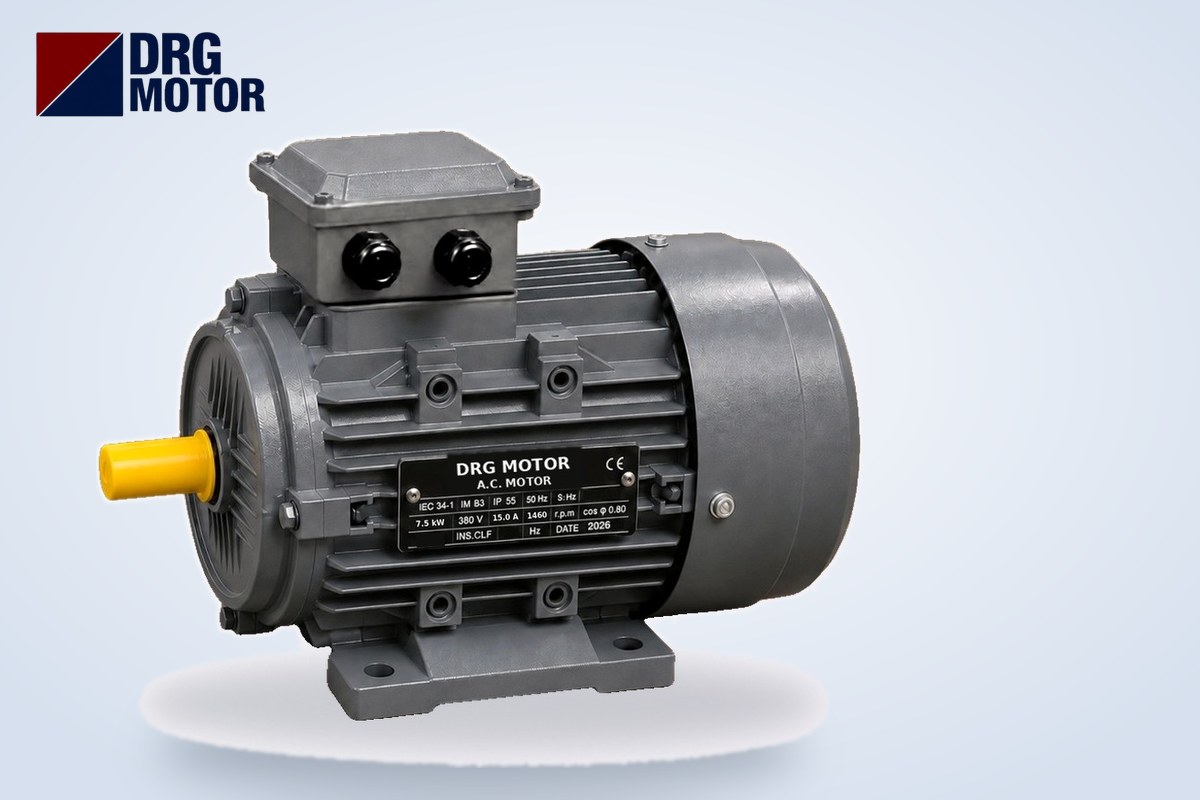

A 7.5 kW (10 HP) three-phase induction motor draws 14.4 A at 3000 rpm, 15.0 A at 1500 rpm and 16.2 A at 1000 rpm on a 380 V supply at full load; on a 400 V supply the same motors draw 13.7 A, 14.3 A and 15.4 A. In other words, the 1500 rpm motor draws only 0.6 A more than the 3000 rpm one, yet delivers almost twice the shaft torque: 49.1 Nm instead of 24.4 Nm.
The difference does not come from power but from the motor's magnetising demand. As the number of poles rises, cos φ falls from 0.88 to 0.84 and 0.79, and the part of the current that does no work and only builds the magnetic field grows. All values below are nameplate data of the 7.5 kW models in our Buy Electric Motors Online store. Aluminium and cast iron versions share the same electrical values; they differ only in frame material.
All our 7.5 kW models at the three speeds are wound for 400/690 V and are connected in delta (Δ) on a 380–400 V supply. To compare the currents of other ratings, use our motor current chart tool.
7.5 kW motor current table: 2, 4 and 6 poles
| Model | Poles / synchronous speed | IEC frame | Rated speed | Current at 380 V | Current at 400 V | cos φ | Rated torque | Is/In |
|---|---|---|---|---|---|---|---|---|
| DRG-132S2-2 | 2 / 3000 rpm | 132S | 2930 rpm | 14.4 A | 13.7 A | 0.88 | 24.4 Nm | 7.9 |
| DRG-132M-4 | 4 / 1500 rpm | 132M | 1460 rpm | 15.0 A | 14.3 A | 0.84 | 49.1 Nm | 7.5 |
| DRG-160M-6 | 6 / 1000 rpm | 160M | 970 rpm | 16.2 A | 15.4 A | 0.79 | 73.8 Nm | 7.0 |
The current in the table is the rated (nameplate) current: the motor draws it at nameplate voltage, rated load and rated speed. The frame also changes with speed: the 3000 and 1500 rpm models come in frame 132 (shaft 38×80 mm), the 1000 rpm model in frame 160M (shaft 42×110 mm). So when you replace a 1500 rpm motor with a 1000 rpm one, remember that the foot dimensions and the shaft diameter change as well as the current.
Why does current rise with the number of poles at the same 7.5 kW?
Think of the motor current in two parts. The active component (I·cos φ) covers the work on the shaft and the losses; the reactive component (I·sin φ) only builds the magnetic field between stator and rotor. Since all three models deliver the same 7.5 kW, the active component is almost identical; what changes is the reactive part.
| Model | In (380 V) | cos φ | Active component I·cos φ | Reactive component I·sin φ | Power drawn from the grid √3·U·I·cos φ |
|---|---|---|---|---|---|
| DRG-132S2-2 | 14.4 A | 0.88 | 12.7 A | 6.8 A | 8.34 kW |
| DRG-132M-4 | 15.0 A | 0.84 | 12.6 A | 8.1 A | 8.29 kW |
| DRG-160M-6 | 16.2 A | 0.79 | 12.8 A | 9.9 A | 8.42 kW |
The table makes the result clear: the active component stays within 12.6–12.8 A on all three models, while the reactive component rises from 6.8 A to 8.1 A and 9.9 A. With more poles, proportionally more magnetising current is needed to build the field across the same air gap; that is why cos φ drops and why the total current rises.
To check this with the formula, take the 1500 rpm model: √3 × 380 V × 15.0 A × 0.84 ≈ 8.29 kW. The motor draws about 8.29 kW from the grid and delivers 7.5 kW to the shaft; the difference is winding, iron, friction and fan losses. On all three models the power drawn is around 8.3–8.4 kW, so a 6-pole motor drawing more current does not mean it consumes more energy; it means the cable and contactor carry more current.
Speed and torque: why does 1500 rpm give twice the torque at the same power?
Power is the product of torque and speed. Rated torque T (Nm) = 9550 × P (kW) / n (rpm):
- 3000 rpm: 9550 × 7.5 / 2930 ≈ 24.4 Nm
- 1500 rpm: 9550 × 7.5 / 1460 ≈ 49.1 Nm
- 1000 rpm: 9550 × 7.5 / 970 ≈ 73.8 Nm
The calculated values match the nameplate torques. The difference between synchronous and rated speed (slip) also gives a clue about the load: 70 rpm on the 3000 rpm model, 40 rpm on the 1500 rpm model and 30 rpm on the 1000 rpm model. As the load decreases, the motor approaches synchronous speed; if the speed you measure with a tachometer falls below rated speed, the motor may be overloaded.
In practice the choice depends on the machine: centrifugal pumps and fans want 3000 rpm directly; geared conveyors, mixers and crushers that need high torque use 1500 or 1000 rpm. To size power, speed and gearbox ratio together on a conveyor, see our article on conveyor belt motor selection. Trying to drive the same machine with fewer poles (for example 3000 instead of 1500 rpm) lowers the current but does not provide the torque the machine needs.
How to interpret current measured with a clamp meter
The most common question on site is: "The motor draws 11 A, is that normal?" To answer it you must read the measured current together with the nameplate In and the supply voltage at that moment.
- Measure while the motor is running, on each of the three phases separately; the clamp must enclose only one conductor.
- Measure the line-to-line voltage at the same time: the expected value at 400 V is lower than at 380 V (14.3 A versus 15.0 A on the 1500 rpm model).
- Estimate the load roughly as measured current / In. For example, if a DRG-132M-4 draws 10.5 A at 380 V, 10.5 / 15.0 = 0.70, i.e. roughly 70% load.
- Use this ratio only as a rough guide: since the reactive component stays almost the same at partial load, the ratio overstates the real load at low loads.
- If the three phase currents differ clearly, check the voltages and terminal connections first.
- Read the steady value after the motor has reached speed, not the surge during starting.
| What the clamp meter shows | Likely meaning | What to check |
|---|---|---|
| All three phases close to each other, below In | Motor running at partial load | Normal; check that the current stays below In when the load rises |
| All three phases close to each other, around In | Motor close to full load | Check overload setting and cooling |
| All three phases above In | Overload, low supply voltage or mechanical strain | Measure the voltage, check the machine for jamming, bearings and belt tension |
| One phase clearly different from the others | Voltage imbalance, loose connection or winding problem | Check line-to-line voltages and terminal connections |
| Current higher than expected although the load is light | Magnetising current; normal, especially on a 6-pole motor | Do not treat current alone as a load indicator |
On the 6-pole model the reactive component is larger, so even at light load the current may look noticeably higher than on the 2-pole model. This is not a fault sign; always compare the result with that model's own In.
Starting a 7.5 kW motor: direct-on-line or star-delta?
Starting current is the Is/In ratio multiplied by the rated current. Interestingly, the starting current of the 7.5 kW motor is very similar at all three speeds:
| Model | In (380 V) | Is/In | Starting current, direct-on-line ≈ In × Is/In | Line starting current in star-delta ≈ 1/3 |
|---|---|---|---|---|
| DRG-132S2-2 | 14.4 A | 7.9 | 113.8 A | 37.9 A |
| DRG-132M-4 | 15.0 A | 7.5 | 112.5 A | 37.5 A |
| DRG-160M-6 | 16.2 A | 7.0 | 113.4 A | 37.8 A |
Direct-on-line starting briefly draws 112–114 A from the supply. Being wound for 400/690 V, these motors are suitable for star-delta starting on a 380–400 V supply: in star the line starting current falls to about one third, around 37–38 A. Since starting torque drops by the same ratio, choose the method carefully for machines that start under load. To compare methods, see our star-delta starting tool, and for other calculations our electric motor calculators.
Motors in this power rating
All 7.5 kW models and other ratings are among the 120 models in our online store:
- DRG-132S2-2 – 7.5 kW – 3000 rpm – aluminium, frame 132S
- DRG-132S2-2 – 7.5 kW – 3000 rpm – cast iron, frame 132S
- DRG-132M-4 – 7.5 kW – 1500 rpm – aluminium, frame 132M
- DRG-132M-4 – 7.5 kW – 1500 rpm – cast iron, frame 132M
- DRG-160M-6 – 7.5 kW – 1000 rpm – aluminium, frame 160M
- DRG-160M-6 – 7.5 kW – 1000 rpm – cast iron, frame 160M
Click to see current prices and order these motors nowSEE PRICES →
Frequently Asked Questions
How many amps does a 7.5 kW motor draw at no load?
No-load current is not nameplate data and varies by model. At no load the motor does no work on the shaft but keeps drawing reactive current to build the magnetic field; so no-load current is not close to zero and is higher on a 6-pole model than on a 2-pole one. Base your assessment on full-load current (14.4 / 15.0 / 16.2 A at 380 V).
How many amps does a 7.5 kW 1500 rpm motor draw?
The DRG-132M-4 draws 15.0 A at 380 V, 14.3 A at 400 V and 13.7 A at 415 V; cos φ is 0.84, rated speed 1460 rpm and rated torque 49.1 Nm.
Will a 7.5 kW motor run on a 220 V three-phase supply?
The 7.5 kW motors in our store are wound for 400/690 V; on a 220 V three-phase supply the voltage is too low and the motor cannot deliver its rated power. That supply needs a motor wound for 230/400 V. A three-phase motor does not run on a single phase either; running it with a capacitor is not recommended.
What should the overload relay be set to for a 7.5 kW motor?
The overload relay is set to the motor's In at the operating voltage: at 380 V, 15.0 A for the 1500 rpm model, 14.4 A for 3000 rpm and 16.2 A for 1000 rpm. To choose a relay whose range covers this value, use our overload, fuse and contactor selection tool.
For help choosing a 7.5 kW motor or panel details, call us on +90 (542) 666 11 11, e-mail [email protected] or use our contact page. To see prices and technical data, visit Buy Electric Motors Online.