English
 Le français
 Türkçe




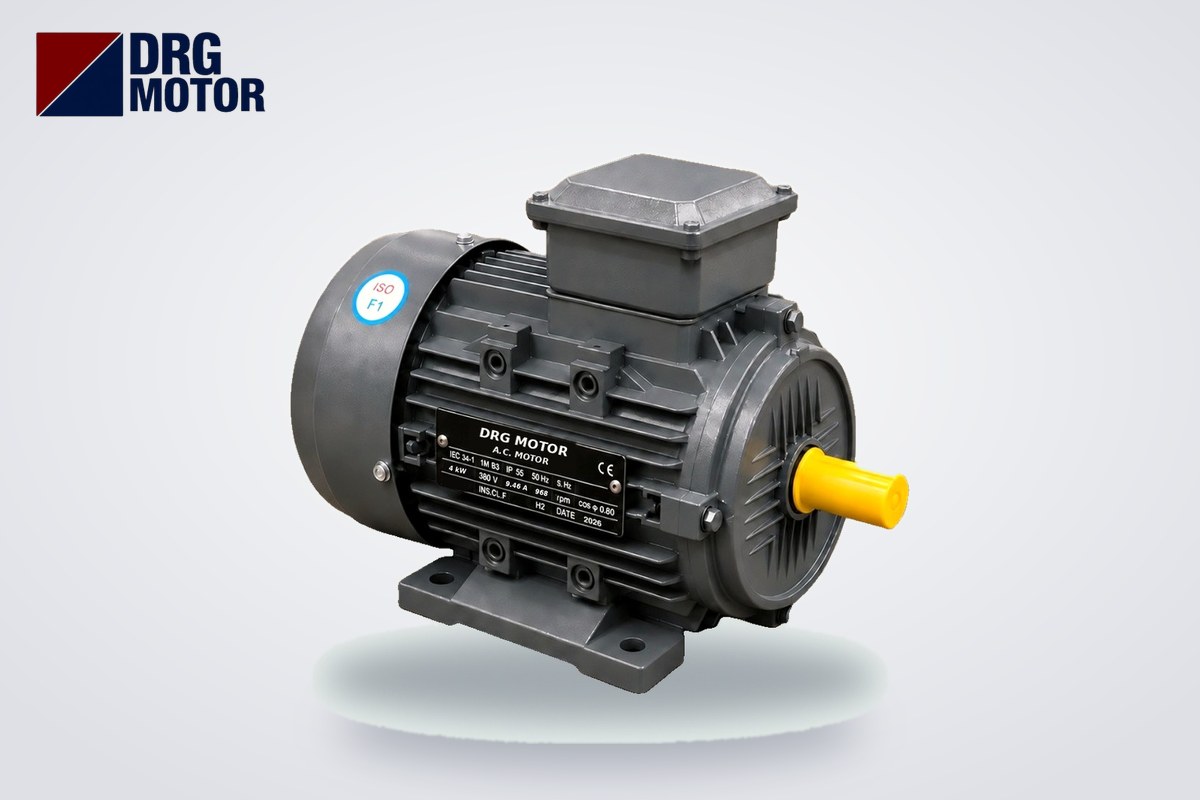

If an electric motor makes noise, the type of sound largely gives away the cause: a steady, deep hum while stationary or running is magnetic (phase loss, wrong connection, high or unbalanced voltage) and is heard as a 100 Hz tone on a 50 Hz supply; a thin, high-pitched whine on a drive-fed motor comes from the drive's switching (carrier) frequency; clicking, growling and crackling usually come from the bearings; rubbing, rhythmic knocking and noisy vibration come from the fan cover, a loose foot, resonance, the coupling or the belt. The first question for a correct diagnosis is this: does the sound disappear the moment the motor is de-energised, or does it continue while the motor coasts down?
A sound that stops instantly when power is cut is electrical, because the magnetic field disappears together with the current. A sound that continues while the motor slows down, deepening and fading with speed, is mechanical. This simple distinction solves half the problem without dismantling anything. Opening the terminal box, measuring voltage and current and working near rotating parts is dangerous: measurements must be made by a qualified electrician, and the motor must be isolated and locked out before any mechanical check.
The rated speed on the nameplate is all you need to work out the rhythm of the sound. If the nameplate is unreadable, check the product pages in our Buy Electric Motors Online section: speed, bearing number, connection and current are given for each model. The calculations below use those values.
Is the motor noise electrical or mechanical? The 30-second test
Listen to the motor while it runs, then cut the power and watch it slow down. If the sound vanishes abruptly at the moment of switch-off, the source is the magnetic field: check the connection, the voltage and the phase balance. If the sound continues and its tone deepens as speed drops, the source is a rotating part: bearing, fan, coupling, belt or rotor balance. If the sound grows only at one particular speed, for example at one point while a drive ramps up, and then fades, that is a sign of resonance; the frame or floor the motor is mounted on vibrates more than the motor itself.
The second half of the test is to separate the motor from its load. Remove the coupling or the belt and run the motor at no load: if the sound disappears, the problem is in the driven machine, the coupling or the belt; if it remains, it is inside the motor.
Possible cause and check by type of sound
| Sound heard | When power is cut | Possible cause | First check |
|---|---|---|---|
| Deep, steady hum; motor does not turn or turns with difficulty | Stops immediately | Phase loss, one blown fuse, loose terminal | Phase-to-phase voltage on all three phases and the three phase currents |
| Louder than normal, harsh hum; motor heats up | Stops immediately | Wrong star/delta connection, high supply voltage | Nameplate voltage vs terminal links, supply voltage |
| Hum that swells and fades rhythmically (woo-woo) | Stops immediately | Voltage unbalance, rotor bar problem | Difference between phase currents, swinging ammeter reading |
| Thin, high-pitched whine or whistle | Stops when the drive stops | Drive carrier (switching) frequency | Carrier frequency parameter in the drive |
| Clicking, growling, dry crackle | Continues while coasting | Bearing damage, lack of grease | Bearing housing temperature, shaft play |
| Metal rubbing, swishing | Continues while coasting | Fan rubbing on the cover, foreign object in the cover | Inside of the fan cover and fan blades |
| Noisy vibration, hum transmitted from the frame to the floor | Continues while coasting | Loose foot bolt, soft foot, resonance | Foot bolts, base frame, gaps under the feet |
| One knock or thump per revolution | Continues while coasting | Coupling insert, coupling misalignment, belt joint | Coupling alignment, insert condition, belt |
| Short squeal or chirp at start | Continues while coasting | Loose or slipping belt | Belt tension and pulley alignment |
What causes humming? Magnetic noise and 100 Hz
The magnetic field in the stator reaches its maximum twice in every supply cycle. The lamination stack flexes very slightly under this force; that is why every three-phase motor running on a 50 Hz supply has a light 100 Hz hum (2 × 50 = 100). This sound is normal and does not depend on the number of poles. The problem is when the hum becomes noticeably louder.
Phase loss
When one of the three phases is lost, a stationary motor cannot start and hums loudly; if the phase drops while running, the motor labours, its hum becomes harsher and its current rises. A single blown fuse, a burnt contactor contact or a loose cable lug are the most common causes. The motor should be stopped without delay in this situation; the winding heats up quickly on phase loss.
Wrong connection and high voltage
A motor with a 230/400 V nameplate is connected in star on a 380–400 V supply. For example, the 1.5 kW DRG-90L-4 motor draws 3.47 A in star at 380 V; if the same motor is connected in delta on this supply by mistake, the winding is fed above its design voltage, the lamination saturates, the motor hums harshly, its current rises far above the nameplate value and it overheats quickly. Motors with a 400/690 V nameplate, for example the 4 kW DRG-112M-4, are connected in delta on a 380–400 V supply. A supply voltage clearly above the nameplate value also causes a similar, milder saturation hum.
Hum that swells and fades rhythmically
If the hum is not steady but swells and fades a few times per second, and the clamp meter reading swings with the same rhythm, two possibilities stand out: voltage unbalance between phases or discontinuity in the rotor bars. The rhythm of a rotor-related swing is close to twice the slip frequency (2 × s × f). In this article's example, the slip of a 4-pole motor with a rated speed of 1450 rpm is (1500 − 1450) ÷ 1500 ≈ 3.33%; the rhythm is 2 × 0.0333 × 50 ≈ 3.33 Hz, heard under load as a swell slightly more than three times per second. The rhythm slows down as the load decreases.
Why does a drive-fed motor whine?
A frequency drive does not feed the motor with a clean sine wave but with pulses switched on and off at high speed. The frequency of this switching is called the carrier frequency, and the motor winding and lamination vibrate at it, producing a thin, high-pitched whine. The sound depends on the drive setting, not on the motor load, and it disappears when the drive stops.
- Raising the carrier frequency makes the whine higher-pitched and, for most people, less annoying; on the other hand the drive runs hotter and leakage currents may increase. Choose the value according to the drive manual.
- If the drive can bring the motor into resonance at certain low speeds, that speed band is skipped with the drive's “skip frequency” parameter.
- The longer the cable between drive and motor, the larger the voltage spikes at the motor terminals; on long runs the drive manufacturer's output filter recommendation should be considered.
Clicking, growling and rubbing: bearings, fan and fan cover
Clicking, growling and dry crackling that continue after power is cut and change tone with speed usually come from a bearing. We covered detailed diagnosis of bearing noise, temperature and shaft-play checks in our bearing failure diagnosis guide; here we only give the points that help separate the bearing from other mechanical sounds.
How often the sound repeats helps locate its source. Because the shaft turns once per revolution, imbalance, a bent shaft, a coupling fault or an object hitting a fan blade produces a knock at the “rotational frequency”, i.e. repeated rated speed ÷ 60 times per second. Bearing damage, by contrast, produces a higher, irregular growl that is not an exact multiple of this frequency.
| Model | Poles | Rated speed | Rotational frequency (speed ÷ 60) | Slip | Rotor-related rhythm (2·s·f) | Bearing |
|---|---|---|---|---|---|---|
| DRG-112M-2 | 2 | 2905 rpm | ≈ 48.42 Hz | 3.17% | ≈ 3.17 Hz | 6206-ZZ-C3 |
| DRG-112M-4 | 4 | 1450 rpm | ≈ 24.17 Hz | 3.33% | ≈ 3.33 Hz | 6206-ZZ-C3 |
| DRG-132M1-6 | 6 | 968 rpm | ≈ 16.13 Hz | 3.2% | ≈ 3.2 Hz | 6208-ZZ-C3 |
| DRG-160M-4 | 4 | 1465 rpm | ≈ 24.42 Hz | 2.33% | ≈ 2.33 Hz | 6309-C3 |
Two practical conclusions follow from the table. First: on a 2-pole motor a once-per-revolution knock repeats about 48 times per second, so it does not sound like separate knocks but like a “rough” note mixed into the hum; on a 6-pole motor the same fault is a more distinguishable knock at around 16 per second. Second: the 100 Hz magnetic hum is the same on all three motor types; its tone does not change with speed and it disappears when power is cut. Any sound that changes with speed is mechanical.
Fan and fan cover
The fan at the back of the motor can rub on its cover because of a foreign object inside the cover, a dented or impacted fan cover, or a fan that has shifted on the shaft. The sound is metal rubbing or swishing and continues while the motor slows down. After isolating and locking out, remove the fan cover and look for rub marks and broken blades; also check whether the cover's air inlet openings are blocked. The fan's own air noise is normal and is more noticeable on 2-pole motors because of their higher speed.
Loose foot, resonance and coupling or belt noise
Loose foot and soft foot
If one of the four feet of a B3 foot-mounted motor does not sit fully on the base, the frame distorts slightly when the foot bolt is tightened. During operation this is heard as a hum and vibration transmitted from the frame to the floor. To check, loosen the bolts one at a time and see whether there is a gap under the foot; if there is, fill it with thin shims. For foot hole spacing and shaft heights see our B3 motor dimension table.
Resonance
A thin sheet-metal base, a long bracket or a light platform can vibrate near its own natural frequency at the motor's rotational frequency or at 100 Hz. The symptom is a sound that grows only at a particular speed, or that drops when you press a hand on one point of the frame. The solution is to stiffen the base (bracing, cross members), move the motor to a solid foundation or, in a drive-fed system, skip that speed band.
Coupling and belt
When the coupling insert is worn or the two shafts are misaligned, a once-per-revolution knock and axial vibration are heard. In a belt drive a loose belt squeals at start, while an over-tensioned belt loads the motor's drive-end bearing and eventually turns into bearing noise. The pulleys must be in the same plane and belt tension must follow the manufacturer's recommendation.
Motor noise checklist
- Cut the power: did the sound disappear abruptly (electrical) or does it continue while coasting (mechanical)?
- Disconnect the load: does the sound remain with the coupling or belt removed?
- Measure the voltage between the three phases and the three phase currents; is there a clear difference between phases? Compare the values with the nameplate and our Motor Current Chart.
- Compare the nameplate voltage with the terminal links: is a 230/400 V motor in star and a 400/690 V motor in delta on 380–400 V?
- On a drive-fed system, note the carrier frequency parameter and any speed band that causes resonance.
- Compare the bearing housing temperature on both ends; turn the shaft by hand and feel for play or binding.
- Remove the fan cover; are there rub marks, broken blades or a foreign object?
- Loosen the foot bolts one at a time to check for soft foot.
- Check coupling alignment, insert condition and belt tension.
- Count the rhythm of the sound: is it a knock matching speed ÷ 60, a 100 Hz hum or an irregular growl?
For other calculations (current, energy consumption, belt and pulley) use our Electric Motor Calculators page.
Motors in the calculation examples
- DRG-90L-4 – 1.5 kW, 1445 rpm rated, aluminium frame, 6205-ZZ-C3 bearing
- DRG-112M-2 – 4 kW, 2905 rpm rated, cast iron frame, 6206-ZZ-C3 bearing
- DRG-112M-4 – 4 kW, 1450 rpm rated, cast iron frame, 6206-ZZ-C3 bearing
- DRG-132M1-6 – 4 kW, 968 rpm rated, cast iron frame, 6208-ZZ-C3 bearing
- DRG-160M-4 – 11 kW, 1465 rpm rated, cast iron frame, 6309-C3 bearing
Click to see current prices and order these motors nowSEE PRICES →
Frequently Asked Questions
Why does an electric motor hum but not turn?
The most common cause is phase loss: when one of the three phases is missing, the motor cannot produce starting torque and hums. Check for a blown fuse, a contactor contact or a loose terminal. A mechanical lock (seized bearing or jammed load) gives the same symptom. Do not leave the motor in this state; the winding heats up quickly.
Does a new motor make noise?
A light 100 Hz magnetic hum and the air noise of the fan are present on every new motor. Clicking, rubbing, a hum that swells and fades rhythmically, or vibration are not normal; they are usually related to the connection, the mounting (soft foot, base frame) or coupling alignment.
Why does the motor make noise only under load?
As load increases, current and slip increase; voltage unbalance and rotor-related rhythmic hum become more noticeable under load. Coupling misalignment and belt problems also grow with the load. Disconnect the load and listen at no load to tell whether the sound comes from the motor or the driven machine.
Is the whine of a drive-fed motor harmful?
A high-pitched whine from the carrier frequency is not a fault symptom on its own. The sound changes with the drive's carrier frequency setting. If the whine comes with overheating, vibration that increases at a certain speed, or bearing noise, cable length, resonance and bearings should be checked separately.
If you have decided to replace a noisy motor, send the power, speed and frame data from the old motor's nameplate to +90 (542) 666 11 11 or [email protected] and we will identify the equivalent model together; all channels are on the contact page. All models are in the Buy Electric Motors Online section.