English
 Le français
 Türkçe




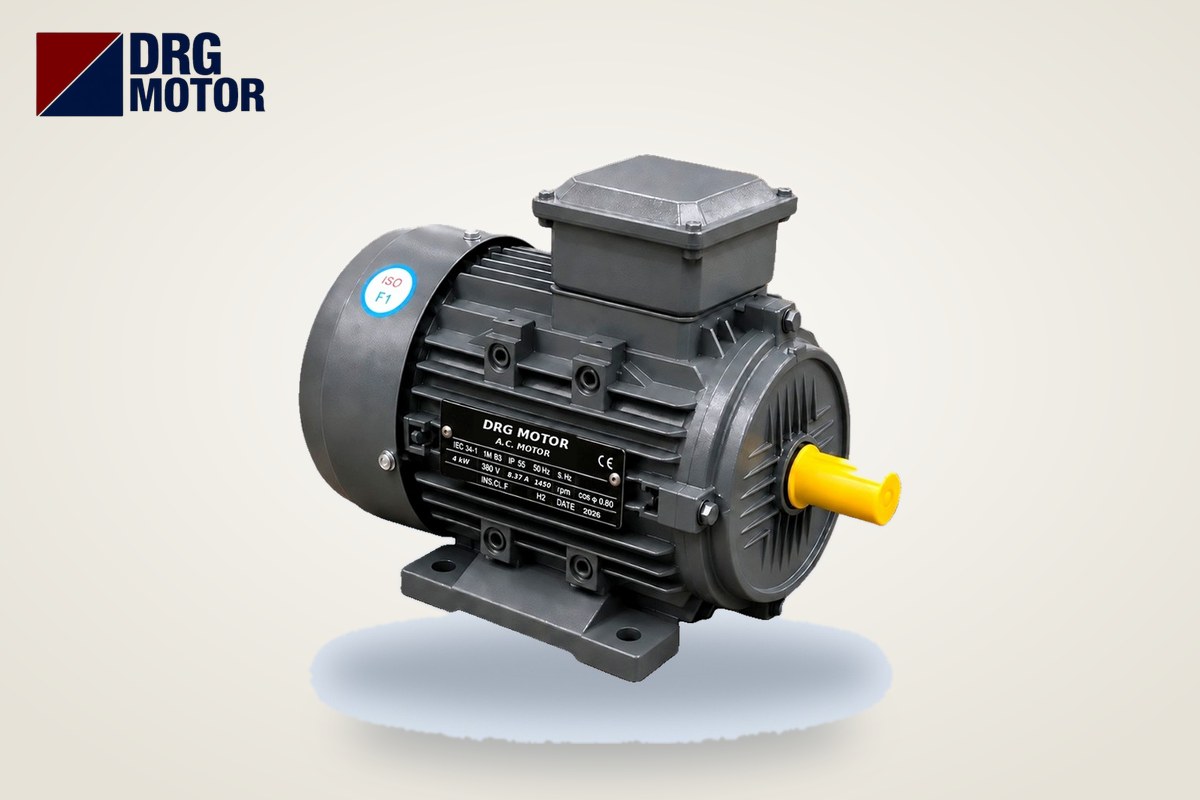

For a 3 kW three-phase motor on 380 V with a run of up to 50 metres, a 4 × 1.5 mm² (3 phases + PE) copper cable is usually enough; for a 4 kW motor, 1.5 mm² is also sufficient in terms of current-carrying capacity, but once the run exceeds about 80 metres you need to move up to 2.5 mm². The calculation starts from motor current: a 3 kW, 1500 rpm motor draws 6.34 A at 380 V and a 4 kW, 1500 rpm motor 8.37 A; the design current (In × 1.25) becomes 7.92 A and 10.46 A, both below the 18.5 A rating of a 1.5 mm² cable. The values are the nameplate currents of the models in our Buy Electric Motors Online store.
At low power, the cross-section is usually governed not by current but by distance. As the cable gets longer, resistance rises, the voltage at the motor terminals falls and the motor draws more current to deliver the same power. The tables below calculate the voltage drop for 20, 50 and 100 m one by one and show at which point you should move to 2.5 or 4 mm². All are example calculations: the installation method, the number of cables in the same tray and the ambient temperature change the result; the final cross-section must be verified by an electrical engineer.
3 and 4 kW Motor Current and the Smallest Cable Size by Current
The cross-section in the table is the smallest value carrying the design current, taken from the table of our motor cable size calculator (copper, PVC, ~30 °C).
| Model | Power | Poles / rated speed | Rated voltage | 380 V connection | In 380 V | In 400 V | Design current In × 1.25 | Smallest size by current | Cable entry | Store |
|---|---|---|---|---|---|---|---|---|---|---|
| DRG-100L-2 | 3 kW | 2-pole / 2,895 rpm | 230/400 V Δ/Y | star (Y) | 6.02 A | 5.71 A | 7.52 A | 1.5 mm² (18.5 A) | 1 × M25×1.5 | See Prices |
| DRG-100L2-4 | 3 kW | 4-pole / 1,450 rpm | 230/400 V Δ/Y | star (Y) | 6.34 A | 6.02 A | 7.92 A | 1.5 mm² (18.5 A) | 1 × M25×1.5 | See Prices |
| DRG-112M-2 | 4 kW | 2-pole / 2,905 rpm | 400/690 V Δ/Y | delta (Δ) | 7.84 A | 7.45 A | 9.80 A | 1.5 mm² (18.5 A) | 2 × M32×1.5 | See Prices |
| DRG-112M-4 | 4 kW | 4-pole / 1,450 rpm | 400/690 V Δ/Y | delta (Δ) | 8.37 A | 7.95 A | 10.46 A | 1.5 mm² (18.5 A) | 2 × M32×1.5 | See Prices |
The difference to watch is the rated voltage. The 3 kW models are rated 230/400 V and are connected in star on a 380 V network; the 4 kW models are rated 400/690 V and are connected in delta at 380 V. This difference directly affects the number of conductors (see the star-delta section below). For a closer look at how current varies with pole count, see our article how many amps does a 3 kW motor draw.
How Is Voltage Drop Calculated?
On a three-phase motor line, voltage drop is found with:
ΔU = √3 × I × (L / 1000) × R × cos φ and %ΔU = ΔU / U × 100
Here I is the motor's nameplate current (A), L the one-way cable length (m), R the cable resistance per km (Ω/km) and cos φ the motor power factor. In the site's table, resistance is 12.1 Ω/km for 1.5 mm², 7.41 Ω/km for 2.5 mm² and 4.61 Ω/km for 4 mm². Acceptance criteria: at most 3% on the supply line and at most 5% in total from the transformer to the motor.
Example: DRG-112M-4 (4 kW, 4-pole, 8.37 A, cos φ 0.82), 1.5 mm² cable over 100 m: ΔU = 1.732 × 8.37 × 0.1 × 12.1 × 0.82 ≈ 14.38 V; 14.38 / 380 × 100 ≈ 3.79%. Since the result exceeds 3%, 1.5 mm² is not suitable at this distance. On the same line, 2.5 mm² brings the drop down to 2.32%.
Voltage Drop Table at 20, 50 and 100 Metres
Cells in bold are selections exceeding the 3% supply limit.
| Model (In, cos φ) | Distance | 1.5 mm² | 2.5 mm² | 4 mm² |
|---|---|---|---|---|
| DRG-100L-2 (6.02 A, 0.87) | 20 m | 2.20 V / 0.58% | 1.34 V / 0.35% | 0.84 V / 0.22% |
| 50 m | 5.49 V / 1.44% | 3.36 V / 0.88% | 2.09 V / 0.55% | |
| 100 m | 10.98 V / 2.89% | 6.72 V / 1.77% | 4.18 V / 1.10% | |
| DRG-100L2-4 (6.34 A, 0.82) | 20 m | 2.18 V / 0.57% | 1.33 V / 0.35% | 0.83 V / 0.22% |
| 50 m | 5.45 V / 1.43% | 3.34 V / 0.88% | 2.08 V / 0.55% | |
| 100 m | 10.90 V / 2.87% | 6.67 V / 1.76% | 4.15 V / 1.09% | |
| DRG-112M-2 (7.84 A, 0.88) | 20 m | 2.89 V / 0.76% | 1.77 V / 0.47% | 1.10 V / 0.29% |
| 50 m | 7.23 V / 1.90% | 4.43 V / 1.17% | 2.75 V / 0.72% | |
| 100 m | 14.46 V / 3.81% | 8.85 V / 2.33% | 5.51 V / 1.45% | |
| DRG-112M-4 (8.37 A, 0.82) | 20 m | 2.88 V / 0.76% | 1.76 V / 0.46% | 1.10 V / 0.29% |
| 50 m | 7.19 V / 1.89% | 4.40 V / 1.16% | 2.74 V / 0.72% | |
| 100 m | 14.38 V / 3.79% | 8.81 V / 2.32% | 5.48 V / 1.44% |
The conclusion is clear: for the 3 kW motor, 1.5 mm² stays below the limit even at 100 m (about 2.9%), but the margin is almost used up. The 4 kW motors reach about 3.8% at 100 m with 1.5 mm² and the next size up (2.5 mm²) becomes mandatory. If there is already a drop on the line up to the main panel, the 5% total limit must also be taken into account.
At What Distance Should You Move Up a Cable Size?
Inverting the same formula gives the longest run allowed for a 3% drop: Lmax = 0.03 × 380 / (√3 × I × R × cos φ) × 1000.
| Model | Max. with 1.5 mm² | Max. with 2.5 mm² | Max. with 4 mm² |
|---|---|---|---|
| DRG-100L-2 | ≈ 103 m | ≈ 169 m | ≈ 272 m |
| DRG-100L2-4 | ≈ 104 m | ≈ 170 m | ≈ 274 m |
| DRG-112M-2 | ≈ 78 m | ≈ 128 m | ≈ 206 m |
| DRG-112M-4 | ≈ 79 m | ≈ 129 m | ≈ 208 m |
As a practical rule, 1.5 mm² is enough up to about 100 m for a 3 kW motor and up to about 78 m for a 4 kW motor; beyond these limits choose 2.5 mm², and 4 mm² on 4 kW runs longer than about 130 m. When values are very close to the limit, prefer the next size up; at start-up the motor draws several times its nameplate current (4 kW, 2-pole, Is/In 8.3 → about 65 A) and starting torque drops noticeably on a long, thin cable.
4-Core or 6-Core Cable? The Star-Delta Case
Direct-on-line starting
The motor does not use a neutral. A 3 or 4 kW motor started direct-on-line gets a 4-core cable carrying three phases (L1, L2, L3) and the green-yellow protective conductor (PE), for example 4 × 1.5 mm² or 4 × 2.5 mm². The PE conductor is connected to the earth screw in the terminal box. If there is a thermistor, brake or separate fan supply, a separate control cable is planned for them.
Star-delta starting
For star-delta starting, the motor must be able to run in delta at 380 V, which means a 400/690 V rating. Therefore star-delta is only possible on the 4 kW models (DRG-112M-2, DRG-112M-4); the 230/400 V rated 3 kW models already run in star at 380 V and cannot be started this way. In star-delta, the terminal links are removed and 6 conductors (U1 V1 W1 + W2 U2 V2) plus PE run from the panel to the motor; in practice two 4-core cables are used. Each conductor carries the phase current: 8.37 / √3 ≈ 4.83 A, design current ≈ 6.04 A. For this value 1.5 mm² is sufficient. Because the starting-current benefit of star-delta is limited at low power, most workshops prefer direct-on-line starting; you can compare methods with the motor starting methods tool.
Workshop Example: Compressor and Saw from a Sub-Panel
Assume a 2% voltage drop has been calculated on the feed from the main panel to a workshop sub-panel (example assumption). Two motors are fed from the sub-panel:
- Compressor: DRG-112M-2, 4 kW, 2-pole, 7.84 A, cos φ 0.88, distance 70 m. With 1.5 mm² the drop is 10.12 V (2.66%), total 4.66% → very close to the 5% limit. With 2.5 mm²: 6.20 V (1.63%), total 3.63% → safe. Choice: 4 × 2.5 mm².
- Circular saw: DRG-100L2-4, 3 kW, 4-pole, 6.34 A, cos φ 0.82, distance 30 m. With 1.5 mm² the drop is 3.27 V (0.86%), total 2.86% → sufficient. Choice: 4 × 1.5 mm².
The example shows that two motors of similar power fed from the same sub-panel can need different cross-sections because of distance. The protective device (fuse, motor protection circuit breaker, overload setting) must match the cable: it must not let through more current than the cable can carry, yet must not trip during starting. Check the values with the overload relay, fuse and contactor selection tool.
Checklist Before Pulling the Cable
- Read the current and voltage on the motor nameplate (230/400 V or 400/690 V?).
- Find the design current with In × 1.25 and select the smallest cross-section from the table.
- Measure the run length; calculate voltage drop with the formula and move up one size if it exceeds 3%.
- Add the drop up to the main panel and check the 5% total limit.
- Plan 4 cores (3 phases + PE) for direct-on-line, 6 cores + PE for star-delta.
- Choose a gland that fits the cable entry: 1 × M25×1.5 on 3 kW models, 2 × M32×1.5 on 4 kW models.
- If many cables share a tray or the environment is hot, have the cross-section verified by an engineer.
- Choose lugs suitable for the cross-section, tighten the terminal nuts and do not forget the PE connection.
Motors in This Power Range
- DRG-100L-2 – 3 kW – 3000 rpm – 100L aluminium
- DRG-100L2-4 – 3 kW – 1500 rpm – 100L aluminium
- DRG-112M-2 – 4 kW – 3000 rpm – 112M aluminium
- DRG-112M-4 – 4 kW – 1500 rpm – 112M aluminium
- DRG-100L2-4 – 3 kW – 1500 rpm – 100L cast iron
- DRG-112M-4 – 4 kW – 1500 rpm – 112M cast iron
- DRG-90L-2K – 3 kW – 3000 rpm – 90L cast iron compact
Click to see current prices and order these motors nowSEE PRICES →
Frequently Asked Questions
What size cable for a 3 kW motor?
A 3 kW, 1500 rpm motor draws 6.34 A at 380 V; the design current is 7.92 A. A 4 × 1.5 mm² copper cable is sufficient up to about 100 m; on longer runs 4 × 2.5 mm² is chosen. An electrical engineer should verify it for the installation conditions.
Is 1.5 mm² cable enough for a 4 kW motor?
In terms of current-carrying capacity, yes: the design current of a 4 kW, 4-pole motor is 10.46 A and a 1.5 mm² cable is rated 18.5 A. However, because of the 3% voltage drop limit, move up to 2.5 mm² on runs longer than about 78 m.
What cable size does a 4 kW motor need at 50 metres?
At 50 m, the voltage drop with 1.5 mm² is about 1.9%, which on its own is below the acceptance limit. If there is also a drop on the line up to the main panel, 2.5 mm² (1.16%) is a more comfortable choice to stay within the 5% total.
How many cores should a motor cable have?
A 4-core cable (L1, L2, L3 and PE) is sufficient for a three-phase motor started direct-on-line; the motor does not use a neutral. Star-delta starting requires 6 conductors plus PE, usually as two 4-core cables.
For help with motor and cable selection, call +90 (542) 666 11 11, write to [email protected] or use our contact page. You can browse every rating, including 3 and 4 kW, among the 120 models in our online store.